
 Poisonous

Why a previous meal cannot clear the next one
Your last uneventful meal of brown roll-rim says nothing about the next one. Published severe cases often involve people who had eaten the mushroom before. Even so, the literature sets no universal sensitization schedule, no safe first exposure, and no dose below which hemolysis cannot occur.
At first, the illness may look like ordinary mushroom poisoning. Nausea, vomiting, abdominal pain, and diarrhea can begin within roughly 60 to 120 minutes. The much rarer Paxillus syndrome takes a different course. Red blood cells break apart inside the blood vessels. That can lead to pallor, weakness, dark urine, jaundice, flank or back pain, and low blood pressure, then to kidney injury, clotting abnormalities, and failure of several organs.
One fatal 1982 report documented an IgG antibody that reacted with an extract of Paxillus involutus. Its authors proposed that immune complexes attached to red cells and activated complement. Later clinical reviews still describe the exact mechanism and individual predisposition as unresolved. Two fatal cases published in 2020 confirm how severe the syndrome can be and how thin the evidence remains. Case reports show that it happens, yet they cannot tell you which prior meal, portion, or personal trait will predict it.
Treat any suspected ingestion as a poison-service decision, even when the person has eaten a similar mushroom before. Do not wait for dark urine or collapse, and do not induce vomiting unless a clinician or poison specialist directs it. Keep an uncooked specimen, meal remnants, packaging, and photographs if you can save them without delaying care. The clinician will ask when the person ate it, how much they ate, when symptoms began, who else ate, and about past meals from the same source.
Prior meal caused no symptoms
Stop eating itPast tolerance does not prove future safety, and published severe cases include repeat consumers.
Brown roll-rim may have been swallowed
Call Poison Control nowEarly expert triage is safer than waiting to decide whether symptoms are gastrointestinal or hemolytic.
Weakness, dark urine, jaundice, severe back or flank pain, fainting, or breathing trouble
Seek emergency careThese signs can accompany hemolysis, shock, kidney injury, or other serious mushroom poisoning.
Read the rolled margin, descending gills, and bruise together
Start with the cap edge, then turn the mushroom over. On a young brown roll-rim, a thick cottony margin curls tightly inward, and older caps spread out and may sink in the center. The underside carries stronger group evidence. Yellowish to cinnamon true gills crowd together, slope down onto the stem, and may fork or form cross-veins near the stem.
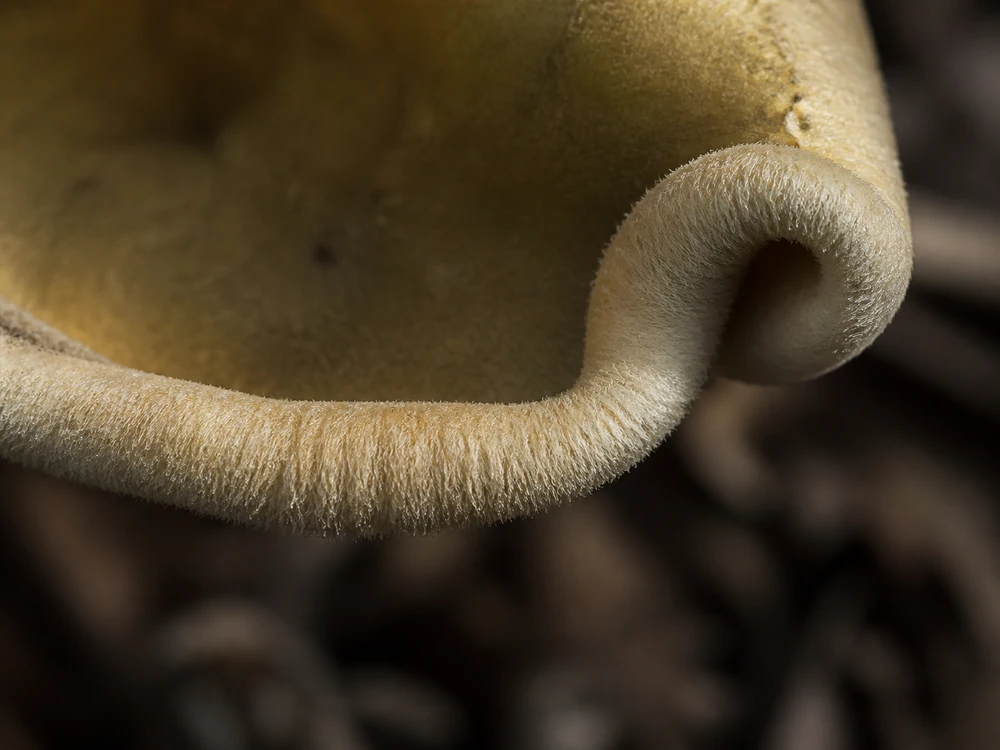
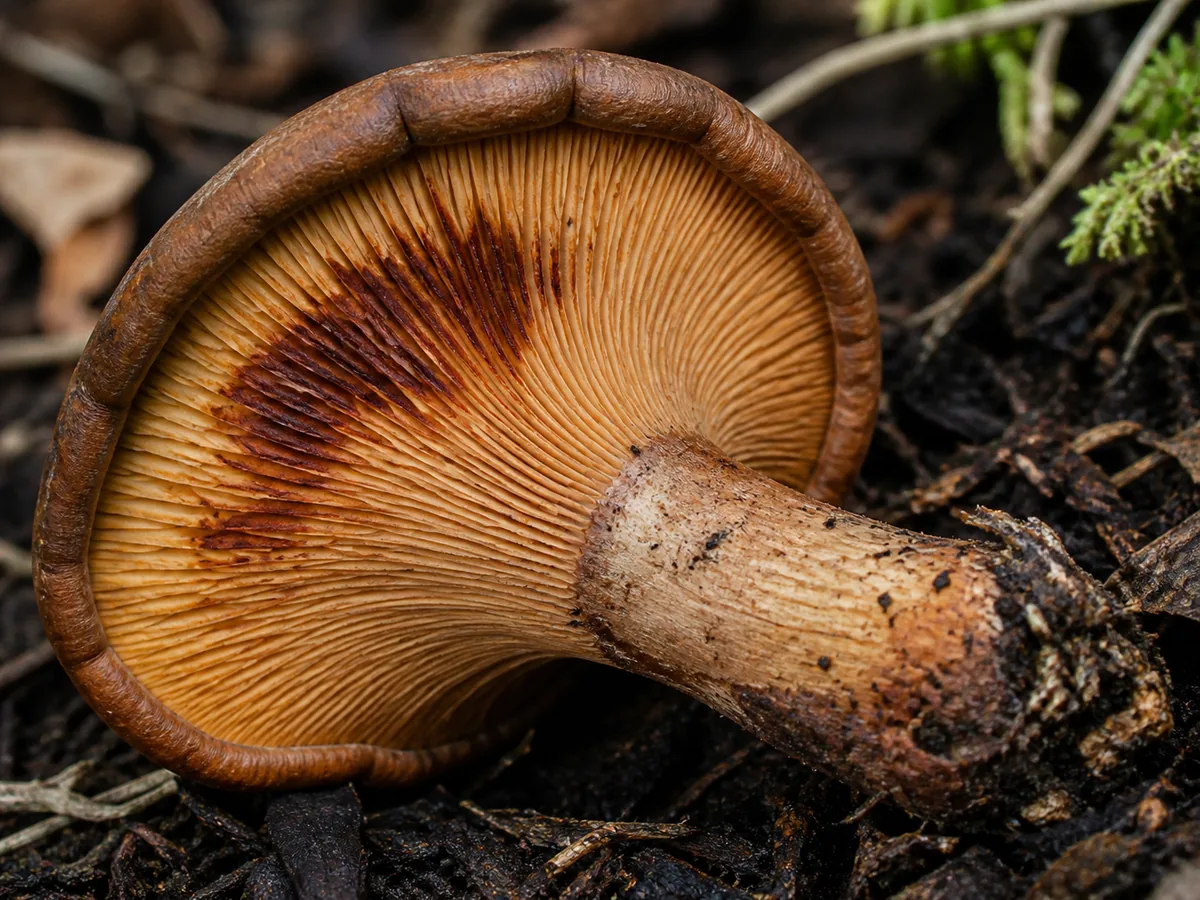
That separable gill layer places a specimen in Paxillus, yet on its own it cannot prove P. involutus in the strict modern sense. Several close species share the same basic construction. Structure separates the roll-rim from chanterelles far better than color does. Chanterelles have blunt folds that belong to the cap tissue, while the brown roll-rim has thin-edged true gills you can lift from the flesh.
| Observation | Brown roll-rim group | Chanterelle | Why it matters |
|---|---|---|---|
| Underside | Thin true gills, descending and separable | Blunt ridges continuous with the cap | Distinguishes two different structures |
| Handling | Brown to reddish brown staining | No matching brown gill bruise pattern | Adds evidence after structure is checked |
| Spore deposit | Brown to purplish brown | Pale cream to yellowish | Rules against a chanterelle identification |
These marks identify a poisonous roll-rim group and never a meal. For a species-level record, keep the whole specimen and note its trees. Color and habitat overlap among European relatives and similar North American taxa. Spore color backs up the structure check, since a brown to purplish brown deposit rules out a chanterelle.
Where habitat helps separate similar roll-rims
Roll-rims in this complex form ectomycorrhizal partnerships with living trees. Birch is a frequent partner, but field accounts also record hardwoods and conifers in woodland, parks, gardens, and other planted settings. That broad picture cannot stand in for the narrow species. A 2014 European study resolved four species and found ecological differences among them.
Paxillus cuprinus, the copper roll-rim, gives the clearest example. That 2014 work described it and named it for the coppery orange-brown it turns with age. It also linked the species with Betulaceae in open temperate places.
So the roll-rim you find under birch on a lawn or roadside may fit that related species better than P. involutus sensu stricto. Color will not sort them in the field, because a weathered coppery cap and a fresh olive-brown one can look alike. Nobody can now assign poisoning reports filed under the old name to one of the four species.
Record the nearest trees, whether the ground is open or forested, cap colors at several ages, spore deposit, date, and locality. Those notes give a specialist more evidence than a close cap photograph alone. North American field guides have also found P. involutus and related Paxillus hard to separate by appearance. Report a North American find conservatively as a member of the group unless regional evidence supports a narrower name.
Season and fruiting vary with climate and local weather, so a fixed number of days after rain gives you no dependable character. Habitat narrows the question, while morphology, microscopy, and sometimes DNA carry the species decision.
Why cooking history is not a safety test
Brown roll-rim has no defensible culinary use. People ate it in the past, and some tolerated it, yet neither fact outweighs modern poisoning evidence. Severe hemolysis reports include repeat consumers, and that pattern offers no promise that an early meal is safe. The published cases define no harmless first exposure, no predictable number of meals, and no safe portion.
Cooking gives no reliable safety boundary either. Old recipes show that people ate the mushroom. They give no evidence that boiling removes the cause of the stomach illness or of the rare hemolytic syndrome.
Leave every suspected roll-rim out of food. If one ends up in a mixed dish, save the remaining mushrooms and contact Poison Control. Picking out the visible pieces and serving the rest leaves the danger in the dish.
What a garden fruiting does and does not prove
Brown roll-rim is an ectomycorrhizal fungus and no food crop. Its underground mycelium lives with living tree roots, so removing a cap leaves the organism in the soil. In a garden or park, photograph a fresh fruiting before you remove it if identification counts. Then lift the visible caps wherever a person might eat them, keep them apart from food mushrooms, and follow local waste guidance.
One fruiting cannot show you how the fungus arrived. The sources tie it to trees and managed ground. They never show that a given nursery root ball brought in a colony. If an animal may have swallowed an unknown mushroom, contact a veterinarian or animal poison service with photographs and a saved specimen. We cannot give a veterinary dose or symptom timeline for pets here.
Where the old species name became a complex
Paxillus involutus belongs to Paxillaceae in the order Boletales. That order also holds many pored mushrooms, and the true gills of Paxillus do not move it outside the order. The familiar name once covered more diversity than one binomial suggests. Multigene work on European collections confirmed four species, including P. involutus sensu stricto and the newly described P. cuprinus.
Ecology gives the clearest split between those concepts. P. cuprinus grew with Betulaceae in open temperate sites. Its coppering and microscopic traits stayed stable, while other lineages varied in other ways. In North America, mushrooms historically called P. involutus also form a complex of similar taxa. Your photograph can support a roll-rim group name, but it cannot carry a European species name or clinical record over to every lookalike worldwide.
That boundary changes how you label a record and leaves the food decision alone. Similar Paxillus linked to poisoning stay out of food. Keep uncertain material under a cautious group name until regional features or DNA sequences resolve it.

 Choice edible