Is devil's bolete poisonous?
Few poisonous mushrooms look as substantial as a mature devil's bolete.
Its cap can exceed the width of a dinner plate, while the short swollen stem can appear almost too thick for the cap above it.
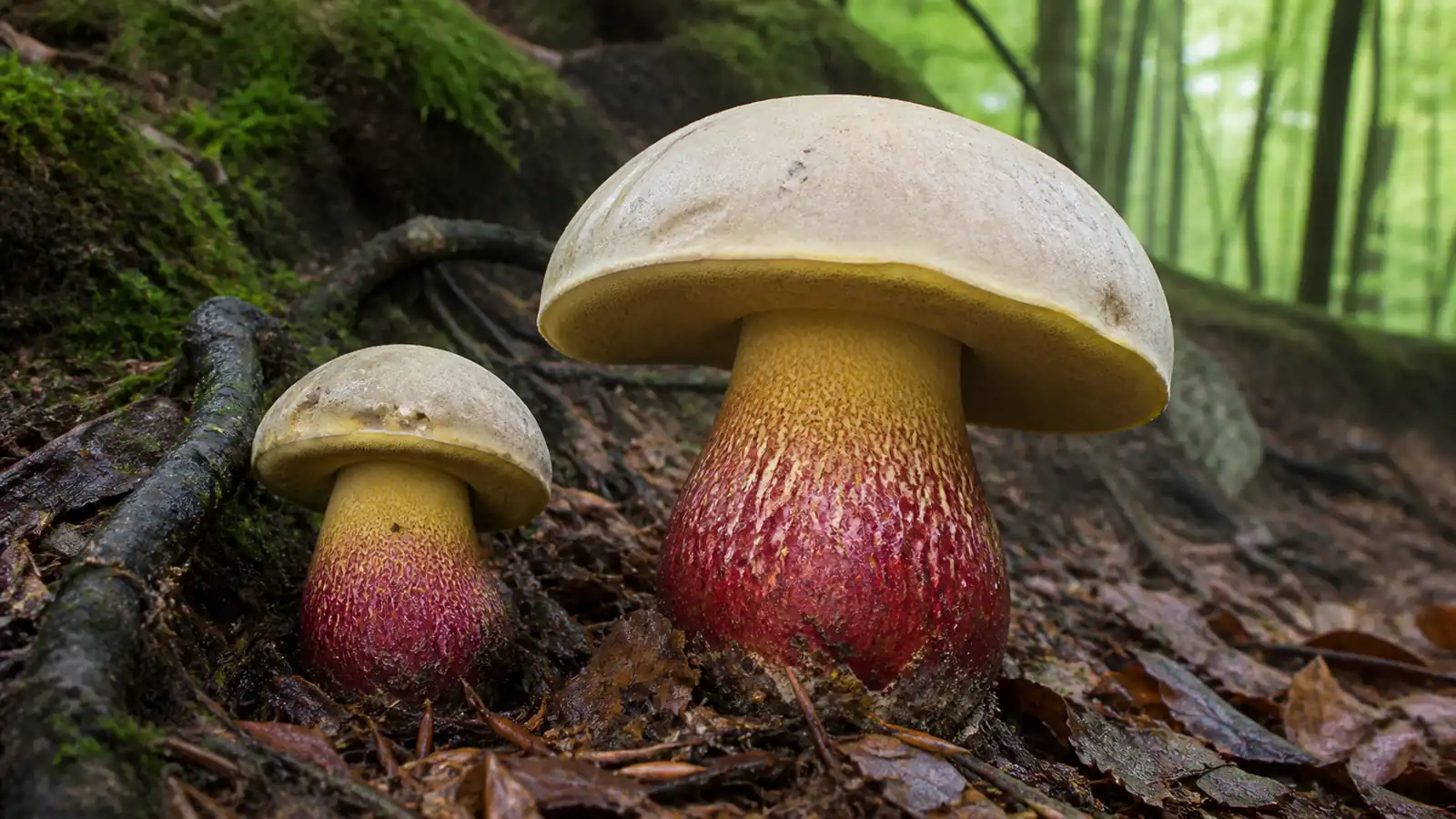
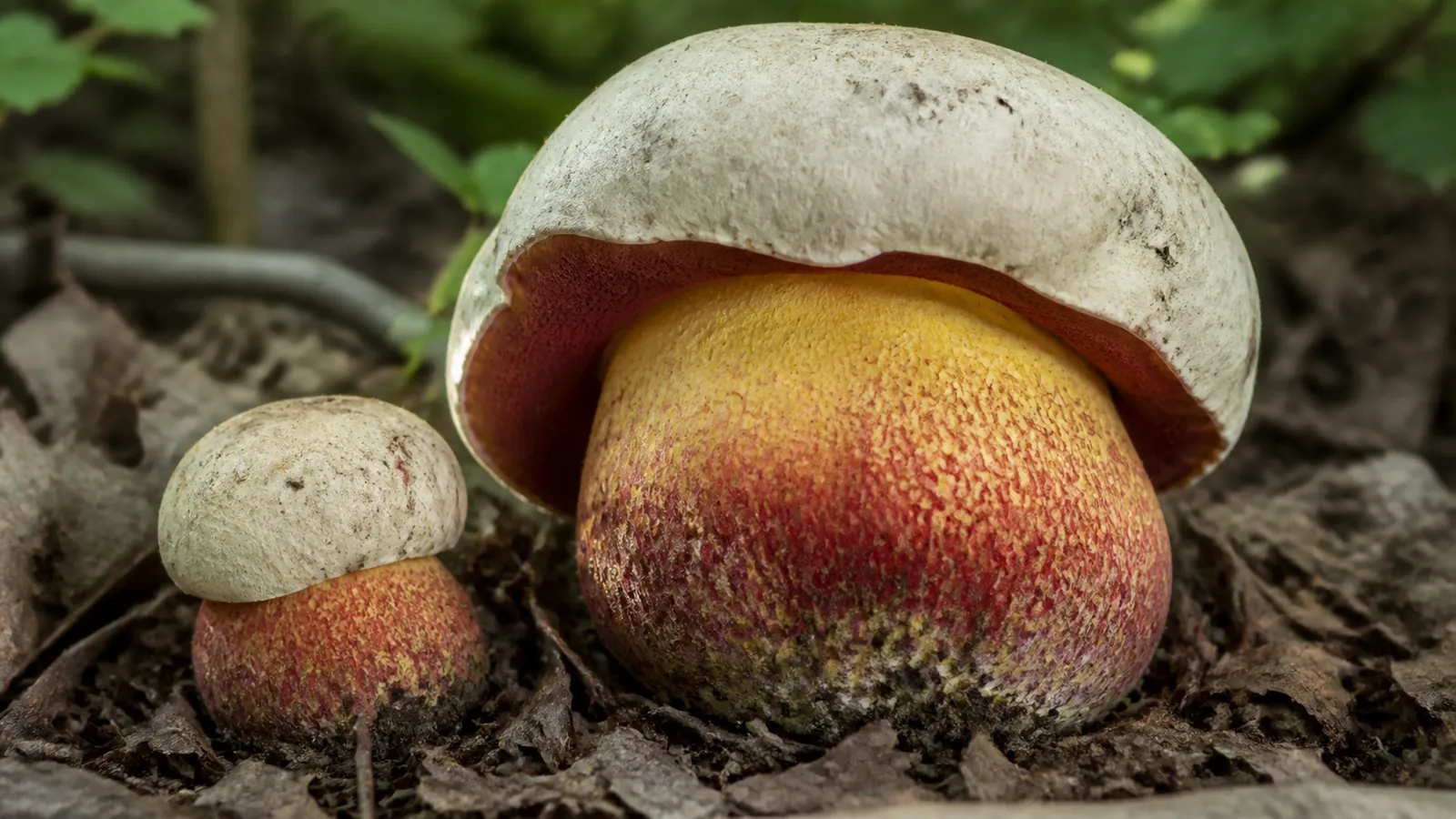
The cap is normally much paler than the lower surface. Chalk white, dirty cream, pale gray, or buff tones contrast with pores that move from yellow in youth through orange to deep red at maturity.
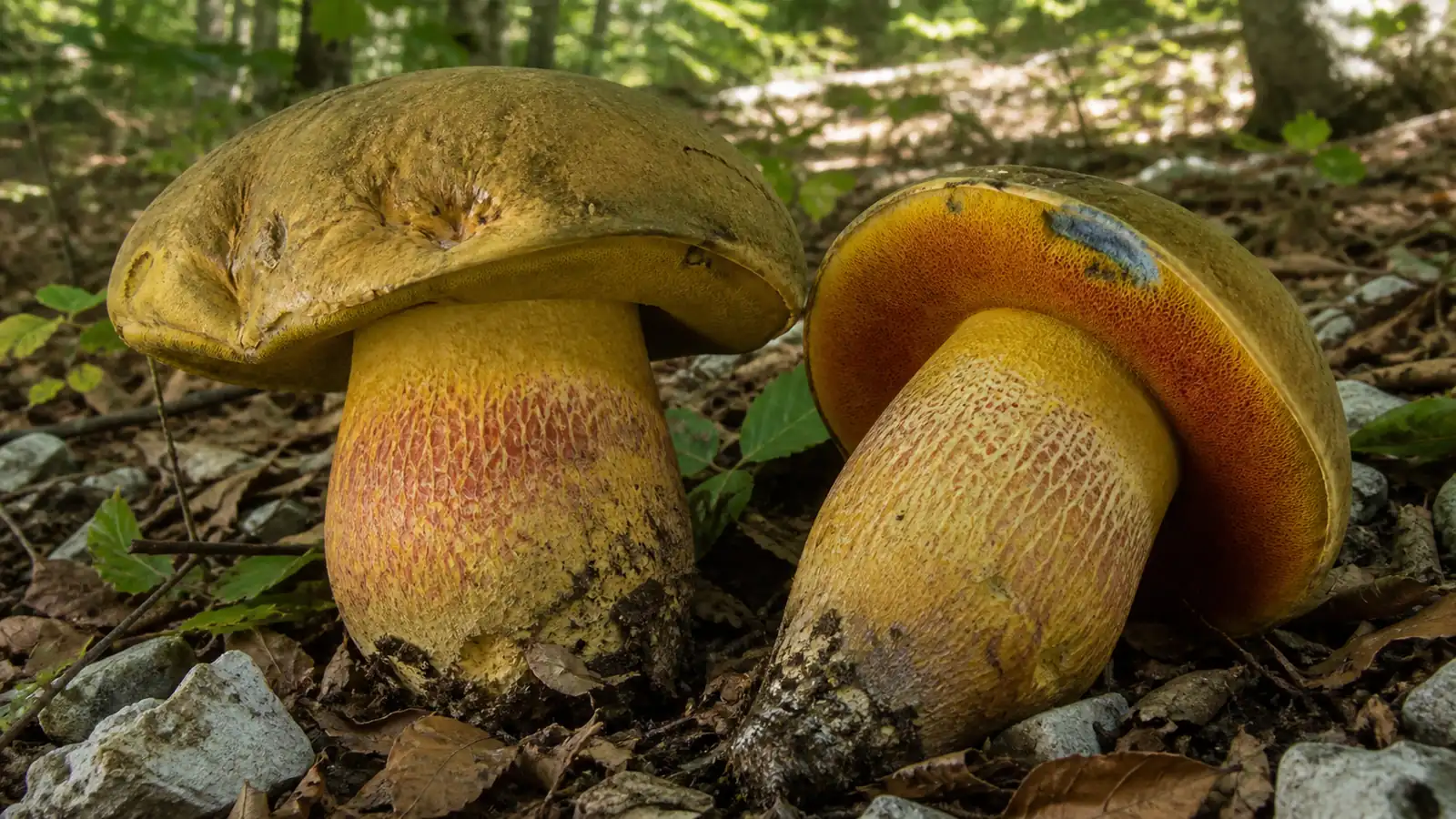
A cut exposes pale flesh that develops blue staining as pigments oxidize. The reaction may be weaker and slower than the near-instant dark blue seen in some related red-pored boletes, so timing and intensity belong in the record.
The stem supplies another strong clue. It is bulbous or turnip-shaped, yellow toward the top, red through the middle, and crossed by a fine raised network rather than scattered dots.
Old fruiting bodies may smell unpleasant, but fresh ones can have little odor. Odor cannot separate a poisonous young specimen from an edible bolete.
The species grows from soil because its mycelium exchanges nutrients with living broadleaf roots. A limestone woodland edge with oak or beech fits the ecological pattern better than an acid conifer bog, but habitat never substitutes for anatomy.
How do you identify devil's bolete?
Broad and often massive, about 10 to 30 cm across and occasionally larger, chalky white to pale gray or buff, dry, and initially domed before flattening.
No gills. The underside has fine pores that begin yellow, then become orange to blood red, with yellowish tubes that blue when bruised.
Very thick, short, and bulbous, yellow near the apex and red across the middle, usually covered by a fine red network.
Pale yellow to whitish flesh that stains blue slowly or moderately when cut. Mature specimens may develop a carrion-like or sour odor.
Document the mushroom before cutting it. Take a full side view, a pore close-up, the complete stem pattern, surrounding trees, and a timed sequence after one clean slice.

A mature cap is typically 10 to 30 cm wide, pale and dry, with a thick rolled margin when young. Pink flushing can occur, but a broadly rose-colored cap should prompt comparison with other Rubroboletus.
The pore surface begins yellow and becomes orange-red to blood red. Bruising produces blue discoloration, while the tubes above the pores stay yellow before reacting.
The short stem is disproportionately thick. Look for a yellow apex, red middle zone, paler base, and a red reticulum that forms an obvious mesh over the upper or central surface.
The olive-brown spore print is consistent with many boletes and cannot decide the species. Microscopic spores, cap chemistry, host association, geography, and DNA may be required to separate difficult red-pored taxa.
Do not use blue staining as a poison test.
Some edible boletes stain blue, and some poisonous specimens react weakly when dry, cold, old, or damaged.
If someone may have eaten this mushroom, act now. Call Poison Control at 1-800-222-1222 (US) or emergency services before symptoms appear, and save a piece of the mushroom for identification.
What happens if you eat devil's bolete?
If someone swallowed a suspected specimen, contact Poison Control or local medical services. Save mushrooms and food remains, note the collection site and host trees, and photograph the pore surface and cut-flesh reaction if this can be done without delaying care.
Symptoms from gastrointestinal mushroom toxins often begin within a few hours. Repeated fluid loss can cause weakness, low blood pressure, electrolyte disturbance, and kidney stress, especially in children, older adults, and people with chronic illness.
Some sources discuss traditional preparation after prolonged cooking, but toxin levels, species identity, and individual response are too uncertain for that practice to support a safety recommendation.
The first report should distinguish a definite whole mushroom from scraps assigned after cooking. A red-pored cap found at the site may belong to a different collection, while the meal may contain more than one bolete species.
Record the color reaction before and after cutting, but do not delay medical contact to perform a full identification exercise. Clinical care follows the exposure and symptoms while mycologists work from saved material.
Fluid loss can progress faster than expected when vomiting and diarrhea occur together.
Dry mouth, dizziness on standing, rapid pulse, little urine, muscle cramps, and unusual sleepiness are concrete signs that home observation is no longer adequate.
A short symptom interval suggests a gastrointestinal irritant more than an amatoxin syndrome, yet it does not rule out a mixed basket. Report every species served and any diner whose illness began at a different time.
Do not give anti-diarrheal medicine, leftover antibiotics, alcohol, or charcoal without poison-center or clinician direction. Some interventions can obscure severity or create additional risk when the toxin and patient history remain uncertain.
Warning
Trouble breathing, fainting, confusion, severe weakness, blood in vomit or stool, or reduced urine needs emergency evaluation. Do not assume every red-pored bolete causes the same syndrome.
Which red-pored boletes share the same signals?
Red pores, blue staining, and a swollen stem define a comparison problem rather than a final name. The decisive work lies in cap color, reticulation, staining speed, host trees, soil chemistry, and geography.
A single underside photograph loses the pale cap and the host setting, while a top view hides pore color and stem mesh. Keep all those views tied to the same intact specimen.
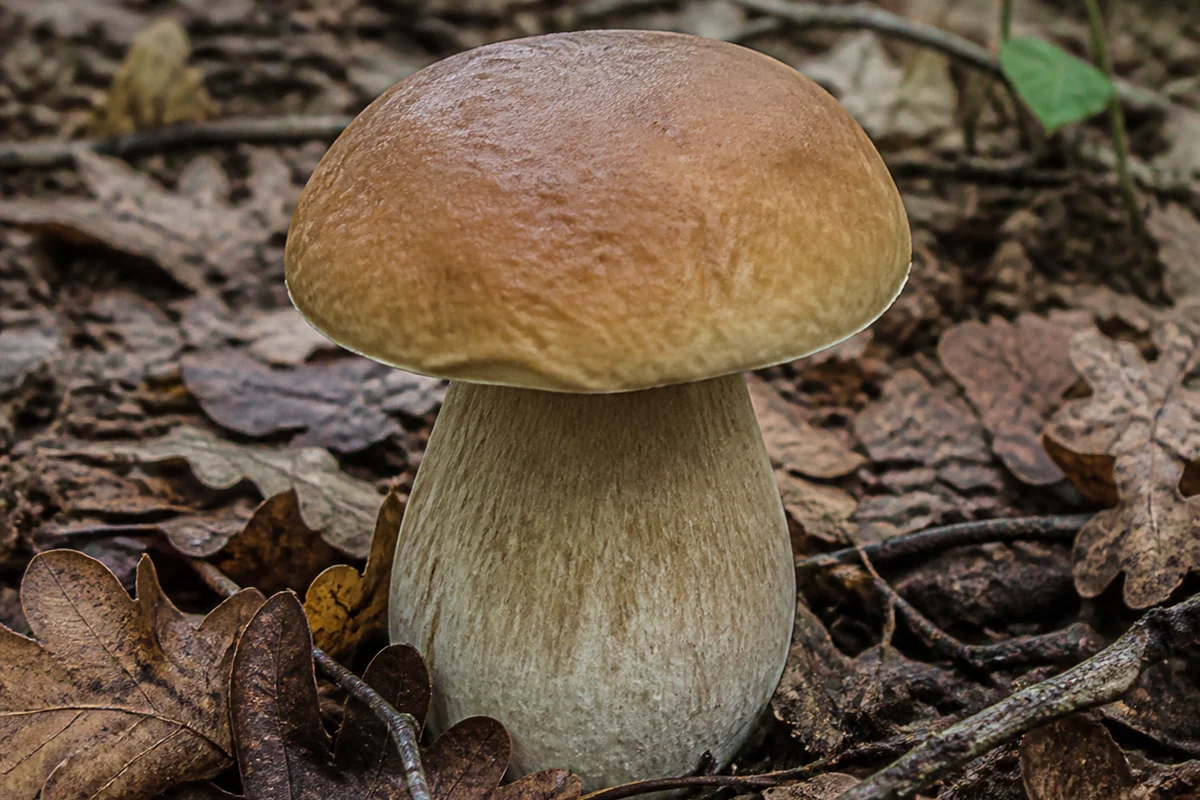
Rubroboletus rhodoxanthus often shows pink or rose tones in the cap and a differently distributed blue reaction, while R. legaliae develops rosy cap colors and can smell of chicory or fenugreek as it ages. Both are unsafe food choices.
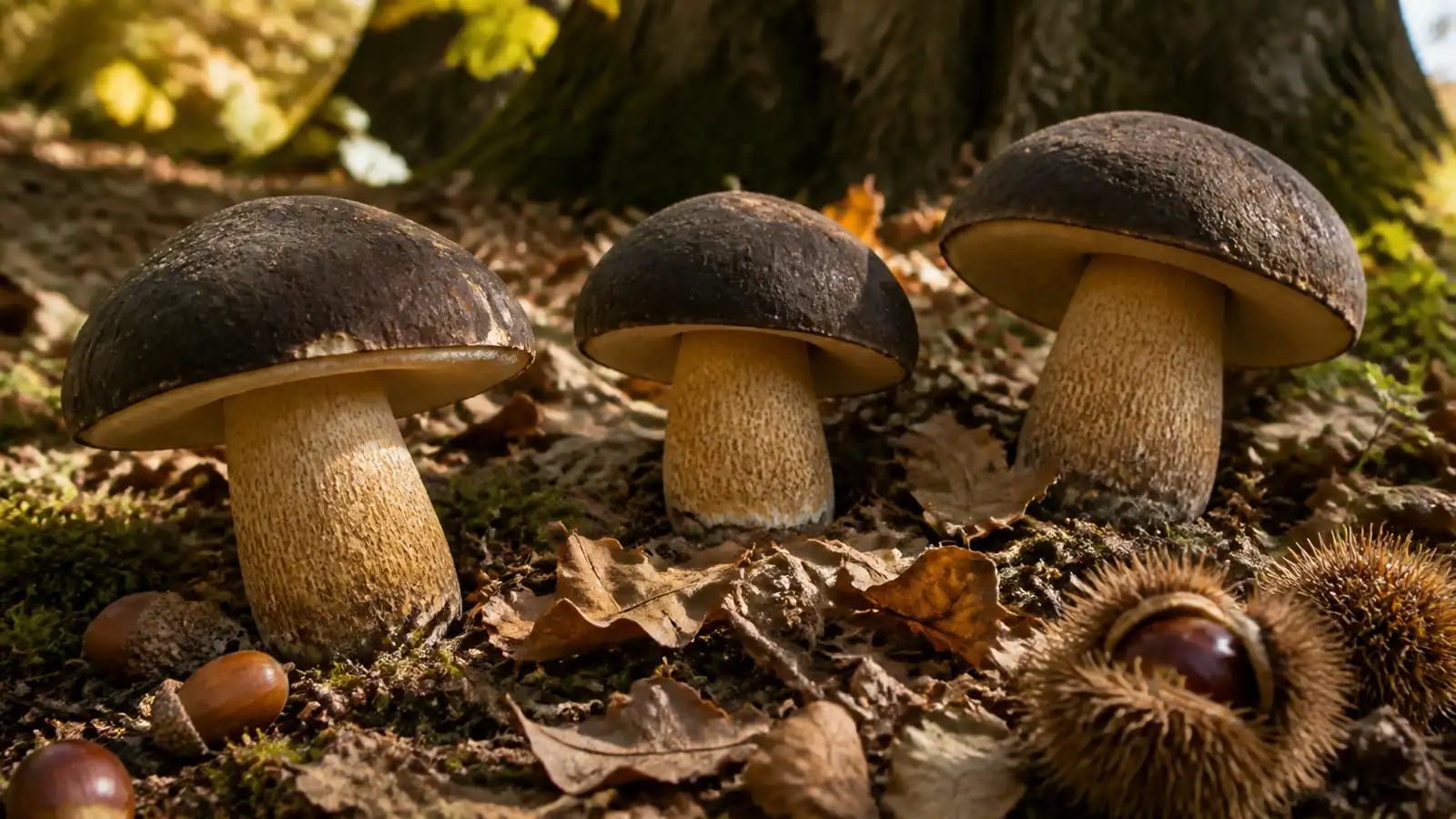
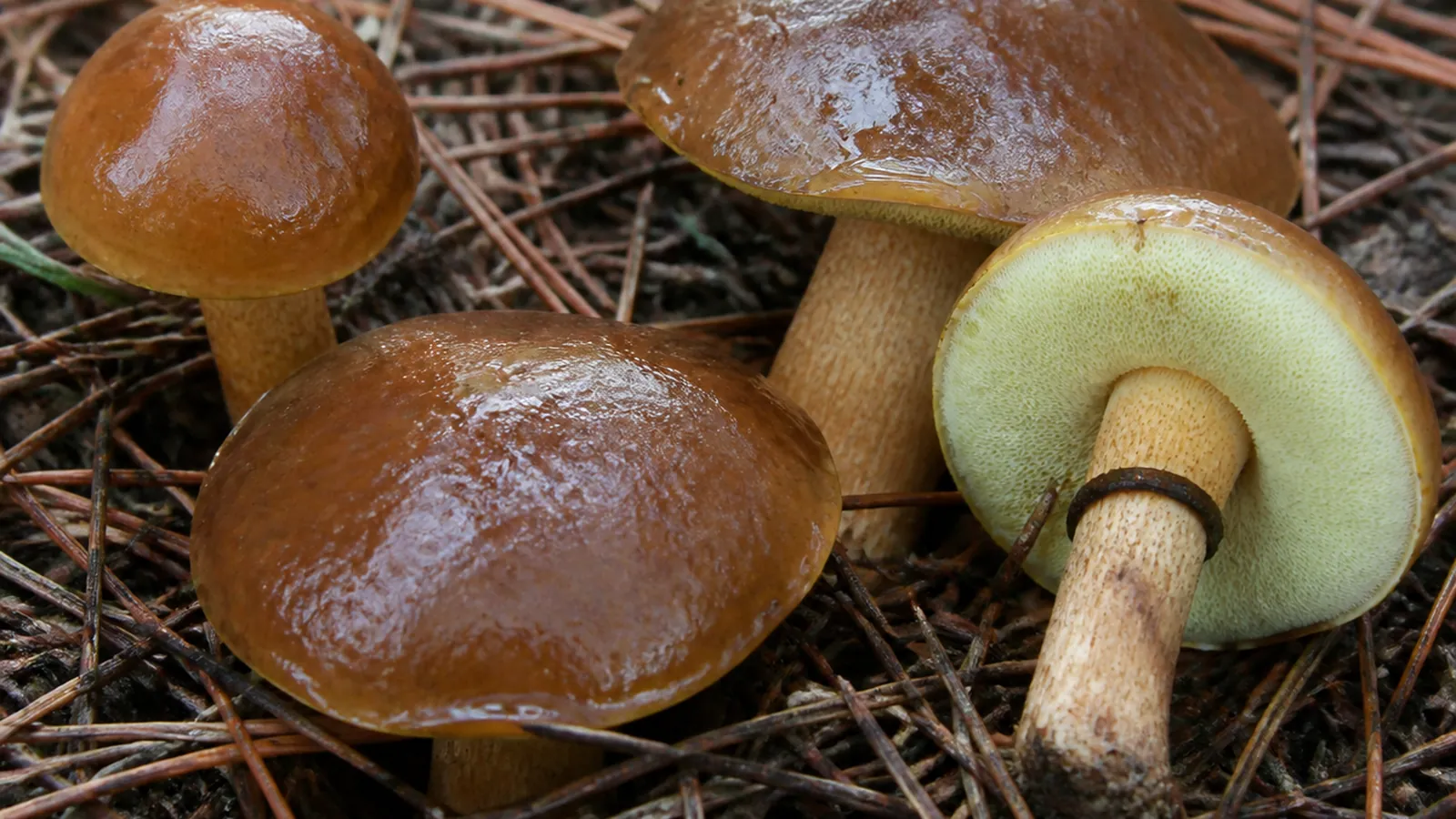
The scarletina bolete has a dark brown cap and a stem covered with red dots rather than a raised net.
It can stain blue much faster, but cooking traditions around that species do not make an uncertain red-pored bolete safe.

| Candidate | Feature pointing away from R. satanas | Remaining problem |
|---|---|---|
| R. rhodoxanthus | Rosier cap, blue reaction concentrated in cap flesh | Weathered colors overlap |
| R. legaliae | Pink cap tones, less extreme bulbous shape | Young pale caps can mislead |
| Scarletina bolete | Dark cap, dotted rather than netted stem | Both have red pores and blue flesh |
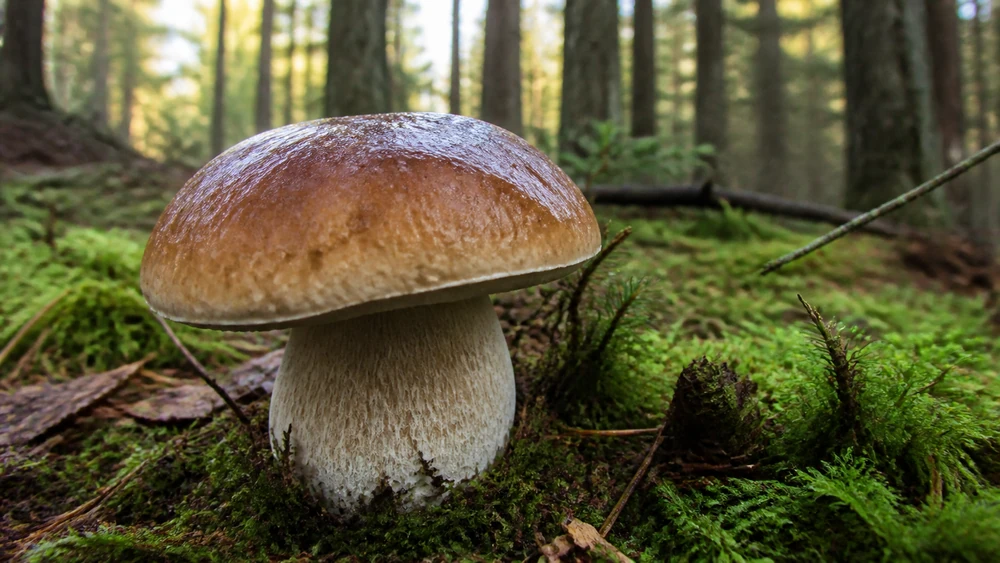
| Bitter bolete | Pale pores that become pink, brown net | Pale cap and stout shape overlap |
| North American red-pored boletes | Different species and host ranges | Satan's bolete is often misapplied as a name |
Key takeaway
A North American find should not be named R. satanas from appearance alone. Regional red-pored bolete keys are necessary because the true species is European.
Why do limestone and old broadleaf trees matter?
Devil's bolete is an ectomycorrhizal partner of broadleaf trees. Fine fungal threads extend the tree's access to water and minerals, while the tree supplies carbohydrates produced through photosynthesis.
Warmth and calcium-rich soil define much of its European distribution. Fruiting is associated with oak, beech, hornbeam, lime, and sometimes sweet chestnut on sunny slopes, open woodland edges, and old parkland.

The species can be rare or protected locally, so field study should minimize disturbance. Photograph in place, take only what local rules allow, and return unused diagnostic material to the site after expert examination when appropriate.
Removing a fruiting body does not remove the underground partnership.
Repeated soil compaction, host loss, and changes to old warm woodland may matter more to the fungus than careful collection of one specimen.
Geography is part of identification evidence. A visually similar bolete from California, the Pacific Northwest, or eastern North America should be evaluated under that region's species concepts rather than forced into a European name.
What can a timed blue-staining test tell you, and where does it fail?
Blue staining is an observation, not a species verdict. Make one clean cut through cap and stem, photograph the fresh surfaces immediately, and compare the same areas again after several minutes instead of judging a single bruised pore.
Dry weather, age, insect damage, freezing, and long storage can weaken or unevenly distribute a reaction. Artificially warm light can also make yellow flesh look orange or make a faint blue cast disappear, so describe the color as well as preserving a photograph.
Several red-pored boletes bruise blue, and some dangerous specimens react less dramatically than expected. The test narrows a comparison only when it stays attached to cap color, pore color, stem reticulation, flesh color, habitat, and geography.
A specimen that does not fit the expected pattern should remain unidentified. Cooking advice, bitterness, or a confident app label cannot repair contradictory morphology.
Is Satan's bolete the same mushroom in North America?
The mushroom was described as Boletus satanas in 1831. Molecular studies later split the broad old genus Boletus, and the accepted combination Rubroboletus satanas places it with red-colored, blue-staining relatives.
Older books may also use Suillellus satanas. Those names refer to the same species concept in different classifications, not separate edible and poisonous forms.
The common name Satan's bolete has been applied casually to North American red-pored species such as Rubroboletus eastwoodiae.
Shared common names do not erase continental taxonomy.
The Natural History Museum lists R. satanas as the accepted name and Boletus satanas as a synonym. Current identification should preserve the older name in search and source notes while using the accepted genus publicly.
Does prolonged cooking make it edible?
Devil's bolete is not a culinary mushroom. Its imposing size, thick flesh, and resemblance to prized boletes do not offset a record of severe gastrointestinal poisoning.
Heat advice is inconsistent across older books and local traditions. Because identification within red-pored boletes is difficult and poisoning can be intense, extended boiling cannot serve as a home safety test.
Keep red-pored specimens out of edible baskets.
Pore fragments and cut blue-staining flesh become much harder to assign after transport, trimming, and cooking.
Discard the meal if an uncertain red-pored bolete was mixed through it. Retain uncooked material for identification and follow poison-center advice instead of sampling the finished dish.
What kind of poisoning does it cause?
Clinical reports place devil's bolete mainly in the gastrointestinal irritant group, but the exact toxic compounds and dose-response relationship are not fully settled. Severe illness does not require a famous named toxin.
Symptoms commonly include nausea, repeated vomiting, abdominal cramping, and diarrhea within hours. Treatment focuses on assessment, hydration, electrolyte correction, symptom control, and evaluation for another toxin syndrome when the identification or timing is uncertain.
| Observation | Practical meaning |
|---|---|
| Symptoms begin early | A gastrointestinal irritant is plausible, but mixed meals still complicate diagnosis |
| Vomiting or diarrhea continues | Dehydration and electrolyte loss need medical attention |
| Symptoms begin after six hours | Clinicians must consider more dangerous delayed syndromes |
| Several diners are affected | Preserve all mushroom and meal evidence from the shared dish |
North American Mycological Association guidance includes certain red-pored boletes among gastrointestinal poisoning sources. It also notes that onset and symptoms guide care but do not replace specimen identification.
There is no established medicinal use for R. satanas.
Pigment, enzyme, or metabolite research should not be translated into a supplement claim or self-treatment.
Devil's bolete questions
Is devil's bolete poisonous?
Does all blue staining mean poison?
Where does it grow?
Does it occur in North America?
What should a field photo show?
Can cooking detoxify it?
Sources & References
- Natural History Museum species dictionary Accepted name and synonyms.
- North American Mycological Association Red-pored bolete poisoning syndrome and response.
- Store norske leksikon Current expert-reviewed taxonomy and European context.
- Mushroom poisoning review Clinical interpretation of mushroom poisoning timing and specimen evidence.
- ANSES Vigil'Anses European confusion patterns involving Satan's bolete.