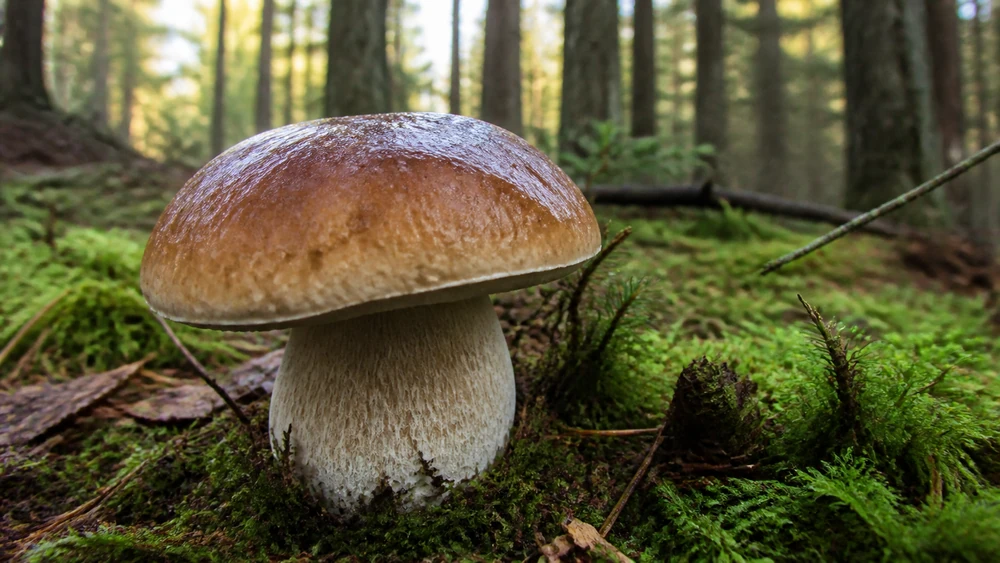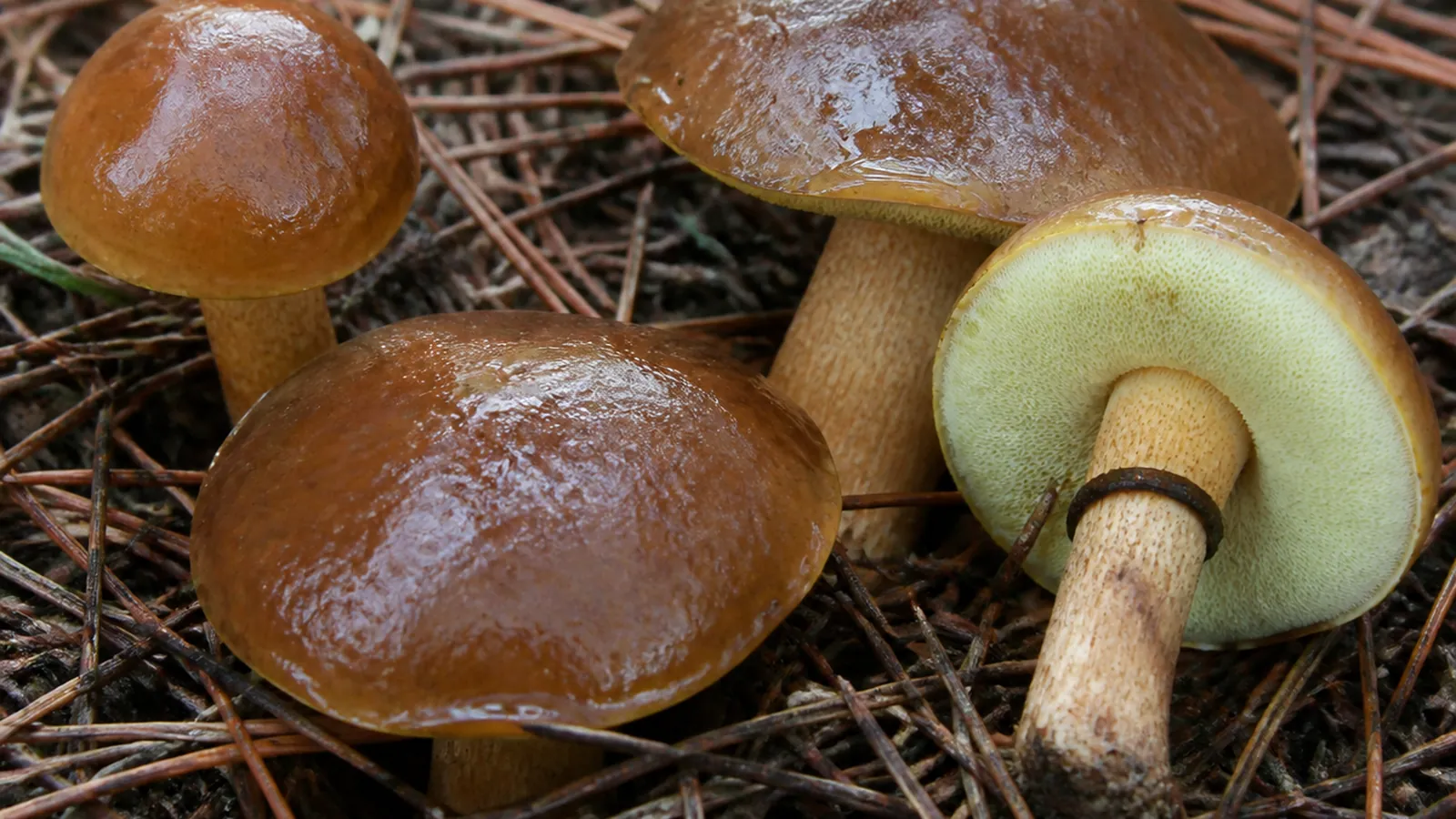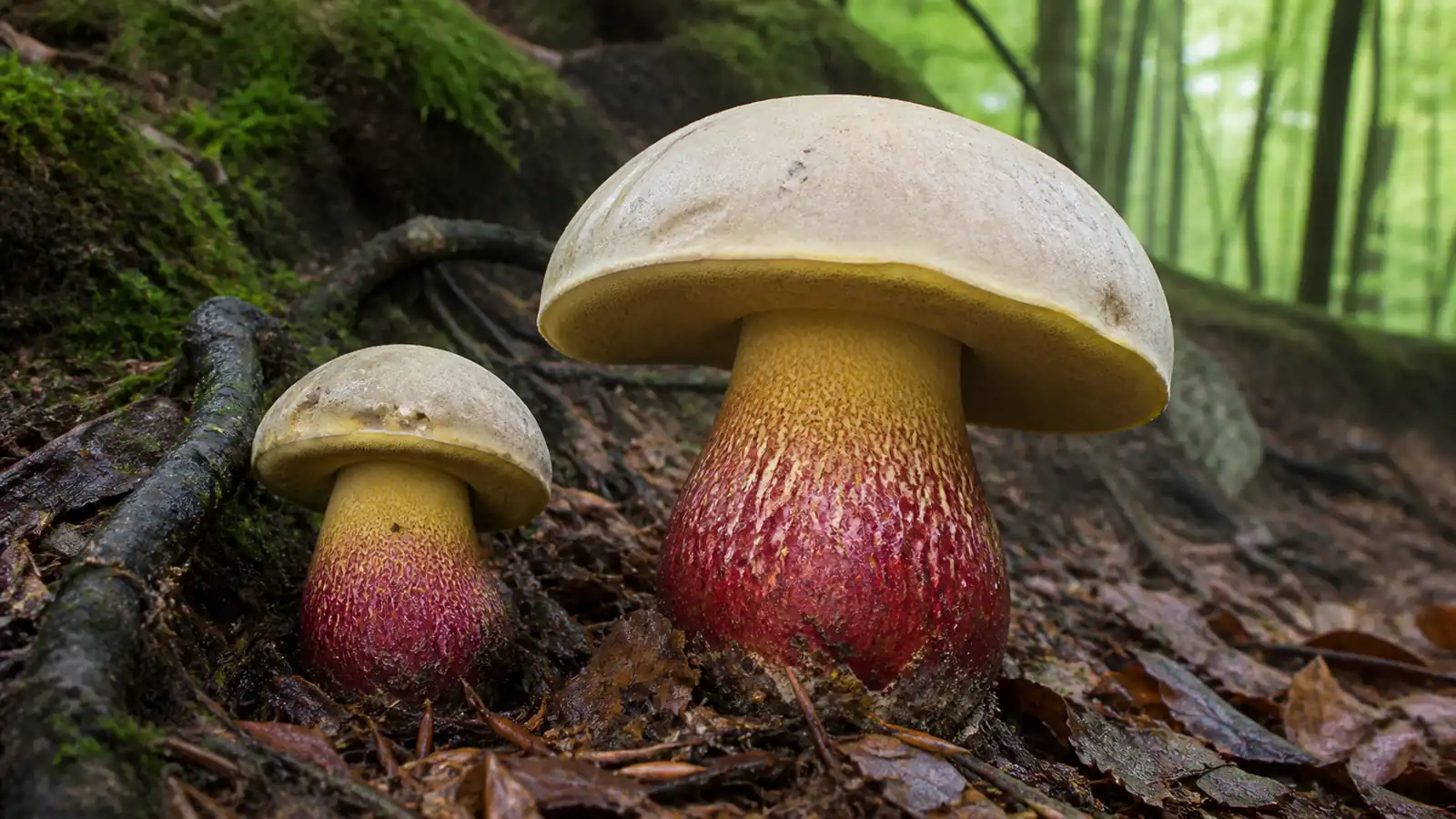
Why is this bright bolete rejected as food?
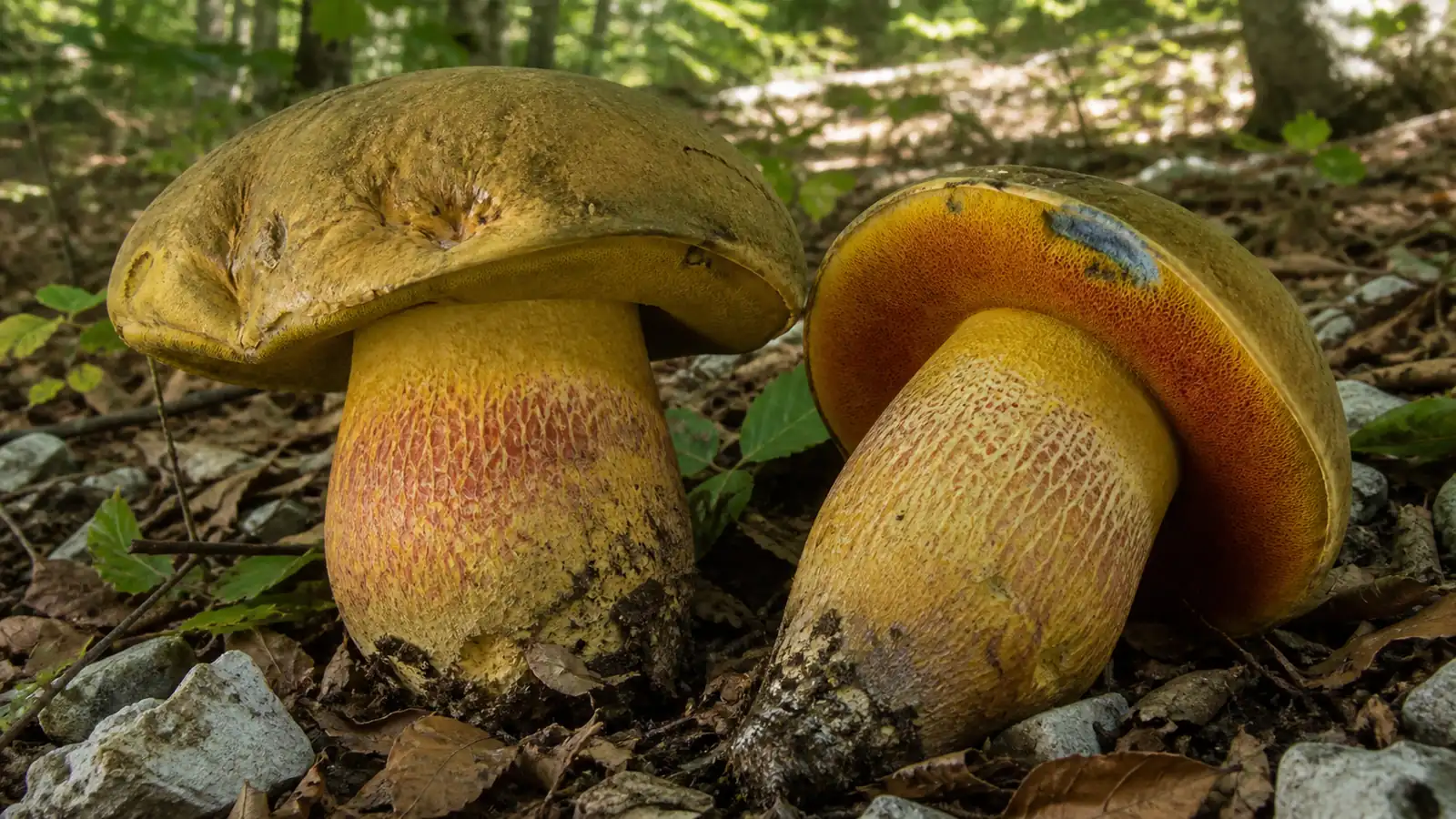
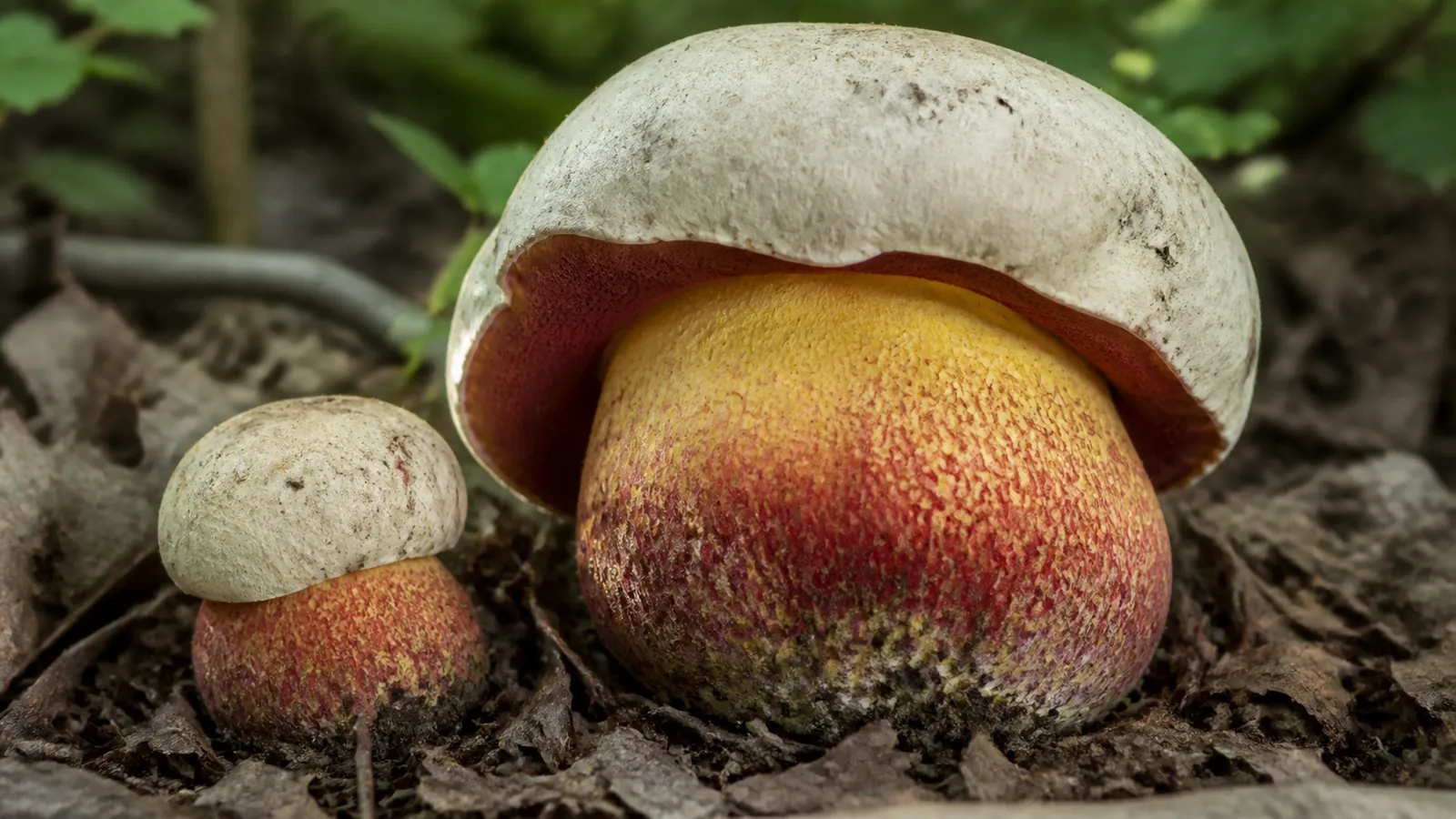
Caloboletus calopus is a substantial woodland bolete whose pale cap contrasts with a vivid stem. The stem is yellow at the top, grades into red below, and commonly carries a yellow or reddish network.
Pressure turns the yellow pore surface blue, and cut flesh can blue as well. These reactions support identification but occur in several unrelated boletes.
The species is famously bitter and is classified as poisonous or inedible. Cooking does not remove the taste or make an uncertain red-stemmed bolete safe.
Key takeaway
Treat the combined pale cap, yellow pores, red lower stem, reticulation, and blue bruising as a reason to document and reject the mushroom from food.
Color must be read as a pattern and in sequence. A dry pale cap, yellow tube surface, red lower stem, raised netting near the apex, and blue reaction after damage together support the name more strongly than any isolated red or blue mark.
Geography changes the identification problem.
Caloboletus calopus is centered in Europe, while similar North American collections may belong to C. rubripes, C. conifericola, or another regional taxon and should not inherit the European name from a photograph.
This bolete illustrates why attractive colors do not create a food signal. A pale cap, yellow pores, red lower stem, raised net, and blue bruising form a memorable combination, but each feature also occurs in other boletes with different names and risks.
The bitterness is reported as intense and persistent through cooking. It can spoil an entire mixed dish, yet deliberately tasting an unidentified red-stemmed bolete is an unnecessary exposure and cannot separate every poisonous or inedible relative.
Caloboletus calopus is centered in European literature. North American mushrooms once given the same name may belong to C. rubripes, C. conifericola, or other regional taxa, so location and host belong beside morphology.
The practical answer is conservative.
Record the full specimen for identification, keep it out of food, and do not let a non-red pore surface erase the wider risk from a difficult red-stemmed group.
Which features must agree before naming Caloboletus calopus?
Pale gray, buff, or olive-gray, 5 to 15 cm, dry and finely velvety before becoming smoother.
No gills. Yellow pores bruise blue when damaged.
Stout and club-shaped, yellow near the top and carmine red below, with a raised net pattern toward the apex.
Pale yellow flesh that blues when cut, with a mild odor and intensely bitter taste.
Photograph the cap, pore surface, entire stem, and cut flesh because no single color identifies this bolete. Note the trees and region before bruising the specimen.

A spore print can confirm the olive-brown deposit expected from this bolete.
It cannot separate every blue-bruising or red-stemmed species.
Rubroboletus species may show red pores rather than consistently yellow pores, while Caloboletus radicans lacks the strong red lower stem. North American C. rubripes and C. conifericola complicate names outside Europe.

Do not perform a taste test on a poisonous candidate. Microscopic characters, host, geography, and DNA may be needed where closely related taxa overlap.
Record the bruise reaction with timed photographs because an immediate dark blue mark and a slow faint change are not equivalent observations. Cut one specimen lengthwise so the flesh color, tube attachment, stem base, and distribution of blue staining remain connected in a single record.
Reticulation also needs a close view. The raised net should be distinguished from longitudinal fibers, handling cracks, or insect damage, and its color and extent should be noted before the stem darkens.
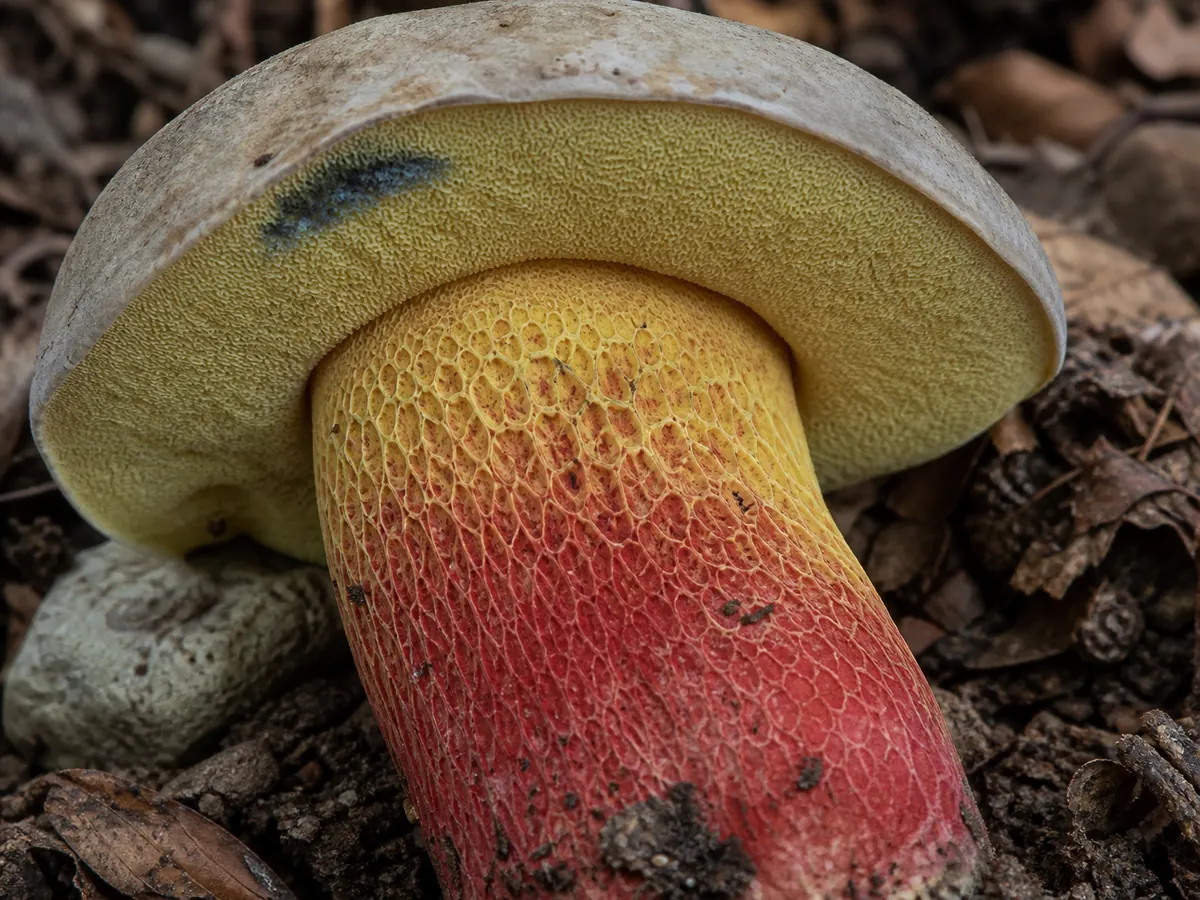
A missing feature can outweigh a matching one. Red pores, a strongly rooting base, a cap unlike the pale dry form, or growth outside a plausible regional range should reopen the comparison rather than be explained away.
When a collection is old, prioritize durable structure over fading color.
The raised stem net, tube layer, rooting or non-rooting base, and host record usually survive longer than the first yellow and red tones.
For a regional expert, a dried voucher retains spores and tissue for microscopy or sequencing. Drying a specimen documents a difficult record, but it never converts that specimen into food.
Read the cap and underside before touching them. The dry pale cap may be finely velvety, while the pore surface begins yellow and becomes olive-yellow with age, providing a baseline before pressure creates blue marks.
Study the stem as a structure rather than a red object. Note the bulbous profile, yellow upper zone, red lower zone, and raised mesh near the top, then distinguish that mesh from longitudinal fibers, drying cracks, or insect tracks.
Cut one specimen from cap through the stem base and start a timer.
Photograph the initial pale yellow flesh, the first blue areas, the reaction after one minute, and the later fade because speed and distribution are more informative than a final blue photograph.
The tube layer may react more strongly than the central flesh. Record that difference along with any red pore mouths, rooting base, odor, or cap color that conflicts with C. calopus.
An olive-brown print supports a bolete placement but adds little at species level. Microscopic spores, pileipellis structure, host, region, and DNA can be necessary when a scientific record needs more certainty than the food decision.
Color balance also changes with exposure.
The red lower stem can fade after heavy rain, yellow pores turn olive with maturity, and blue oxidation can mask the original flesh, so field notes should distinguish fresh color from later change.
Photograph the cap surface dry and wet when a fruiting spans changing weather. A pale finely velvety cap supports the concept, while a greasy surface, strong pink tones, coarse cracking, or a differently colored margin may direct a regional key elsewhere.
Odor is usually less decisive than structure, but it still belongs in a voucher note. Record it before drying because storage can replace the original smell with a generic dried-mushroom odor.
If someone may have eaten this mushroom, act now. Call Poison Control at 1-800-222-1222 (US) or emergency services before symptoms appear, and save a piece of the mushroom for identification.
Which red-stemmed boletes can be confused with it?
Red-stemmed blue-bruising boletes overlap strongly in color. The pale cap, yellow pores, upper stem net, blue reaction, bitter flesh, and verified region must agree.
Never eat a red-stemmed bolete from a photograph. Rubroboletus and other lookalikes can be poisonous, while North American bitter boletes may belong to different Caloboletus species.
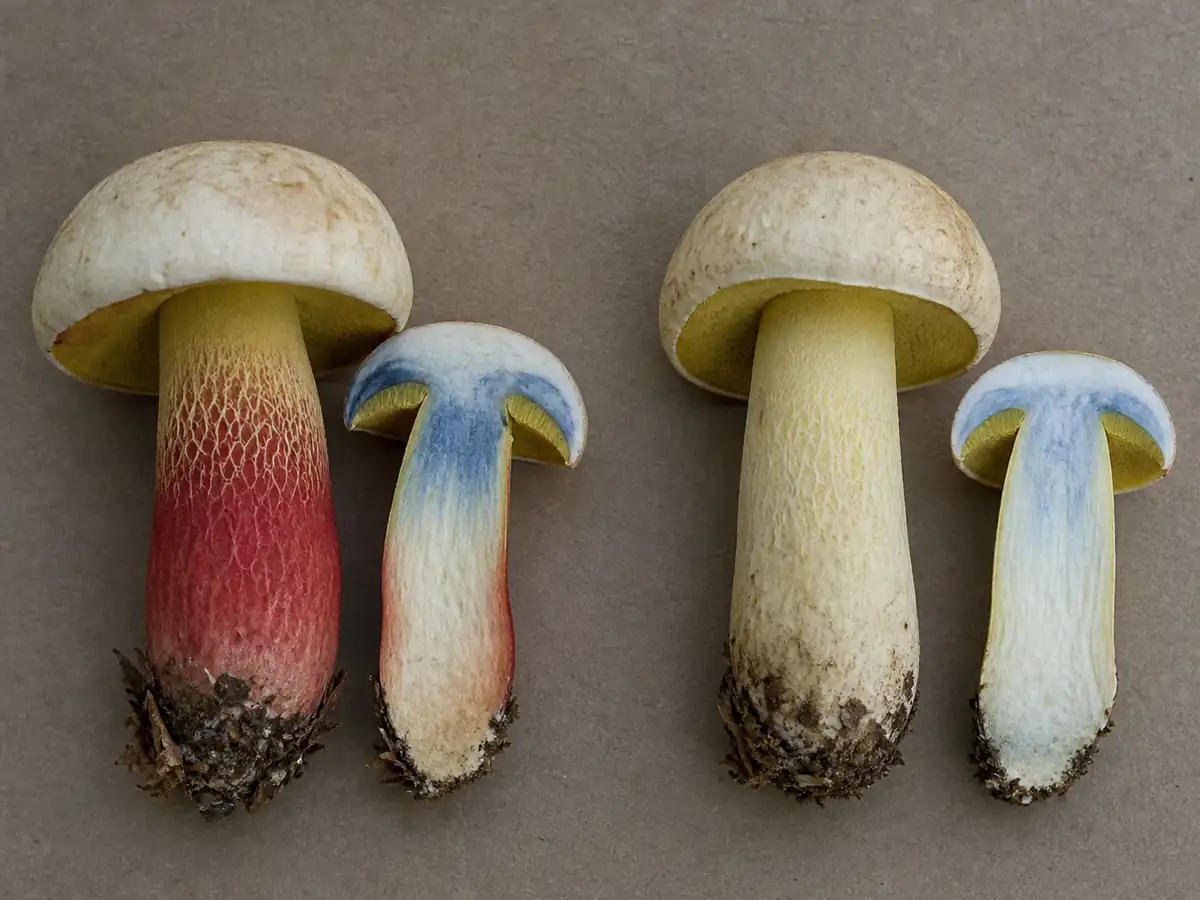
A blue stain is a chemical reaction, not a toxicity test. Some edible boletes bruise blue and some dangerous boletes do not, so the reaction must stay inside a full identification that includes pore color, stem ornament, host, and region.
Caloboletus radicans is also bitter and blue-bruising but usually has a paler stem without the strong red lower zone. Rubroboletus candidates often bring red pore mouths or different cap and stem patterns, yet regional keys are still needed because weathered colors converge.
| Candidate | Pore and stem pattern | Geographic or safety limit |
|---|---|---|
| Caloboletus calopus | Yellow pores, yellow upper stem, strong red lower zone, raised net | European name requires regional evidence |
| Caloboletus radicans | Yellow pores and blue bruising, usually without the strong red lower zone | Also bitter and unsuitable as food |
| Rubroboletus species | Red pore mouths are common in several species | Some members are poisonous |
| North American Caloboletus | Red-stemmed, bitter, and blue-bruising forms occur under conifers | Do not force a European name onto them |
Caloboletus radicans combines a pale cap, yellow pores, blue bruising, and bitter flesh, but its stem is generally paler and often roots more strongly. Weathering can reduce the red zone of C. calopus, so one washed stem does not create a safe binary.
Rubroboletus species frequently bring red pore mouths, different cap colors, and distinct stem patterns. Several are poisonous, and an old specimen can lose bright pore color, which makes a regional red-pored-bolete key more reliable than a remembered photograph.
North American C. rubripes and related taxa can be red-stemmed, bitter, and blue-bruising under conifers. Applying a European beech-associated name without checking geography can produce a confident but biologically wrong label.
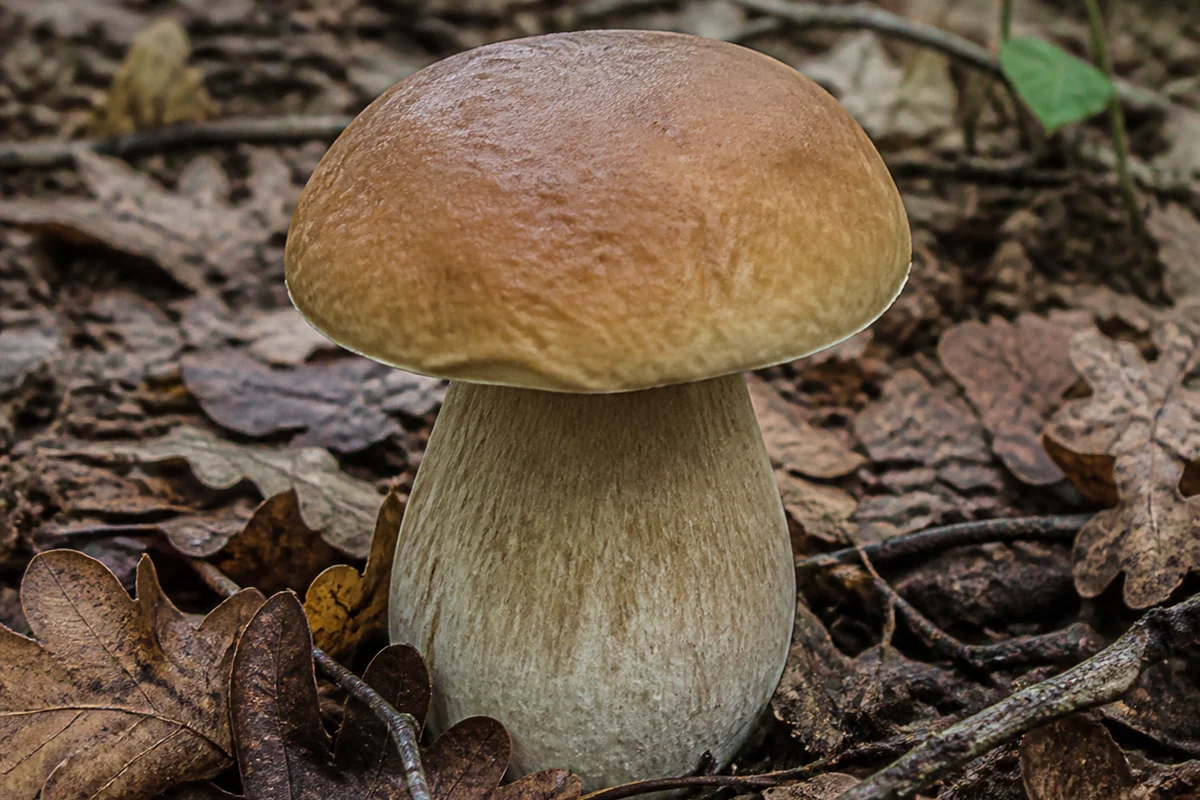
Edible blue-bruising boletes exist as well. That fact does not make blue neutral in practice, because it means the reaction must be interpreted with pores, stem, cap, host, and region rather than used as an edible or poisonous switch.
If the specimen lacks its base, has been washed, or comes from an unknown tree setting, preserve photographs or a dried voucher for study and leave it out of the kitchen.
A food decision should also account for incomplete collections. Slugs may remove pore mouths, soil may hide a rooting base, and a broken upper stem may remove the reticulation, leaving too little evidence to choose among several red-stemmed boletes.
Why does cooking not solve the bitterness?
Do not cook or preserve bitter beech boletes. The bitterness can spoil an entire mixed dish, and gastrointestinal effects make experimental preparation inappropriate.
A cooked bolete meal does not become safe merely because all pieces have pores. Keep each wild species separated until an expert identification is complete.
Reported poisoning is mainly gastrointestinal, so nausea, vomiting, abdominal pain, or diarrhea after a bolete meal needs prompt poison-service advice.
Save an uncooked specimen, photographs, meal remnants, and the time each person ate rather than relying on a remembered cap color.
Cooking does not solve this mushroom's defining food problem. Heat may soften the flesh and drive off water, but the bitterness persists and can spread through sauce, stock, or a pan of otherwise edible mushrooms.
Do not use a small raw taste as a shortcut.
Taste descriptions in keys are observations from expert practice, while a public safety decision has to account for toxic red-stemmed lookalikes and the possibility of swallowing tissue.
Keep uncertain boletes separated in the field. Once cut pieces share a basket or pan, pore color, stem netting, base shape, and individual bruise patterns become harder to reconstruct.
If someone has eaten a suspect bolete and develops nausea, vomiting, abdominal pain, or diarrhea, contact a poison service with the meal time, remaining mushrooms, and collection photos. A bitter flavor after cooking does not identify which species was consumed.
Which trees support bitter beech bolete?
The fungus forms ectomycorrhizae with living trees. European records commonly place it with beech and oak, though spruce, fir, and other conifers can also be partners.
It fruits from soil rather than wood, singly or in small groups, from summer into autumn. Acidic woodland soils are frequent in field accounts.
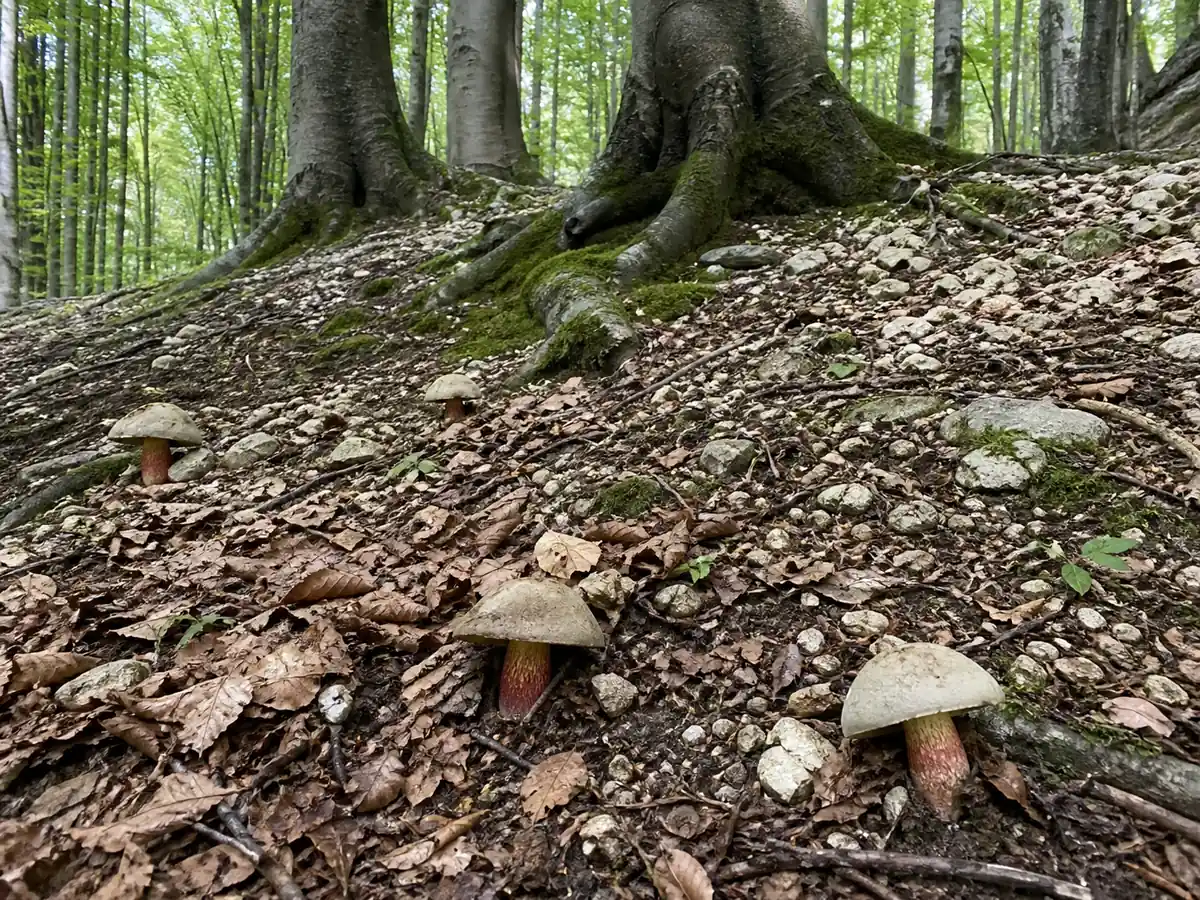
Because the fruiting body depends on a root partnership, its appearance can shift with host and site while the underground fungus remains. Avoid raking soil or removing more specimens than documentation requires.
Host evidence is strongest when roots, leaves, and several nearby trees agree. A fruiting body under beech in mixed woodland may still connect to oak or a conifer beyond the immediate photograph, so habitat narrows the field without proving the species.
The mushroom is the temporary reproductive structure of a persistent root partner. Removing it does not remove the underground fungus, and digging for mycelium damages the fine roots that make the association possible.
Ectomycorrhizal hyphae surround fine roots and extend into soil, moving mineral nutrients and water while receiving carbon from the tree.
The fruiting bolete is a seasonal reproductive structure of that larger partnership.
European records often involve beech and oak, with spruce, fir, and other conifers also reported. In a mixed stand, the nearest trunk is only a candidate because roots cross and can extend well beyond the canopy.
Acidic woodland soils and summer-to-autumn moisture commonly support fruiting. A rocky or mossy surface can expose caps while hiding the root network that controls where the fungus persists.
Removing a fruiting body does not remove the mycelium or help the host.
Take only what a lawful voucher requires, retain the base and habitat data, and avoid raking the soil around a scarce collection.
Fruiting records become more useful when soil, slope, drainage, recent weather, and the full tree mix are included. Those details help later reviewers separate a real range or host pattern from a mushroom name copied between regions.
Why did Boletus calopus move genera?
The species was long called Boletus calopus. Molecular phylogeny showed it was distant from the type of Boletus, and Caloboletus was erected in 2014 with C. calopus as its type species.
Regional records need care because related bitter red-stemmed taxa have been separated from the European species.
The older name Boletus calopus remains common in field guides and image databases. Molecular work showed that this lineage sits away from the core Boletus group containing porcini, and the species became the type of Caloboletus in 2014.
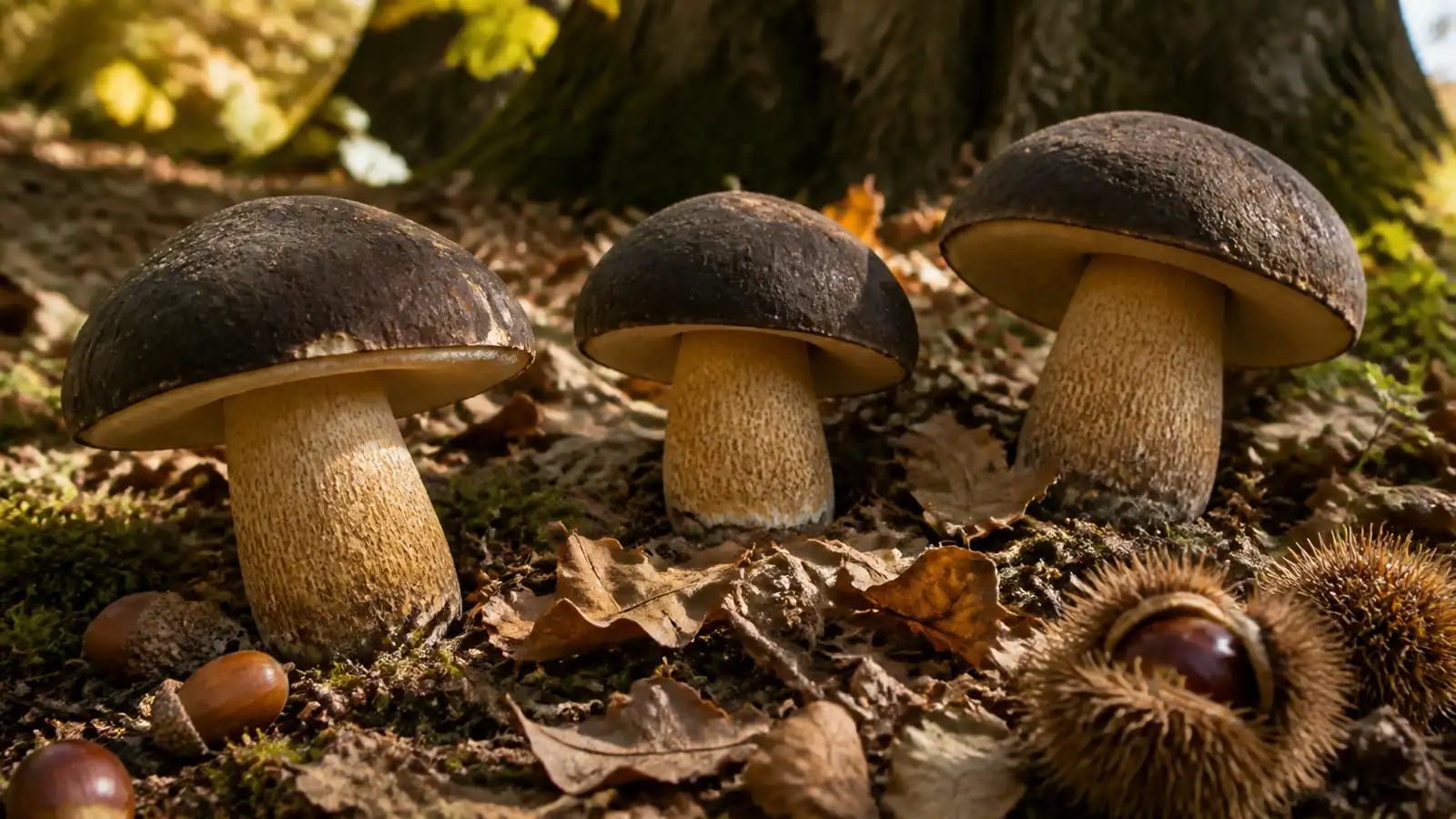
That change is more than a label update because it warns against inferring culinary similarity from the old genus. A mushroom once called Boletus is not therefore close to Boletus edulis in ecology, chemistry, or food value.
Regional naming remains active. Use both combinations when researching older records, then check whether a modern local treatment recognizes C. calopus or a related red-stemmed bitter species in that area.
Bitter beech bolete safety questions
Is bitter beech bolete edible?
Do its pores bruise blue?
What color is its spore print?
Does it always grow with beech?
Can bitterness be cooked out?
Is a North American lookalike the same species?
Sources & References
- Italian Journal of Mycology review Morphology, ecology, taxonomy, bitter compounds, and edibility.
- Index Fungorum No. 146 Caloboletus combination and nomenclatural authority.