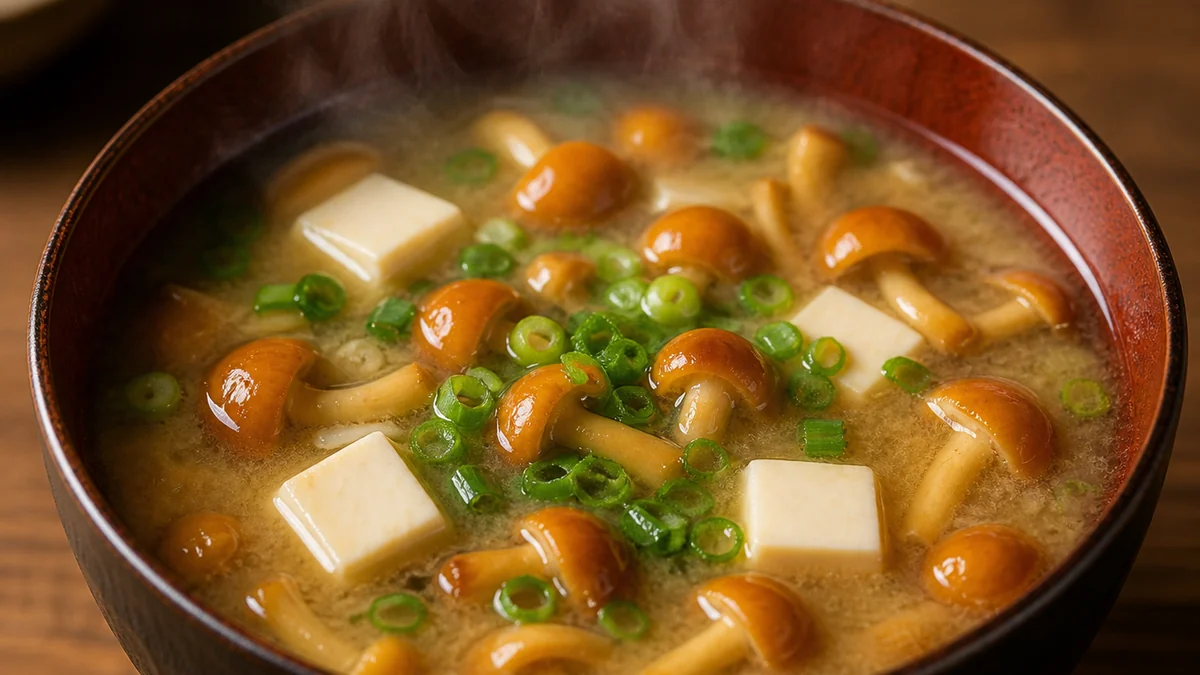
Nameko are grown for the clear gelatinous coating that thickens a broth, and a few seconds under a tap removes it. Do not rinse them, add them to already simmering liquid two or three minutes before serving, and stop when the broth visibly thickens.
You opened the pack, found small amber mushrooms coated in something clear and slippery, and your first instinct was to rinse them.
Do not, because that coating is the reason the mushroom is grown and it comes off in about four seconds under a tap.
The coating is the ingredient
Nameko produce a gelatinous layer while they grow. It is a feature of the living mushroom rather than anything that happened in the pack.
Only the last line is a problem, and it is a smell rather than a texture. Everything else people worry about with this mushroom is the mushroom working correctly.

What the coating does in a dish is thicken it, so a handful of nameko dropped into a broth gives the liquid body within a couple of minutes, in the way a small amount of starch would.
That is why the species is cultivated at all. Nameko is a mild mushroom with an unremarkable flavor, and what it sells on is the texture the coating creates.
The Japanese name refers to that slippery quality directly rather than apologising for it, which is the clearest signal available that the coating is the point. The nameko mushroom profile has the rest of the species.
Cooking MushroomsHow to Cook Cauliflower Mushroom Without Trapping GritDo not wash them
This is the strictest cleaning rule anywhere on this site. It is also the whole preparation.
Key takeaway
Do not rinse nameko. They are grown indoors on sterilized logs or sawdust blocks and arrive clean, and a few seconds under running water removes most of the coating you paid for.
That is not a figure of speech about how quickly it goes, since the layer is water-soluble and there is no way to get it back once it has left.
What replaces washing is barely a step at all, since picking over the cluster is the whole of it: break it apart, drop the base where the substrate was, and put the rest straight into whatever you are cooking.
Our guide to cleaning mushrooms argues against water for most species on the grounds that it waterlogs the flesh. Here the reason is different and stronger, since the water takes the ingredient away rather than adding one.

There is a related instinct worth heading off, which is patting them dry with a towel, and that does the same job as a rinse more slowly.
A wild find is the one exception and it is rare outside Japan. Those come off dead hardwood and can carry debris, in which case a very quick rinse is the lesser of two losses.
The methods that keep the coating
Liquid, not much time in it, and a pot rather than a pan.
The second step is where people go wrong by being conscientious. Nameko added at the start of a twenty-minute soup are mush by the end, and the coating has long since dispersed.
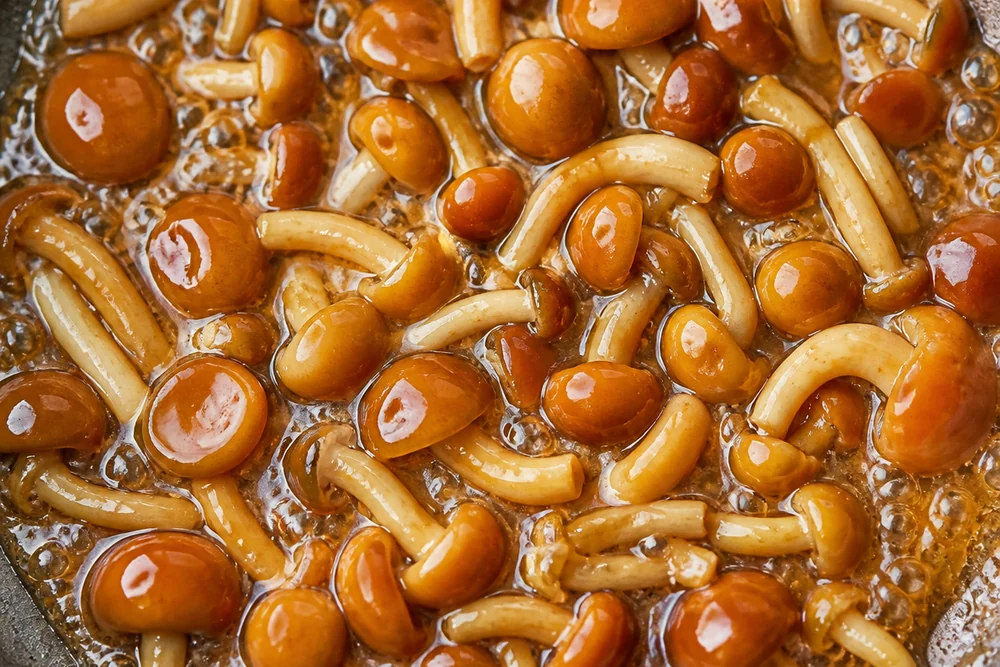
That thickening is what the whole short list of nameko dishes is built around:
- Miso soup, which is where most Japanese households meet it.
- Clear dashi-based soups, where the thickening is most obvious.
- Grated daikon with nameko, which is barely cooked at all.
- Noodles or rice, with the mushrooms stirred through at the last moment.
- Hot pot, added to the shared pan late so each round gets some.
Temperature at the moment they go in decides more than the clock does. Liquid at a bare simmer thickens gently and holds the caps intact, and a hard boil disperses the coating in seconds.
The first of those is the best introduction, because the coating gives a miso broth body that miso alone does not have while the mushrooms stay whole and distinct in it.
The third is the one worth trying if you are unconvinced. Grated daikon with nameko is barely a recipe and it demonstrates the texture better than anything cooked longer does.
Anything that ends wet and ends fast suits them, and the list of things that do not is a good deal shorter.
Can you fry them
You can. Most of what you bought will be gone by the time it is done.
| Method | What happens to the coating | Verdict |
|---|---|---|
| Simmered in broth | Disperses into the liquid, thickens it | Yes, this is the point |
| Hot pan with a splash of liquid | Partly kept, becomes a glaze | Works well |
| Dry high-heat sear | Driven off entirely | Pointless |
| Deep fried | Gone, and the mushroom is too small | No |
Three things go wrong in a dry pan, in this order:
- The coating evaporates within the first minute.
- The surface stays wet until it has gone, so nothing browns.
- By the time browning could start, the mushroom itself has dried out.
What you are left with at the end of that sequence is a small, mild, slightly chewy mushroom with no particular quality to recommend it.
There is a way to read that list as an instruction rather than a warning. Anything that keeps a little liquid in the pan keeps a little of the coating, and the amount you keep is roughly the amount of liquid you left in.
A pan with butter and a spoonful of stock is the honest compromise. The coating turns into a glaze that clings to the mushrooms instead of thickening a broth, which is a different pleasure rather than a lesser one.
If what you want is a browned mushroom then buy a different one, which is not a criticism of nameko so much as what happens when a mushroom is grown for a property dry heat destroys.
Cooking MushroomsHow to Cook Black Morels: Halve Them, Never Slice ThemDo you have to cook them
Yes, always. Nameko is never eaten raw in any tradition that uses it.
Tip
Two minutes of simmering is enough for both flavor and digestion. Raw, the coating is genuinely unpleasant and the flavor has not developed, so there is nothing on the other side of the rule.
The reason here is flavor rather than safety, and our page on cooking enoki mushrooms deals with a small cluster mushroom where the instruction really is a safety one.
There is no toxin here and no special handling. The instruction is about flavor and texture, and the mushroom is simply not pleasant in either respect before it has met heat.
Two minutes also happens to be the maximum you want, since the window between raw and mushy is unusually narrow and that is the one genuinely fiddly thing about the species.
What they taste like
Mild, earthy and faintly sweet, which is not why anybody buys them.
The texture is the reason to buy them, and small firm caps suspended in a broth their own coating has thickened is a specific sensation rather than a general mushroom one.
Texture is also why the mushroom divides people so sharply. Someone who dislikes okra or grated yam will dislike nameko for the same reason, and that reaction is about the coating rather than about mushrooms.
There is no way around it and no reason to try, since the species has one quality and either you want it in the bowl or you buy something else.
Miso, dashi and soy are the natural partners because they are all wet and all savory. Nameko in a cream sauce is not wrong exactly, but the coating and the cream do the same job and neither improves the other.
Compared with the other small Japanese cluster mushroom in the shop they are much milder, and our guide to cooking shimeji mushrooms deals with a species that needs sustained heat to taste of anything at all.
Anyone eating them regularly will find the figures on our nameko nutrition record. The coating shows up there too, since it is where a good deal of the soluble fiber sits.
Cooking MushroomsHow to Cook Black Truffle Without Losing Its AromaIf the texture is not for you
Some people meet nameko once and never buy it again. That is a legitimate reaction rather than a failure of nerve.
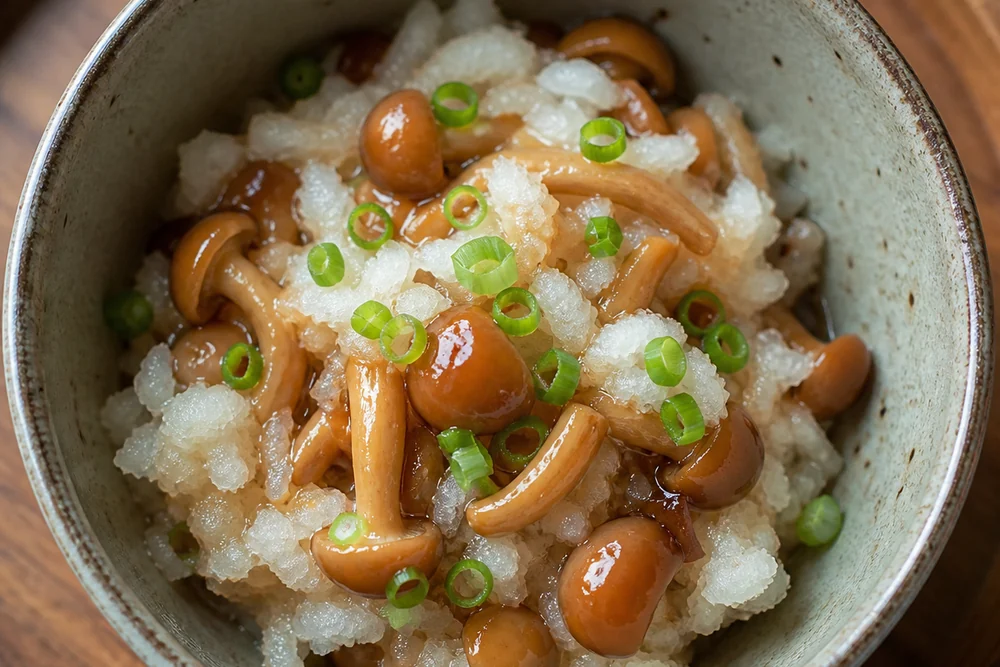
The reaction is about texture rather than taste, which is worth naming because people often assume they dislike the flavor.
The coating belongs to the same family of textures as okra, grated yam and natto, and people tend to feel the same way about all of them. If those are not for you, nameko probably is not either, and no cooking method changes that.
There is one thing worth trying before giving up on the species. Cook them long enough that the coating disperses completely into a large volume of liquid, in a stew or a thick soup, and the body is there while the slipperiness is not.
Chopping them small has the same effect for a different reason, since in a filling or a sauce the pieces stop being distinct enough to notice and what survives is what they give the mixture.
What does not work is trying to wash the texture away, which was covered above and applies here too. A rinsed nameko is not a nicer nameko, only a blander one.
Anyone who has decided against the species entirely is not short of options, and nothing else in the shop does what this one does is both the honest answer and the reason it exists.
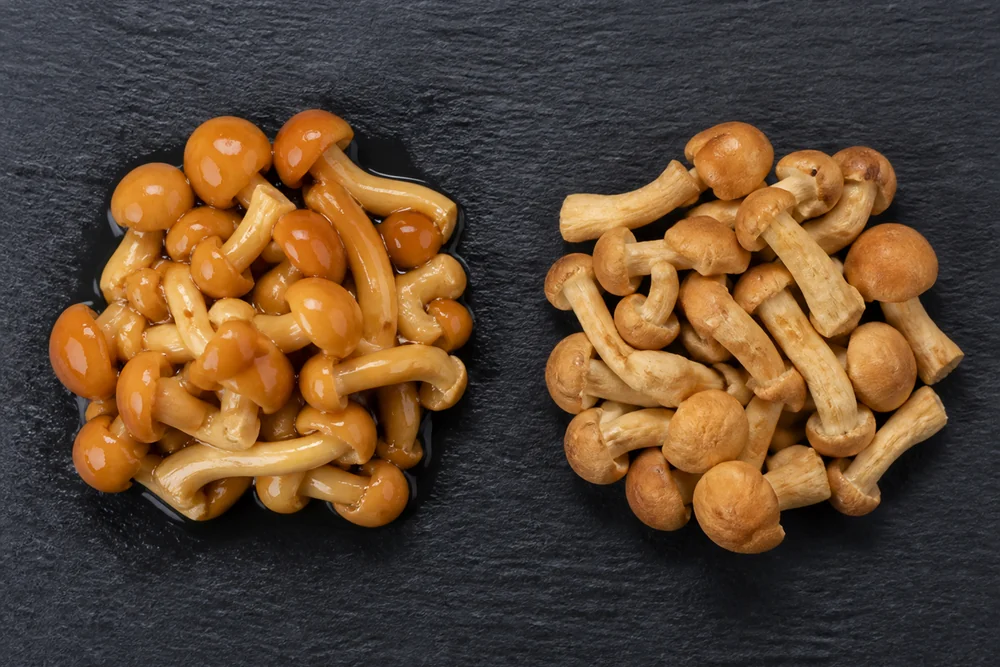
Fresh, vacuum-packed and canned
Most people outside Japan meet a packaged form first. Packaging matters more for this species than for almost any other.
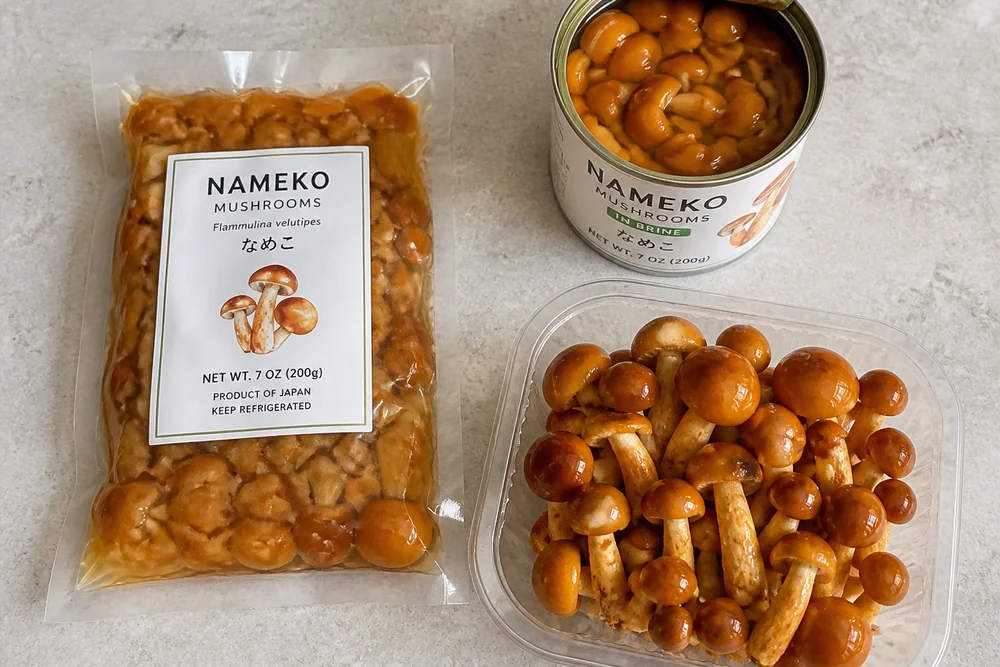
Four things separate the three, and only the first of them is about quality.
Availability rather than preference decides this for most people. A Japanese grocer will have all three, a general Asian supermarket usually has pouches and cans, and an ordinary supermarket has none of them.
The vacuum pouches are the ones to look for. They keep the coating almost intact, they last months unopened, and the difference from fresh is small enough that most dishes will not show it.
Price usually tracks the form rather than the quality, so fresh is expensive because it travels badly, pouches are moderate, and canned is cheap for the good reason that it is the least of the three.
Canned nameko is a step down rather than a write-off. The texture is softer and the brine adds salt you have to account for, and in a miso soup neither of those is fatal.
The trap with canned is the instinct to rinse the brine off. That takes the coating with it and leaves you with the softest and least interesting version of the mushroom, so drain it and adjust the salt instead.
If none of the three is available, our page on nameko substitutes works through what comes closest, and the honest answer is that nothing really does. For anyone with a log and some patience, growing nameko mushrooms is more practical than the import situation suggests.
Buying and keeping them
Look at the caps rather than the surface, since the surface will always look wet.
The surface is glossy on a fresh pack and glossy on a tired one, which is why it tells you nothing. Shape and color are what change with age.
A good pack has domed caps that are still separate from one another, with an even amber color. That is a young cluster and it will behave the way this page describes.
Three signs say a pack is past its best:
- Caps gone flat and dark rather than domed and amber.
- The cluster collapsed into a single mass rather than separate mushrooms.
- A sour or fermented smell, which is spoilage rather than coating.
That last one is the only real test. The naturally slippery surface does not by itself show that the mushrooms are old.
Quantity per bowl is small and the thickening is why. A generous handful across four bowls of soup is enough to change the body of the broth, and twice that turns it into something closer to a sauce than a soup.
Fresh nameko keeps three or four days and no longer, which is short even by mushroom standards.
Price is low for what the mushroom does, which is worth saying because the packaging looks specialist. A pouch costs less than a punnet of oyster mushrooms in most shops and goes further, since a handful is enough to change a pot of soup.
Everything usually goes wrong in the first thirty seconds after the pack is opened. The coating reads as spoilage, the mushrooms go under the tap, and what follows is a reasonable method applied to an ingredient already stripped of its point.
Leave them in the pack, use them soon, and see our page on storing nameko mushrooms for the container and freezing detail.
Sources & References
- Pholiota microspora, the nameko (Fungi Atlas) Species reference used for the amber cap color, the gelatinous surface layer produced during growth, and the habit of fruiting in clusters on dead hardwood.
- Specialty Mushroom Production: Pholiota (Penn State Extension) Extension reference used for log and sawdust block cultivation indoors, which is why cultivated nameko arrive clean and need no washing.
- Mushroom polysaccharides and viscosity (Journal of Agricultural and Food Chemistry) Food chemistry reference used for the polysaccharide nature of the surface layer and its effect on the viscosity of a liquid it is cooked in.