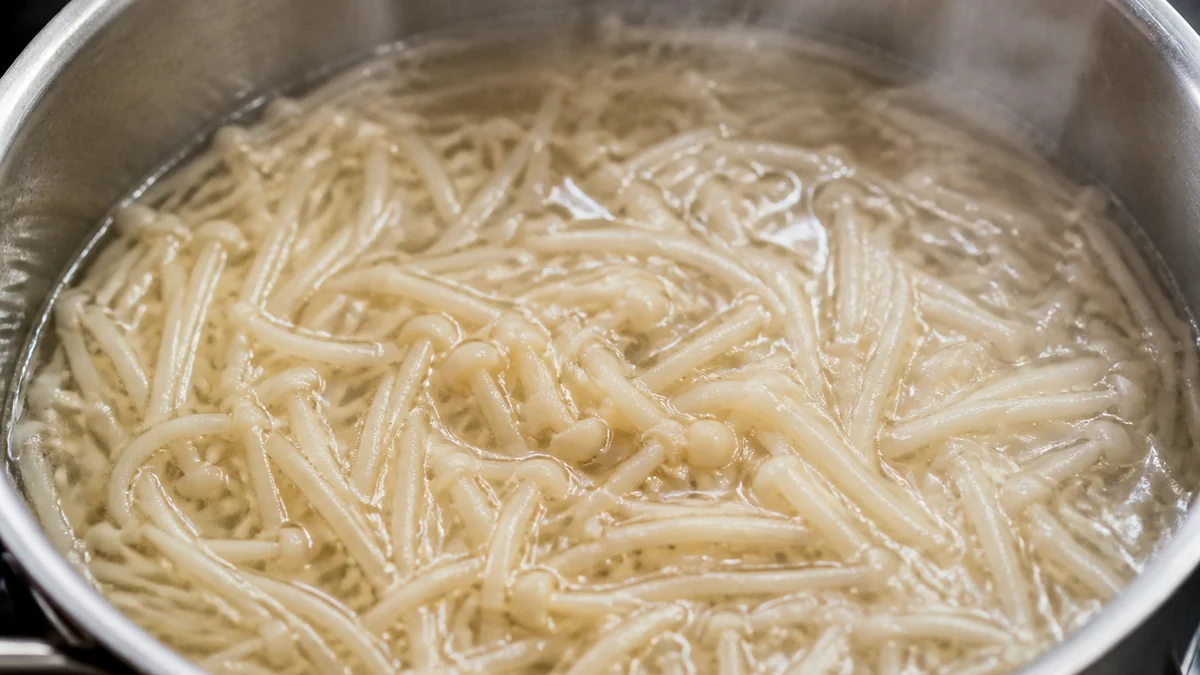
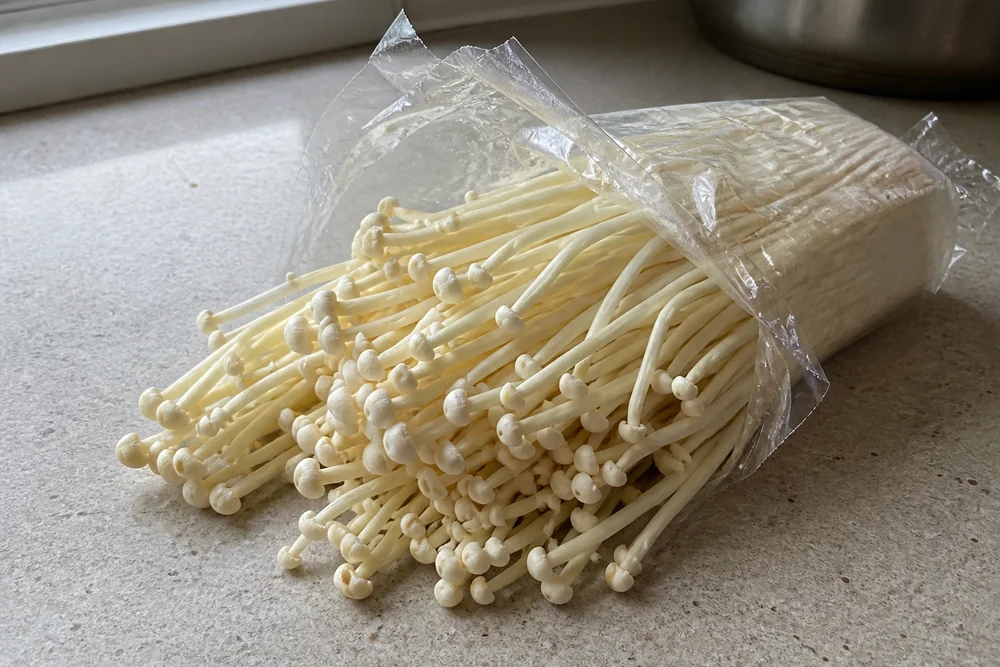
Enoki is the one common cultivated mushroom where the cooking instruction is a safety instruction. CDC and FDA advise cooking it thoroughly after a multistate Listeria outbreak that caused 36 illnesses across 17 states, 31 hospitalizations and four deaths, and more than twenty recalls have followed since 2020. Thorough means 165 degrees Fahrenheit, which thin strands reach in two to three minutes in simmering broth. Cut about an inch off the compressed base, separate the strands, and add them at the end rather than the start, because enoki contributes texture rather than flavor and long cooking removes the only thing it was there for.
Most enoki recipes you will find serve it raw, in a salad or as a garnish.
That is the one preparation public health agencies specifically advise against, and the reason is not theoretical.
Raw enoki is the one thing to avoid
Cook it through. The advice is unusually direct for a vegetable aisle product.
- The instruction
- Cook enoki thoroughly rather than eating it raw.
- Who says so
- CDC and FDA, following a multistate outbreak investigation.
- The outbreak
- 36 illnesses across 17 states, 31 hospitalizations, four deaths.
- Since then
- More than twenty enoki recalls in the United States since 2020.
- Highest risk
- Pregnancy, age 65 and over, and weakened immune systems.
None of those five lines is disputed, and all of them come from the same investigation.
The 2020 investigation traced Listeria monocytogenes infections to enoki supplied by a single Korean producer, and four people died while two pregnancies were lost.
That last point is what makes this a cooking instruction rather than a news item. Recalls have kept arriving in the years since, which means the guidance is not about one bad batch that has already been removed from shelves.
Warning
CDC advises that people who are pregnant, aged 65 or older, or immunocompromised should not eat raw enoki at all, even from packs that have not been recalled. For everyone else the advice is to cook them thoroughly and to keep raw enoki away from food that will not be cooked.
None of that makes enoki a dangerous ingredient. It makes raw enoki a preparation worth dropping, and cooked enoki is both safe and better, which is a rare case of the careful answer also being the tastier one.
If a meal does go wrong, the symptoms worth acting on are worth knowing, and Listeria is slower to appear than most food poisoning.
The guidance asks three things of a home kitchen. None of them is onerous:
- Cook enoki through rather than serving it raw, whatever the recipe says.
- Keep the raw pack away from salad leaves, bread and anything else going out uncooked.
- Wash the board, the knife and your hands afterwards as you would for raw chicken.
How long they need
Thoroughly means 165 degrees Fahrenheit. Enoki reaches it faster than almost anything else you will cook.
The thin strands are the reason this is easy, since there is almost no mass for heat to travel through and enoki hits temperature while thicker vegetables are still warming up.
That cuts both ways. The window between cooked and overcooked is short, and enoki left simmering for fifteen minutes turns limp and stringy without becoming any safer than it was at three.
Three timings cover almost every dish:
- Simmering broth: two to three minutes, added at the end.
- Hot dry pan: four to five minutes, most of it undisturbed.
- Residual heat off the stove: about a minute, enough at this thinness.
- Stir-fried at the very end: about a minute, and only in a pan that is already hot.
Add it late. The instruction that keeps enoki good is the same one that keeps it safe, which is not usually how these things work out.
Batch size changes the arithmetic more than people expect, since a small handful in a large pot is up to temperature almost at once while a whole pack in a small saucepan cools the liquid enough to add a minute or two.
One question the guidance does not settle is whether cooking makes a recalled pack safe. Thorough cooking destroys the organism, but a recall is issued because a batch tested positive, and the sensible response to a recall notice is to return the pack rather than to cook around it.
Trimming the base
An inch off the bottom, and the rest separates in your hands.
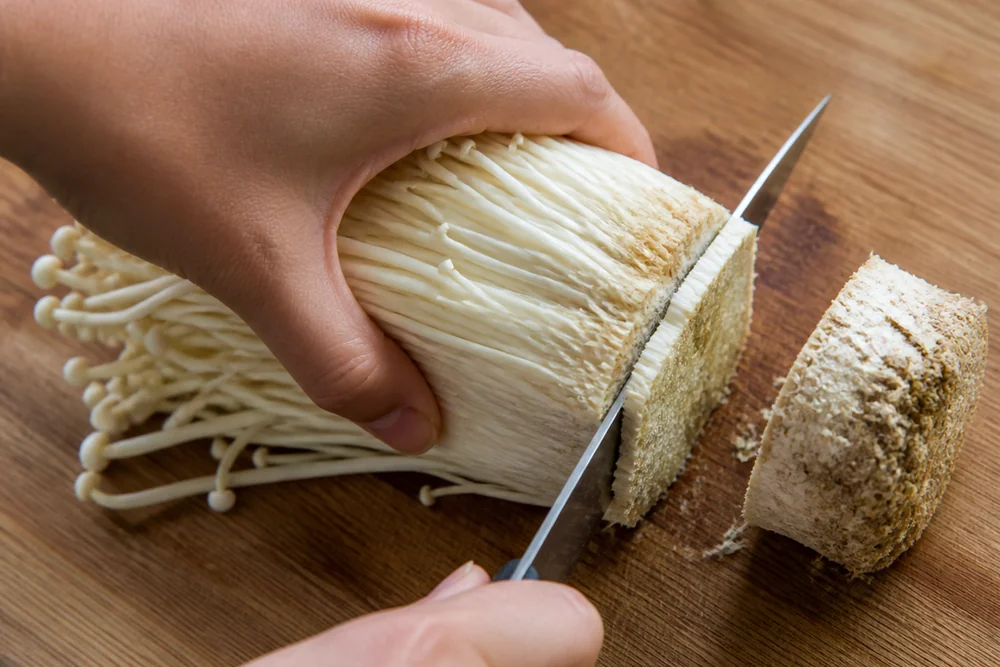
The base of a pack is a dense plug where the strands were growing out of their block. It is compressed, often gritty, and it will not soften however long you cook it.
What the plug actually is explains why it never softens:
- Compressed substrate the strands were grown out of.
- The tangled base tissue where hundreds of stems meet.
- Whatever grit came off the block during packing.
Do not rinse them unless they need it. Enoki is grown in sealed conditions and arrives clean, and soaking a bundle of thin strands only makes them harder to brown later.
Buying well removes most of the trouble before the kitchen, so look for firm white strands with no browning at the cut end, no free liquid in the pack, and a bag that is still tight rather than puffed.
A puffed pack is worth leaving on the shelf. Gas inside a sealed bag means something has been growing in there, and it is not the enoki.
What enoki actually contributes
Texture, almost entirely, since the flavor is faint enough to disappear into anything it meets.
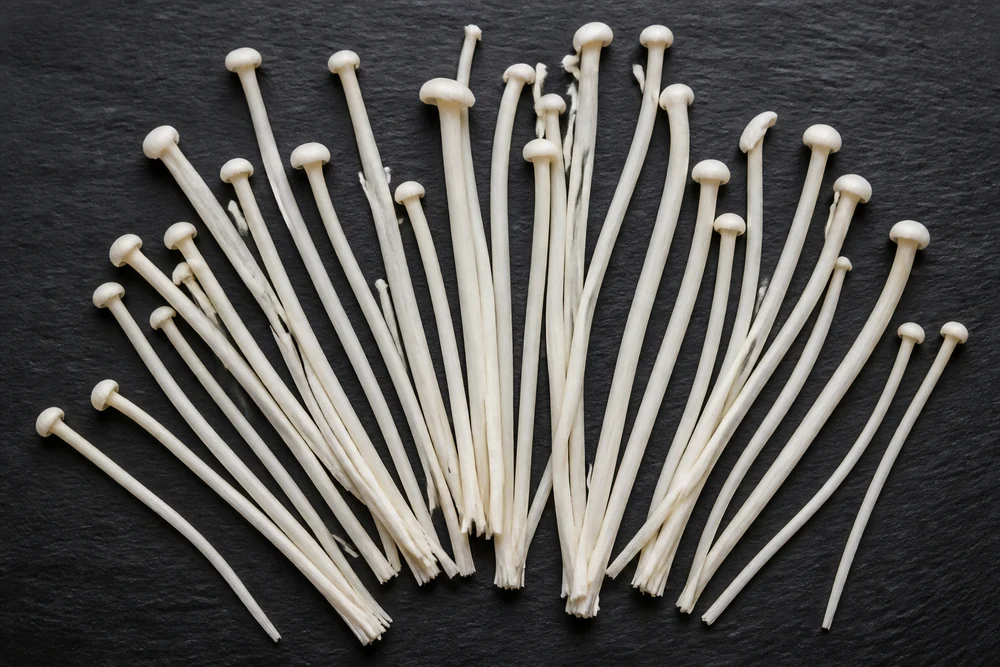
The taste is mild and slightly fruity, and it disappears entirely into anything assertive. Nobody adds enoki mushrooms to a dish because of how it tastes.
What it brings is a springy, slightly crunchy bite that survives in hot liquid where most vegetables go soft. In a bowl of noodles the enoki is the thing that still has resistance, which is a job oyster mushrooms cannot do at all.
Comparing it against the other cluster mushrooms in the same aisle makes the point, since shimeji keeps a firm bite from dense stems while enoki keeps a springy one from thin numerous strands.
Anyone eating it often rather than occasionally will find the figures on our enoki nutrition record. As a cooking matter it behaves like a very thin, very high-surface mushroom, which is what every timing on this page assumes.
Pay attention to cooking time before adjusting seasoning. Overcook a bundle and there is nothing left to rescue it with, because the property you paid for has already gone.
Cooking MushroomsHow to Cook Black Morels: Halve Them, Never Slice ThemBroth is the method it was made for
Two methods suit enoki and the rest do not: wet and fast for hot pot, ramen and miso soup, or dry and pressed for the pan method below.
Drop them in during the last two or three minutes, since they reach temperature almost immediately and hold their shape for a few minutes after that.
Key takeaway
Add enoki at the end, never at the start. A bundle that goes in with the stock loses its structure long before the dish is ready, and at that point you have paid for a texture ingredient and dissolved it.
Timing by dish, since the window shifts with how hot the liquid already is.
| Dish | When to add | What to expect |
|---|---|---|
| Hot pot | Last 2 minutes | Springy strands, the classic use |
| Ramen or noodle soup | Last 2-3 minutes | Adds bite where noodles have none |
| Miso soup | Off the heat, 1 minute | Residual heat is enough at this thinness |
| Stew or braise | Not recommended | Nothing survives a long cook |
Separate the strands before they go in. A whole bundle dropped in as one piece cooks unevenly at the center and comes out as a clump.
The pan method nobody expects
Pressed flat in a hot pan, enoki stops being a soup ingredient.
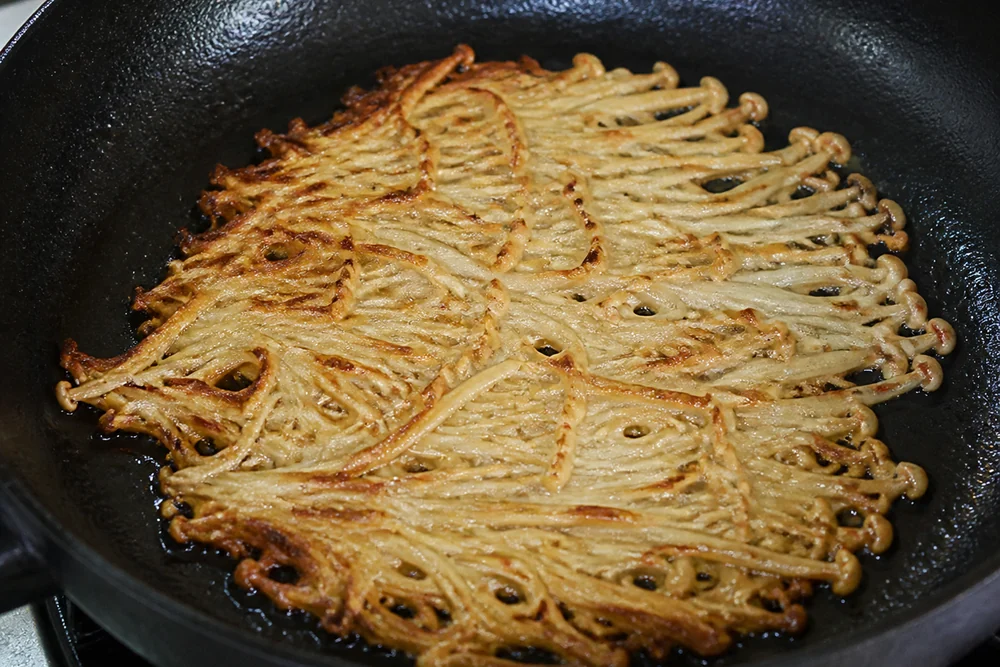
Lay a handful in a hot oiled pan, press it flat, and leave it alone. The strands knit together as they brown, and the edges crisp while the middle stays tender.
That patience is the whole technique, and five minutes is realistic with most of it spent not touching the pan.
Two things make the difference between a mat and a scattered mess. Enough fat that the strands are in contact with the pan rather than with each other, and enough weight on top to hold the tangle down while it sets.
Thickness of the mat is the variable nobody mentions, because a handful spread thin crisps through and turns brittle while a thick pad stays soft in the middle however long you leave it.
A second pan pressed on top works, and so does a plate with a tin on it. Neither is fussy once you have seen the result, which holds together well enough to cut into wedges.
The result is genuinely good and completely different from what the pack suggests. Season it after it comes out, since salt early draws water and stops the browning that makes the method work.
The same rule governs cremini and button and every other mushroom in a dry pan.
Serve it hot and cut it at the table. A crisped enoki mat softens within a few minutes of coming out of the pan, so it is worth timing to the meal rather than making ahead.
What it goes with is more forgiving than the technique. A dipping sauce with acid in it, a scatter of spring onion, or nothing at all beyond salt all work, because the appeal is texture rather than seasoning.
Cooking MushroomsHow to Cook Black Truffle Without Losing Its AromaCleaning a pack
Almost nothing. That is the correct amount.
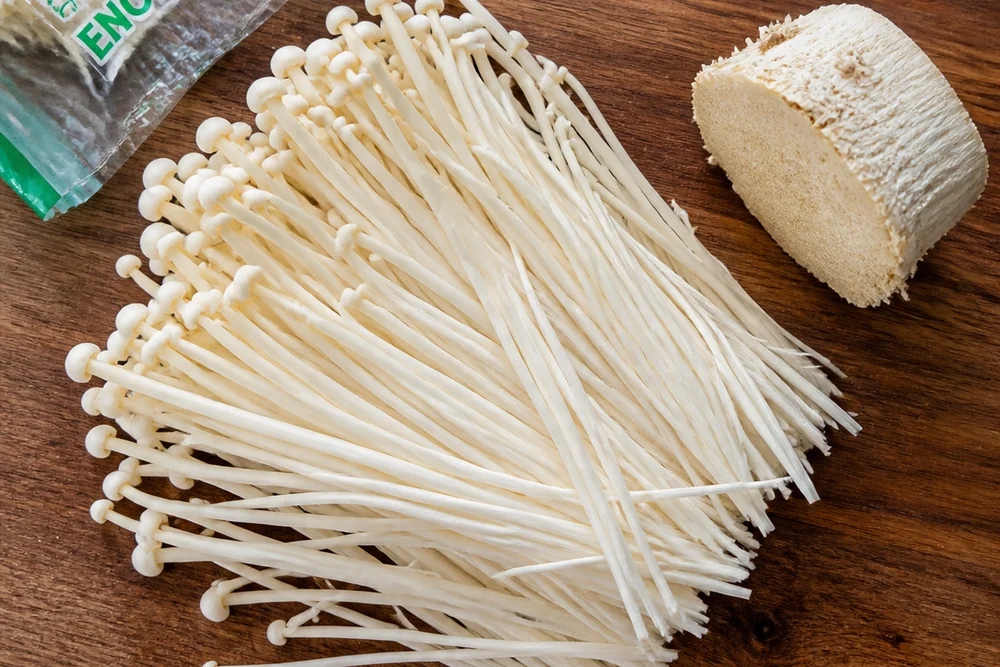
Enoki is grown in sealed bottles in the dark, in conditions closer to a laboratory than a farm, so nothing settles on the strands and there is no grit to remove.
Water is worth avoiding for a practical reason rather than a fussy one. The strands are thin and they hold water between them by capillary action, so a rinsed handful arrives in a pan carrying liquid it will release exactly when you wanted browning.
If a pack genuinely looks dirty, that is a reason to question the pack rather than to wash it, and our guide to cleaning mushrooms covers the general case that enoki sits at the extreme end of.
Dry hands matter more than you would expect. Wet fingers separating a bundle leave water on every strand they touch, which is enough to keep a pan from crisping.
Wild enoki looks nothing like the pack
The white strands in the pack and the mushroom growing on a log in January are the same species, which you would never guess.
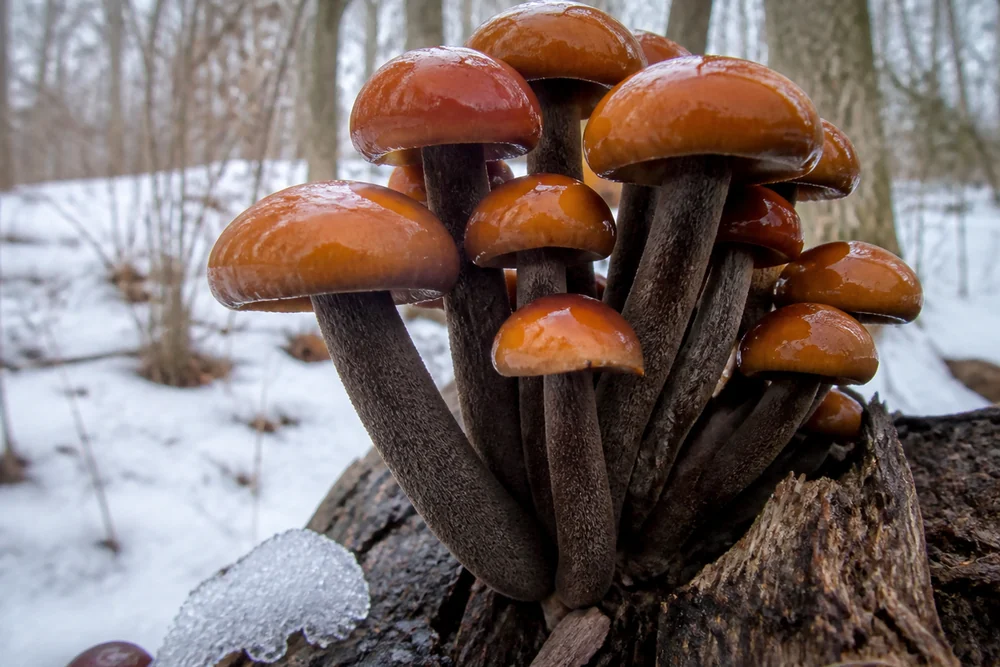
Those two forms differ on four points that matter once one of them is on your board.
| Cultivated enoki | Wild velvet shank | |
|---|---|---|
| Cap | Tiny, white, on a long strand | Thick, sticky, orange-brown |
| Stem | Pale and thin throughout | Short, dark and velvety at the base |
| Season | Year round in a growing room | Winter, on hardwood |
| Cooking | Two to three minutes in liquid | Longer, and the stems get discarded |
Grown in the dark with raised carbon dioxide, the mushroom stretches into long pale strands with tiny caps and never develops pigment. Grown outdoors in ordinary light it produces a short thick stem, a sticky orange-brown cap and a dark velvety base, which is why it carries a completely different common name in English.
That wild form is a genuinely good winter mushroom that cooks very differently, with thicker meatier caps, stems tough enough to discard, and none of the timing advice on this page applying to it.
Foragers know it as velvet shank and shoppers know it as cultivated enoki, and for cooking purposes those really are separate ingredients despite sharing a name in the literature.
The practical point is narrow: if someone hands you foraged enoki, do not cook it by the timings on this page, which were written for a strand a millimetre thick.
Storing an opened pack
A few days refrigerated. Handling matters as much as the timing does.
An opened pack keeps three or four days in the fridge if it stays dry, which is short even by mushroom standards and shorter than a foraged basket that was sorted properly. Wrap it loosely rather than resealing it airtight, because trapped moisture is what turns the strands slimy.
Condensation inside the pack is the early warning. Enoki respires in the bag and the water it gives off has nowhere to go, so a pack that has been sitting in a warm shop is already partway through its life.
Sliminess and a sour smell are the end, whatever the date printed on the pack says, and there is no rinse that recovers it.
Freezing is not worth it either. Enoki is mostly water in very thin strands, so freezing ruptures the structure and thaws into something limp, which removes the one property the mushroom was bought for.
The handling rule from the outbreak guidance applies at home as well as in a factory. Keep raw enoki away from anything that will not be cooked, and wash the board and your hands afterwards as you would for raw meat.
Quantity per person is smaller than the pack suggests. A single standard pack is two generous servings in a soup and one if you are making a crisped mat, because the mat shrinks to a fraction of the volume it started at.
Three things shorten an opened pack faster than the date does:
- Water on the strands, from a rinse or from wet hands.
- Warmth, since they respire hard and the bag traps what they give off.
- Being squashed, because broken strands go slimy first.
Two of those three are handling rather than storage, which is why the pack matters less than what you did to it on the way home.
Timidity is what ruins it more often than carelessness. Thirty seconds at the end is not a reliable way to ensure that enoki has cooked fully.
Everything else about keeping mushrooms in a fridge belongs to storing fresh mushrooms, and enoki is unusual only in the handling, not in the storage.
Sources & References
- Outbreak of Listeria Infections Linked to Enoki Mushrooms, March 2020 (CDC) Federal public health investigation used for the outbreak figures of 36 illnesses across 17 states, 31 hospitalizations and four deaths, for the identification of enoki mushrooms as the source, and for the recommendation to cook enoki mushrooms thoroughly.
- Outbreak Investigation of Listeria monocytogenes: Enoki Mushrooms (FDA) Federal agency investigation used for the traceback to the supplying producer, for the ongoing recall record, and for the advice to keep raw enoki separate from foods that will not be cooked.
- Listeria: People at Risk and Prevention (CDC) Public health guidance used for the identification of pregnancy, age 65 and over and weakened immune systems as the higher risk groups, and for the principle that thorough cooking destroys the organism.