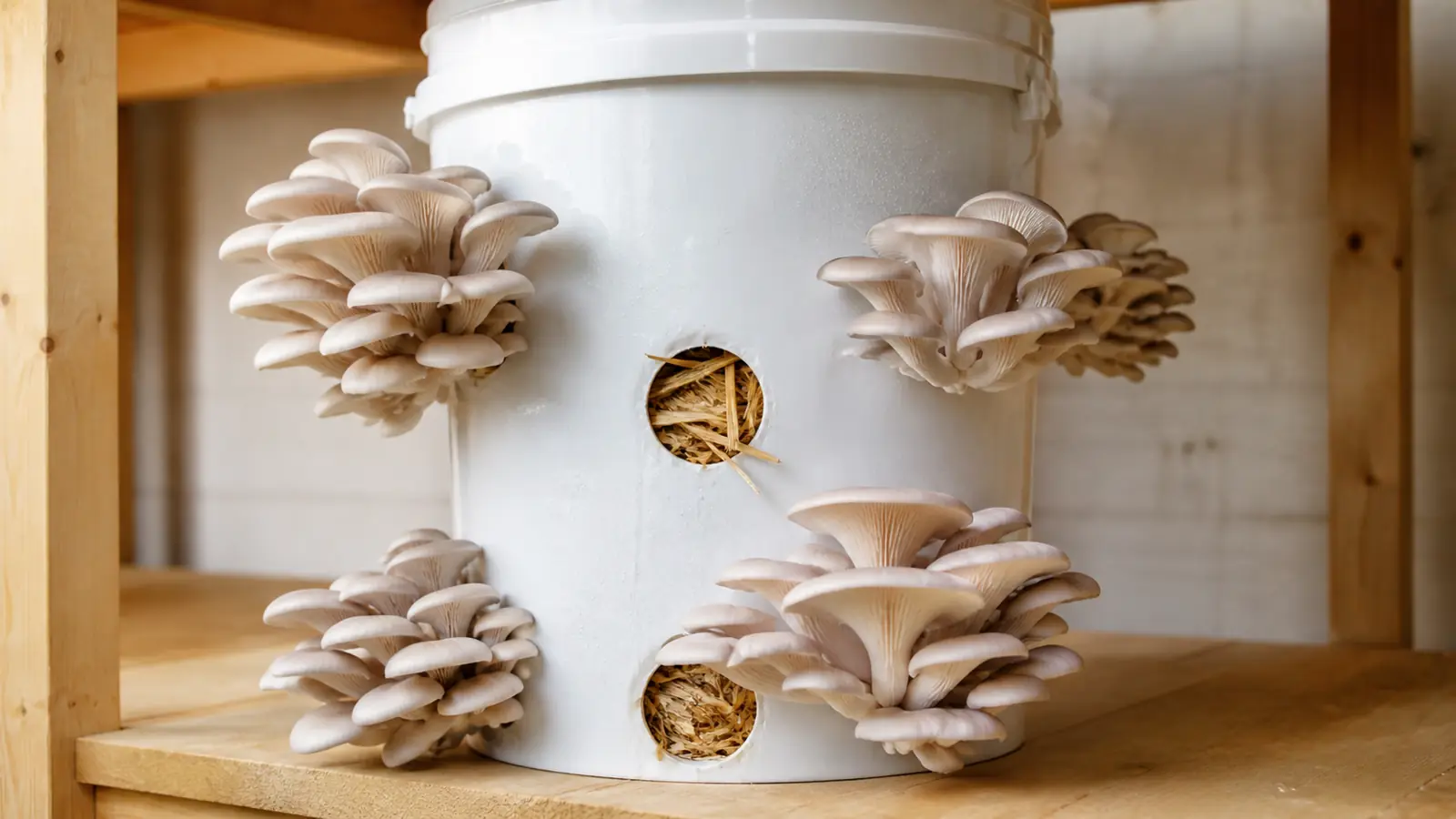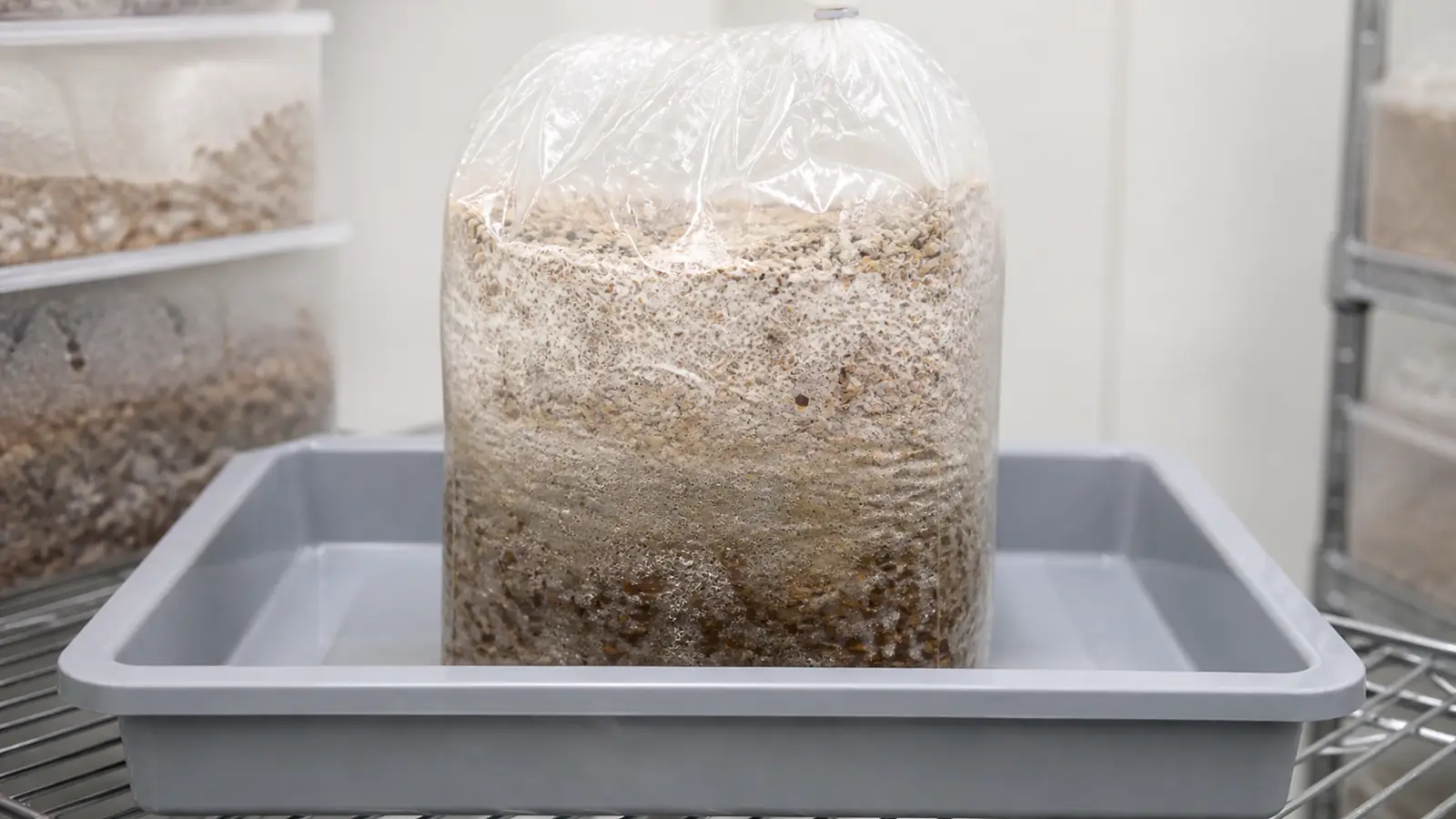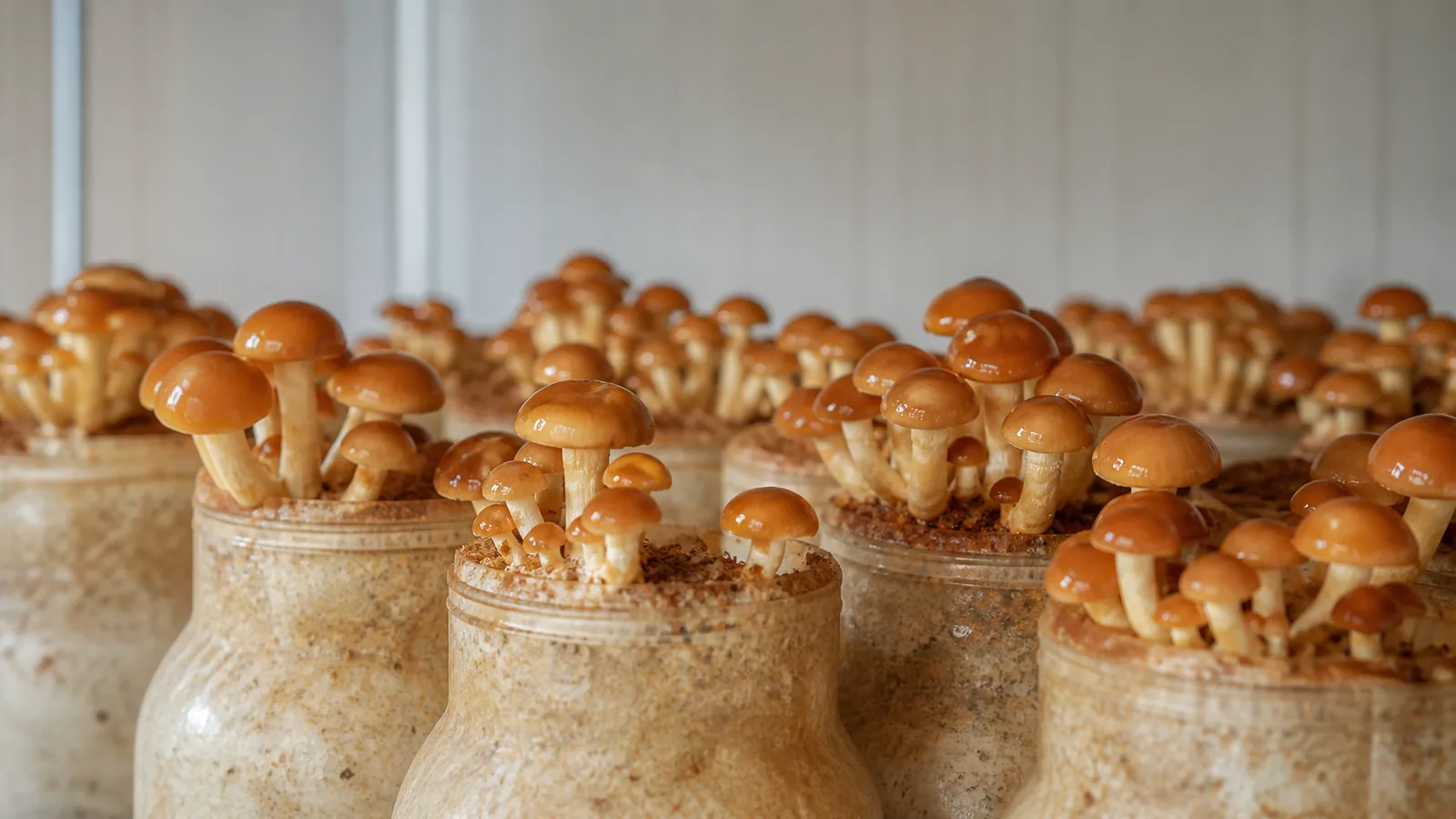
Nameko needs verified Pholiota microspora culture, a complete sterile woody-substrate system, sound colonization, and one strain-owned fruiting protocol rather than averaged temperature and humidity values.
Nameko can carry two scientific labels and still be the same cultivated subject because the current name is Pholiota microspora, while Pholiota nameko remains common in older research and supplier catalogs.
Verify the current species name before choosing a method. A vague Nameko label does not justify cloning a grocery cluster or cultivating an unidentified wild Pholiota, because this guide covers only traceable cultivated material.
The practical challenge is keeping identity, substrate processing, colonization, fruiting climate, and harvest evidence attached to the strain and container system that produced them instead of searching for one perfect temperature.
What is nameko called now?
| Route | What arrives | Work you own before fruiting |
|---|---|---|
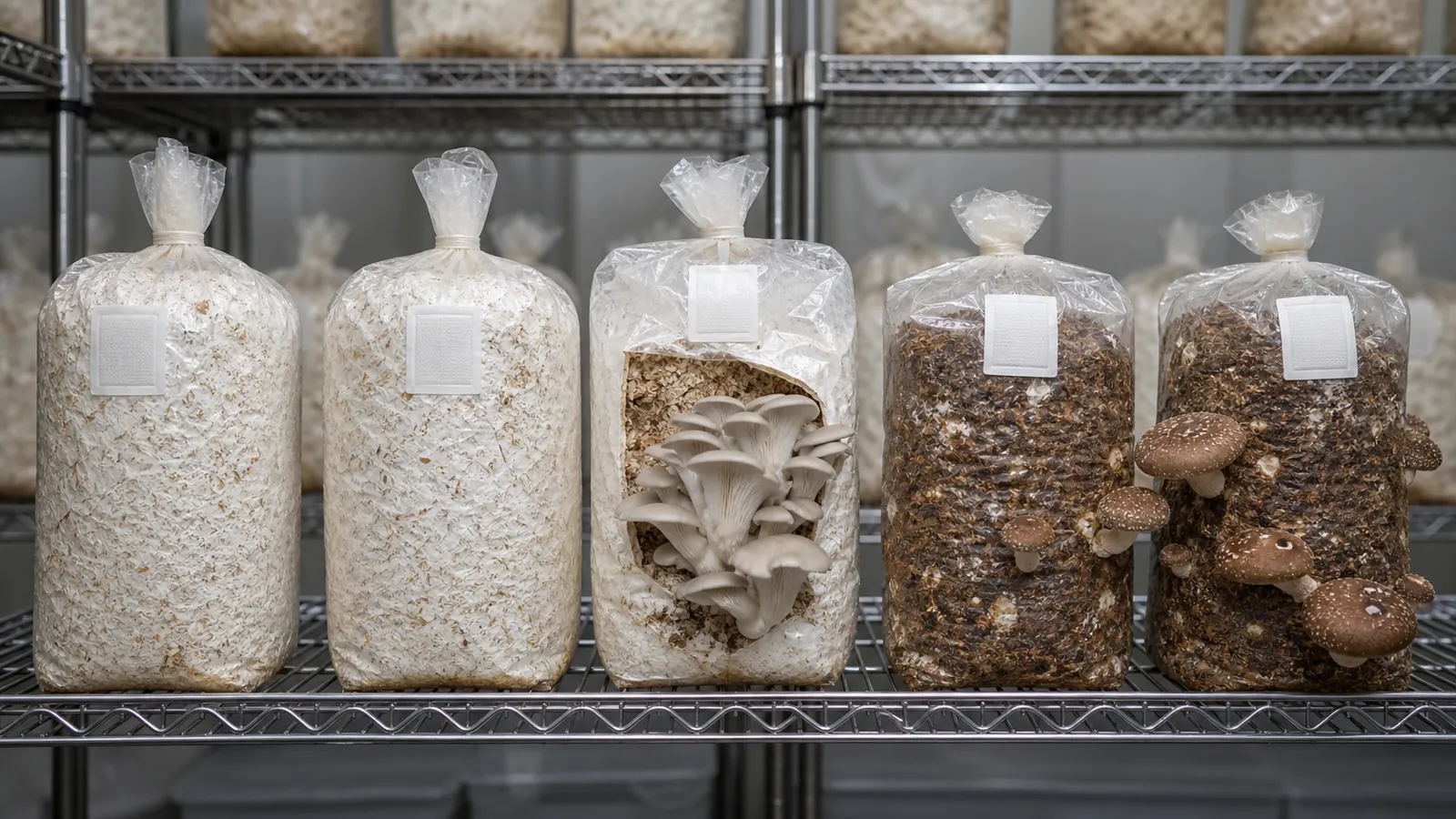
| Prepared block or bottle | Verified Pholiota microspora already colonizing a finished substrate | Supplier-directed maturation, fruiting conditions, harvest, and disposal |
| Spawn | Verified culture on grain or another carrier | Formula selection, pressure sterilization, complete cooling, clean transfer, incubation, and every failed container |
The NCBI taxonomy record lists P. microspora as the current name and P. nameko as a heterotypic synonym, citing Hitoshi Neda's nomenclatural work. That relationship lets older cultivation evidence remain useful without treating the historical name as a different crop.
P. adiposa chestnut mushroom is a separate cultivated species in the same genus. A supplier label naming P. adiposa therefore points to a different crop process, even when both products are sold as clustered Pholiota mushrooms.
The Nameko mushroom profile provides the species context, but a profile photograph cannot authenticate an unlabeled culture. Use the producer's scientific name, strain record, container type, and written cycle as the operating identity.
Because wild Pholiota species can overlap in color and form, an amber cap is not a culture label and this cultivation route must never become a shortcut for wild identification or edibility.
A credible label should follow the culture through transfer rather than living only on a discarded shipping box. Record the producer, strain or lot, arrival date, substrate format, and supplied stage instructions before the first environmental change.
Growing MushroomsWhat Does a Mushroom Farm Actually Cost to Start?Should you buy a prepared block?
A prepared block is the best starting route when you can manage a cool humid fruiting space but cannot pressure sterilize supplemented woody substrate. It leaves formula preparation, heat treatment, cooling, inoculation, and early contamination control with the producer.
Starting from spawn offers control over container size and formula, but it also transfers every upstream failure to the grower, while pressure-vessel safety remains owned by manufacturer instructions and proper training.
| Decision signal | Prepared block | Spawn route |
|---|---|---|
| Pressure sterilization equipment | Not required for the supplied substrate | Required by the validated supplemented formula |
| Clean inoculation space | Producer-owned | Grower-owned |
| Formula and moisture record | Supplier provides it | Grower must preserve it |
| Best fit | First crop or limited sterile equipment | Experienced sterile workflow |
SCORE Lowest preparation burden | Prepared colonized block
SCORE Most process control | Verified spawn with a complete tested formula
Buying a block does not make the later stages automatic. Confirm whether the product needs more closed incubation, how its opening is prepared, which fruiting range belongs to it, and whether the producer supports another flush.
The route decision also sets the useful failure boundary. A defect already visible inside a delivered sealed block belongs with the supplier, while a defect that follows home inoculation requires review of cooling, transfer, incubation, and container handling.
What substrate does nameko need?
Nameko is cultivated on woody material, but the word sawdust is not a complete recipe. Particle blend, supplements, water, container fill, filter, heat treatment, cooling, inoculum, strain, and incubation jointly determine what happens next.
One controlled bottle study combined equal volumes of alder and beech sawdust at 60 percent moisture, packed 450 grams into 0.85-liter polypropylene filter bottles, sterilized them at 121 C for one hour, cooled them to 25 C, and inoculated each bottle with 10 grams of wheat-grain spawn.

Another published system used 84 percent sawdust, 14 percent cottonseed hulls, 1 percent lime, and 1 percent gypsum. Its culture and container history differed, so copying the supplement percentage into the first bottle method would create an untested hybrid.
| Published system | Bulk materials | Processing and container evidence |
|---|---|---|
| Alder-beech bottle study | Equal-volume alder and beech sawdust at 60 percent moisture | 450 g in a 0.85 L filter bottle, 121 C for one hour, then complete cooling |
| Sawdust-cottonseed bag study | 84% sawdust, 14% cottonseed hulls, 1% lime, 1% gypsum | Its own strain, bag, spawn, and incubation sequence |
| Corn-stalk trial | Tested wood chips with several corn-stalk proportions | Best-performing treatment in that experiment included 38% wood chips and 38% corn stalks |
The corn-stalk trial shows that agricultural residue can replace part of the woody fraction under controlled conditions without proving that loose corn stalks can be added safely to any home formula, because the result belongs to the entire experimental treatment.
That trial reported its strongest yield for a treatment containing 38 percent wood chips and 38 percent corn stalks, yet yield alone does not authorize substitution. The tested particle preparation, remaining ingredients, water, sterilization, bag fill, strain, and crop environment all traveled with that result.
The alder-beech study documents production burden rather than a simplified home recipe because its one-hour sterilization at 121 C cannot transfer to a larger or denser container without validated heat penetration, and the center still must cool before inoculation.
The bottle study supplies a complete mass, volume, moisture, heat, cooling, and inoculum chain, while the other systems show that different ingredient sets came with different strain and container histories. That comparison supports choosing one documented chain, not combining its most convenient parts.
Key takeaway
Preserve a complete validated formula or buy the finished substrate. Matching one visible ingredient cannot reproduce its water, heat penetration, container gas exchange, cooling, or clean inoculation.
When is a nameko block fully colonized?
Colonization is complete when sound white growth reaches through the visible substrate without persistent bare pockets. The closed container should remain structurally stable, without expanding colored colonies, sour-looking wet zones, or a sharp collapse in growth.
- Bottle-system incubation example
- 30 days at 25 C
- Bag-system incubation example
- 45 to 50 days at 20 C in darkness
- Bottle-system pin checkpoint
- 7 to 10 days after fruiting conditions
- Bottle-system development checkpoint
- Another 5 to 6 days before harvest
- What determines the schedule
- The verified strain, substrate, container, and supplier protocol
Those clocks describe different systems rather than a universal 30-to-50-day range. A bottle at day 30 is not ready because another study opened its bottles then, and a bag should not be held to day 50 when its producer defines an earlier evidence-based transition.
The mycelial network feeds through substrate during the vegetative part of the mushroom life cycle, so the shift to fruiting belongs after complete coverage and the supplier's required maturation evidence.
Check the sides and bottom under steady light, then compare the same container over time. One thin uncolonized seam may still be advancing, while a stationary wet pocket or colored boundary requires isolation rather than patience.
Complete coverage requires a coherent particle mass without loose waterlogged material, a sharp bare channel, or growth stopped at a colored patch, since any of those defects changes the decision from waiting to containment.
Open an unfinished container to make it fruit faster
Opening a partly colonized bottle exposes nutrient-rich bare substrate before the culture owns it. Holding a sound advancing container preserves the sealed environment and makes the next inspection comparable with the last.
Hold a sound advancing culture within its verified incubation conditions
What fruiting climate does nameko need?
Published Nameko systems disagree enough that averaging their numbers would erase the evidence. The correct choice is the complete climate package supplied for the verified strain and container, measured where the crop actually sits.
One bottle study fruited at 15 plus or minus 1 C and 95 to 100 percent relative humidity while using 500 lux for 12 hours daily and ventilation that kept carbon dioxide below 1000 ppm within that research room.
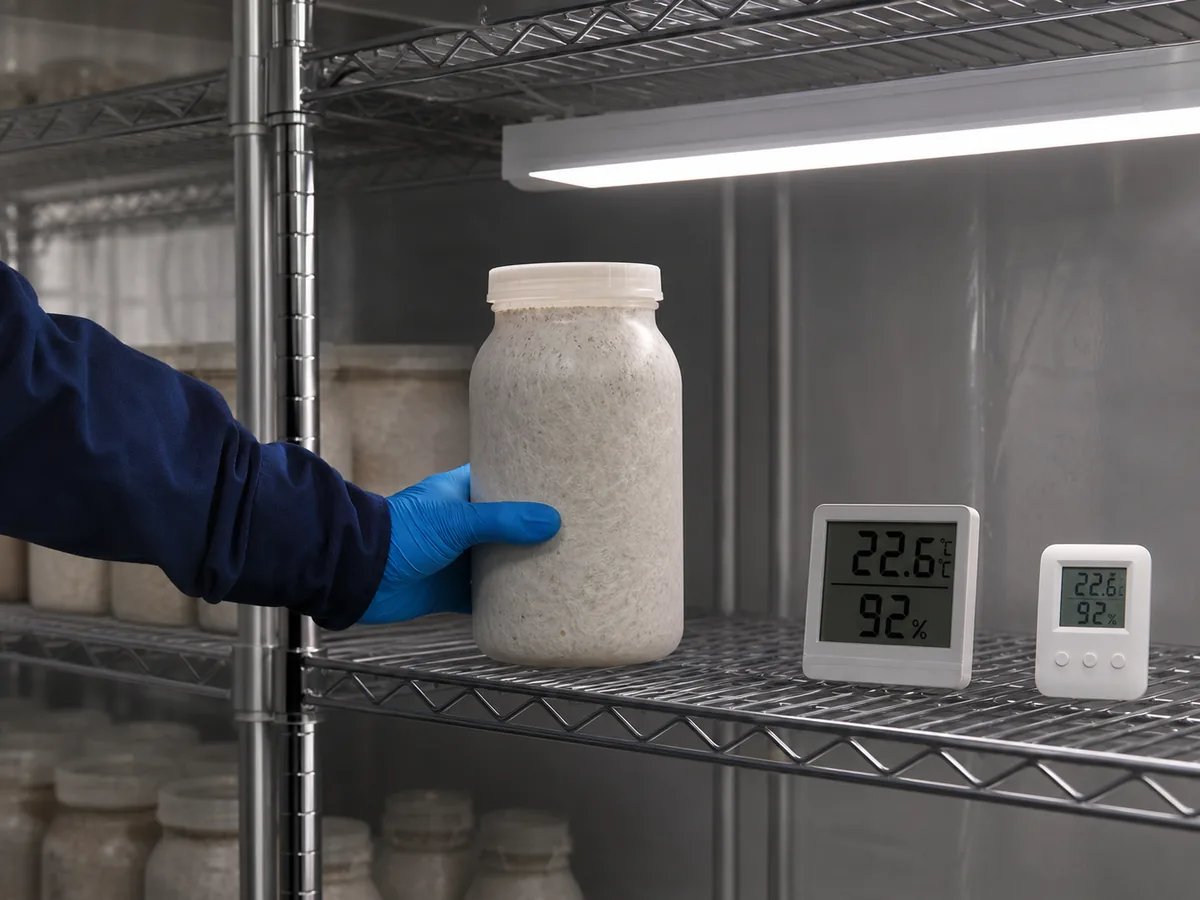
The contrasting bag study opened mature bags at 23 C and 70 to 80 percent relative humidity, reporting fruit formation after 5 to 7 days within its own strain and production sequence rather than for every block sold as Nameko.
| Control | Bottle-study example | Bag-study example | Home decision |
|---|---|---|---|
| Temperature | 15 plus or minus 1 C | 23 C | Follow the verified culture protocol |
| Relative humidity | 95 to 100% | 70 to 80% | Measure at crop height and avoid pooled water |
| Light | 500 lux for 12 hours | Not transferable from the bottle study | Use supplier guidance |
| Air | Below 1000 ppm CO2 in the experimental room | Protocol-specific room management | Provide safe ventilation without adopting a lab number as an occupied-room target |
A humidifier controls evaporation but cannot replace fresh-air exchange. Direct fan blast can exchange air while drying cap surfaces, so measure the shelf and adjust one control at a time.
Place the temperature and humidity sensors beside the crop rather than near the humidifier outlet or room door. A distant reading can look stable while the bottle surface cycles between condensation and drying.
Carbon dioxide can help diagnose ventilation around the crop, but the research-room value cannot be adopted as a human exposure target, so keep the occupied room safely ventilated and follow supplier guidance for local shelf exchange.
The bottle settings form one linked induction treatment because low temperature, high humidity, timed light, and measured ventilation were applied together after its own incubation stage. The warmer bag result belongs to a different strain and sequence, so neither source validates a midpoint assembled from both.
Tip
Test the empty fruiting space before exposing the crop. Stable shelf-level temperature, humidity, drainage, modest light, and safe room ventilation make later mushroom signals interpretable.
How do you read nameko pins?
Pins confirm that induction has started only when compact initials continue enlarging. In the bottle study they appeared 7 to 10 days after fruiting conditions, then developed for another 5 to 6 days before harvest.
The first 7 to 10 days answer whether induction produced enlarging pins in that bottle system, while the next 5 to 6 days describe development toward harvest, so keeping those windows separate prevents an early pin from being mistaken for a mature cluster.
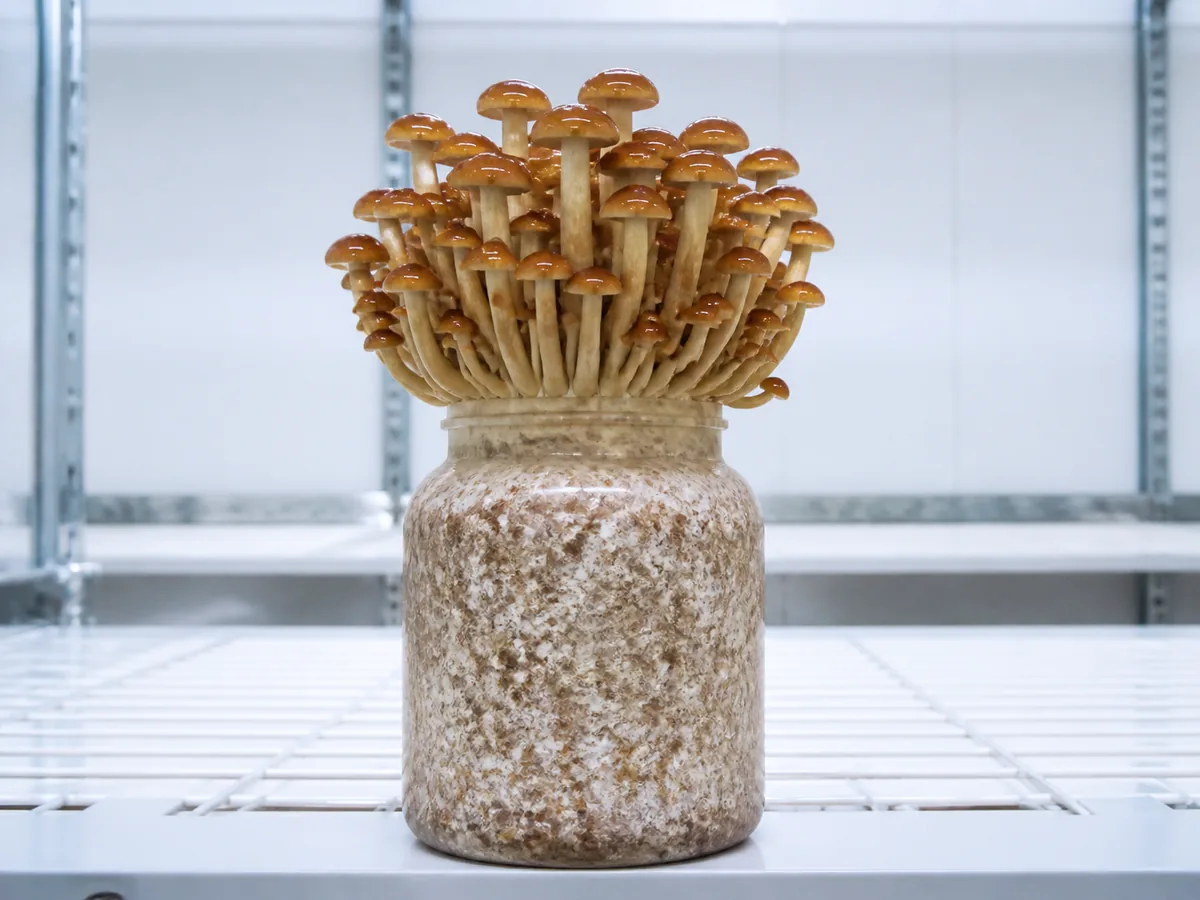
Those observations are checkpoints inside one protocol, not a promised home countdown. Strain vigor, substrate, container mass, colonization quality, sensor placement, and room recovery can all move the visible schedule.
| Crop evidence | More likely limit | Bounded response |
|---|---|---|
| Firm pins enlarge evenly | Conditions support development | Keep the verified range steady |
| Dry cap edges or stalled tiny pins | Excess evaporation | Check humidity and direct airflow before changing temperature |
| Long stems with undersized caps | Air may be accumulating around the cluster | Check safe room exchange and shelf obstruction |
| Pooled water or soft tissue | Surface stays too wet | Stop direct wetting and improve drainage |
When pins stall, use their visible condition to choose the first adjustment. Dry edges justify checking evaporation, while stretched stems justify checking trapped air, and the next growth interval shows whether that specific correction helped.
Because cluster shape records several controls at once, read it beside the substrate surface. Dry margins with a dry surface support an evaporation diagnosis, while soft tissue above pooled water supports a moisture-removal problem.
If pins do not appear, first confirm identity, complete colonization, the correct opening instruction, and sensor accuracy before using the no-fruiting guide to organize broader causes.
When should you harvest nameko?
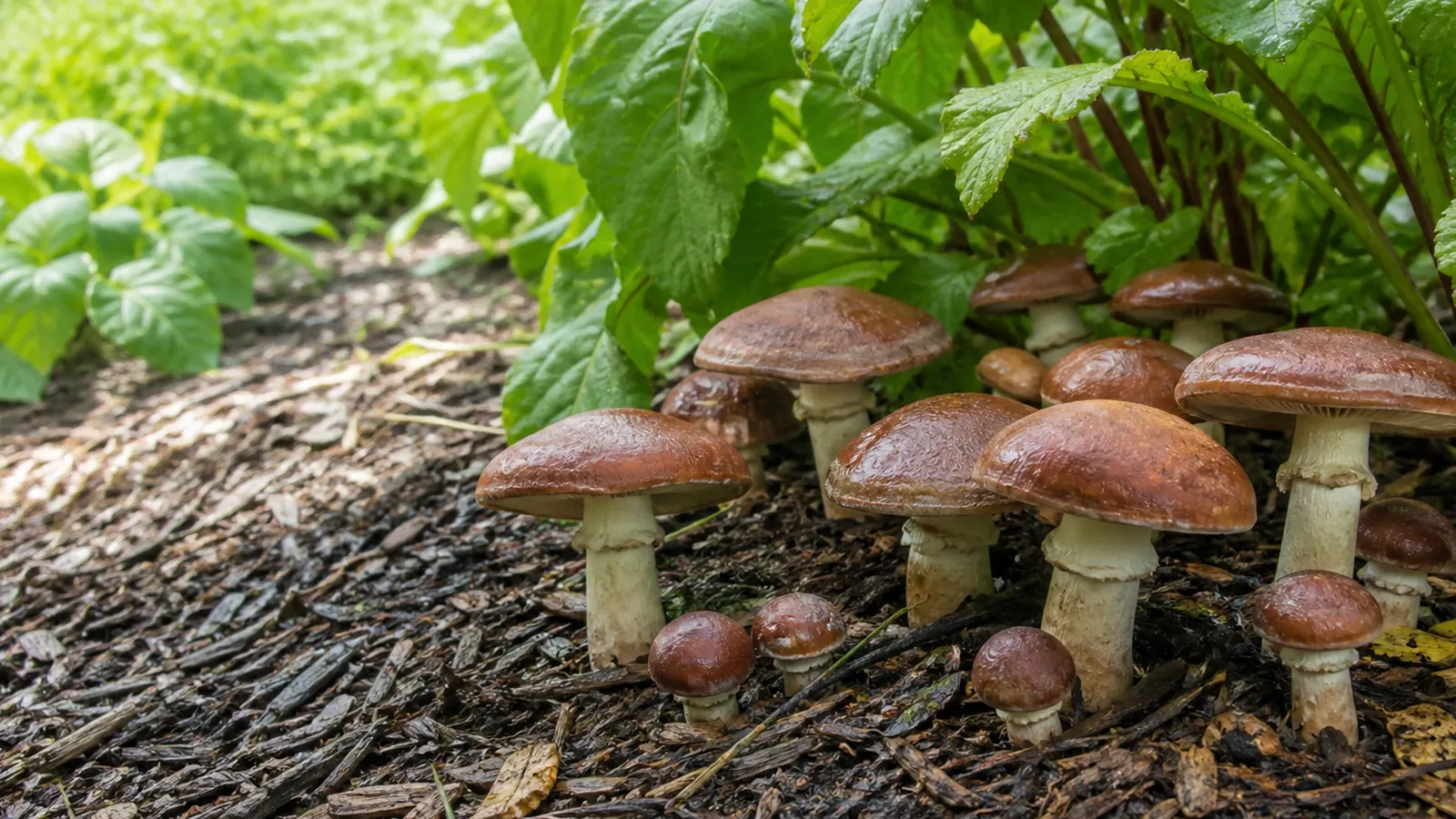
Nameko's amber cap surface is naturally glossy and gelatinous, so slipperiness alone does not signal decay. Read it with cap firmness, stem strength, cluster cohesion, odor, and substrate condition.
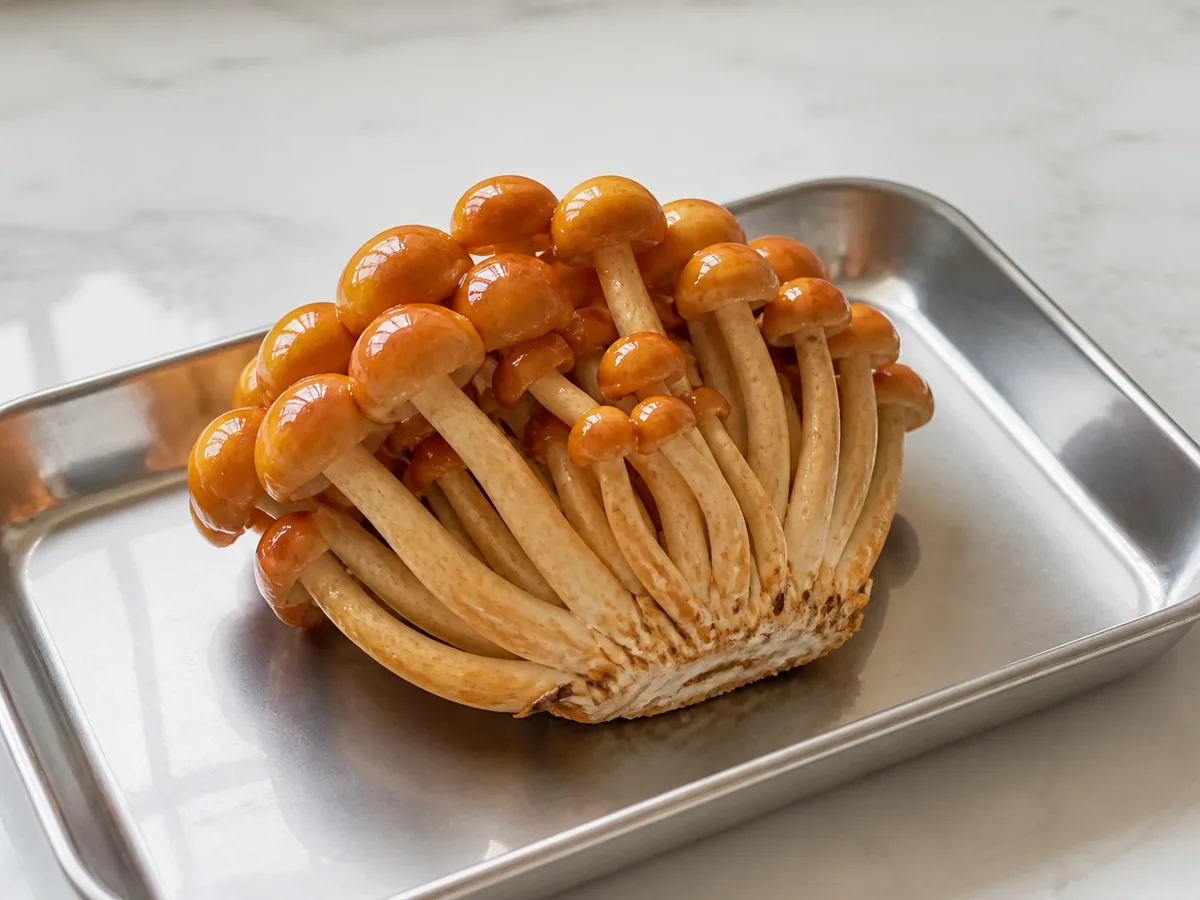
One study harvested the whole clump and removed substrate remnants afterward, so a home grower should follow the supplier's cutting or twisting instruction, keep dirty substrate away from food, and cool the clean crop promptly.
Harvest readiness belongs to the fruit rather than the calendar. Firm caps and a cohesive joined base can be ready even when a printed day estimate is early or late for the room.
Do not confuse the crop's normal gel with waterlogged substrate or soft collapsing tissue. The first is a species trait, while the latter conditions can mark poor quality or a failed container.
Handle the cluster by its joined base rather than squeezing the caps, then trim away attached substrate, place the clean mushrooms in a shallow breathable container, and refrigerate promptly instead of piling a wet cluster at room temperature.
Is that slime normal or contamination?
Foreign green, black, pink, or sharply spreading growth across the substrate is not normal Nameko slime. Keep the container closed, move it away from sound cultures, and follow local disposal guidance rather than smelling or opening it.
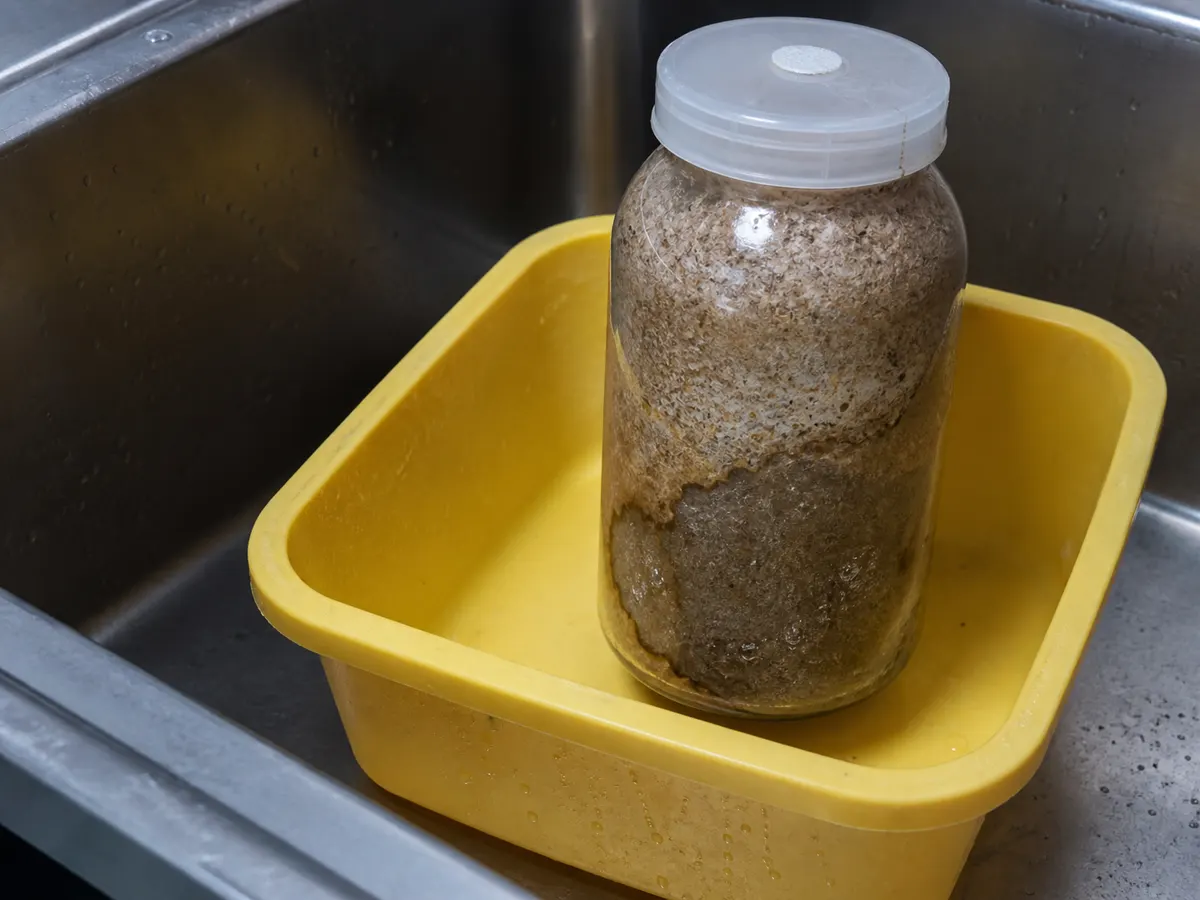
Protect neighboring cultures first and do not attempt to harvest through expanding foreign growth or wet decay. Broader mushroom contamination controls apply after the suspect container is closed and isolated.
A firm amber cluster can be ready even when waterlogging, structural collapse, contamination, or repeated nonproduction rules out another flush after cutting.
After a clean harvest, inspect the remaining surface without digging into it. Proceed only with the supplier's next-flush instructions when the block remains cohesive, smells normal, drains correctly, and shows no foreign colony.
Do not assume that a first clean crop proves the substrate can continue. Loss of structure, standing liquid, repeated stalled pins, or a new colored boundary can make retirement the safer decision even after edible mushrooms were removed.
Warning
Never cultivate an unidentified wild Pholiota as Nameko, and never salvage food from a container with expanding foreign growth, wet decay, or a foul odor.
The final inspection owns one action at a time.