Is beautiful clavaria poisonous?
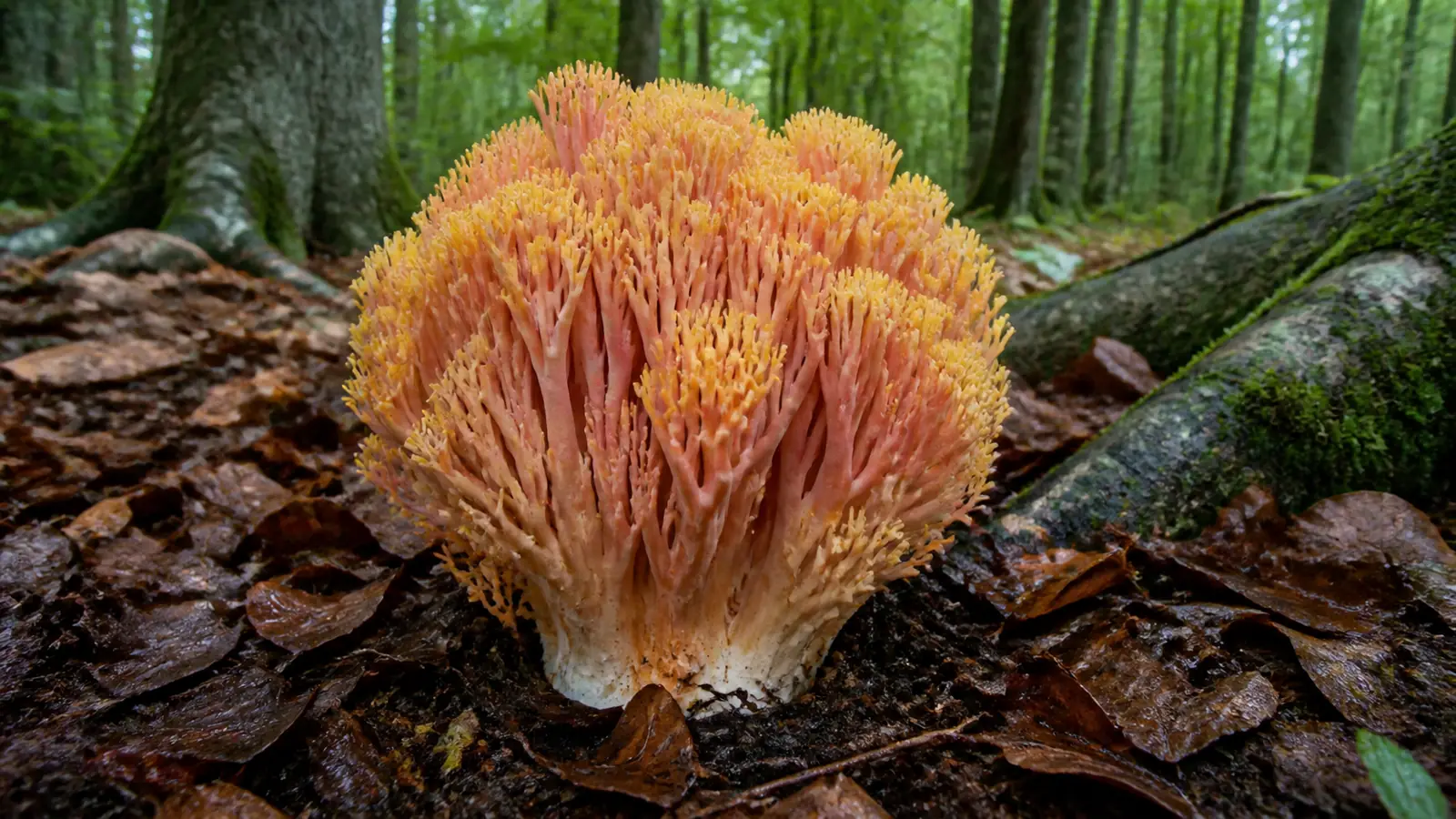
Beautiful clavaria is visually distinctive at its best and taxonomically difficult in ordinary field conditions. A fresh fruiting body combines a pale trunk, salmon or pink branches, and yellow terminal tips in a dense upright coral.
Those colors inspired both the scientific name formosa and the common name. They also create false confidence because rain, sunlight, age, bruising, and photography can turn the same collection yellow, peach, beige, or brownish.
Ramaria formosa is poisonous as food. Reports describe a bitter mushroom with a purgative effect, and contemporary toxicology literature places it among Ramaria capable of gastrointestinal illness.
The safest task is group recognition followed by restraint.
A coral mushroom has no cap, gills, or pores. Its many branches carry spores over their outer surfaces, and species-level identification often uses spore size, ornamentation, hyphae, chemical reactions, and habitat.
Key takeaway
Pink branches with yellow tips can suggest beautiful clavaria, but they cannot authorize a meal. Preserve the whole base, photograph fresh colors immediately, and leave edibility decisions to a verified local identification.
This profile follows the accepted European-centered name Ramaria formosa. Collections from distant regions may represent related or lookalike taxa even when field guides use the same common name.
Researchers have isolated secondary metabolites from Ramaria formosa and tested limited biological activity in vitro. Finding a compound in a poisonous fruiting body does not establish a medicine, a human dose, or a safe home extract.
The common name creates two problems at once. It preserves the old Clavaria label even though the accepted species is Ramaria formosa, and it encourages a color match in a group where age and weather can erase the most memorable colors.
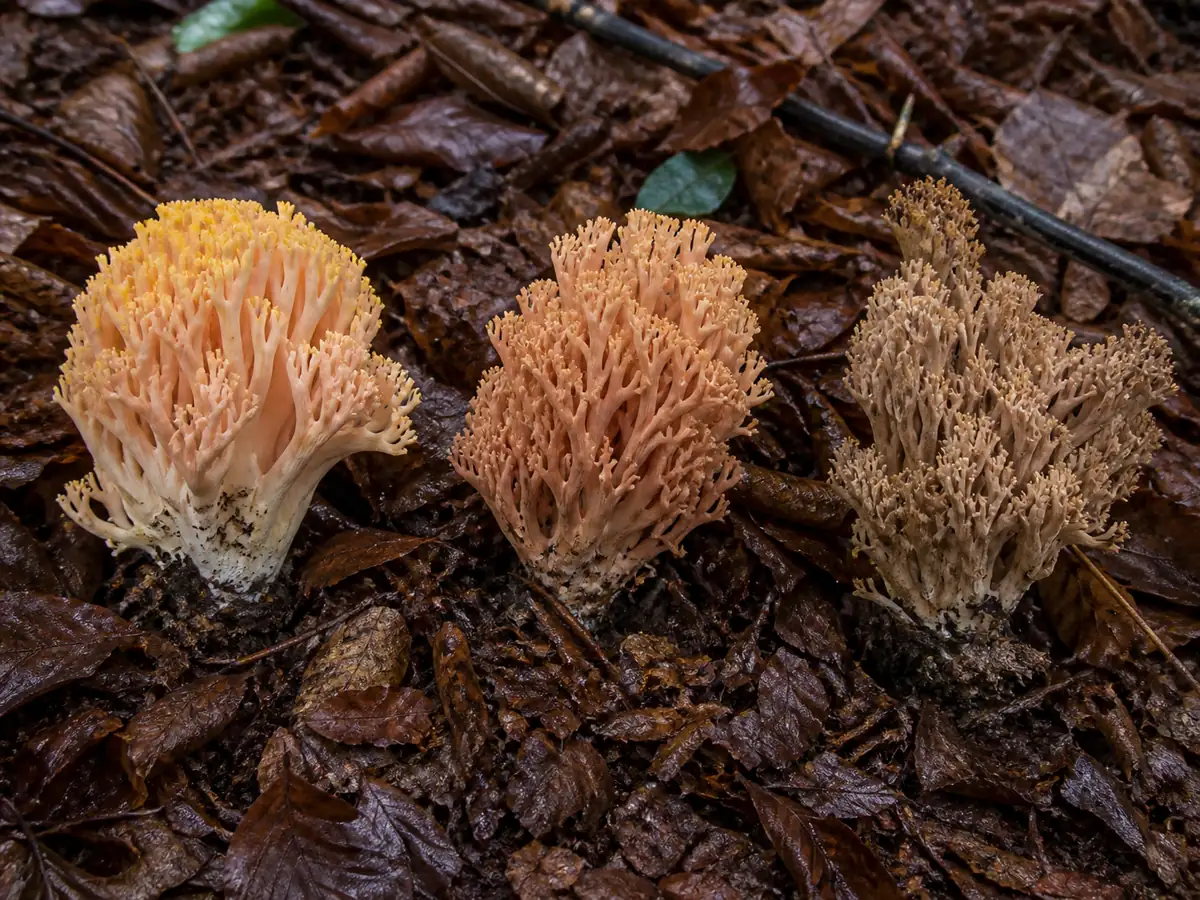
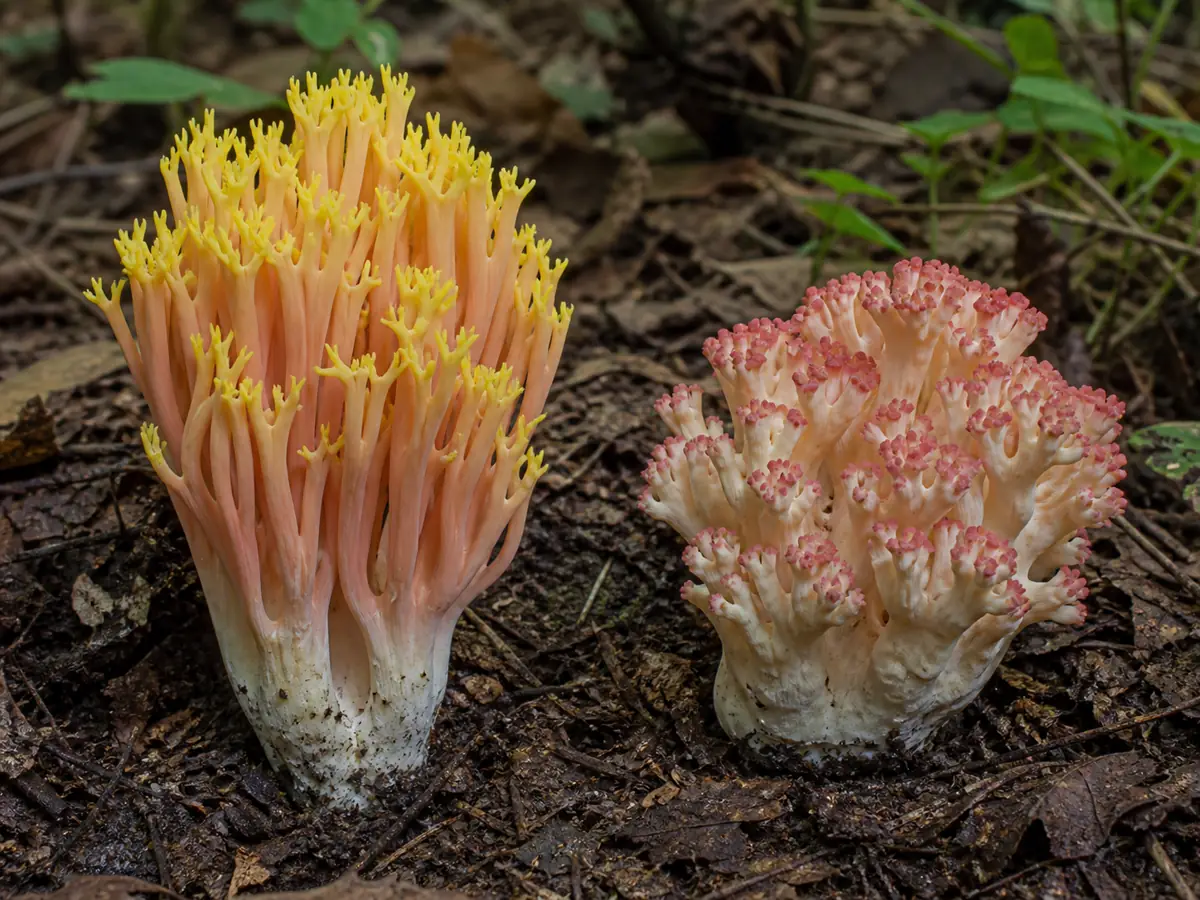
A fresh fruiting may show salmon, peach, or pinkish branches with contrasting yellow tips above a stout pale base.
Older branches can fade toward buff, stain brown where handled, and lose the yellow tips, so two ages from one cluster may look less alike than two different coral species.
The food decision does not depend on a perfect species name. Ramaria includes difficult regional complexes and several gastrointestinally toxic corals, which means an uncertain pink, yellow, or pale branched collection stays out of a mixed basket.
Reported illness centers on nausea, vomiting, diarrhea, and abdominal cramping. Fluid loss can become more serious in children, older adults, and people with kidney or heart disease, even when the toxin does not produce the delayed liver syndrome associated with amatoxins.
How do you identify Ramaria formosa?
No cap. The fruiting body is a dense coral-like mass up to about 20 cm tall and 25 cm wide.
No gills or pores. Spores develop across the outer surface of the upright branches.
A thick short whitish base divides repeatedly into salmon-pink branches with yellow tips.
White brittle flesh that may stain ochre-pink when damaged, with a mild odor and persistently bitter taste.
Photograph the fruiting body before touching it because branch color can change after handling. Include the whole base, branch junctions, tips, nearby trees, and the soil surface in the first record.
A mature cluster can reach roughly 20 cm tall and 25 cm across. A stout pale base divides into many parallel upright branches, which divide again near their ends and finish in two or more short points.
| Character | Supports R. formosa | Why certainty remains limited |
|---|---|---|
| Color zones | Pale base, salmon branches, yellow tips | All three fade with age and weather |
| Build | Tall parallel coral branches from a stout base | Several large Ramaria share the architecture |
| Damage | Flesh may turn ochre or pinkish | Staining strength varies |
| Taste | Reported bitter | Taste testing a poisonous candidate is inappropriate |
| Microscopy | Ornamented ochre spores and hyphal characters | Specialist technique and regional keys are needed |
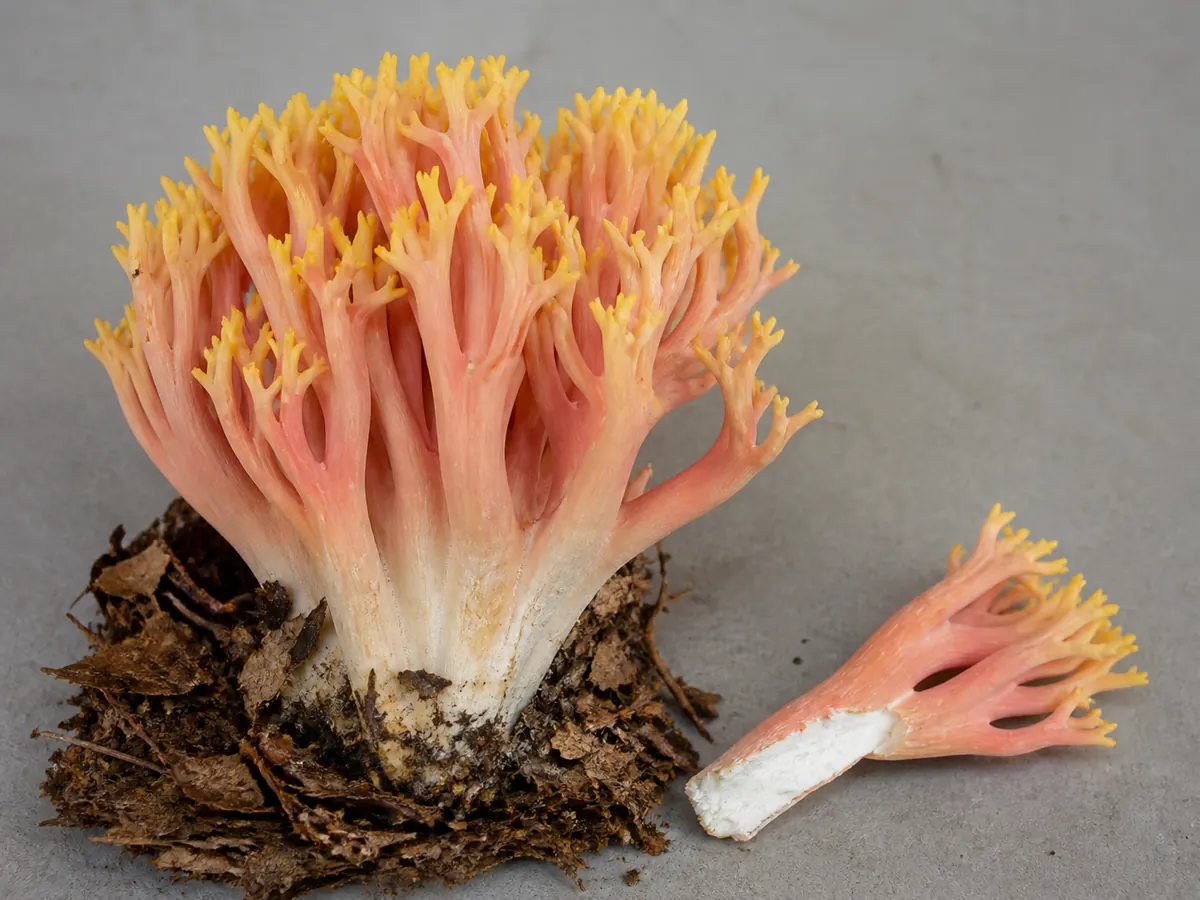
Fresh color is temporary.
Yellow tips can fade, salmon branches can turn peach, and old tissue can become nearly beige-brown.
A spore print is harder to collect from a branched fungus than from a cap. Place a clean branch section over contrasting surfaces without confusing fallen branch fragments with the print.
Microscopic confirmation is recommended in regions where the species is rare or the local Ramaria complex is unresolved. Dutch records explicitly require microscopy for certainty.
Start at the base before the branch tips break.
Record whether several trunks rise from one compact base, whether the flesh is solid or chambered, and whether soil, litter, or hidden wood lies beneath the cluster.
Follow one branch upward through repeated forks. The spacing, thickness, orientation, and shape of the final tips carry more information than the overall coral silhouette, especially after pink and yellow pigments fade.
Cut one edge specimen lengthwise only when collection is lawful and abundant. Note whether the context changes color, whether insects have hollowed the branches, and whether the odor is mild or unpleasant without tasting the tissue.
Spore deposit color offers limited separation because many Ramaria have ochre to yellow-brown spores.
Specialists compare spore dimensions and ornamentation, clamp connections, tissue reactions, host ecology, and DNA when regional species overlap.
A field record should therefore state what is known at each level. Coral fungus may be secure from the branching form, Ramaria may be plausible from architecture and spores, and R. formosa may remain provisional until microscopy and regional evidence agree.
If someone may have eaten this mushroom, act now. Call Poison Control at 1-800-222-1222 (US) or emergency services before symptoms appear, and save a piece of the mushroom for identification.
What should you save after a suspected coral mushroom poisoning?
Coral mushrooms from one basket can represent several species even when their colors overlap. Save each intact base, photographs, and location label separately so a poison specialist does not have to treat a mixed collection as one organism.
Do not induce vomiting or rely on salt water, alcohol, or another home remedy. Call the local poison service for case-specific advice, especially when a child, older adult, or medically vulnerable person cannot keep fluids down.
Which coral fungi can be confused with Ramaria formosa?
Beautiful clavaria belongs to one of the hardest mushroom groups to identify from macroscopic features. Several Ramaria share salmon, yellow, cream, and pink branches, while age, rain, handling, and camera color can erase the useful contrasts.
The classic three-color pattern supports R. formosa, but microscopy and regional expertise may still be required. Do not use a coral shape or one tip color to make an eating decision.
Do not eat a pink, yellow, or cream Ramaria identified only from a photograph. Ramaria formosa can cause intense diarrhea and other gastrointestinal symptoms, while superficially similar coral fungi have different edibility.
Ramaria botrytis is usually stouter and more cauliflower-like, with pale branches and pink-red tips rather than salmon branches ending yellow. Old or faded specimens can lose that contrast.
Ramaria pallida can also cause gastrointestinal poisoning and may look cream to gray-pink. Confusing one poisonous coral with another does not improve the food decision.
Ramaria botrytis is often sought as food in some regions and can show pink-tinted branch tips, but its compact cauliflower-like architecture and branch proportions differ from the classic formosa pattern. Those tendencies overlap enough that a faded or broken cluster should not be sorted for dinner by color.
Ramaria pallida and other pale toxic corals create the opposite problem. A weathered R. formosa can lose vivid salmon and yellow tones, while a naturally pale species can acquire brown handling marks, bringing both toward the same beige field appearance.
Mixed baskets are particularly difficult after transport. Coral tips snap, bases become separated, and soil or kitchen moisture changes colors, so keep every cluster in its own paper container with the location and nearby trees recorded.
An edible reputation attached to a common name is not portable across countries. Regional Ramaria traditions can involve different species concepts, and a meal history does not validate an uncertain local identification.
What happens if beautiful clavaria is eaten?
Beautiful clavaria is not food. Its bitter taste can persist after prolonged cooking, and ingestion is associated with a gastrointestinal or purgative syndrome.
Symptoms may include nausea, vomiting, cramps, and pronounced diarrhea.
Fluid loss becomes more important for children, older adults, and anyone with kidney, heart, or other conditions affected by dehydration.
Cooking does not turn uncertain Ramaria into an edible coral. The identification problem remains even if a regional tradition eats a different yellow or pink species.
If a coral mushroom was eaten, keep raw specimens and meal leftovers, note the location and trees, record the preparation, and contact a poison service when symptoms occur. A mixed basket may contain more than one Ramaria, so save every distinct color or shape.
Warning
Do not wait for a species name before treating severe or persistent vomiting, diarrhea, weakness, fainting, confusion, or inability to keep fluids down as a medical problem.
Protein, mineral, or antioxidant measurements from another Ramaria cannot change this decision because coral species and collection sites differ. After ingestion, the useful record is the amount eaten, symptom timing, hydration, and every distinct specimen from the meal.
Do not taste a coral mushroom to test bitterness. Even a small chew-and-spit test creates unnecessary exposure, and flavor does not reliably distinguish the gastrointestinally toxic Ramaria from regional species eaten by experienced collectors.
Cooking is not a correction step for an uncertain identification. There is no validated household process that makes R. formosa safe, and broken cooked branches lose the architecture needed for later review.
If one uncertain coral entered a mixed dish, retain the uncooked remainder and meal leftovers rather than trying to identify individual cooked pieces.
Record who ate it, the amount and time, preparation, onset of symptoms, and the original collection site for the poison service.
Persistent vomiting or diarrhea, weakness, fainting, confusion, or inability to retain fluids deserves urgent medical advice. Do not wait for every diner to become ill because portion size and individual response can differ.
Where does beautiful clavaria grow?
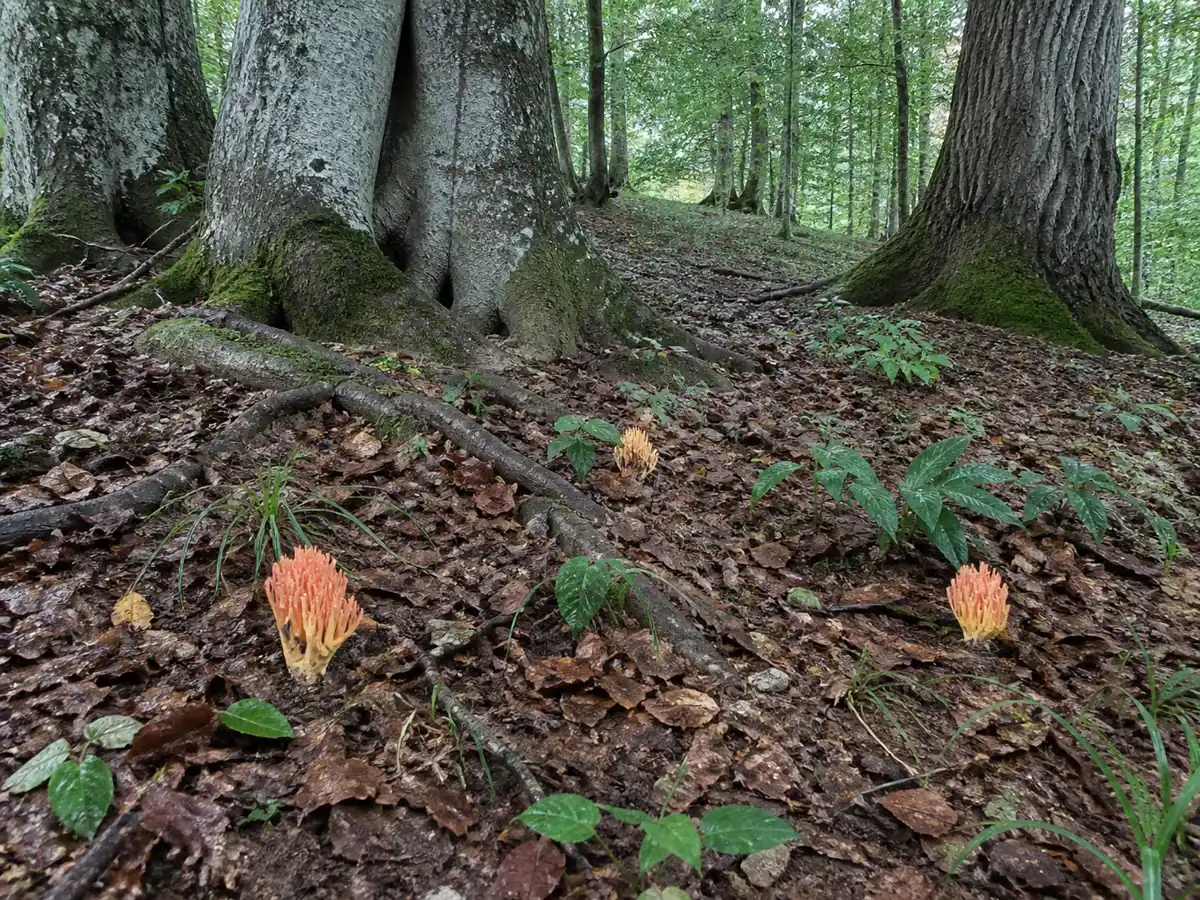
Ramaria formosa fruits from soil in woodland rather than directly from a log. It is generally treated as mycorrhizal, with beech and oak among the most frequently reported tree partners in Europe.
Mixed woods and pine-oak systems also produce records. The tree relationship means a coral cluster can rise through leaf litter several meters from the trunk while still depending on living roots below.
Summer through autumn is the normal season.
Moist soil after rain promotes fruiting, while drought can stop visible mushrooms without removing the underground mycelium.
The species is rare or declining in parts of Europe and may be associated with older, less intensively disturbed woodland soils. Nutrient enrichment and habitat change can reduce suitable sites.
Do not rake or excavate a rare collection to expose every base. One carefully documented edge specimen and non-destructive habitat photographs usually provide more conservation value than dismantling the cluster.
Its probable partnership with living tree roots also explains why moving a fruiting body or a handful of soil is unlikely to establish it elsewhere.
Protecting the root zone, litter layer, and undisturbed soil serves the fungus better than attempted cultivation.
The fruiting body rises from soil because the fungus is associated with living roots rather than feeding on the visible litter. Beech and oak are frequent partners in European records, but roots cross underground and a mixed stand can hide the actual host.
Summer and autumn fruiting follows suitable soil moisture. A cluster can emerge near a path or in a managed grove when the root system and relatively undisturbed soil remain, so a tidy setting does not turn it into a lawn decomposer.
Some populations are rare or sensitive to nutrient enrichment and soil disturbance.
Photograph branch architecture, one intact base, surrounding litter, and candidate trees without raking the entire colony or removing every fruiting body.
Moving a coral cluster does not move its ecological partnership. The persistent fungus and host roots remain below ground, which is why habitat protection and careful documentation offer more value than attempted transplantation.
Why is beautiful clavaria a Ramaria?
Ramaria formosa is the current name for a species first described as Clavaria formosa by Christiaan Persoon and transferred to Ramaria by Lucien Quélet in 1888. EPPO and several national databases place it in Gomphaceae within Gomphales.
Family labels vary in older records, and coral-fungus names have been applied broadly. Modern typification and DNA sequence data help anchor the name, but regional species complexes remain difficult.
Beautiful clavaria remains common in older field guides, while the accepted scientific name is Ramaria formosa. Not every pink-and-yellow coral belongs to that species.
The species began in older literature as Clavaria formosa and was later placed in Ramaria, which is why the common name and accepted genus do not match.
Current classification places it in Gomphaceae within Gomphales rather than with the simple club fungi that many readers associate with Clavaria.
Modern sequence studies have shown that morphology-based coral-fungus names can hide multiple lineages and regional interpretations. A name on an old field-guide plate may therefore represent a broader concept than a current voucher-backed record.
Use Ramaria formosa for material that fits a regional, evidence-supported concept, and use Ramaria species group when the characters stop short. A cautious label preserves useful data better than a confident name built from color alone.
Beautiful clavaria questions
Is beautiful clavaria edible?
What colors identify it?
What color is its spore print?
Where does it grow?
Can cooking remove the bitter or toxic effect?
Can it be identified from a photo?
Sources & References
- EPPO Global Database Preferred scientific name and current Gomphaceae classification.
- Index Fungorum name record Basionym, current name, typification, and nomenclatural history.
- Catalogue of fungi in China, Ramaria Modern sequence context and verified R. formosa accessions within a difficult genus.
- High-resolution metabolite study of toxic Ramaria Toxicity context for Ramaria and reported gastrointestinal effects of R. formosa.
- Netherlands species atlas Microscopy requirement, beech and oak ecology, rarity, and habitat sensitivity.