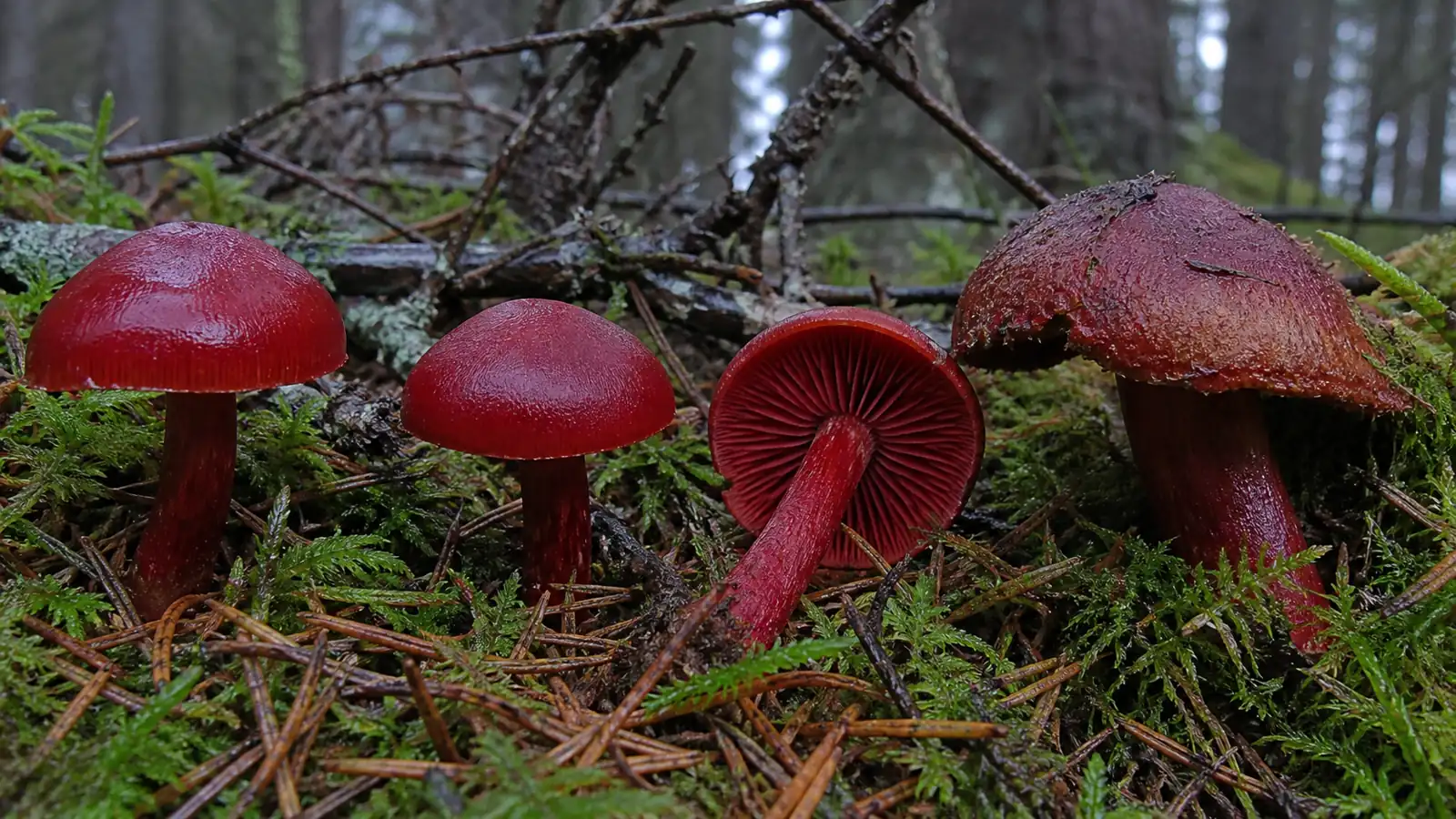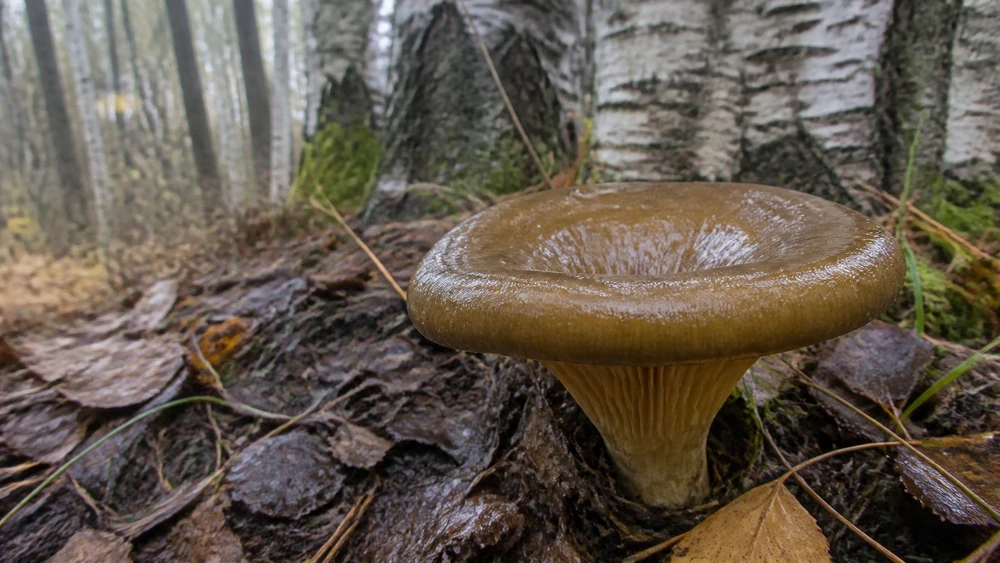
Is deadly fibrecap poisonous?
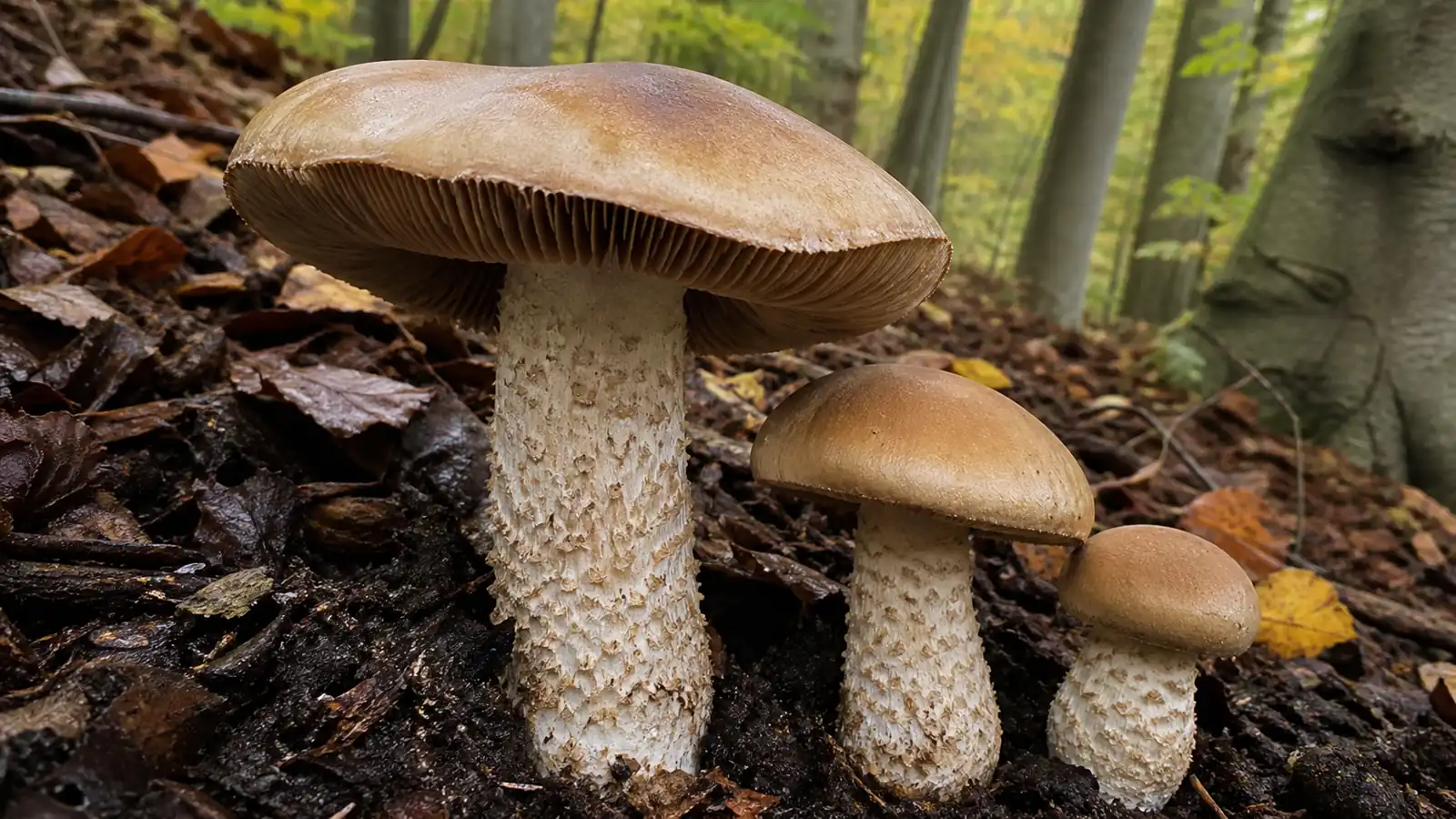
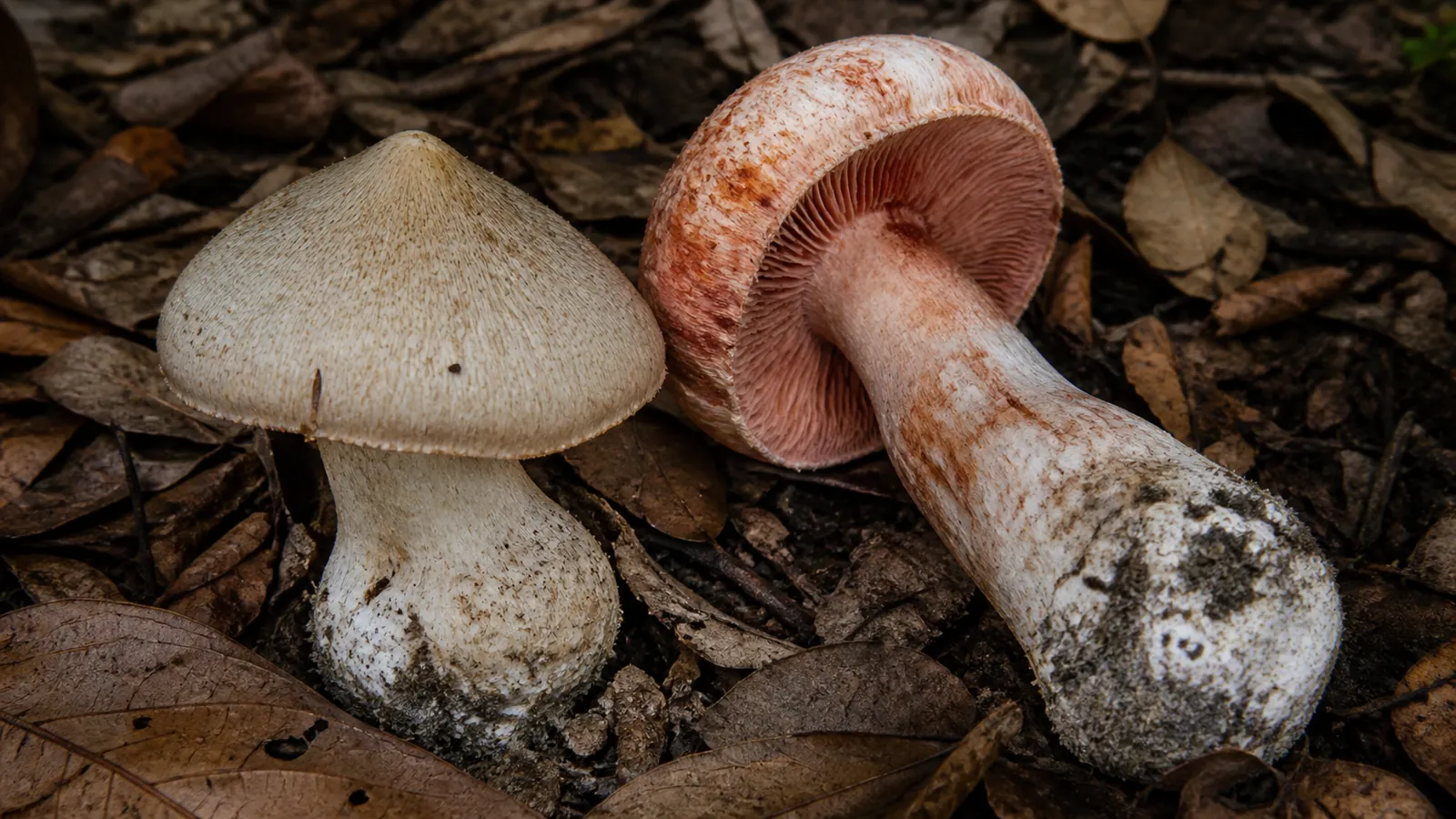
Deadly fibrecap often begins as an unremarkable straw-colored mushroom. The cap is conical with a central bump, then broadens while radial fibers pull apart and the margin develops fine splits.
Bruising and maturity transform the appearance. Brick-red patches emerge where the cap is handled, along gill edges, through stem fibers, and in cut flesh, sometimes over minutes rather than immediately.
The gills start pale and become dull olive-brown or tobacco-brown as spores mature. They remain attached to the stem instead of being free, and the stem has no ring.
A swollen base can be present, but there is no cup-like volva. Digging out the base matters because a cut stem can hide both its shape and the absence of surrounding tissue.
The reported odor ranges from fruity to perfumed or unpleasant.
Weather, age, and individual perception make that clue too unstable to decide a food collection.
Its spring fruiting window creates the practical danger. Pale specimens can overlap St George's mushroom in calcareous broadleaf settings before red staining and brown spores become obvious.
How do you identify deadly fibrecap?
About 3 to 9 cm across, cream to straw-colored, conical then broadly convex with an umbo, radially fibrous, splitting near the margin, and bruising brick red.
Crowded and attached, pale cream or gray when young, becoming olive-brown to tobacco-brown and reddening where damaged.
Firm, pale, often thickened at the base, without a ring or volva, gradually developing reddish stains after handling or age.
Pale flesh that reddens slowly, with a fruity, perfumed, or unpleasant odor reported. Never taste it.
Handle one specimen in a controlled way while leaving another untouched as a color reference. Photograph the same bruised areas immediately, after five minutes, and after fifteen minutes.

The cap's radial fibers and pointed to broad umbo place it among fibrecap-like mushrooms. Fine margin splits become more visible as the surface dries or expands.
A tobacco-brown spore print separates it from white-spored spring mushrooms, but many fibrecaps share brown spores. Microscopy and a current regional key remain important.
Record whether the red color lies on the surface, develops after injury, or was present from the start.
Naturally red-capped species and red-staining pale species represent different evidence.
Do not wait for every part to turn red. A plausible pale fibrecap with brown mature gills is already excluded from an edible basket.
If someone may have eaten this mushroom, act now. Call Poison Control at 1-800-222-1222 (US) or emergency services before symptoms appear, and save a piece of the mushroom for identification.
What happens if you eat deadly fibrecap?
Symptoms can begin within 15 minutes to a few hours and include heavy sweating, salivation, tears, vomiting, diarrhea, abdominal cramps, pinpoint pupils, slow or irregular pulse, low blood pressure, wheezing, and copious airway secretions.
Call Poison Control or emergency services immediately after suspected ingestion. Breathing difficulty, faintness, confusion, or a very slow pulse requires urgent emergency care.
Keep the person upright when breathing allows and avoid giving food or drink to someone who is drowsy, choking, or producing heavy secretions. Follow dispatcher instructions because airway condition can change quickly.
Remove contaminated mushroom pieces from a child's mouth without sweeping blindly into the throat. Do not force fluids, and keep the remaining material where it can be identified.
Save the mushrooms and meal remains and note the timing of the meal and every symptom. Photographs should show the cap fibers, gills, full stem, staining reaction, and surrounding trees.
Count neither mushrooms nor diners as a dose estimate. Caps differ in size and muscarine content, portions are uneven, and one person may have eaten concentrated fragments from the bottom of a dish.
Asthma, chronic lung disease, heart conduction problems, frailty, and very young age can make airway or circulatory effects harder to tolerate. Tell the poison service about medications that already slow the pulse or dry secretions.
Atropine can reverse clinically important muscarinic effects, but excess atropine has its own dangers. The decision belongs to clinicians who can observe pupils, lungs, pulse, pressure, temperature, and mental status.
Warning
Do not induce vomiting or take a home remedy. Clinicians can provide airway support, fluids, monitoring, and atropine when indicated under toxicology guidance.
Why is St George's mushroom the critical comparison?
The most consequential comparison is St George's mushroom, which can share pale colors, spring timing, mealy odor, broadleaf habitat, and substantial size. Mature gill color and injury response carry more weight than the overall silhouette.
Other fibrecaps are not reassuring alternatives because many contain muscarine and species-level field identification can be difficult.
St George's mushroom keeps crowded white gills and produces a white print. It does not develop the progressive brick-red staining and tobacco-brown gills of deadly fibrecap.
The livid pinkgill produces salmon-pink spores and typically lacks the all-over red injury response.
Pale Agaricus has free gills, a ring, and chocolate-brown mature spores rather than attached gills and a ringless stem.
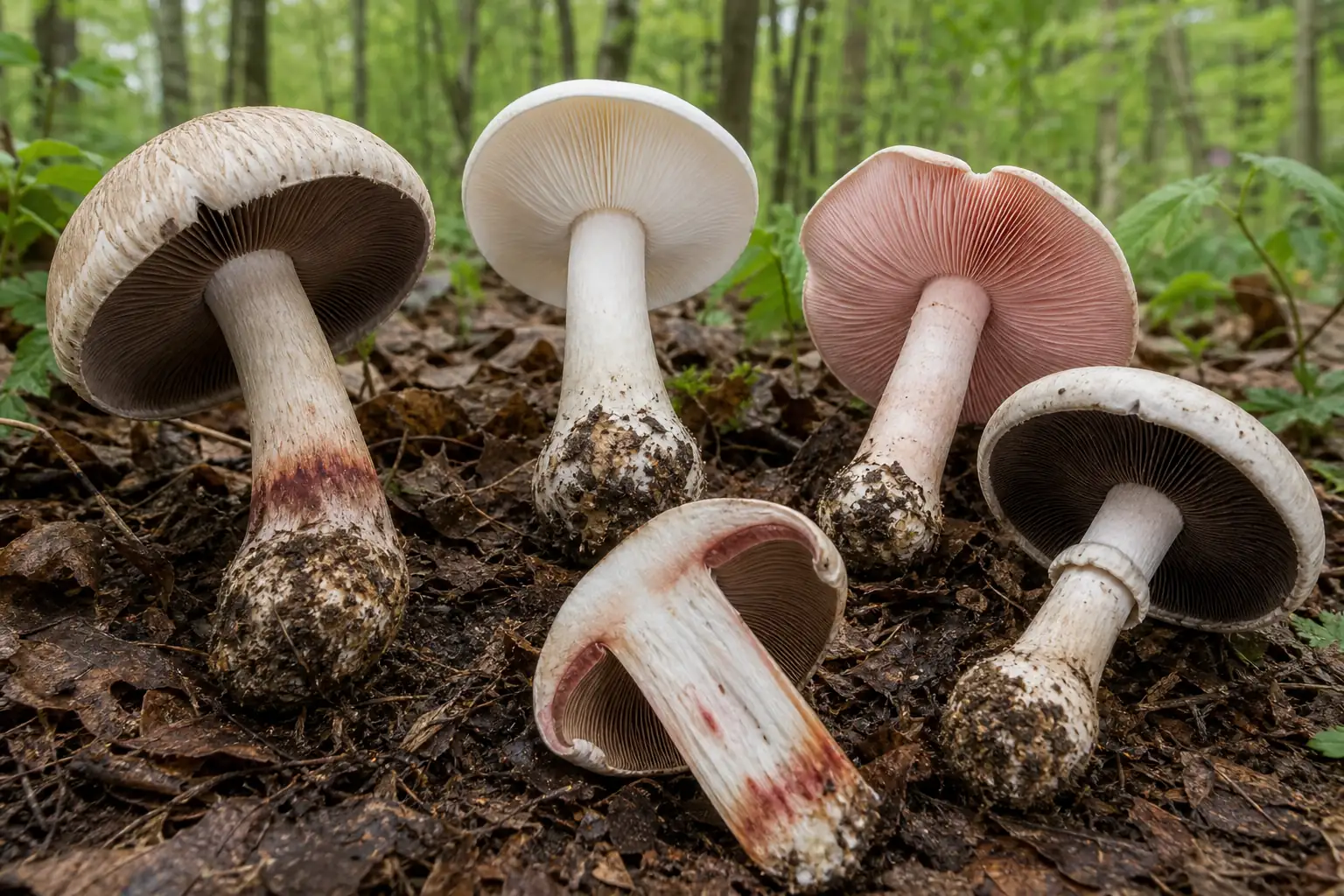
| Candidate | Evidence against deadly fibrecap | Dangerous overlap |
|---|---|---|
| St George's mushroom | White gills and print, no red injury stain | Spring timing, pale robust cap, mealy odor |
| Livid pinkgill | Salmon-pink notched gills and spores | Pale broadleaf fruiting body |
| Field mushroom | Free gills, ring, chocolate print | Young gills can be pale |
| Other Inocybaceae | Microscopic or molecular differences | Muscarine may still be present |
A field mushroom comparison is useful only when the complete stem and mature gills are present. Ring fragments and gill color are easily lost in a trimmed basket.
Key takeaway
When a pale spring mushroom has attached gills that are turning brown, do not let a familiar mealy odor overrule the fibrecap pattern.
Why do older sources call it Inocybe?
The species was long known as Inocybe erubescens and Inocybe patouillardii. Molecular phylogeny moved it into Inosperma, so older medical and field literature remains searchable under the former names.
The epithet erubescens means reddening, accurately describing the injury and age reaction.
The common name brick-red tear mushroom also points to the same transformation.
Inocybaceae contains many small brown-spored mushrooms that require microscopic and molecular evidence. A genus-level shift changes the label, not the poisoning risk recorded under older names.
How should delayed reddening be observed without over-trusting it?
The reddish color associated with deadly fibrecap may develop after bruising, cutting, age, or handling, and it can appear unevenly across cap, gills, stem, and flesh. A single fresh photograph can miss a useful clue, while an old red specimen can hide what it looked like at collection.
A weak or absent reaction cannot clear the specimen. Drying, cold, age, damage, and natural variation may suppress the expected color, and other mushrooms can redden for unrelated reasons.
The strongest interpretation combines delayed reddish staining with a fibrous cap, crowded gills that mature brown, complete stem base, broadleaf habitat, and the correct season. Reddening raises or lowers confidence only inside that whole pattern.
When a suspected specimen came from a meal, preserve both early and later photographs. The color record can help an identifier, but poison-center contact must begin before the observation is complete.
How can a woodland symbiont appear in a park lawn?
Deadly fibrecap forms mycorrhiza with broadleaf trees, especially in warm calcium-rich ground. Beech, oak, lime, and hornbeam are recurring associates across its European range.
It fruits on soil in woodland, old parks, gardens, cemetery lawns, and path margins where established roots remain below the grass. Managed surroundings do not separate it from forest ecology.

Fruiting may begin in late spring and continue through summer or autumn after suitable rain.
That earlier season increases overlap with pale spring edibles.
The visible mushrooms are temporary reproductive structures. Removing them reduces immediate access for children and pets but leaves the underground mycorrhiza intact.
Tree identity and soil chemistry support the diagnosis but never establish edibility. Several edible and poisonous species can share the same host root zone.
Why can a spring edible comparison fail before spores mature?
A pale young deadly fibrecap can be collected during the same spring window as stout white edible mushrooms, before its reddish injury response or tobacco-brown gills are obvious. Season and cap color therefore narrow the search, but they cannot complete it.
Only the spring date matches
Keep the mushroom out of food and record the host treesMany unrelated species share a fruiting month.
The specimen is still pale
Preserve it intact and compare unhandled, cut, and mature materialDelayed reddening can be weak or uneven.
Mature gills are brown and attached
Treat the collection as an unsafe brown-spored fibrecapThat pattern conflicts with the white-gilled spring edible comparison.
Someone already ate it
Call Poison Control before waiting for color or symptomsMuscarinic illness can begin quickly, and identification can continue during the response.
The comparison becomes stronger when cap fibers, gill attachment, spore color, stem base, injury response, and broadleaf ground all agree. A mealy smell or a familiar collecting place cannot cancel conflicting anatomy.
An immature specimen may withhold the decisive character. When the mature state is unavailable, unresolved identification is the safe conclusion rather than a reason to favor the edible name.
What does muscarine do to breathing and circulation?
Muscarine activates peripheral muscarinic acetylcholine receptors.
Glands release saliva, tears, sweat, and airway mucus, while smooth muscle and cardiac effects can constrict airways, intensify intestinal movement, and slow the heart.
The syndrome is often remembered through a list of secretions, but the consequence matters more than the mnemonic. Bronchospasm, bronchorrhea, low blood pressure, and bradycardia can threaten breathing and circulation.
| Finding | Consequence |
|---|---|
| Sweating, tears, saliva | Rapid fluid loss and clear cholinergic signal |
| Wheeze and wet breathing | Airway narrowing and secretions need urgent support |
| Slow pulse or low pressure | Reduced circulation may cause fainting or shock |
| Vomiting and diarrhea | Adds dehydration and electrolyte loss |
Hospital treatment is guided by symptoms, monitoring, and poison-center consultation. Atropine can counter clinically important muscarinic effects, but dosing belongs to trained clinicians.
Muscarine research does not create a medicinal role for the mushroom. The fruiting body is a toxic exposure source, not a controlled pharmaceutical preparation.
Can a mixed spring basket be salvaged?
Deadly fibrecap has no culinary use. Muscarine is heat-stable enough that ordinary cooking cannot be treated as detoxification.
A mixed spring basket is especially risky because pale caps become anonymous after cleaning. Keep every species in a separate rigid container and retain complete stem bases.
Do not salvage a dish by removing visible suspect pieces.
Juices and small fragments can spread through the food, and the original identification may involve more than one toxic species.
Discard the intended meal and preserve evidence for Poison Control. The loss of one basket is minor compared with a cholinergic emergency.
Deadly fibrecap questions
Is deadly fibrecap actually deadly?
How fast do symptoms start?
Does it always look red?
How is it different from St George's mushroom?
Does cooking remove muscarine?
Why did the scientific name change?
Sources & References
- Mushroom Poisoning review Deadly fibrecap as a muscarinic species, clinical syndrome, and identification evidence.
- North American Mycological Association Muscarine symptoms and emergency response.
- Fatal mushroom neurotoxin study Current biochemical context for muscarine-producing fibrecaps and funnels.
- Missouri Poison Center Muscarinic onset and symptom pattern.