A cooking guide that spends the disappointment first, because the pigment does not survive heat and a buyer should know that before the pan goes on. It then covers the firmer flesh that is the real reason to buy this species, the thinner cut and harder cooking that flesh needs, why chewiness here means undercooked rather than overcooked, an honest answer to the bacon comparison, and the species boundary on the one study it cites.
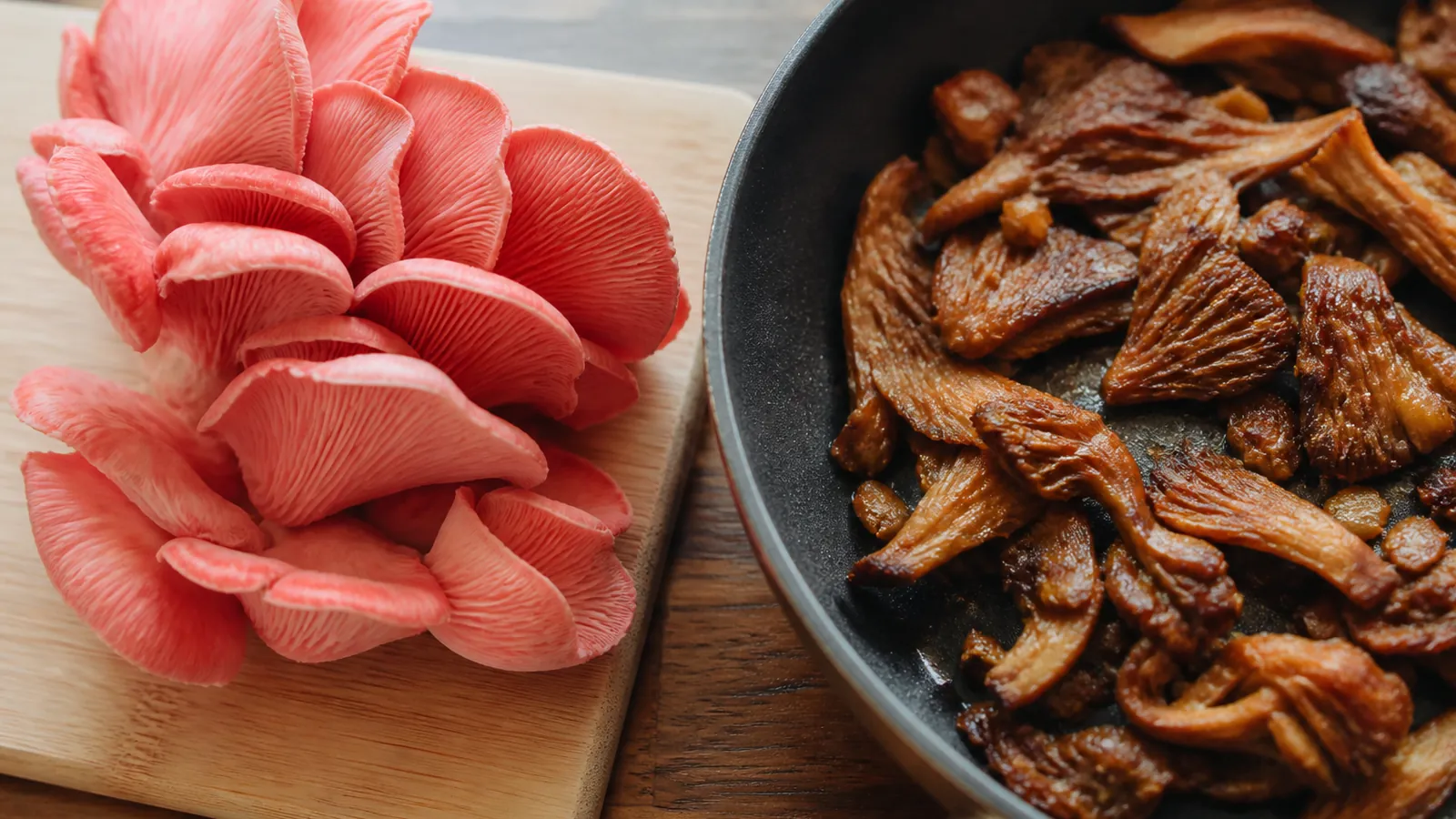
The pink does not survive cooking, and knowing that before you start is the difference between a good dinner and a disappointing one.
If you bought them for the color, read the next thirty seconds carefully, because it changes what you should do with them.
Do pink oyster mushrooms stay pink when cooked?
This is the question that decides whether you should have bought them, so it goes first.
- How long the pink lasts
- About a minute in a properly hot pan
- What is left
- A brown mushroom, the same brown as any other browned mushroom
- Any method that preserves it
- None, including gentle ones and short ones
- The only way to keep it
- Not cooking them, which is not an option with this mushroom
The change is quicker and more complete than any of that suggests. Two plates make the point faster than a paragraph can.
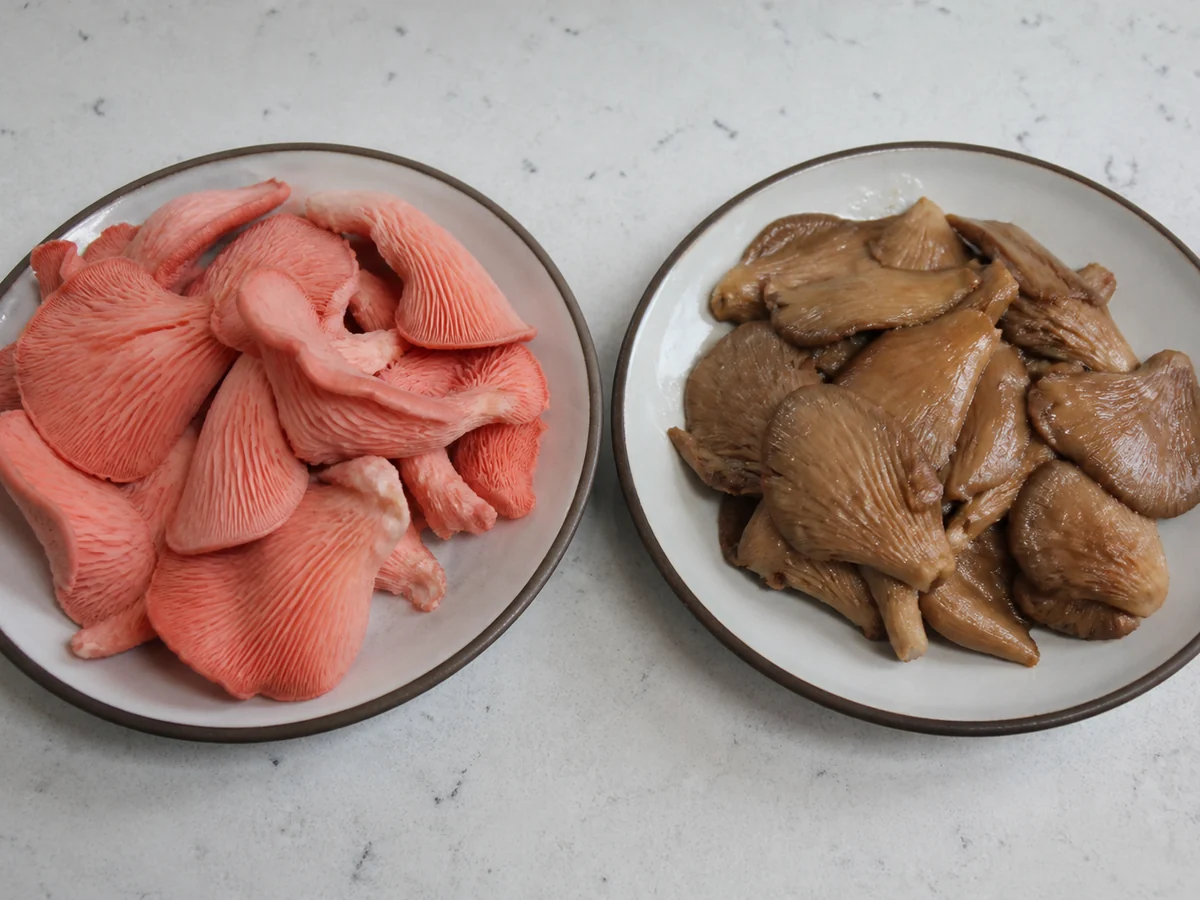
The pigment sits in the flesh and it is not heat stable. It fades as the mushroom heats and it is gone well before the pieces are cooked through.
Lower heat does not save it. Cooking them gently gets you a pale grayish brown instead of a rich brown, which is worse in every way and still not pink.
There is no version of this where the plate comes out pink, so if that was the whole idea, the honest advice is to use them raw as a garnish elsewhere or to buy something else next time.
None of which means they are not worth cooking.
- If you wanted pink on the plate, this mushroom cannot do that
- If you wanted a firm chewy mushroom that crisps hard, it does that better than its relatives
- The decision is worth making before the pan goes on, not after
- Raw as a garnish is the only way the color reaches a plate, and eating them raw has its own answer
Cook them to develop the flavor and texture.
Cooking MushroomsHow to Cook Cauliflower Mushroom Without Trapping GritWhat are pink oysters actually worth buying for?
Once the color is off the table, this is still a genuinely good mushroom. It has one clear advantage over its common relative, and it is worth the price on its own.
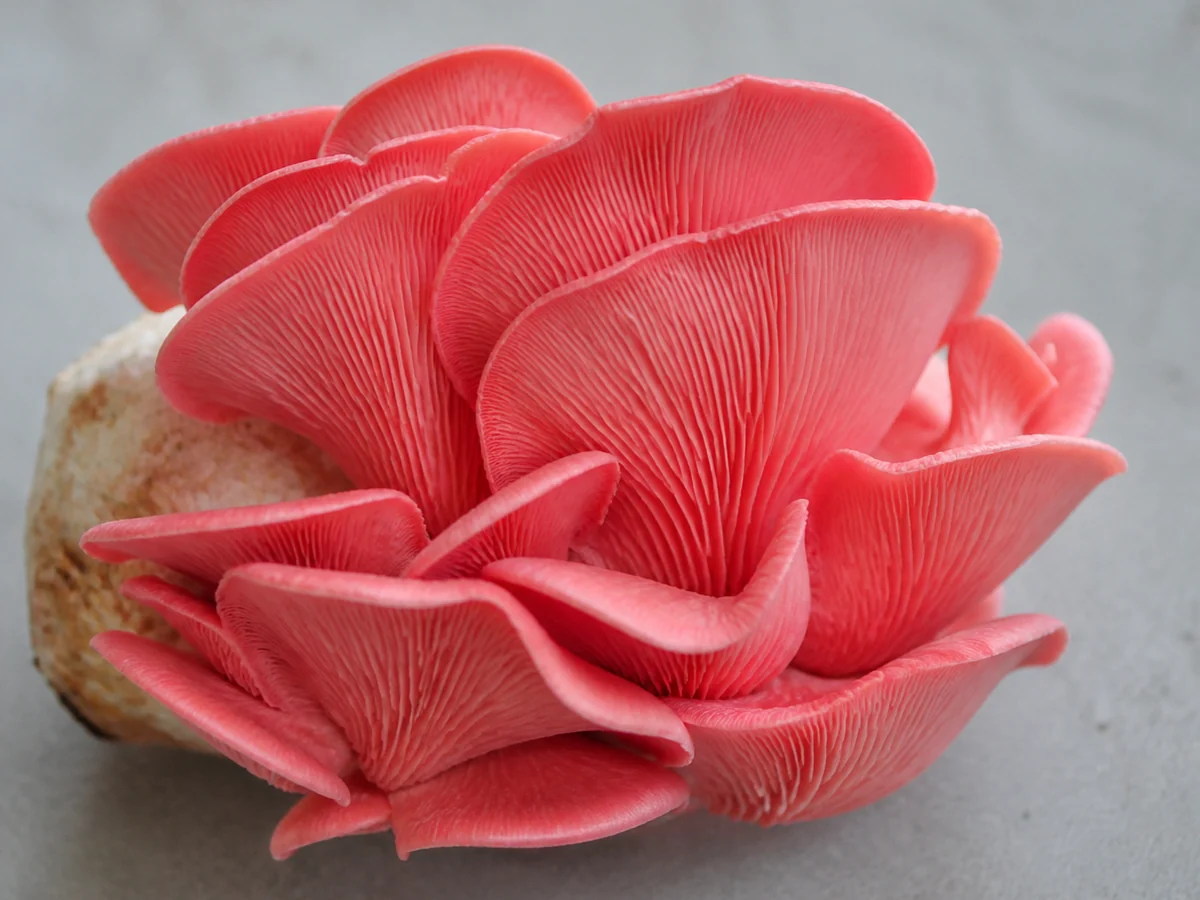
Set against the common oyster mushroom, the differences line up neatly. Only one of them is about color.
That first line is the whole case for the species. Everything else about it is either shared with its relatives or gone by the time it reaches the plate.
The common oyster mushroom is soft, and its great weakness is that it goes limp if you look at it wrong.
This one does not. It keeps a bite that survives a hot pan and a few minutes of neglect, which is a genuinely useful property.
That firmness is also why the method below departs from the oyster mushroom method, which is written for a softer flesh and says to work fast.
The shape is shared, though. Both are thin fans with gills running down a short stem, so everything about surface area applies to this species as much as to its relative.
How should you cut pink oyster mushrooms?
The cut here is thinner than you would use for the common oyster, and that is deliberate.
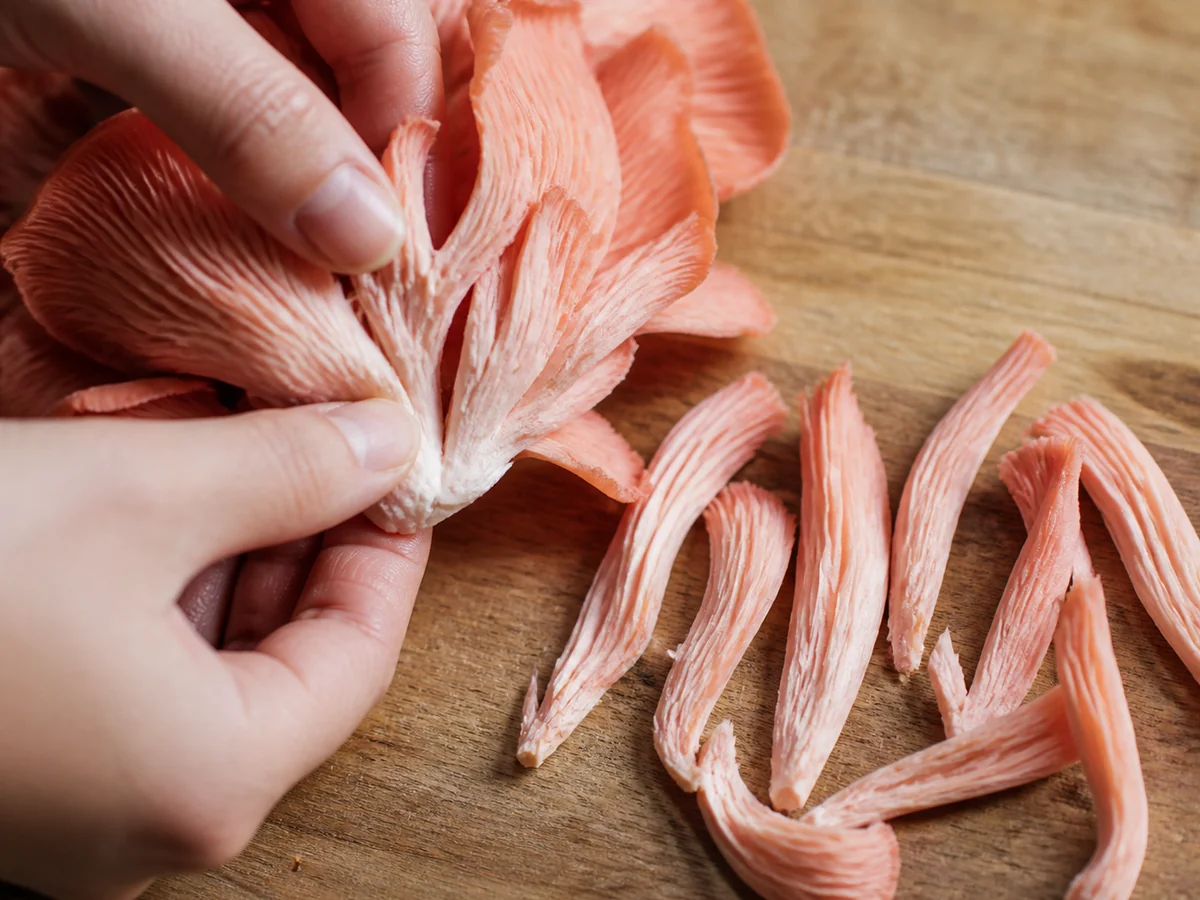
One instruction here runs directly against the advice on the common oyster page, so it is worth stating clearly.
Warning
With a common oyster mushroom, whole small caps are fine and thin strips are actively discouraged, because thin strips lose the fan shape and wilt into nothing. Pink oyster is firm enough that this does not happen, and the extra edge is exactly what a chewier flesh needs to soften and brown. This is the one place where the two species take opposite instructions.
The cluster pulls apart along its own lines and no knife is needed.
Work down from the cap edge with your fingers, take strips a centimeter or so wide, and let the pieces be whatever length they naturally come out. Matched thickness still matters more than tidiness.
Very large caps are worth splitting further.
- A thick base and a thin frill in one strip cook at different rates
- That unevenness is tolerable in a soft mushroom and obvious in a firm one
- Strips about a centimeter wide are a reliable default
- Length does not matter, so let the pieces come out however they separate
How long should you cook them?
Here is where most people stop too early, and where this mushroom is unlike almost everything else on this site.

Cooked side by side, the two species want visibly different treatment, and the difference is mostly time.
| Common oyster mushroom | Pink oyster | |
|---|---|---|
| Heat | Hot | Hot, and held there |
| Time | A few minutes, then stop | Longer, until the edges curl |
| Target look | Golden with crisp frills | Dark brown, curled and visibly shrunken |
| When to stop | When the edges crisp | Later than you want to |
| Shrinkage | Noticeable | Dramatic, and expected |
The shrinkage is the part that makes people stop. It is worth expecting rather than reacting to.
A pan that looked generously full reduces to what looks like a side portion. The instinct is that something has gone wrong.
It has not. Concentrating that flesh is the entire point, and the volume you lose is water.
Fat goes in after the released water has cooked off, as with any thin-fleshed mushroom, because adding it earlier just dilutes it in liquid that has nowhere to go yet.
Give them room, because a crowded pan holds the temperature down, and holding the temperature down is how the chewy version happens.
Cooking MushroomsHow to Cook Black Truffle Without Losing Its AromaWhy are your pink oysters chewy?
Almost every mushroom failure on this site is a version of overcooking or flooding, and this one is neither.

The diagnosis inverts here. It is worth setting out line by line, because the usual reflex makes it worse.
That third line is worth holding on to. It is rare enough that most cooks have never met a mushroom it applies to.
A dried-out king oyster slice or a collapsed common oyster cannot be rescued. A chewy pink oyster usually can, because the problem is that the cooking has not finished rather than that it went too far.
So if you taste one and it fights back, put it back in the pan and turn the heat up, which is the opposite of what you would do with almost any other mushroom and works here.
If they are still chewy after another few minutes at proper heat, the pieces were cut too thick.
- Cut too thick is a note for next time rather than something to fix now
- Cut too thin is barely possible with this species, unlike the common oyster
- A pan that is merely warm produces the same chewy result at any thickness
- Tasting one piece early is worth more than watching the clock
Do pink oysters really taste like bacon?
You will have seen this comparison, because it is how these are sold, and it deserves a straight answer.
- What genuinely transfers
- Cooked thin and hard, they curl, crisp and shrink like a rasher
- What does not
- The fat, the salt and the cured, smoked flavor
- What people actually do
- Add oil, salt, smoked paprika and sometimes maple to supply those
- The fair summary
- A texture and appearance comparison rather than a taste one
The curl is real, and genuinely striking the first time. It is the reason the comparison caught on at all.
Thin strips cooked hard behave in the pan very much the way a rasher does, and on a plate they look the part. That is not marketing, it is what the flesh does.
What they do not have is any of the things that make bacon taste like bacon. Those are all added, and a pink oyster with oil, salt and smoke on it tastes like a pink oyster with oil, salt and smoke on it.
Treated as an imitation it disappoints, and treated as a firm crisp savory ingredient that happens to curl, it is one of the more useful mushrooms you can buy.
How long do pink oysters keep?
Two loose ends, and the second one is about the limits of what anybody has actually measured.
These are among the shortest lived mushrooms on a shelf. Thin flesh and a large surface mean they dry out and go limp faster than a dense cap does, and a few days is realistic rather than a week.
The same thinness makes them dry beautifully. If you have more than you can use, drying them is a far better outcome than watching them wilt, and they rehydrate with more bite than most species.
Keep that limit attached to the finding.
A measured comparison of boiling, microwaving, grilling and deep frying covered four cultivated species, two of them Pleurotus. It found frying caused the most severe losses in protein, ash and carbohydrate, that boiling raised total glucans by enhancing the beta-glucan fraction while cutting antioxidant activity, and that grilling and microwaving best maintained the nutritional profile.
Pink oyster was not among them. Those findings are a reasonable guide for a close relative and they are not a measurement of this mushroom, and anybody telling you otherwise has not checked which species were in the study.
Sources & References
- Effect of different cooking methods on nutritional value and antioxidant activity of cultivated mushrooms, International Journal of Food Science and Nutrition 2017 The four-method comparison across four cultivated species including Pleurotus ostreatus and Pleurotus eryngii. Pleurotus djamor, the pink oyster, was not among the species measured.