Colorado sets no statewide mushroom rule. The binding limit comes from the manager of the specific ground, and inside the national forests it is often set at ranger district level. White River allows five gallons a day, Medicine Bow-Routt one, and San Juan asks for a permit above one gallon. Personal use permits are commonly free and issued at the district office. Collecting is prohibited in designated wilderness, in research natural areas, in the national parks and across the state park system.
Somebody will tell you Colorado allows five gallons a day. They are quoting a real number from a real forest, and it is wrong for a good deal of the state.
The rule that binds a picker in Colorado is set well below the state line, and two national forests a few hours apart differ on it by a factor of five.
- National forest
- The commonest ground, and the rule is set by the forest or the ranger district.
- National park
- Collecting is prohibited, including Rocky Mountain and Mesa Verde.
- State park
- Collecting is prohibited across the Colorado state park system.
- BLM
- A fourth answer again, set by the local field office.
- Wilderness
- Closed to collecting even where the surrounding forest is open.
Does Colorado have one foraging rule?
No, and there is no level at which one exists.
No Colorado statute governs personal mushroom collecting, and the state agencies that manage land set rules for their own ground rather than for the state. The binding rule belongs to whoever manages the dirt you are standing on, which is the same arrangement described on the national page and much sharper here because Colorado's public land is split four ways.
What makes the state unusual is not the structure but the spread. Two of its national forests answer the same question with one gallon and with five.
Colorado also carries an unusual amount of every kind of public land at once. Forest Service, Park Service, state parks and the Bureau of Land Management all hold large blocks, often adjoining each other.
Key takeaway
The unit of decision in Colorado is the ranger district, not the state and often not even the forest. A figure without a district attached to it is a figure from somewhere else.
Who sets the rule that binds you?
Four managers cover almost all of it, and none of them is obliged to coordinate with the others.
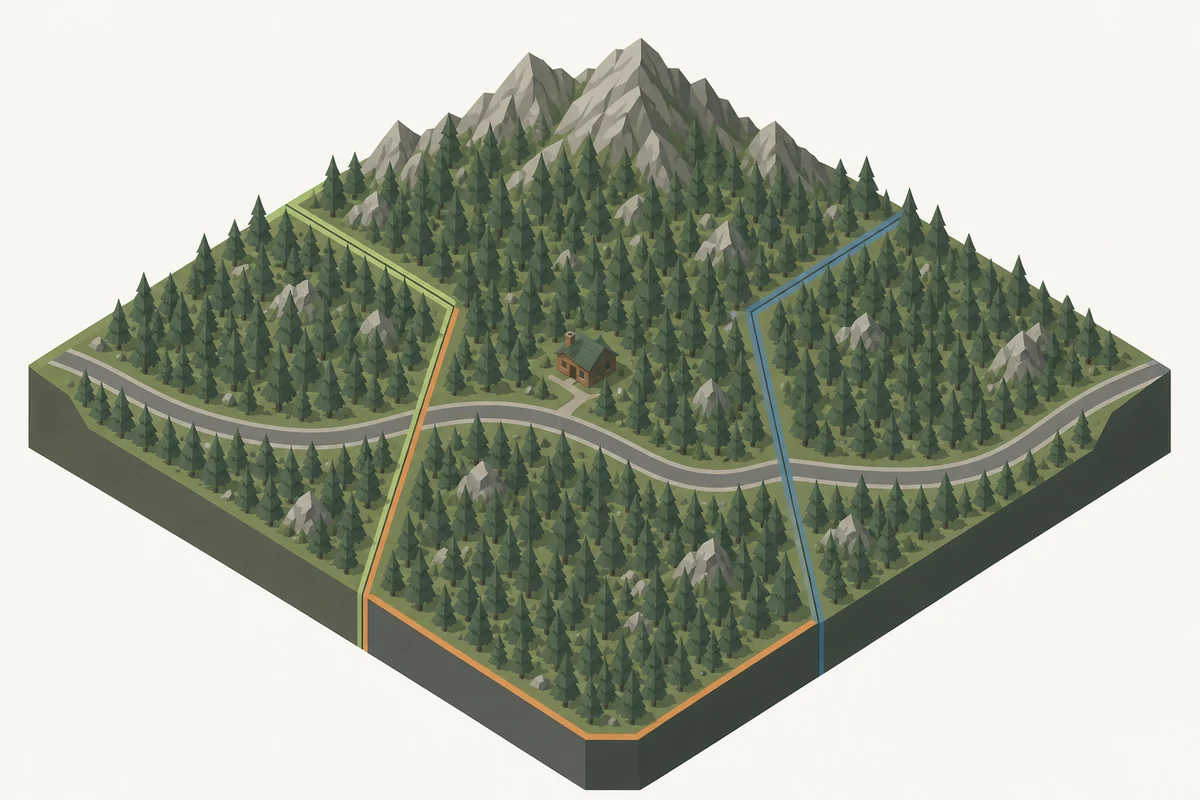
The Forest Service runs the national forests, the Park Service runs the national parks, Colorado Parks and Wildlife runs the state parks, and the Bureau of Land Management runs a large share of the lower country.
Those four blocks touch each other constantly in Colorado. A single day's walk can cross two of them without any change in the trees or the trail surface, which is the practical reason the agency question comes first.
Working out which of the four you are on is the first job, and it is easier than it sounds.
- The trailhead sign usually carries the agency name
- Mapping apps show land ownership as a layer
- A forest road number is a Forest Service road
A district boundary is the detail that catches people.
It is a line on a management map rather than a feature on the ground, and a picker can cross one on a forest road without any indication that the answer just changed. Nothing is signed, nothing changes underfoot, and the limit is different on the other side.
That is why a Colorado answer has to be attached to a place. Naming the forest is usually not specific enough, and naming the district is.
The Bureau of Land Management works differently again, because its unit is the field office rather than the district and its ground is often lower, drier and less productive for mushrooms.
That does not make it irrelevant. A great deal of Colorado access runs across BLM ground on the way to somewhere else, and the rules there are neither the forest rules nor the park rules.
How much can you pick in a Colorado national forest?
There are commonly three tiers. The middle one is where most pickers sit without ever realising there were tiers at all.
| Tier | What it usually covers | Permit |
|---|---|---|
| Incidental use | Up to about one gallon in possession | None |
| Personal use | Commonly up to five gallons a day | Free permit |
| Commercial | Any picking for sale | Paid permit and conditions |
Gallons are a volume rather than a weight, which matters because mushrooms pack badly and dry down hard.
A gallon of whole boletes weighs very little and a gallon of chopped ones weighs a good deal more. How you carry them therefore changes how close to the line you are, which is not something most pickers think about until somebody asks.
Most limits are written as gallons in possession for exactly that reason, since a container is something a ranger and a picker can both look at.
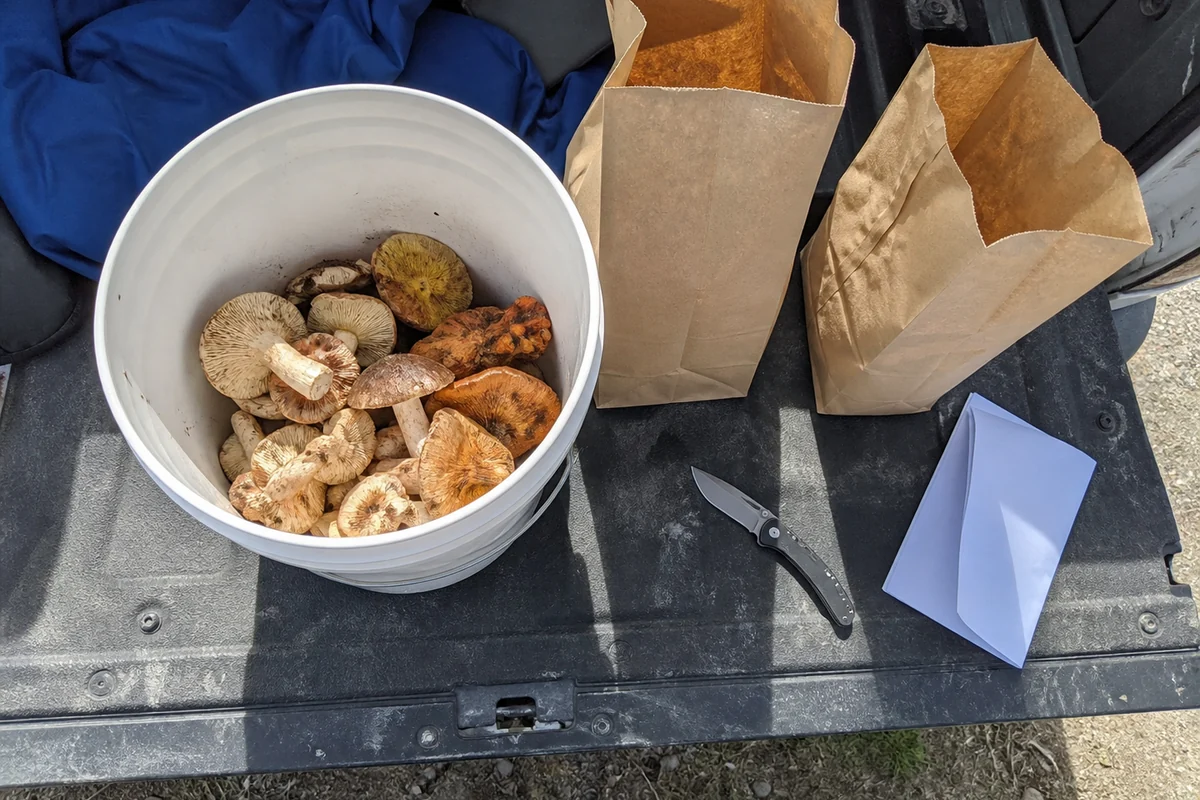
The spread between forests is the part worth planning around, because it is not small.
Those figures are not a ranking of generosity. A forest under heavy picking pressure sets a lower number for the same reason a quiet one does not, and the limit reflects the ground rather than the agency's mood.
A picker who reads the White River figure and drives to the Medicine Bow-Routt is carrying an allowance five times the one that applies to them. Nothing about the forest looks different, and the porcini and chanterelles they came for grow in both.
Colorado picking runs on the summer monsoon rather than on a northern autumn, so the summer season is short, intense and tied to July and August rain.
Seasonal caps sit on top of daily ones in several forests, so a generous daily figure can still be attached to a modest annual total.
Note
Plan against the lowest figure you might be under rather than the highest you have read. Nobody has ever been in trouble for picking a gallon in a five gallon forest.
What is Colorado actually good for?
Elevation does the work here. It makes Colorado a genuinely different proposition from any lowland state.
The spruce and fir belt between roughly 9,000 and 11,000 feet is where the season lives. Snowmelt and the summer monsoon arrive there in sequence rather than together, which stretches a productive window across July, August and September.

King boletes are the reason most people drive up. They come in under spruce after the monsoon breaks, and a good year on the western slope produces them in the quantities the permit tiers were written to control.
None of the four is settled by a phone photograph, and a hand lens and paper bags are worth more at altitude than anywhere else, because a second visit means a second drive.
Aspen stands are worth learning as a separate habitat, sitting lower than the spruce belt, fruiting on a different schedule and frequently falling on a different manager's ground.
That last point is the one that matters legally. A single day's drive up a Colorado valley can cross two or three management boundaries, and the rules change at every one of them.
When do you need a permit?
The word permit does more work in Colorado than in most states, because it covers three different situations.
Three kinds of permit exist. Knowing which one you need is most of the question, and the answer turns on quantity and on money rather than on species.
- No permit, for incidental amounts in possession
- A free personal use permit, for a normal picking day
- A paid commercial permit, for anything sold
A permit is needed the moment you pass the incidental amount, and the kind you need is the free personal use one unless money is involved.
Incidental use is the tier with no paperwork at all. It commonly allows about a gallon in possession, which is a good afternoon for somebody cooking that week and no use at all to somebody drying a winter's supply.
The phrase in possession is worth reading carefully, because it describes what is on you rather than what you picked today.
Somebody who picked a gallon on Saturday and another on Sunday is over the incidental amount on Sunday afternoon, even though neither day was.
That is the situation the free permit exists for, and it is also the reason people collect one before a weekend rather than after it.
Pick up to the incidental amount with no permit at all
Collect a free personal use permit from the ranger district office
Carry the permit with you rather than leaving it in the car
Assume one forest permit covers the next forest
Treat a free permit as unlimited once you have it
Sell any of it on a personal use permit
Personal use permits are commonly issued free, which surprises people who expect a fee. What they are not is automatic, and they are issued locally rather than centrally.
Commercial permits are a different conversation entirely. They usually carry conditions on where, when and how much, along with a fee, and they are issued on a much shorter list of forests.
The line into commercial is drawn at the sale rather than at the volume. Somebody picking a legal personal amount and then selling it has crossed into the third tier without ever exceeding the second.
That distinction matters in a state with a restaurant market for wild mushrooms, because an informal arrangement with a kitchen is exactly the thing the commercial permit exists to license.
ForagingMushroom foraging laws in the UK: what is actually legalWhich ground is closed even inside an open forest?
An open forest is not uniformly open. The closed parts are not fenced, signed or obvious from the ground.
Colorado carries a great deal of designated wilderness, and much of it sits inside national forests that issue mushroom permits freely at the district office a few miles away.
Designated wilderness is the largest closed category. Collecting is prohibited inside it even where the national forest around it issues permits freely.
Research natural areas and special interest areas work the same way and are far less well known.
They exist to protect a specific feature rather than a landscape, so they are small, scattered and marked on management maps rather than on the ground. Walking into one from an open trail takes no effort at all.
Warning
Rocky Mountain National Park, Mesa Verde and the Colorado state parks all prohibit collecting. A national park inside a state that allows foraging on other public land is one of the commonest mistakes in this subject.
The practical consequence is a map habit rather than a sign habit. Signs mark trailheads reliably and boundaries in the middle of a forest much less so, which means the check has to happen before the walk rather than during it.
Most mapping apps carry a public land layer that shows designations, and switching it on once before a trip removes the whole category of mistake.
It is worth doing on the drive rather than at the trailhead. Cell coverage in Colorado mushroom country is unreliable, and a layer that has not loaded is a layer that is not helping.
What about state parks and open space?
Federal land dominates the conversation in Colorado, and it is not the only ground people actually walk.
Colorado state parks are considerably more restrictive than the national forests around them. Collecting is generally not permitted. Do not assume that a state park follows the rules of a nearby forest.
County and municipal open space is a third category again. Front Range counties hold very large open space systems, they are heavily used, and their ordinances tend to prohibit collecting outright.
| National forest | State park | County open space | |
|---|---|---|---|
| Personal picking | Generally permitted, tiered | Generally not permitted | Usually prohibited |
| Where the rule lives | Forest and district policy | State parks regulation | County ordinance |
| Who to ask | The district ranger office | The park office | The county open space department |
| How obvious is the boundary | Signed at roads | Signed at entrances | Often only at trailheads |
Neighbouring states cut the problem differently again. Minnesota next door splits fungi from plants and Wisconsin further east splits a plant from its own parts, where Colorado splits nothing and simply hands the question to whoever owns the dirt.
Wilderness inside a national forest is the fourth case, and it is covered above rather than here, because it sits inside federal ground rather than beside it.
The lesson repeats across all four. In Colorado the question is never what the rule is, it is whose ground you are standing on, and the answer changes more often than in any state on this site.
How do you get the answer for one specific place?
The whole page reduces to one phone call. Check the current rule for the specific place before relying on a general collecting limit.
Four steps cover it, and the first one is the one people skip.
Three questions cover the call.
- What is the mushroom limit in this district this season
- Do I need a permit for that amount, and where do I collect it
- Is the area around this trailhead wilderness or otherwise closed
Ask for this season rather than the policy. Limits and permit practice are set annually, and a page from three years ago can be accurate about the structure and wrong about the number.
Carrying the permit matters more than getting it, because a permit in a glovebox five miles away is not doing the job it was issued for.
The same goes for the answer you were given. Note the district and the date you called, because a limit quoted to you in July is the one you were relying on in August.
Check the designation and the permit conditions before traveling to the trailhead.
Anything that survives the drive down off the mountain still needs an evening, and sorting a foraged basket matters more after a long descent than after a short walk.
From there the questions stop being Colorado ones. Use the beginner's routine to decide what is worth picking and how to check its identity.
Sources & References
- Permits, Rocky Mountain Region (USDA Forest Service) Regional Forest Service permit pages, used for the structure of incidental use, free personal use and commercial permits, for the issuing of personal use permits at ranger district offices, and for the principle that limits are set at forest and district level rather than regionally.
- Northern Region mushroom harvest information (USDA Forest Service) Used as the Forest Service statement of the personal use permit structure, including the free personal use tier with daily and seasonal caps and the separate treatment of commercial harvest.
- Public lands in Colorado and mushroom foraging (Modern Forager) Used for the forest-level comparison quoted here, including the five gallon daily allowance in the White River National Forest, the one gallon daily allowance with an annual cap in the Medicine Bow-Routt, and the San Juan requirement for a permit above one gallon, together with the closure of wilderness, research natural areas and special interest areas.