There is no United States mushroom foraging law, and a state-level answer misleads exactly where it matters. The rule depends on who manages the ground. Check the specific park, forest, or private property for current collecting permission, limits, and species exceptions before setting off. It is not legal advice and every figure in it is an example that changes.
There is no United States mushroom foraging law, and the state you are in is usually the wrong thing to ask about.
The rule that applies to you is set by whoever manages the specific ground under your feet, which can change twice in a single afternoon's walk.
Is it legal to forage mushrooms in the US?
Asking whether it is legal to forage mushrooms in the US gets no clean answer, because no federal statute governs personal mushroom collecting across the country. What exists instead is a large set of local rules, each written by a land manager for the land they manage.
Warning
This page explains how the system is arranged and is not legal advice. Every figure quoted here is an example that changes, and the managing agency for the ground you are standing on is always the authority over anything written here.
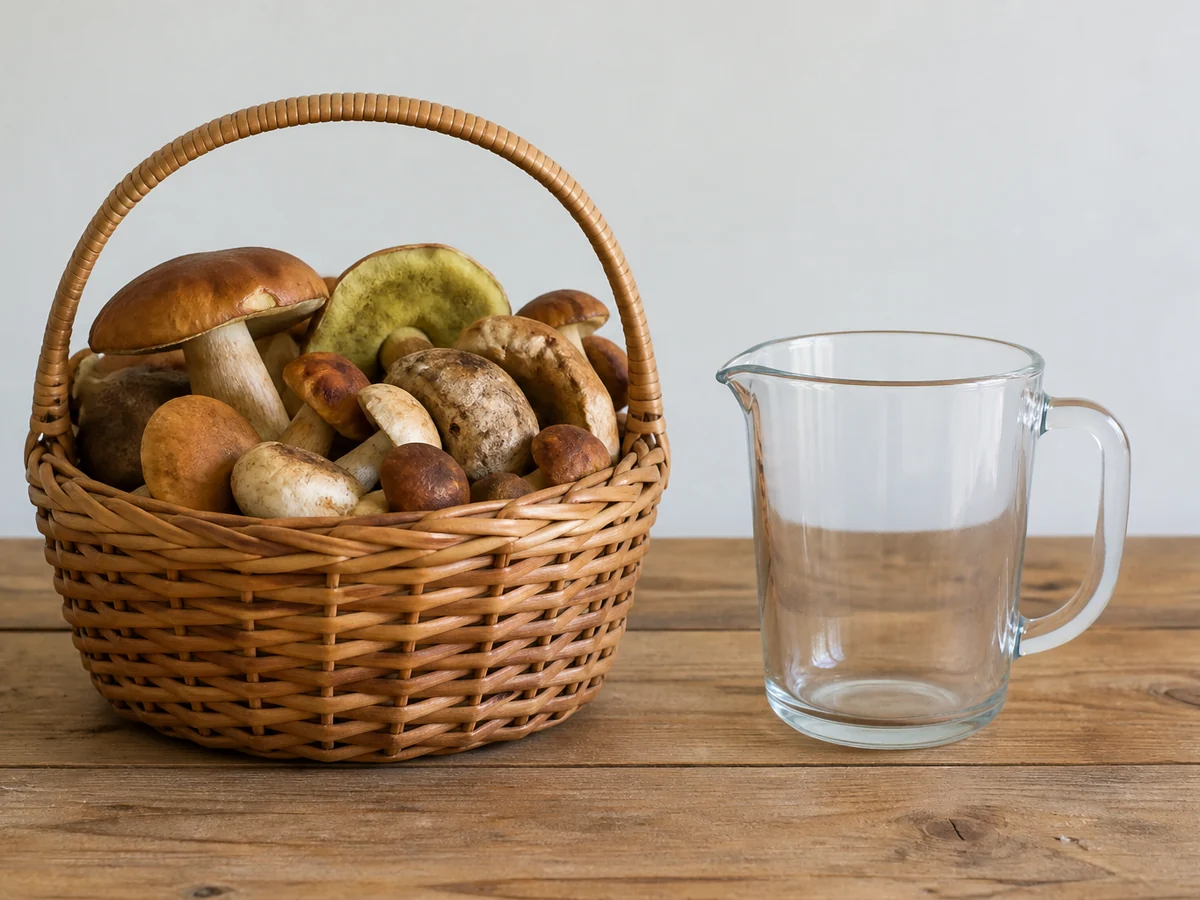
A basket of wild mushrooms is the same basket whichever land manager's ground it was filled on.

A state-level answer is right on average and wrong exactly where it matters. Within one state you can have a national park where collecting is prohibited by default, a national forest where a few gallons a day is fine, a state forest with its own position, and a city park that bans it outright.
All four of those can sit within an hour's drive. The state has not changed and the answer has changed four times.
So the question worth asking is not whether foraging is legal in your state. It is who manages this particular ground, and what does that unit currently publish.
Who decides the rules where you are standing?
Six categories cover almost everywhere a person walks.
Those categories differ in kind rather than in degree.

Sorted by who manages the land, those categories are simpler than the boundary above suggests.
The category is what decides, so identifying it is the first task rather than the last. Identify the land category first, then check the rules of the individual property or management unit.
Tribal land deserves naming separately, because it is not a variation on the others.
Reservation and other tribal lands are governed by the nation whose land it is, under its own law rather than under a federal recreation rule. Access and collecting are decided there, and permission is sought there.
That is worth knowing precisely because such land often appears on a general map without any indication that a different jurisdiction applies.
The unmarked boundary is the part that catches careful people out.
- A trail can leave one ownership without a sign or a fence
- The woodland itself looks identical either side
- Trailhead parking can belong to a different manager from the trail
- Paper maps show terrain and routes, not who manages the ground
Can you pick mushrooms in a national forest?
Yes, in most of them. National forests are where the majority of legal foraging in the country actually happens.
Spring is when this bites hardest. Morel season sends far more people into national forests than any other time of year, and it is also when species-specific rules are most likely to apply.
In the Rocky Mountain states the question is more often about forests than anything else. So much of the ground there is federal that the forest rules end up deciding most trips.
Do you need a permit to forage?
Often not.
Where one is required for personal use, it is usually free.
Personal collecting below a forest's incidental threshold typically needs no paperwork at all. Above it, the permit exists to record who is out there rather than to raise money, which is why it so often costs nothing.
Commercial permits are the exception and are priced accordingly, which is a separate system covered further down.
How much are you allowed to pick?
Five points describe how forest limits are usually written.
Those two thresholds are both Forest Service positions, and they differ by a factor of five. A forager who learned the first one and drove to a different forest would be applying a number that does not exist there.
ForagingMushroom foraging laws in Germany: protected species and small quantitiesCan you sell mushrooms you foraged?
Not under a personal-use permission, no.
Every published limit is written against that distinction. Personal use means for you and your household, and it stops at the point anything is sold, bartered or traded away.
Selling at any scale moves you into commercial harvesting, which is a separate permit system with its own thresholds, seasons and fees.
That boundary is stricter than people expect. Giving a surplus away can fall outside a personal-use permission in some places, which is not obvious to anyone who thinks of selling as the only line.
Which parts of a forest are closed even when the forest is open?
Designations inside a forest override the general position.
Wilderness areas, research natural areas and recently burned ground are all commonly closed or restricted while the surrounding forest stays open.
Burn closures deserve particular attention here. A burn scar is exactly where a lot of foragers want to be the following spring, and it is also where a closure order is most likely to be in force for reasons of falling timber and unstable ground rather than of harvesting.
Those orders are published separately from the permit rules and expire on their own schedule.
Can you pick mushrooms in a national park?
Assume not until the park itself says otherwise. The National Park System default runs opposite to the national forest default, which is the reversal that catches people.
| Land type | Default position | Where the exception comes from |
|---|---|---|
| National forest | Collecting generally allowed, sometimes under a free permit | The forest's own published permit rules |
| National park | Removing plants or plant parts is prohibited | A superintendent designation for that specific park |
Under the National Park Service regulations, damaging or removing plants and their parts is prohibited. A superintendent can designate limited hand gathering for personal use, on a written determination that it will not harm park resources, and can cap the quantity and the location.
That designation does not live in the general regulation, because it lives in the individual park's own compendium, which is why two parks can give opposite answers while pointing at the same rule.
Some parks do permit personal mushroom collecting and many do not.
- Check the park, never the agency, and never a neighboring park
- The compendium is the document that carries the answer
- A rule allowing gathering may still name which species and how much
- Treating a park like a forest because both are federal is the error to avoid
Can you forage in state parks and city parks?
Sometimes. This is the tier most people actually walk in, and the least predictable of the three.
| Tier | What is common | What varies |
|---|---|---|
| State parks | Often restrictive, sometimes with named exceptions | Rules can differ from state forests in the same state |
| State forests | Often more permissive than state parks | Whether a permit exists, and what it covers |
| County and city parks | Frequently prohibit collecting outright | Enforcement, and whether the rule is published at all |
A rule that permits collecting can still restrict other things. Quantities, seasons, tools, and which parts of a property are open are all commonly limited separately from the permission itself.
The regional pages here carry the area detail that a national page cannot.
Readers in the west should start with California foraging, where state and federal ownership interlock more than almost anywhere else.
The northeast pages cover the states with the densest public access. Much of that access is state rather than federal, which changes where the lookup points.
For the spring rush, the midwest pages cover the morel belt.
The southeast pages carry the longest season of the four.
Do you need permission on private land?
Yes. Private land is not a harder version of the public-land question but a different question entirely.
Note
On private ground the operative issue is permission, not regulation. Collecting without it can be trespass whether or not any foraging rule exists, and the absence of a fence is not permission.
A great deal of apparently open woodland in the United States is privately owned, including land that looks and feels like public forest. Timber company holdings, family woodlots and conservation easements are all common and rarely obvious from a trail.
Permission from one owner does not extend across a boundary to a neighbor. If access is going to be repeated, having it in writing protects both sides and costs nothing.
What happens if you get it wrong?
Usually less than people fear.
Never quite nothing, either.
The common outcome on public land is being asked to stop, to tip out what was collected, or to obtain the permit that was needed. Keeping that short record costs a minute and settles anything raised afterwards.

- It answers a ranger's question without anyone relying on memory
- It records which permission you were collecting under at the time
- It builds a picture of where and when things fruit for you
- It costs nothing if it is never needed
Penalties exist above that and vary with the land and the scale. Someone collecting a basket for dinner and someone filling sacks for resale are not treated the same way, and the difference is the personal-use line described earlier.
None of which is a reason to guess. The lookup takes less time than the drive to the trailhead.
How do you check the rules before you go?
Four steps, done before you leave the house.
Check the current rule for the exact ground you intend to visit.

Four steps, in this order, and none of them takes long.
- Step one
- Identify the land manager, using a land ownership map layer rather than a trail name
- Step two
- Find that unit's own current published rules, not a summary of them
- Step three
- Check for species-specific and seasonal exceptions, which sit apart from the general limit
- Step four
- Note where, when, how much, and under what permission
- The standing caveat
- Every figure on this page is an example that changes, including these
Step one is the one people skip, and it is the one that does the work. A trail name tells you nothing about ownership, and a parking area at the trailhead can belong to a different manager from the woodland it serves.
The tools for step one are ordinary and mostly free. Mapping applications aimed at hunters and hikers carry public land ownership layers that shade each manager differently, and they work offline once an area is downloaded.
Agencies publish their own maps too. A national forest issues maps showing its boundary and its internal designations, and counties run parcel viewers that show private ownership.
Any one of those beats guessing from a trail sign.
The point is only to learn the manager's name, because everything after that is a search for what that manager currently publishes.
Roadsides are worth a separate thought, since they look like nobody's land and are not. A verge normally belongs to whoever holds the right of way, which is usually a state or county transport authority with its own position on collecting anything at all.
One last boundary is worth marking.
Permission to collect something is an entirely separate question from whether it is safe to eat, so anyone new to this should start with foraging for beginners before worrying about permits.
The same separation applies at the other end. Knowing that a species is safely edible tells you nothing at all about whether you are allowed to pick it where you are standing.
Sources & References
- 36 CFR 2.1, Preservation of natural, cultural and archeological resources, National Park Service That damaging or removing plants and their parts is prohibited in park areas, and that a superintendent may permit limited hand gathering for personal use and may cap the quantity and the location
- Forest Product Permits, Bureau of Land Management That this agency publishes no single national mushroom quantity and directs the public to contact the nearest local office, which is itself evidence that no national figure exists
- Northern Region Mushroom Harvest Information, USDA Forest Service Regional personal-use permit guidance. Treat the quantities discussed as examples and check the current rules for the individual forest before collecting.
- Mushroom Permits, Willamette National Forest, USDA Forest Service Willamette National Forest personal-use collecting guidance. Check its current limits and permit conditions before a trip.