Why is angel wing considered poisonous?
Angel wing was once eaten in several regions, especially Japan, but its safety history changed after a severe 2004 poisoning outbreak. Fifty-nine people developed acute encephalopathy and 17 died after eating Pleurocybella porrigens.
Many affected patients had chronic kidney failure or received dialysis.
That association identifies a particularly vulnerable group, but it does not prove healthy kidneys make the mushroom safe. Later chemical work found a three-part mechanism capable of damaging mouse brain tissue.
The mushroom itself looks delicate rather than threatening.
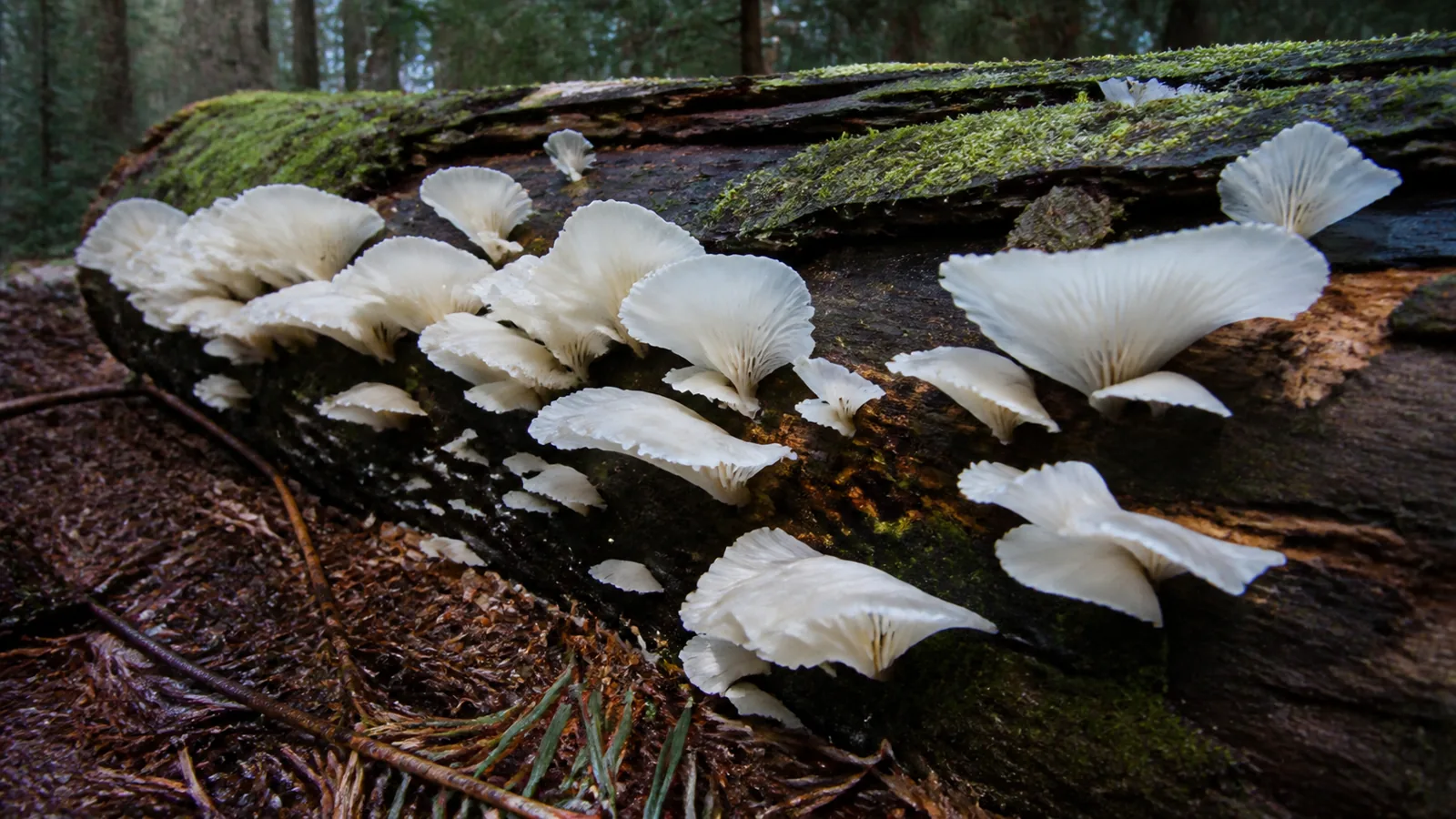
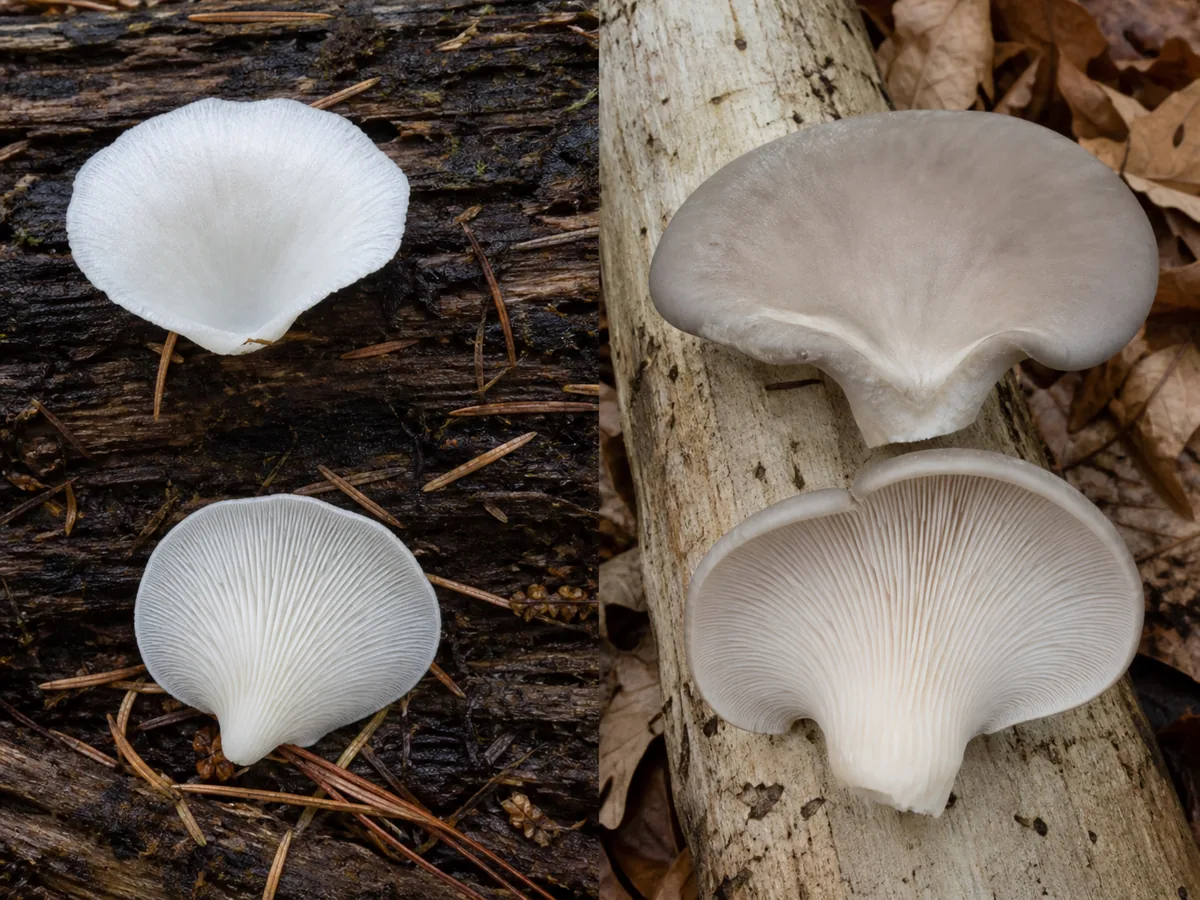
Thin white fans overlap like petals on decaying conifer wood, and crowded gills run outward from a short lateral attachment. The shape invites comparison with cultivated oyster mushrooms.
That resemblance defines the reader's real task. Before thinking about a white shelf mushroom as food, identify the host and examine whether the flesh is unusually thin, translucent, and nearly stemless.
Warning
Do not use past personal meals as evidence of safety. A mushroom can be eaten without immediate illness and still have a documented severe outbreak under different exposure or health conditions.
This profile treats angel wing as poisonous because the consequence of a wrong decision is neurologic injury and because no preparation or safe serving has been established.
Researchers isolated pleurocybelline, a lectin, and pleurocybellaziridine while investigating the encephalopathy cases. In a mouse model, the combined compounds damaged the blood-brain barrier and increased hippocampal cell death, but that work does not define a safe human dose or an antidote.
Toxin-related compounds have been studied in fruiting bodies and cultured mycelia, so cultured material does not solve the safety problem.
Pleurocybella porrigens is the type and sole widely accepted species of its genus, while older literature may use Nothopanus porrigens.
The 2004 outbreak changed the food decision because the clinical pattern was severe and delayed. In the Yamagata case series, consumption preceded neurologic symptoms by two to three weeks, early signs included tremor, slurred speech, and weakness, and several patients progressed to seizures and profound disturbance of consciousness.
Kidney disease was a prominent feature, but it does not create a safe category for everyone else.
The outbreak cannot measure the risk of every meal, and later mechanistic studies have not produced a household test that identifies a harmless specimen or preparation.
Three of the ten analyzed patients died. That outcome is enough to reject old advice that treats angel wing as a normal edible, even while researchers continue to study why susceptibility and severity differed.
Conflicting field guides should be read by publication date and evidence. A historical edible label records past practice, while a current safety decision has to include the human outbreak and the absence of a proven detoxification method.
Which field marks point to Pleurocybella porrigens?
Thin white fan, ear, or tongue shape, usually 2 to 6 cm across, often translucent at the margin and yellowing with age.
Crowded white gills radiating from the attachment point and running to the base.
Absent or reduced to a very short lateral attachment, never a substantial oyster-mushroom stem.
Very thin, pliable to fragile white flesh with a mild odor and no safe taste test.
Begin with the wood.
Angel wing is a decomposer of conifer logs and stumps, often in cool damp forest where the wood has softened and lost obvious bark. Look for nearby needles, cones, remaining bark, and the structure of the wood before naming the mushroom.
Individual caps are commonly 2 to 6 cm wide.
They are white when fresh, fan-shaped to ear-shaped, and attached from one side without a meaningful central stem. Margins can be thin enough to look translucent.
| Feature | Angel wing | Typical oyster mushroom tendency |
|---|---|---|
| Host | Decayed conifer | Commonly hardwood, with species exceptions |
| Cap | Small, very thin, white to cream | Usually thicker and more substantial |
| Attachment | Nearly stemless | Often has a short but fleshier lateral stem |
| Flesh | Fragile and pliable | Denser and meatier |
| Spore print | White | White to pale lilac, so overlap remains |
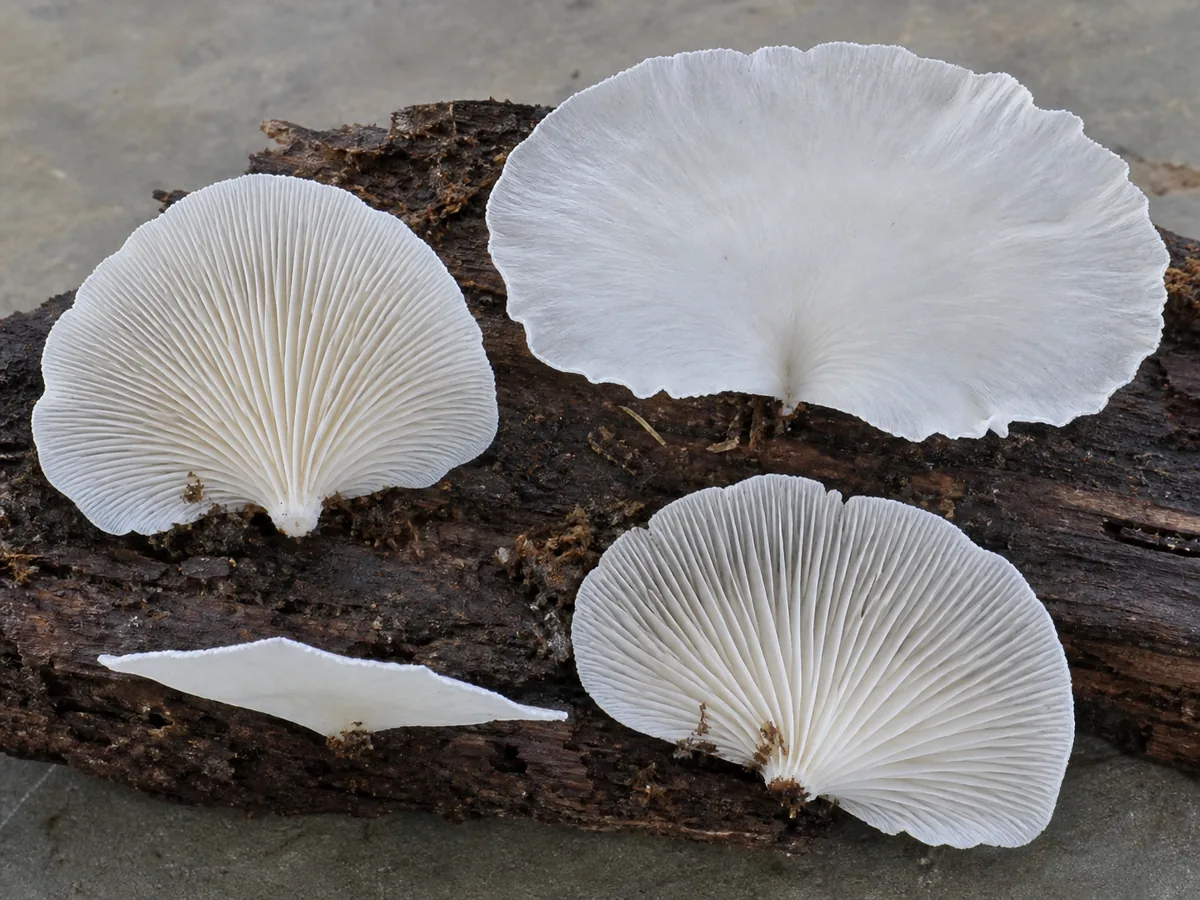
A spore print cannot safely separate angel wing from every oyster mushroom because both can produce pale prints. Use it only as one observation in a complete identification.
Do not rely on size alone.
Young oyster mushrooms can be small, while old angel wings can expand and become irregular. Host identity and flesh structure carry more value together.
Begin by identifying the wood before the white caps are moved.
Retain bark, needles, cones, branch pattern, and a wide habitat photograph because a pale weathered log can be misread as hardwood after its bark falls away.
The cap often attaches laterally without a clear stem and forms a thin ear, tongue, or fan. Several caps may overlap along one piece of wood, but each remains more delicate and less substantial than the thick fleshy shelves expected from many culinary oysters.
Turn one intact cap to show the gills radiating from the attachment. A white spore deposit supports both Pleurocybella and several Pleurotus lookalikes, so it cannot replace the substrate and flesh comparison.
Condition changes the clues.
Old caps become translucent, waterlogged, yellowed, or ragged, and frost can collapse the thin flesh, which makes a fresh specimen and a mature specimen more useful than a single damaged shelf.
Microscopy or sequencing may be appropriate for a documented record, but food safety does not need that final name. A thin white stemless mushroom on conifer wood is enough to stop an oyster harvest when the evidence remains incomplete.
If someone may have eaten this mushroom, act now. Call Poison Control at 1-800-222-1222 (US) or emergency services before symptoms appear, and save a piece of the mushroom for identification.
Who faces the greatest risk from angel wing?
Thin flesh and small caps do not predict a low exposure. Assessment after ingestion should prioritize the amount eaten, repeated meals, kidney function, timing, and neurologic symptoms, with people who have kidney disease matching the highest-risk historical patient pattern.
How does angel wing differ from oyster mushrooms?
Angel wing is often compared with white oyster mushrooms because both form pale gilled shelves on wood.
The most useful first split is the host and the build. Angel wing is thin, nearly stemless, and associated with decayed conifer wood, while common Pleurotus oysters are usually thicker and most often fruit from hardwood.
That distinction is not strong enough to approve food from a photograph. Confirm the wood, attachment, flesh thickness, cap size, and the whole collection.
Treat any thin white oyster-like mushroom on conifer wood as a no-food collection. Angel wing has been linked to fatal acute encephalopathy, and cooking does not establish safety.
White oyster mushrooms can overlap in cap shape and gill pattern. A buried or badly decayed log may be hard to identify, so an unknown host removes a major piece of evidence.
Crepidotus species can be small, pale, and stemless on wood, but their mature gills and spore prints turn brown rather than remaining white.
Pleurotus oysters usually supply more substantial flesh and often a short lateral stem, although those characters vary. Many familiar cultivated and wild oysters favor hardwood, which makes a confirmed conifer substrate a strong warning rather than a universal genus test.
Small white Crepidotus and other shelf fungi can also occur on wood. Their spore colors, gill attachment, cap texture, and size differ, but a mixed log can hold more than one species and a white top view hides most of that evidence.
Do not transfer the identity of one cap to an entire cluster. Photograph the attachment of several fruiting bodies, keep conifer and hardwood collections separate, and reject any food collection that includes thin stemless shelves from uncertain wood.
Cooking cannot repair this comparison. Heat may change texture and flavor, yet no validated temperature or duration has been shown to remove the encephalopathy risk from angel wing.
Can angel wing be made safe to eat?
Angel wing should not be prepared as food. Boiling, sauteing, drying, freezing, or fermenting has not been shown to remove the encephalopathy risk.
The 2004 cases occurred after consumption of a mushroom that had a history of being eaten.
Traditional use therefore cannot serve as the final safety test.
If a white mushroom from conifer wood was mixed with oysters, stop the meal and keep uncooked and cooked samples. Record the substrate, collection location, meal time, amount eaten, and health conditions of everyone who shared it.
The clinical pattern can differ from common gastrointestinal mushroom poisoning. In a ten-patient series involving kidney failure, neurologic symptoms began two to three weeks after the meal and progressed from tremor, speech difficulty, or weakness to impaired consciousness and seizures.
Because delayed symptoms can obscure the cause, the mushroom meal must be stated explicitly to clinicians.
There is no responsible culinary method for this species. Boiling, soaking, drying, fermenting, or discarding cooking water has not been validated to prevent the neurologic syndrome linked to consumption.
A healthy adult also cannot infer safety from the kidney association.
The outbreak identified an important susceptibility pattern, while the absence of equivalent case data in other groups leaves uncertainty rather than permission.
When angel wing enters a mixed basket, discard the uncertain batch instead of sorting cooked pieces by appearance. Thin white caps lose identifying texture during preparation and shared liquid can make reconstruction harder after exposure.
If a meal may have included it, save leftovers and photographs and contact a poison service. Report the date of consumption even when it was weeks earlier because the published syndrome had an unusually long interval before neurologic signs.
What did toxin research find?
Angel wing has no established medicinal use. Modern research focuses on explaining toxicity rather than developing a consumer remedy.
Researchers isolated pleurocybelline, a lectin, and pleurocybellaziridine.
In a mouse model, the three constituents together damaged the blood-brain barrier and increased cell death in the hippocampus.
Animal and molecular results help build a plausible mechanism for the outbreak. They do not define an exact dangerous dose for every person, and they do not create an antidote or a safe extract.
Do not use angel wing in teas, tinctures, powders, or self-experiments. People with kidney disease should be especially alert to the historical patient pattern, while everyone should avoid ingestion.
Researchers have investigated several constituents and proposed that more than one may contribute to toxicity.
Experimental results can support a biochemical pathway, but animal or cell models do not determine a safe serving for a healthy person.
Renal impairment may have affected exposure or clearance in the outbreak, and the recovered patients tended to have less severe kidney failure. That association deserves clinical attention without becoming a claim that normal laboratory values eliminate risk.
The long delay also complicates causal reconstruction. People may forget a mushroom meal, share different portions, or have other illnesses, so outbreak analysis depends on meal histories, specimen records, and exclusion of competing explanations.
No supplement or medicinal role offsets the poisoning evidence. The useful research question is how the syndrome occurs and who is susceptible, while the public decision remains avoidance.
Where does angel wing grow?
Pleurocybella porrigens breaks down dead conifer wood. It is reported from cedar, pine, spruce, fir, and other conifers across northern temperate forests, often on logs that are already soft and moss-covered.
The fruiting bodies grow in overlapping shelves or loose tiers. They may cover a long section of a log after cool wet weather, creating a conspicuous white layer against dark wood.
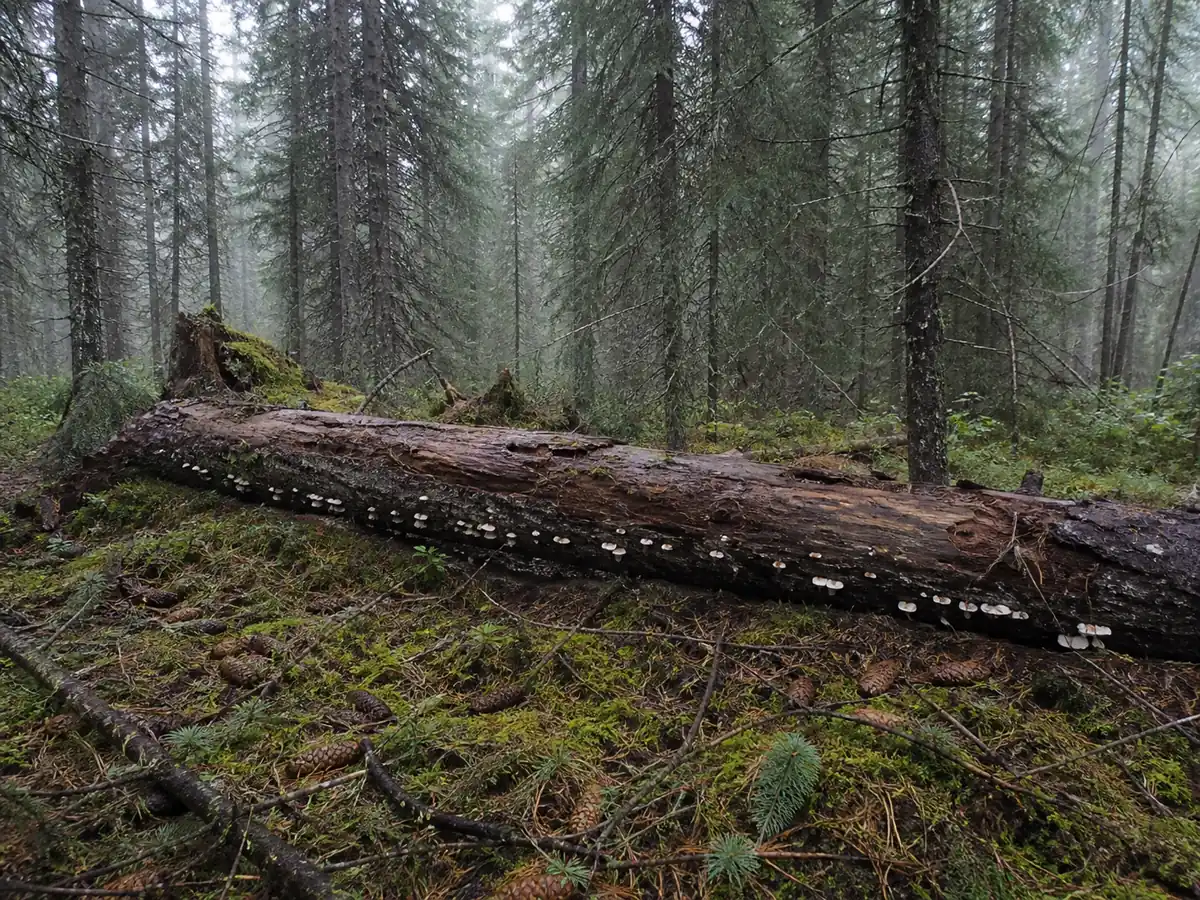
Late summer and autumn are the normal fruiting period.
Timing varies with latitude and rainfall, so season helps locate the mushroom without confirming it.
Fresh caps are pure white and delicate, while older tissue can yellow and curl at the margin. Age changes appearance without changing the safety decision.
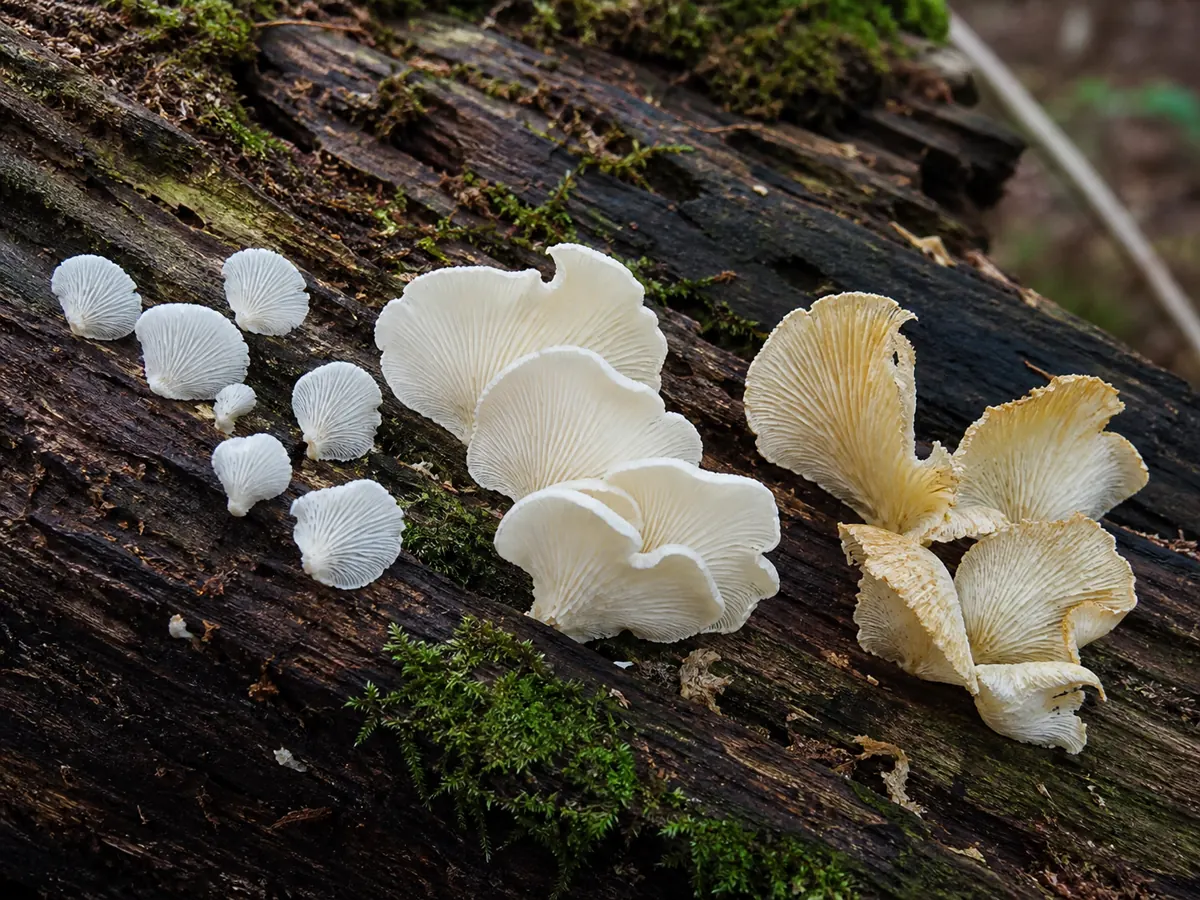
The species is widespread in the Northern Hemisphere. A regional field guide may use different common names, but sugihiratake and angel wing refer to the same current species.
Ecologically, the fungus contributes to nutrient cycling as wood softens and breaks apart. That useful forest role has no connection to human edibility.
Landscape fruitings can return while the decaying conifer wood remains.
Removing the dead substrate is the practical long-term change when access is a concern, while fungicide is rarely useful against a decomposer already established inside wood.
Angel wing decomposes conifer wood after the tree or exposed tissue dies. It can spread across stumps and fallen logs, producing rows or overlapping shelves where moisture remains high.
Spruce, fir, and hemlock are useful host clues in northern forests, but local tree identification still matters. A conifer name inferred from one loose needle can be wrong when branches from several trees cover the same log.
Fruiting often follows cool wet weather in autumn.
The visible caps can appear quickly and disappear after frost or drying, while the wood-decaying mycelium remains active inside the log.
Leave the decaying substrate in place unless land management requires its removal. The fungus contributes to nutrient cycling, and documenting a fruiting does not require stripping the whole cluster from a log.
Where does Pleurocybella porrigens fit taxonomically?
Pleurocybella porrigens is the current name and the type species of Pleurocybella. Recent phylogenetic treatment places the genus in Phyllotopsidaceae within Agaricales.
Older literature may use Nothopanus porrigens or place the species in Tricholomataceae. Those names reflect earlier classifications rather than a different angel-wing mushroom.
Pleurocybella is monotypic in widely used modern treatments, which means P. porrigens is the sole accepted species in the genus. That taxonomic clarity does not make field identification from a single image reliable.
Angel wing questions
Is angel wing mushroom edible?
Did only people with kidney disease get sick?
How is it different from oyster mushroom?
Does cooking destroy the risk?
What color is its spore print?
How long can symptoms be delayed?
Sources & References
- Brain and Nerve clinical case series Ten cases, kidney-failure association, delayed neurologic progression, and seizures.
- Toxicon mechanism study Outbreak totals and experimental evidence involving three mushroom constituents.
- Proceedings of the Japan Academy review Chemical investigation of the acute encephalopathy mechanism.
- BMC Research Notes transcriptome study Morphology, conifer habitat, distribution, outbreak context, and toxin-pathway research.
- NCBI Taxonomy Current species name and Phyllotopsidaceae lineage.