
Yes, a verified true morel can be a reasonable pregnancy food when the batch is sound and every piece is thoroughly cooked. Raw morels, lightly heated morels, an uncertain wild collection, and any product whose species cannot be traced should stay off the plate.
That answer needs more caution than the word edible suggests because true Morchella has caused severe illness without a poisonous lookalike being present.
No controlled human pregnancy study specific to morel consumption was identified. The judgment therefore rests on direct human outbreak evidence, pregnancy food-safety guidance, and official instructions for identifying, storing, and preparing morels.
The useful question is whether the exact mushrooms and the way they were cooked clear the failures documented in Montana, not whether morels appear on an edible-species list.
Why did the 2023 outbreak change the pregnancy answer?
In spring 2023, a Montana restaurant served cultivated true morels imported from China. Public health investigators identified 51 people with gastrointestinal illness, including three hospitalizations and two deaths associated with the outbreak.
FDA testing confirmed the mushrooms were true morels rather than toxic false morels. Tests did not identify a pathogen, pesticide, heavy metal, known toxin, or other contaminant that explained the illnesses.
The preparation history supplied the clearest signal.
| Preparation | What investigators observed | Pregnancy decision |
|---|---|---|
| Cold-marinated and uncooked | The strongest association with illness occurred on the date raw morels were served | Do not eat |
| Hot boiled sauce poured over raw morels, then marinated | Investigators classified this as partially cooked, and diners still became ill | Do not treat hot liquid as cooking |
| Morels cooked or thoroughly heated at other restaurants | Facilities receiving mushrooms from the same importer reported no associated illness complaints | Thorough heating reduces the known risk |
| Unknown restaurant method | A menu description cannot show whether the center of every piece was heated | Ask, then choose another dish if the answer is vague |
Morel exposure was strongly associated with illness, and people who ate more pieces were more likely to meet the case definition, which makes portion size part of the risk.
Raw service carried a stronger association than the earlier partially cooked service. The evidence does not prove that one cooking method makes every morel safe, but it does show why a raw garnish, cold pickle, quick blanch, or splash of hot sauce is not an acceptable pregnancy shortcut.
Those two deaths occurred in people with chronic medical conditions that might have reduced their ability to tolerate profound fluid loss. That detail prevents an exaggerated claim while preserving the dehydration warning.
CDC found no additional reports when it asked for similar cases across states, and other restaurants that thoroughly heated mushrooms from the same importer reported no complaints. That contrast supports cooking as a protective step without turning it into a guarantee.
A modest first portion is prudent after the identity and preparation checks pass because it limits exposure and makes a reaction easier to connect to one ingredient.
A true morel is hollow, but one cut is not a full identification
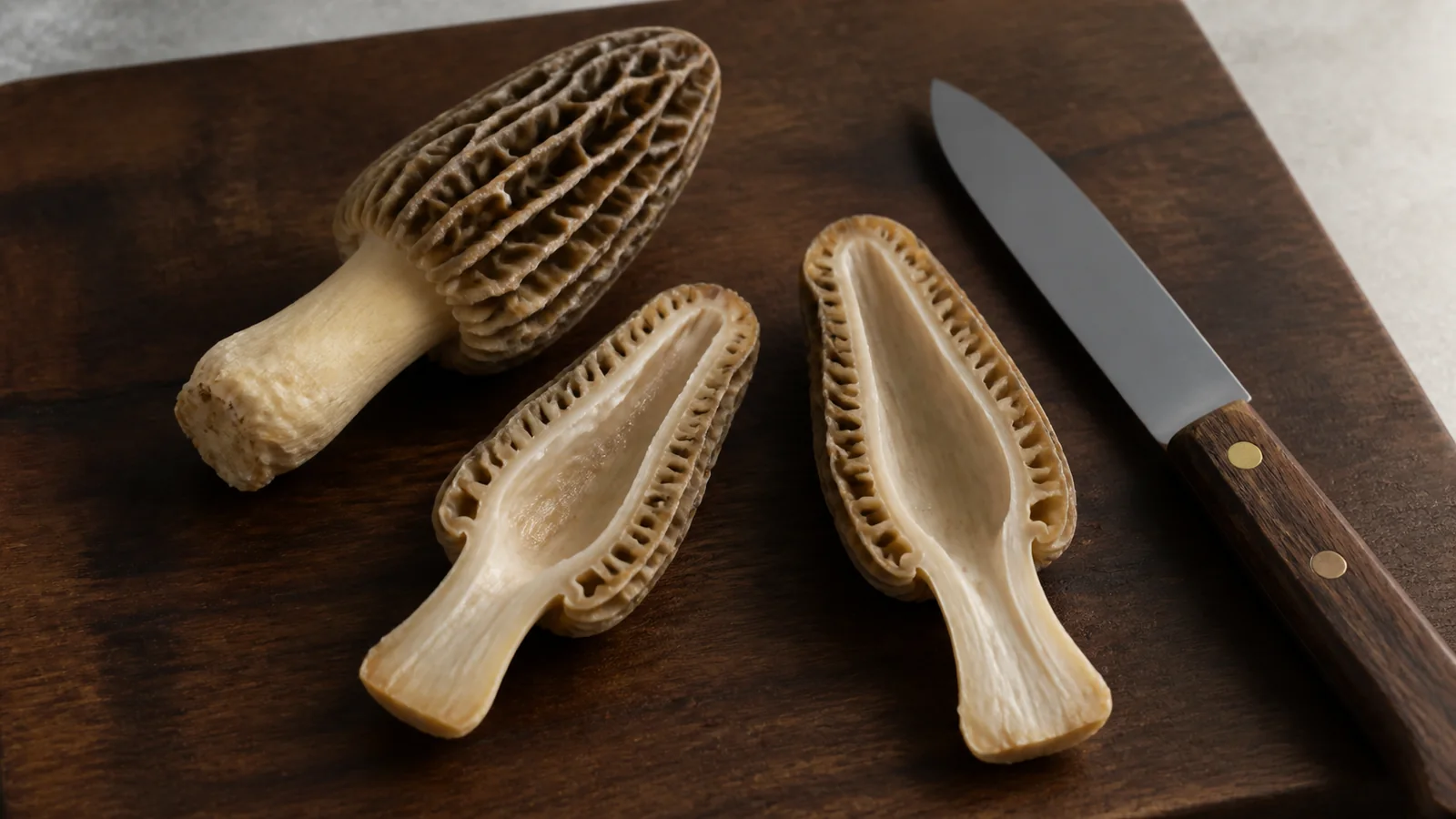
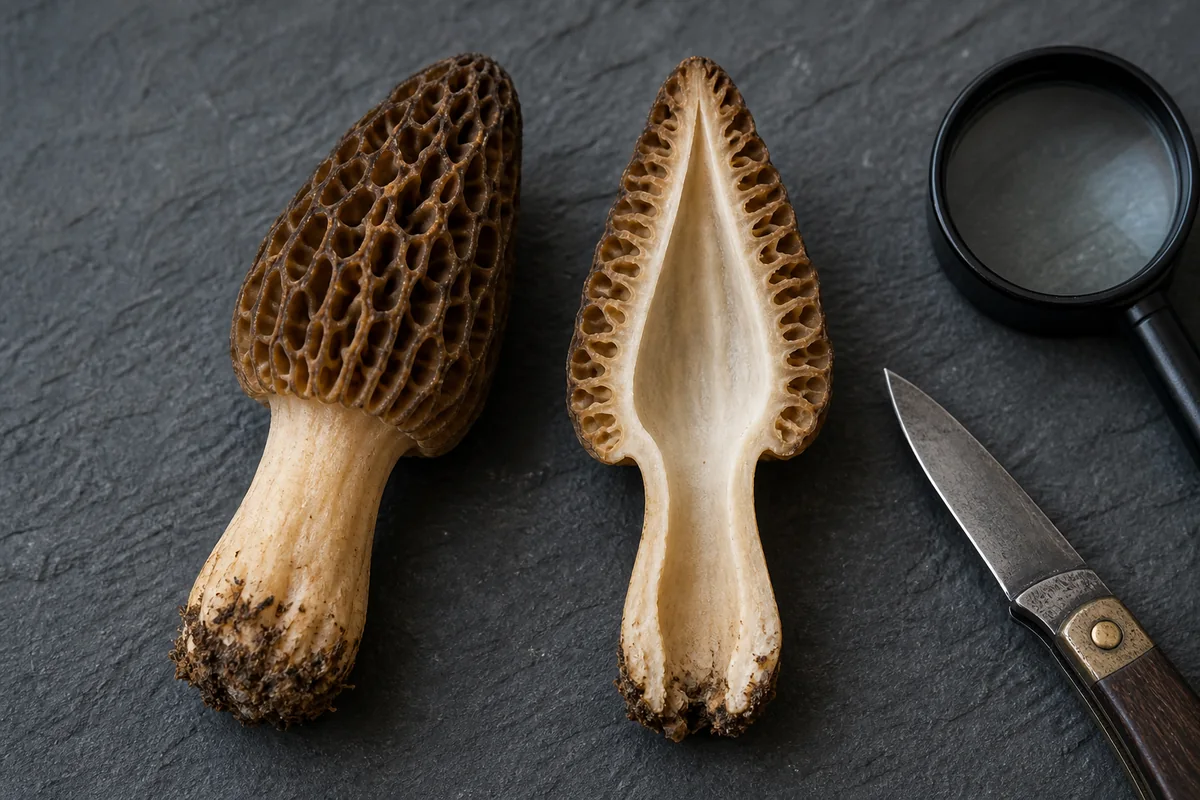
True morels belong to the genus Morchella. Their caps have distinct pits and ridges, and the fruit body is hollow through the cap and stem when cut lengthwise.
Those features are useful for rejecting a conflicting mushroom, but hollow is not a complete identification. Cap attachment varies among true-morel groups, and damaged or processed mushrooms can hide the features an experienced identifier would compare.
False morel is a market and foraging name applied to mushrooms outside Morchella, including species of Gyromitra and Verpa.
Those names can include species with gyromitrin or related hazards that can cause vomiting, diarrhea, dizziness, loss of coordination, seizures, liver and kidney injury, and death.
FDA has detained canned and dried products sold as morels after finding toxic species in the shipments. That history matters because a sealed package can preserve a seller and lot number while still containing the wrong mushroom.
Heat is not a rescue plan for a false morel. FDA warns that high temperature can break down some gyromitrin, but toxins may remain after cooking and still cause serious illness.
An intact batch from a knowledgeable commercial supplier leaves more evidence than a bag of broken caps.
When the batch is wild, a qualified local identifier is the right person to examine it because photographs and identification apps cannot assess texture, attachment, habitat, odor, and every specimen in the basket.
Mixed collections deserve a strict rejection. One true morel does not certify the mushroom beside it, and a loose false morel can travel through cleaning and cooking with the rest of the batch.
The general morel name also covers several true Morchella groups. You do not need a species-level taxonomy lesson to eat a reputable product, but the supplier or identifier must be able to place the batch inside true Morchella rather than relying on resemblance.
SafetyAre Hedgehog Mushrooms Safe During Pregnancy?Traceability disappears as morels are sliced and dried
Fresh whole morels preserve the cap, stem, attachment, hollow interior, and present condition. Every processing step removes some of that evidence and transfers more responsibility to the person or business that named the mushroom before processing.
Cultivated is useful source information, but it is not a safety finish line because the Montana mushrooms were cultivated true morels that received inadequate cooking.
Use the form of the product to decide how much proof the source must provide.
- A fresh commercial batch should name Morchella, identify the supplier, keep the mushrooms intact, and arrive dry and firm.
- A sealed package of dried whole morels should preserve the processor, lot or date, species claim, and recognizable pieces.
- A restaurant should be able to say that the mushrooms are true morels and explain how they were cooked from raw.
- A gift or mixed wild basket should come from the qualified person who identified every specimen and kept unlike species separate.
- An unmarked powder, loose dried mix, or anonymous online bag leaves too little identity evidence for a pregnancy meal.
Montana health officials advise choosing morels that are dry and firm while rejecting bruised or slimy specimens. A valuable spring mushroom is still perishable food, and price does not reverse decay.
- Form
- Whole mushrooms preserve more visible identity evidence than slices or powder
- Condition
- Dry and firm belongs in the kitchen, while slime, mold, sour odor, or collapse belongs in the trash
- Cold storage
- Keep fresh morels at 40 F or below
- Package
- Use breathable packaging such as a paper bag instead of trapping moisture in sealed plastic
- First serving
- Keep the portion modest and serve no other unfamiliar wild mushroom in the same meal
Those condition and package checks protect both the mushrooms and the evidence needed to reject a doubtful batch.
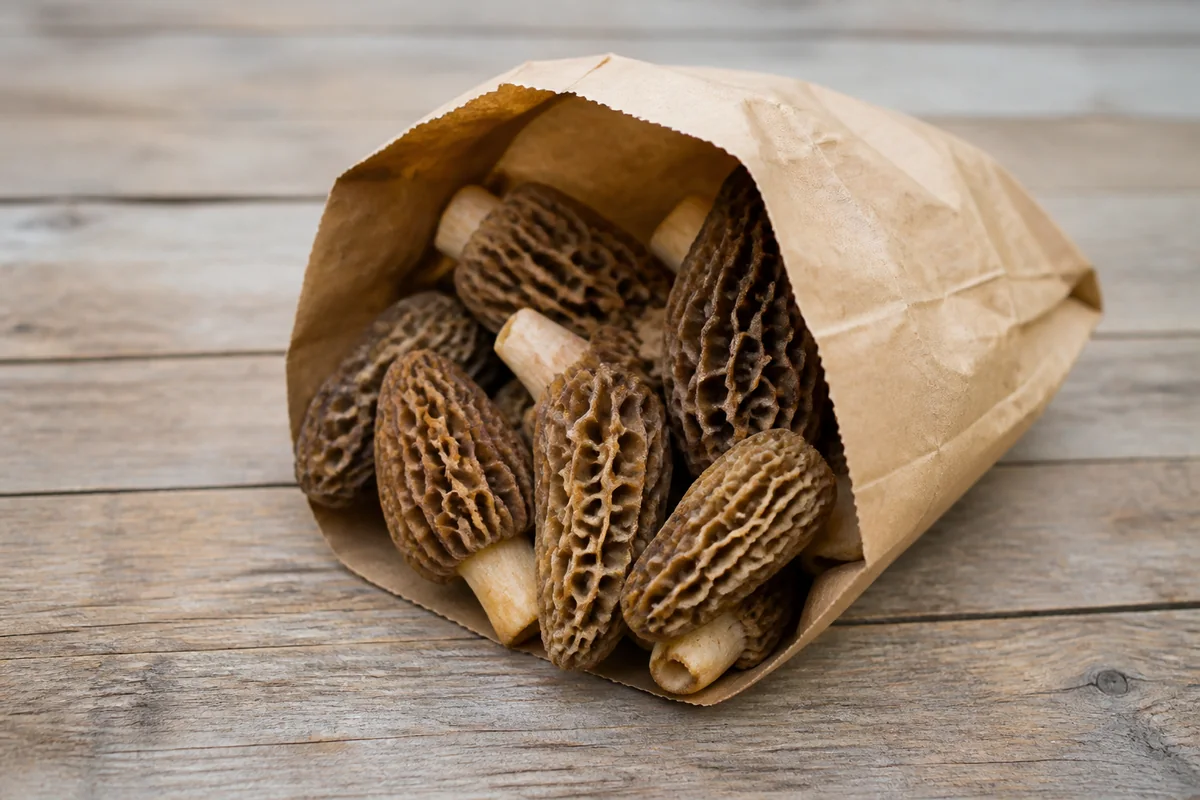
Inspect a fresh batch after it reaches refrigerator temperature, not only under flattering market light. Press the stem gently, smell the open bag, and look into the pits for mold, insects, wet decay, or broken material from another species.
Fresh morels belong in a clean refrigerator promptly because FDA places mushrooms among perishable produce stored at 40 F or below.
Once refrigerated, keep morels away from raw meat and from utensils that touched it because species identity does not prevent ordinary cross-contamination.
Dried morels need the same source check and a complete cooking step after rehydration. Drying concentrates the product and changes its texture, but it is not the sustained heating that public health agencies recommend.
If restaurant staff cannot confirm true morels and thorough cooking, choose a cultivated mushroom dish with a clear supply chain and a method the kitchen can describe.
SafetyAre Oyster Mushrooms Safe to Eat During Pregnancy?Hot sauce over raw morels did not count as cooking
One outbreak preparation poured a boiled sauce over raw morels and left them in the marinade for 75 minutes. Investigators still classified the mushrooms as partially cooked because hot liquid touching the surface did not establish sustained heat through every piece.
Official guidance says to cook morels thoroughly, but it does not publish one universal time or internal temperature. A precise number would look reassuring while outrunning the evidence.
So start by opening the mushroom.
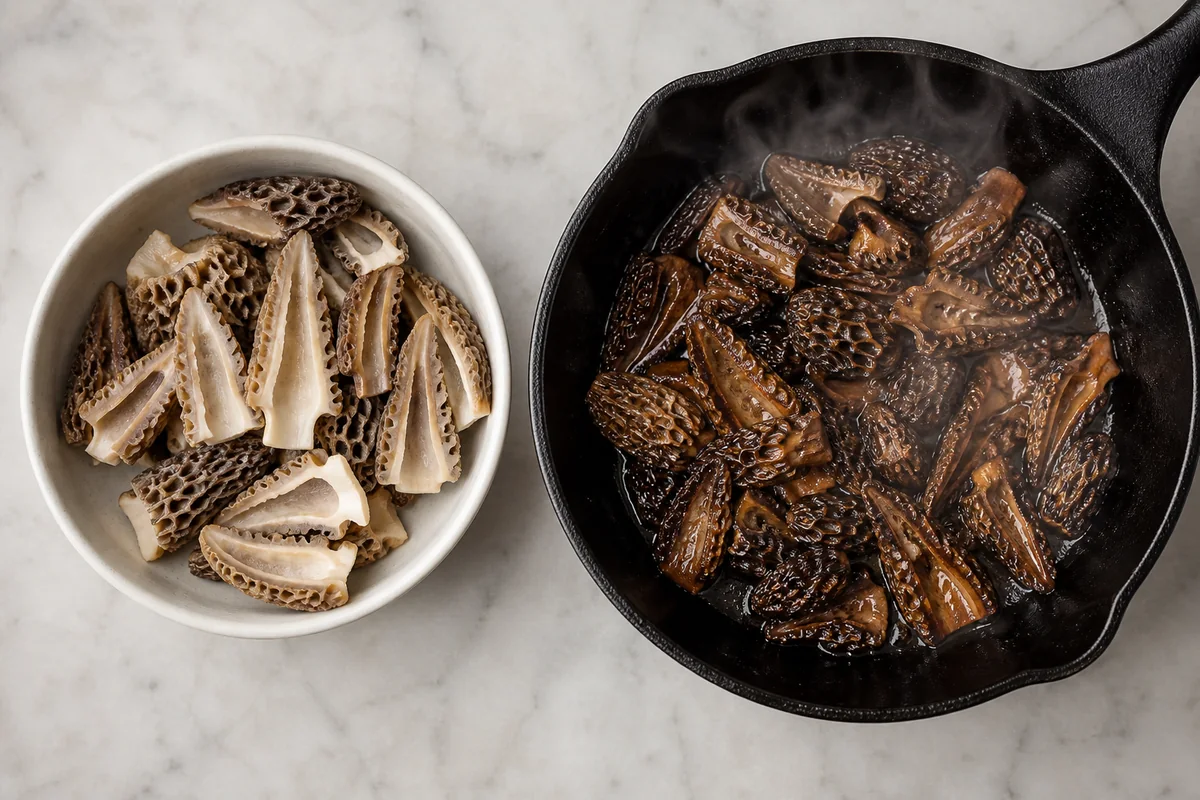
Split each morel lengthwise so the hollow center, thick stem, insects, grit, and hidden decay are visible. Rinse under cool running water, remove damaged areas, and skip soap or produce cleanser because FDA pregnancy guidance calls for water rather than household chemicals.
Pat the pieces dry and move them to a clean pan in one uncrowded layer. Crowding traps released moisture and can leave thick mushrooms warming in liquid while the cook assumes that steam means every center is finished.
Warning
A cold marinade, raw garnish, quick blanch, brief sear, or hot sauce poured over raw morels does not meet the outbreak evidence for thorough cooking. Heat every piece through as the cooking step itself.
The mushrooms should steam, shrink, soften, and continue cooking until the surfaces brown and the centers are hot and tender. Add a finishing sauce after that endpoint rather than asking the sauce to perform the cooking.

This cooking sequence is observable without pretending that color alone proves safety.
- Inspect and split every fresh or rehydrated piece.
- Rinse away grit, then dry the surface with a clean towel.
- Cook in a single layer so every morel receives sustained heat.
- Continue past the first steam until the tissue has shrunken and become tender throughout.
- Keep raw mushrooms and their utensils away from food that will not receive more heat.
A thick whole morel can brown outside before its center receives the same treatment, which is why splitting serves both inspection and cooking. Very large specimens can be divided again rather than given a longer guess.
Rehydrated dried morels should be lifted from their soaking liquid so settled grit stays behind, rinsed if needed, and cooked completely. Do not stir raw morel powder into a finished sauce after the heat is off.
Chill cooked leftovers promptly in a shallow covered container because thorough cooking resolves one stage of risk while careless storage can introduce another.
Symptoms can start before the table is cleared
The severe Montana cases developed gastrointestinal symptoms rapidly, with a median onset of one hour among people whose medical records were reviewed. Profuse vomiting and diarrhea produced clinically documented dehydration.
Nausea, abdominal pain, diarrhea, vomiting, bloating, loss of appetite, fatigue, and dizziness all appeared in the investigation. A rapid start after a morel meal is enough reason to call even if another diner feels well.
Call Poison Control in the United States at 1-800-222-1222, or the local poison service, when morels were raw, lightly cooked, mixed, incorrectly identified, or followed by symptoms.
State the pregnancy during the first call and give the meal time, portion, source, product form, cooking method, and symptom times.
Do not induce vomiting or use a home remedy unless a clinician directs it. Emergency services are appropriate for collapse, seizure, severe confusion, trouble breathing, inability to wake, or signs of severe dehydration.
Keep the evidence because the specific toxic agent in true morels remains unknown.
- Refrigerate uncooked specimens, cooked leftovers, trimmings, and rehydrated pieces in separate containers.
- Save the package, receipt, seller or restaurant name, lot mark, and photographs taken before cooking.
- Record what every diner ate and when each symptom began.
- Tell the specialist whether the batch was fresh, dried, powdered, cultivated, foraged, or mixed with another mushroom.
Feeling well after one hour does not clear an uncertain mushroom because other mushroom syndromes can begin later. The safe endpoint is the advice of the poison specialist or clinician who can assess the actual batch, preparation, symptoms, and pregnancy.
Sources & References
- Outbreak Linked to Morel Mushroom Exposure, Montana, 2023, CDC MMWR
- Investigation of Illnesses: Morel Mushrooms, FDA
- Morel Mushrooms, Montana Department of Public Health and Human Services
- Safer Food Choices for Pregnant Women, CDC
- Fruits, Veggies and Juices, Food Safety for Moms-to-Be, FDA
- Selecting and Serving Produce Safely, FDA
- Import Alert 25-02, Morel Mushrooms Due to Adulteration, FDA
- Harvesting Morel Mushrooms, University of Minnesota Extension