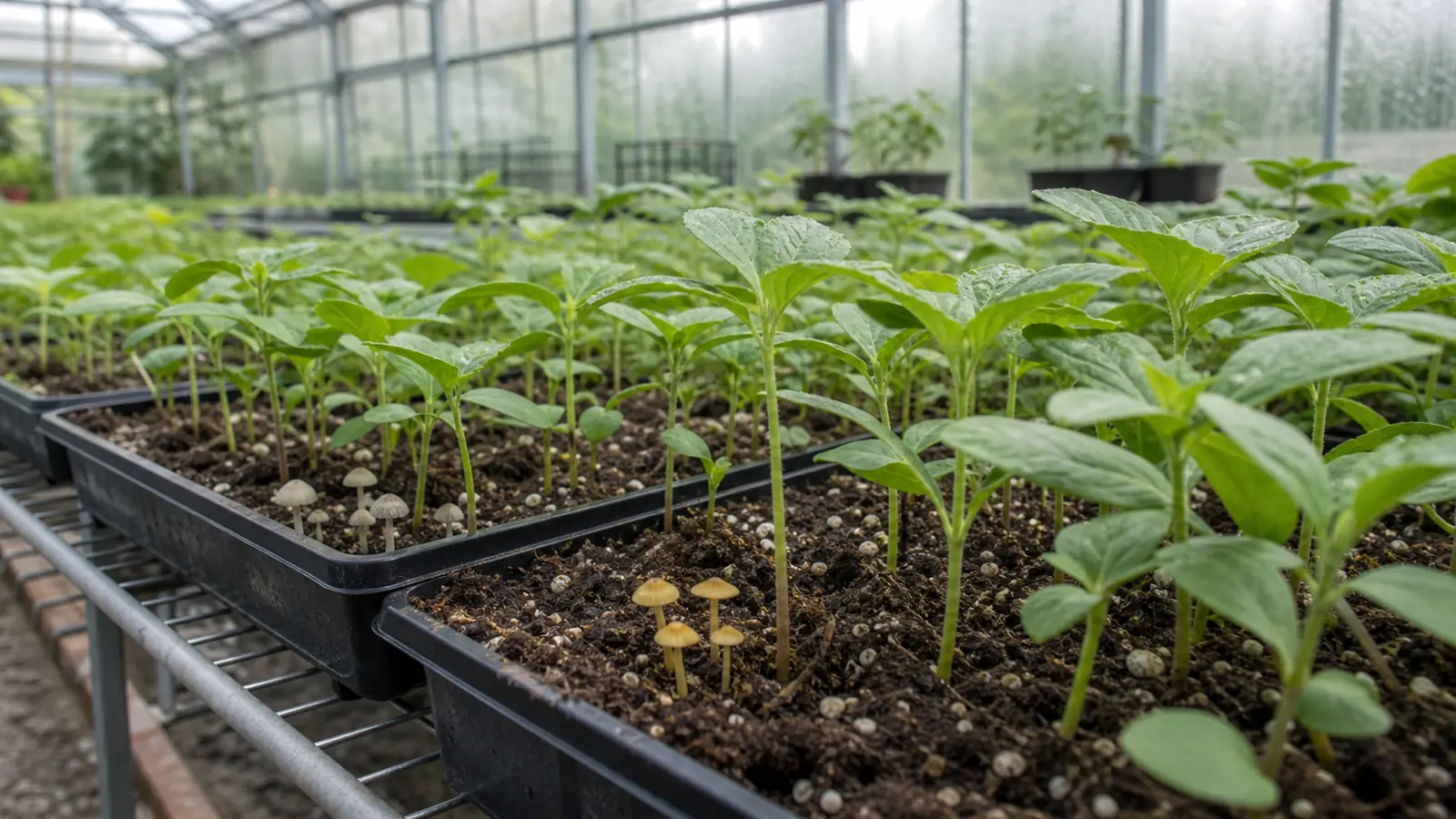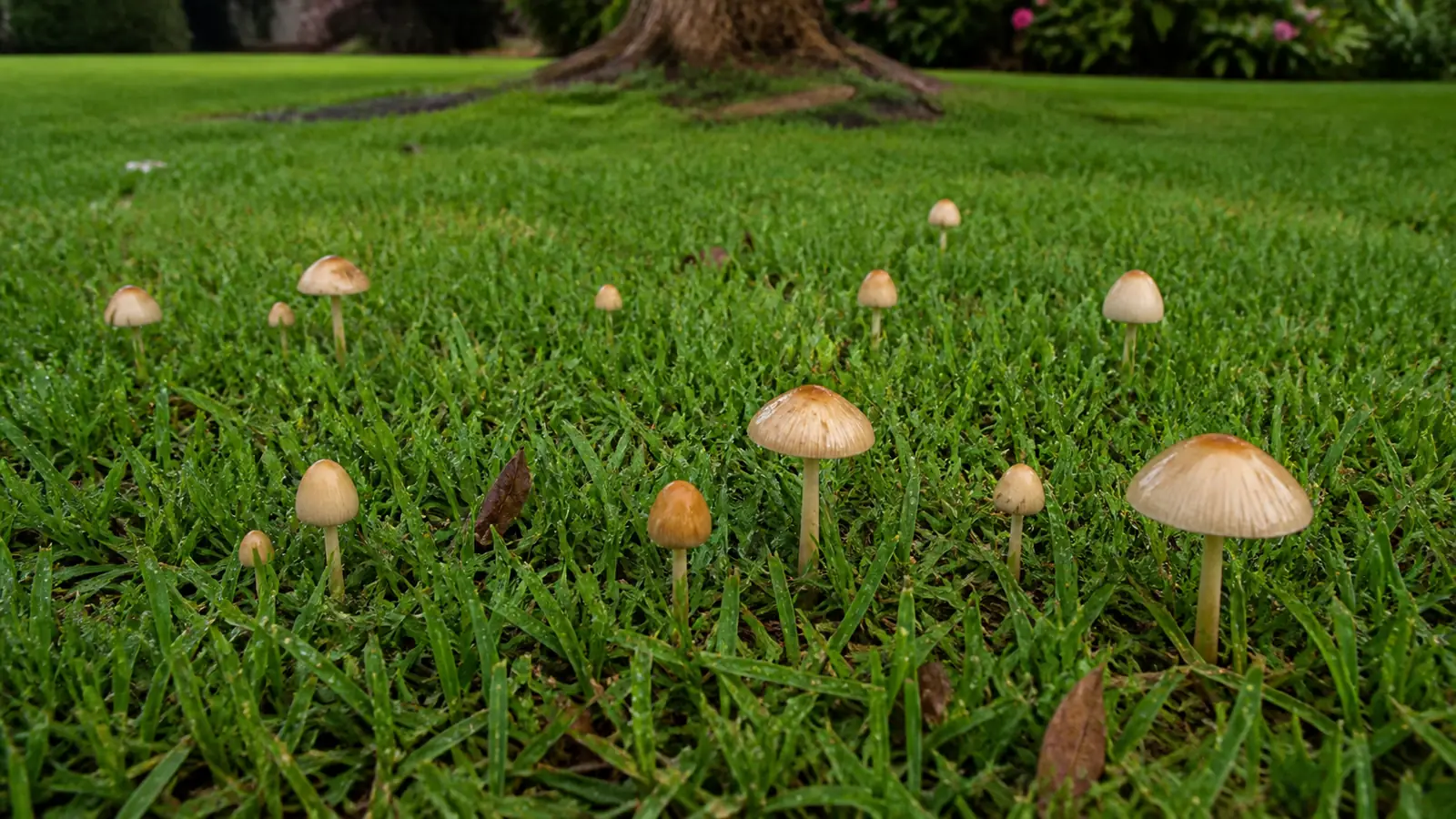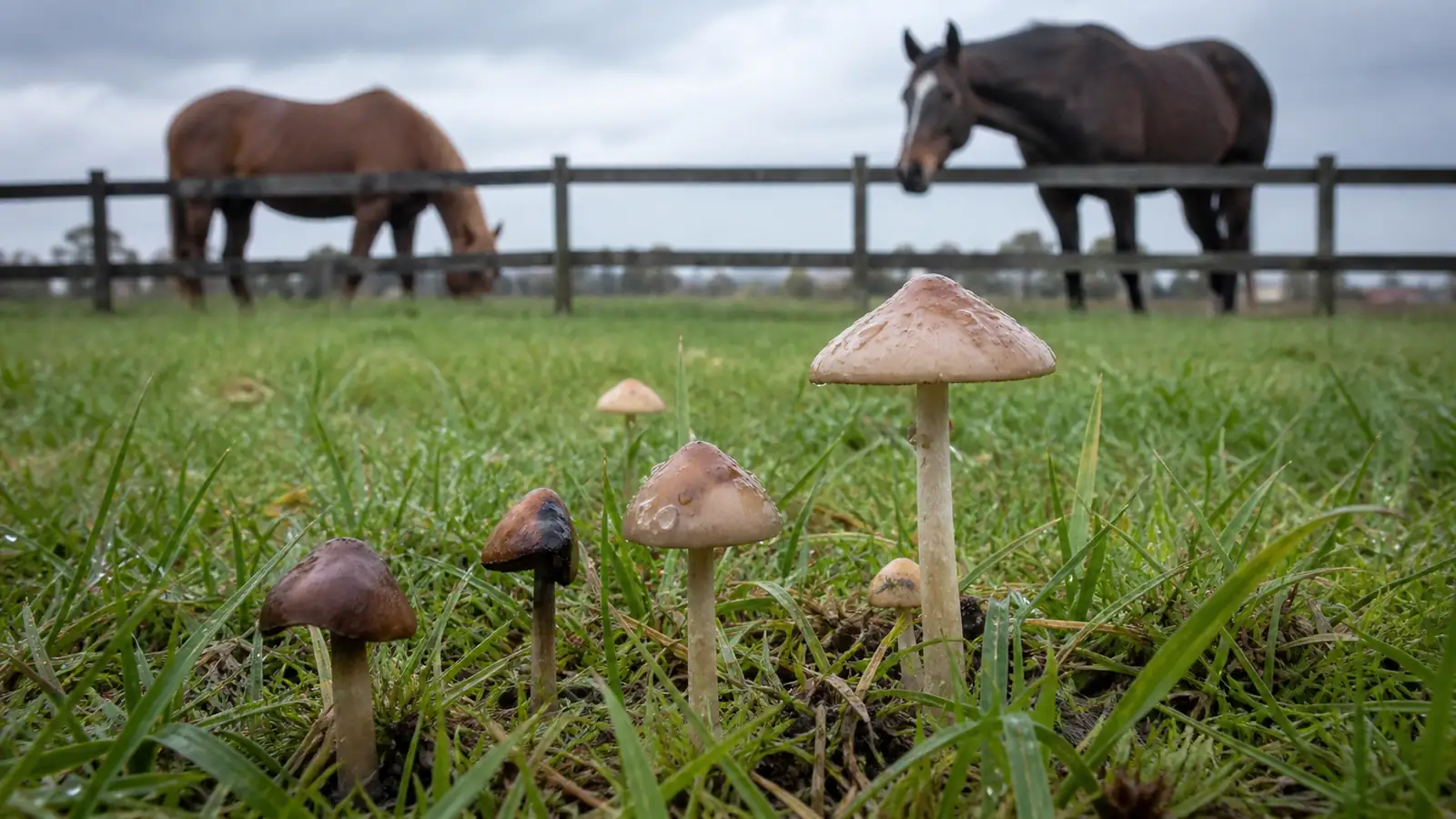
Pasture mushrooms can arise from dung, grass thatch, buried wood, or wet organic matter. Large-animal poisoning is uncommon but possible, so remove access, preserve evidence, and call a veterinarian after suspected ingestion.
Mushrooms in a horse pasture can fruit from manure, grass thatch, buried roots, old wood, or another wet organic pocket after rain. Many pasture fungi are harmless decomposers, but an unknown flush should not remain accessible to horses because toxic species can occur and visual identification is difficult.
Protect the animals first, then document the field evidence before removing the caps. Species identification becomes more useful when the photograph includes the substrate, full base, underside, growth pattern, and nearby trees.
What Mushrooms Grow in Horse Pastures?
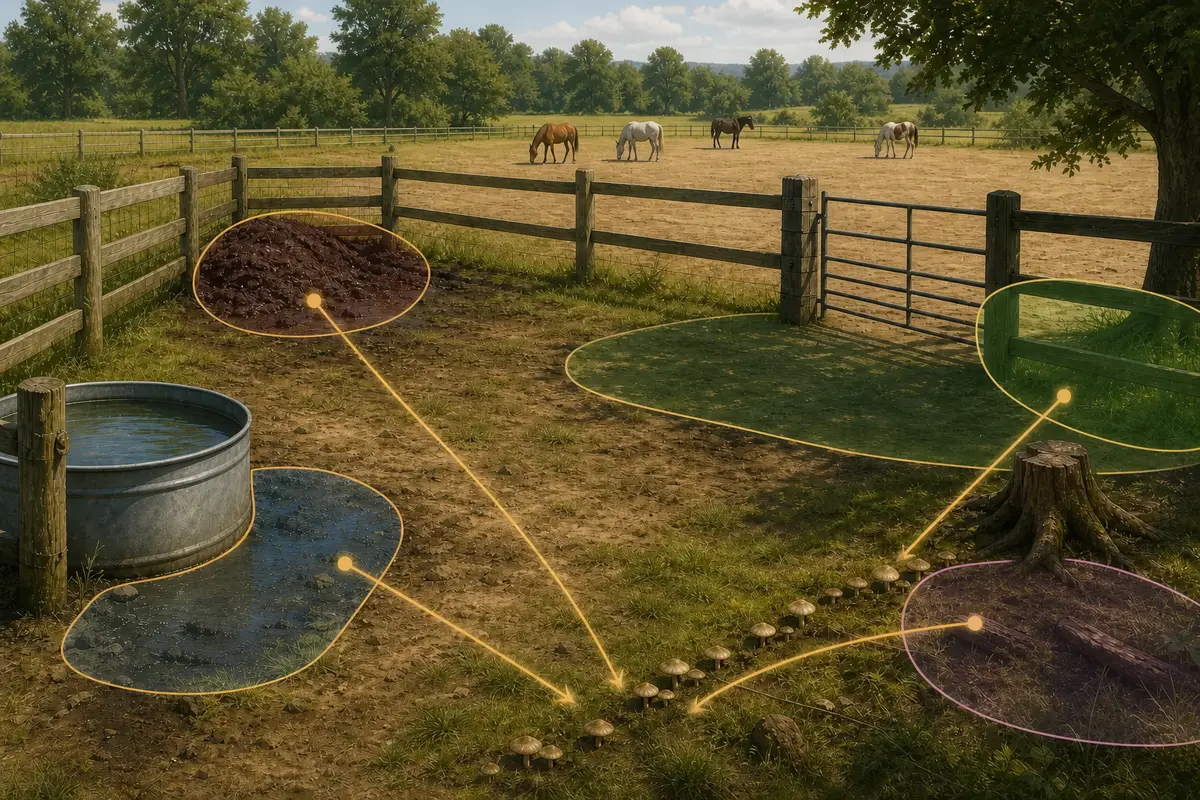
A pasture is not one uniform habitat.
Closely grazed grass, manure piles, fence lines, shaded trough areas, buried stumps, and compacted wet gateways can support unrelated fungi within a few yards.
| Fruiting pattern | Likely food source | Evidence to record | Important limit |
|---|---|---|---|
| Small caps directly on dung | Manure decomposer | Confirm direct attachment, cap change, gills, spore color, and dung age | Dung habitat does not establish edibility |
| Arc or ring through grass | Soil or thatch colony | Map the ring, grass response, cap spacing, and complete specimens | Several groups can form rings |
| Cluster near a stump or fence line | Buried root or wood | Trace the line, expose one full base, identify nearby wood when possible | The food source may be below ground |
| Scattered caps in a low wet area | Soil organic matter | Note drainage, recent rain, compaction, and body form | One wet flush can contain multiple species |
Four live profiles show recognizable pasture candidates, but the shared habitat does not make a photograph sufficient for identification.
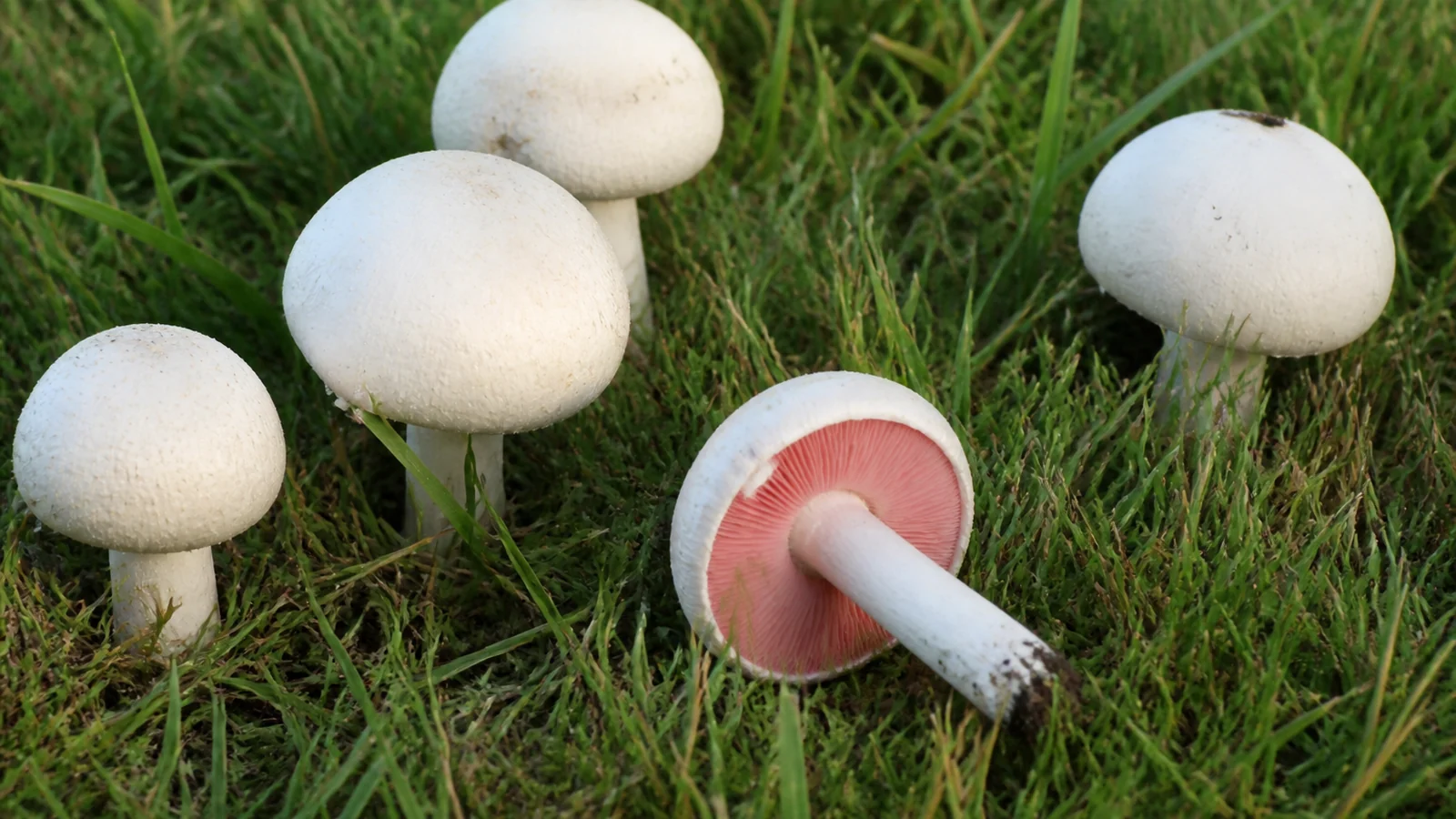 Short grazed grassField MushroomYoung gills begin pink and darken brown; confirm the complete plain stem base.
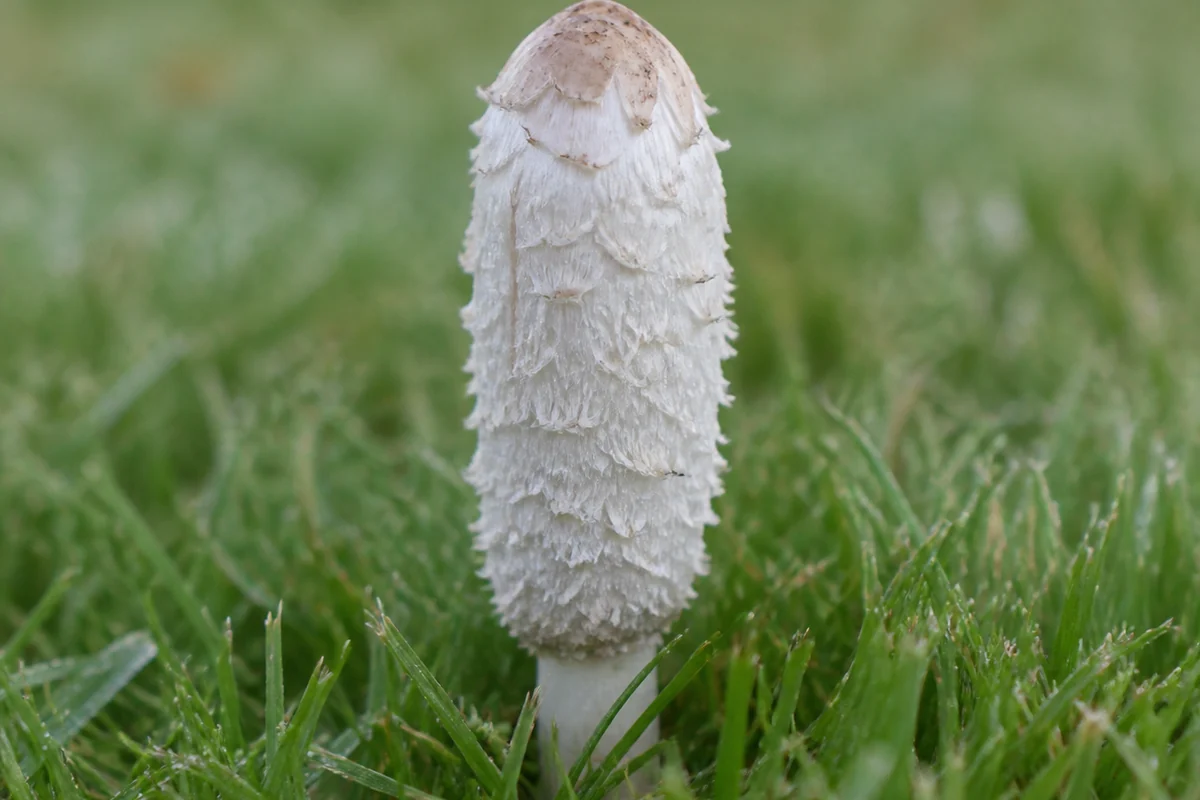 Disturbed pasture edgesShaggy ManeThe tall shaggy white cap blackens and dissolves as it matures.
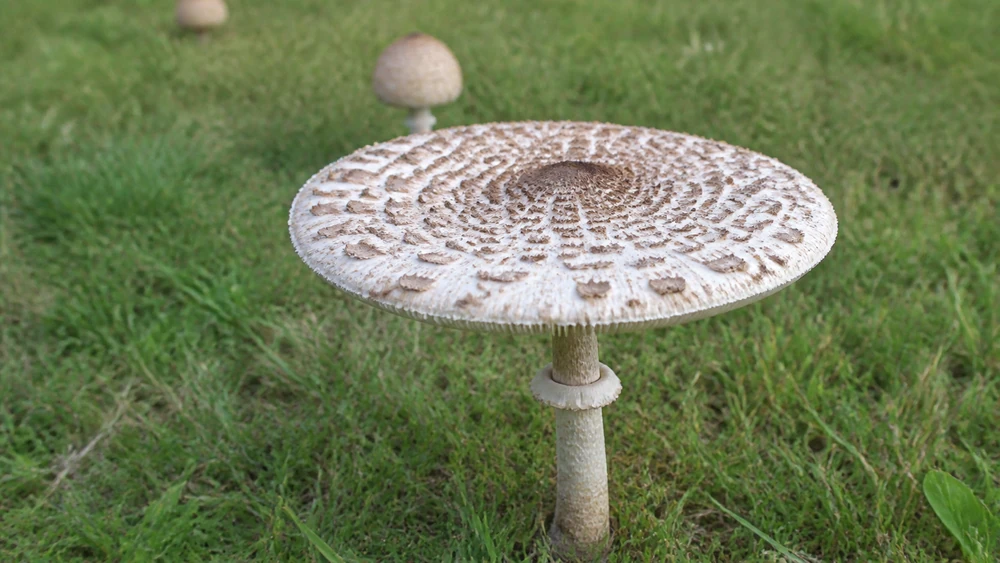 Warm lawns and grazed grassGreen-Spored ParasolA large scaly cap can leave a greenish spore print; poisonous.
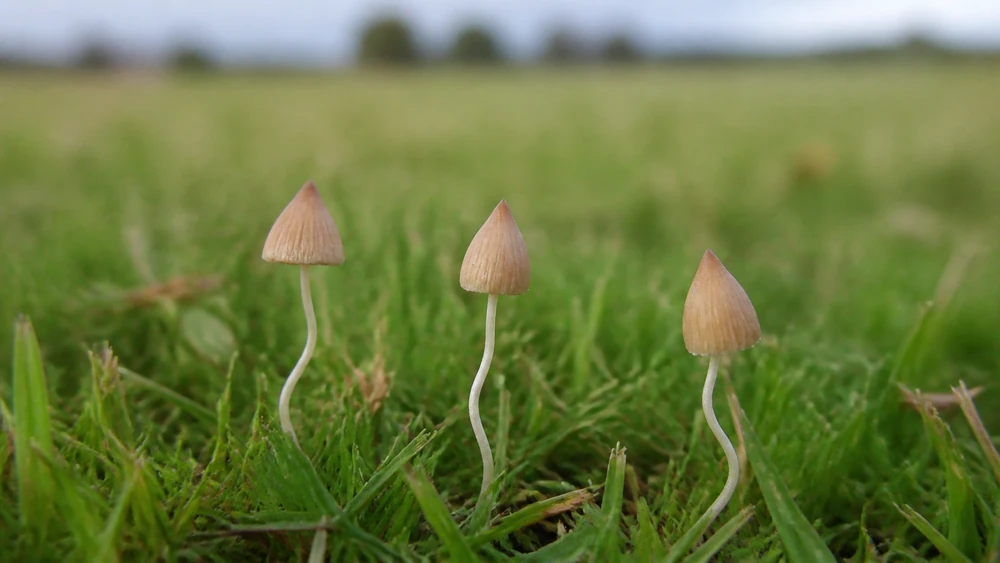 Grazed acidic grasslandLiberty CapThe small pointed cap grows from decaying grass roots rather than directly from dung; poisonous.
Color is a weak first filter. White field caps can overlap with pale toxic mushrooms, while small brown dung caps can belong to several groups that require mature gills, a spore deposit, and sometimes microscopy.
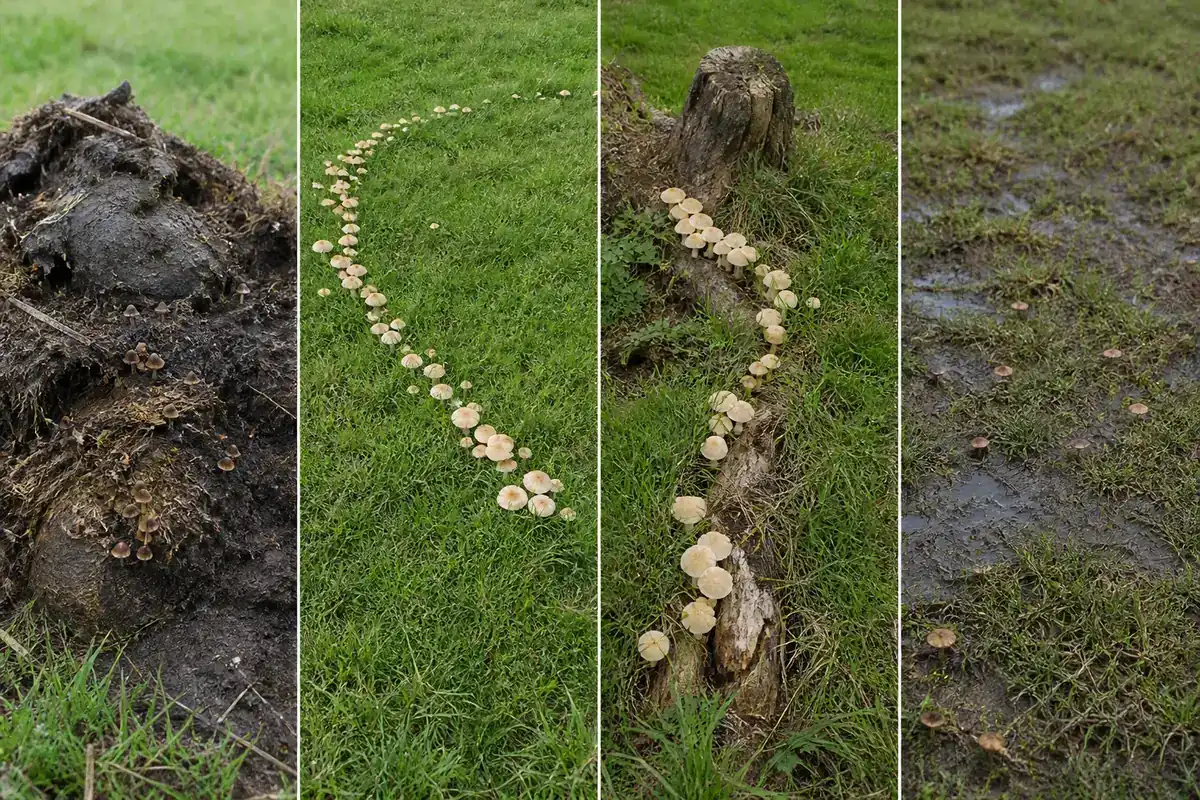
Use field photographs to preserve evidence before a mower, hoof, sun, or rain destroys it. Start with the entire patch, then move close enough to show the cap, underside, stem surface, and uncut base.
- Mark the exact paddock, date, recent rainfall, and first time the flush was seen.
- Show whether the cap attaches to dung, soil, thatch, wood, or a root line.
- Photograph young and mature specimens because gill color and cap shape can change.
- Include nearby trees, water troughs, hay stations, and manure-storage areas.
- Keep one intact specimen away from animals if a veterinarian or diagnostic service requests it.
Do not use the common name horse mushroom as a field shortcut. A name associated with pasture or manure does not make every large white cap the same species.
Can Pasture Mushrooms Poison Horses?
Mushroom poisoning is reported less often in large animals than in dogs or people, but it remains possible.
University of Kentucky equine toxicology guidance recommends monitoring pastures and removing mushrooms rather than assuming a horse will avoid them.
Toxic mushrooms can contain amatoxins, muscarine, ibotenic acid, muscimol, gyromitrin, orellanine, psilocybin, or other compounds. Amanita, Galerina, and some Lepiota species can contain amatoxins that damage the liver.
A horse with abundant suitable forage may be less likely to investigate unfamiliar caps. Hunger, overgrazing, curiosity, confinement near a flush, or mushrooms mixed into cut forage can change that behavior, so good grass is risk reduction rather than a guarantee.
Warning
Keep horses off an unknown active flush | Fence or move horses away, photograph the undisturbed patch, pick visible fruiting bodies, and patrol again after rain. If ingestion is possible or the horse is unwell, call the attending veterinarian or an emergency equine service immediately.
Wear gloves when collecting material contaminated with manure or chemicals, then wash after the task. Store specimens in a paper container rather than a sealed wet plastic bag when a specialist asks for a sample.
Mushrooms are not the only fungal pasture hazard. Moldy hay, ergot bodies on seed heads, endophyte-associated fescue problems, and fungal toxins on clover involve different organisms and exposure routes.
A cap-free field therefore does not certify the forage. Feed inspection and pasture-plant management still matter independently.
IdentificationWhat Are the Tiny Bird's Nest Fungi in Your Mulch?When Are Horses Most Likely to Reach Pasture Mushrooms?
Exposure depends on access and feeding conditions as much as the number of caps. A flush inside a closely grazed sacrifice area presents a different opportunity from the same mushrooms behind a fence in grass with ample forage.
Inspect where the horse actually spends time. Gateways, trough approaches, shade trees, hay-feeding circles, and fence corners concentrate hooves, manure, spilled feed, and water while also limiting the animal's choices.
| Pasture situation | Why access increases | Immediate control |
|---|---|---|
| Short or overgrazed paddock | Caps stand among the limited forage available | Move horses, provide suitable forage, and rest the area according to the farm plan |
| Flush beside a trough or shade | Horses repeatedly occupy the same small zone | Fence the patch and correct overflow or persistent wetting |
| Mushrooms mixed with cut grass or hay | The animal cannot sort intact caps from the feed as easily | Stop feeding the affected material and call the veterinarian if intake is possible |
| New horses or curious young animals | Individual investigation behavior is unpredictable | Increase patrols and remove access instead of relying on avoidance |
| Night turnout after warm rain | A fast flush can appear between daylight inspections | Walk mapped hotspots before turnout and again after the weather changes |
Do not interpret normal appetite as proof that a horse ignored the patch. Hoof disturbance, missing caps, and fragments in the grazing zone can narrow the exposure window even when nobody witnessed a bite.
The most useful prevention decision is often temporary access control. Species identification can continue from saved evidence after the horses are safely away from the flush.
IdentificationWhy Are Mushrooms Growing Under Your Deck?What Should You Do if a Horse May Have Eaten a Mushroom?
Call a veterinarian as soon as ingestion is suspected.
Do not wait for a species name or for obvious illness, because the mushroom may disappear and some serious toxin syndromes begin after a delay.
Move the horse away from the source without creating a stressful chase. Keep other animals out of the same area and record the earliest possible exposure time.
Chewed caps or witnessed intake
Call the veterinarian immediately and report the estimated time, amount, horse size, and current conditionDirect evidence of intake matters even when the animal still appears normal.
Disturbed patch but no witnessed intake
Photograph remains, count missing or damaged caps when possible, remove access, and call for case-specific adviceHoof damage and grazing can make the amount uncertain.
Colic, diarrhea, drooling, weakness, tremors, incoordination, depression, or collapse
Treat the situation as an emergency and follow the veterinary service's transport and safety directionsThese signs have many causes and cannot be diagnosed from the pasture alone.
Old flush found with no illness
Remove remaining caps, preserve representative material, patrol the paddock, and discuss risk factors with the veterinarianDelayed discovery weakens timing evidence but does not justify a home test.
Give the veterinarian a compact evidence packet.
- Horse age, weight, medical conditions, pregnancy status, medications, and normal diet.
- Paddock location, suspected time window, weather, and access duration.
- Clear photographs of the patch, complete specimens, underside, and substrate.
- Observed signs with exact start times and changes.
- Any other animals exposed and whether they show signs.
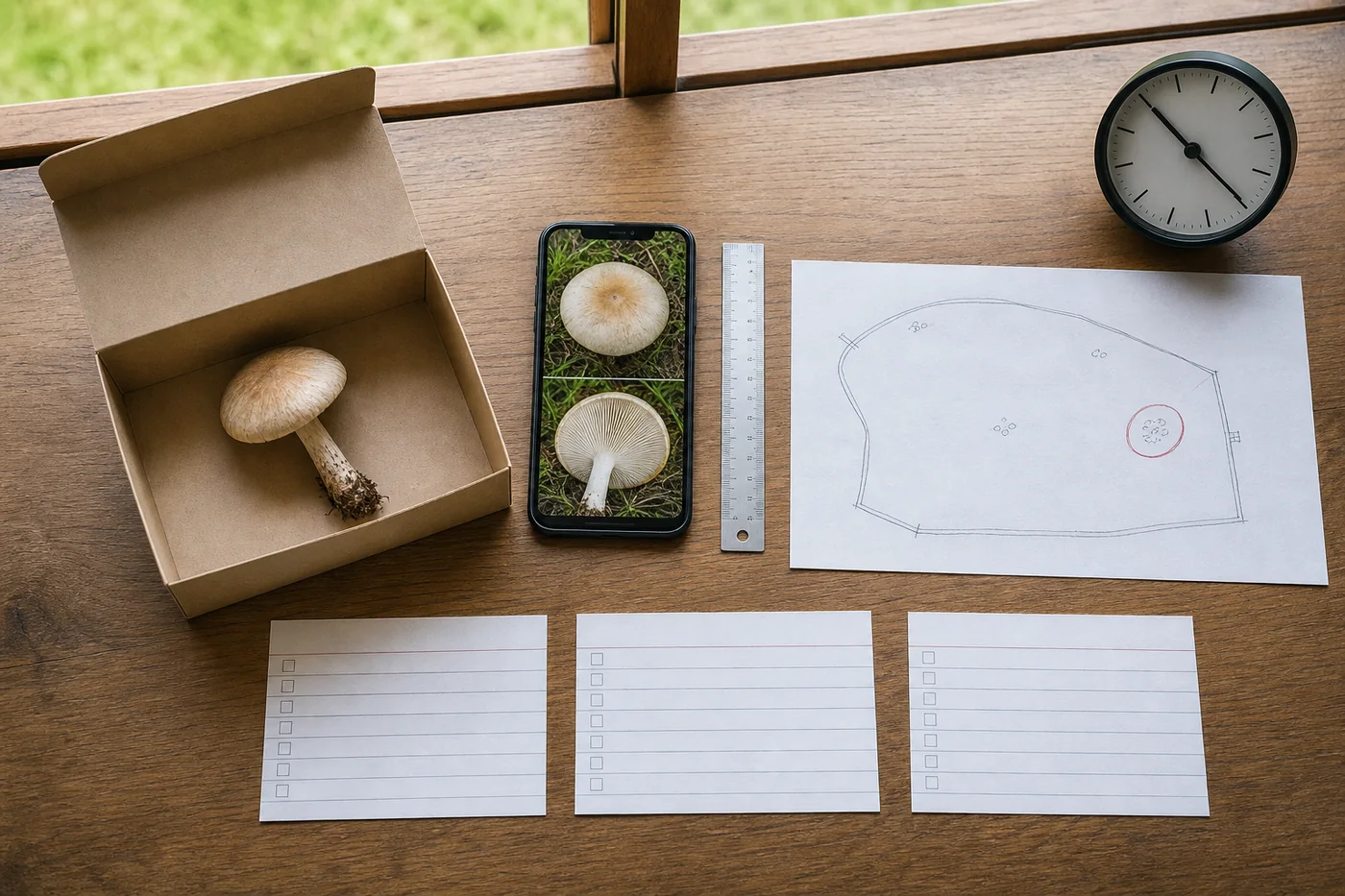
Merck Veterinary Manual notes that onset time helps guide prognosis and treatment.
Signs within a few hours may differ from syndromes that begin after six hours, but mixed mushrooms in one area can make timing less reassuring.
Do not induce vomiting, administer charcoal, oil, salt, milk, or another home remedy unless the veterinarian directs it. Horses cannot vomit normally, and an improvised treatment can add aspiration, colic, electrolyte, or medication risk.
Save the mushrooms and photographs, but never delay urgent animal care while trying to identify them online. The veterinarian may consult a toxicologist, diagnostic laboratory, mycologist, or poison service as the case requires.
How Can You Reduce Mushrooms in a Horse Pasture?
Permanent elimination is unrealistic because fungal networks and spores are part of pasture soil.
The practical goal is to reduce access during flushes and correct repeatable wet organic hotspots.
Walk high-risk areas after warm rain, especially around troughs, shade, manure accumulation, fence lines, old stumps, hay stations, and low compacted ground. Small caps can open and collapse between routine weekly checks.
Picking or mowing removes fruiting bodies for a short period but leaves the underlying fungus.
Hand removal is more controlled around a small flush because mowing can scatter pieces and miss caps below the cutting height.
Do not spread manure mechanically through a paddock during conditions that will leave wet clumps accessible and poorly broken down. Follow local nutrient-management, parasite-control, and pasture-rest recommendations because farm conditions differ.
Broad fungicide treatment is rarely a sensible pasture answer.
A product must be labeled for the specific site, target, and grazing use, and chemical treatment does not repair a leaking trough or remove buried wood.
A pasture can still fruit after sensible corrections because rain and natural decomposition continue. Success means fewer accessible caps, faster detection, healthy forage, controlled wet spots, and a clear veterinary response plan if exposure occurs.
Sources & References
- Merck Veterinary Manual Animal mushroom toxins, onset timing, and veterinary care.
- University of Kentucky Equine Programs Equine amatoxin risk and pasture removal.
- University of Kentucky Livestock Disease Diagnostic Center Wet-weather pasture flushes and large-animal risk.
- Penn State Extension Horse forage and pasture management.