
A provenance audit of mushroom hair claims, following the reishi 5-alpha-reductase result from enzyme assay to cell line to the steps a swallowed extract would still have to clear, plus the hair loss patterns that change the answer and the supplement minerals that can cause shedding.
Every mushroom hair growth claim currently stops at the same place, which is a laboratory bench.
A commonly quoted finding was measured in a dish of mouse cells. It does not establish hair growth in people taking a mushroom product.
That is not a reason to dismiss the research. It is a reason to know exactly which step you are being sold.
Which mushroom hair claims exist and what each rests on
The category is smaller than it looks once each claim is traced to the study behind it.
| Claim | Species | What was actually measured |
|---|---|---|
| Blocks DHT | Reishi | 5-alpha-reductase activity, in an enzyme assay and later in a cell line |
| Improves scalp circulation | Cordyceps | Blood flow and endurance measures, none of them at a follicle |
| Antioxidant scalp support | Chaga | Antioxidant capacity in laboratory assays |
| Feeds hair with nutrients | Shiitake and others | Copper, selenium and B vitamin content, as food composition |
| Strengthens hair topically | Various | Cosmetic formulation performance, which is a separate category |
Two things stand out from that column on the right. Every entry sits at the level of isolated enzymes, cells or food composition, and not one of them measured hair.

Hair outcomes are not difficult to measure. Trials in this field count hairs in a marked area, photograph the same scalp under standardized light, and weigh shed hair over a fixed period.
Those measurements exist and are routine, which makes their absence from this literature a choice rather than a limitation.
Check the level at which each finding was measured. When a claim appears below, the question is which level it was measured at, and whether anybody carried it further.
Medicinal MushroomsLion's Mane Benefits: What Human Trials Actually FoundWhat the 5-alpha-reductase result actually measured
Reishi carries the only mushroom hair claim with a specific named mechanism, which is why it dominates the category.
The mechanism is real at its own level. Triterpenoids isolated from Ganoderma lucidum were shown to inhibit 5-alpha-reductase in a 2006 study, and that enzyme converts testosterone into dihydrotestosterone, the androgen involved in patterned hair loss.
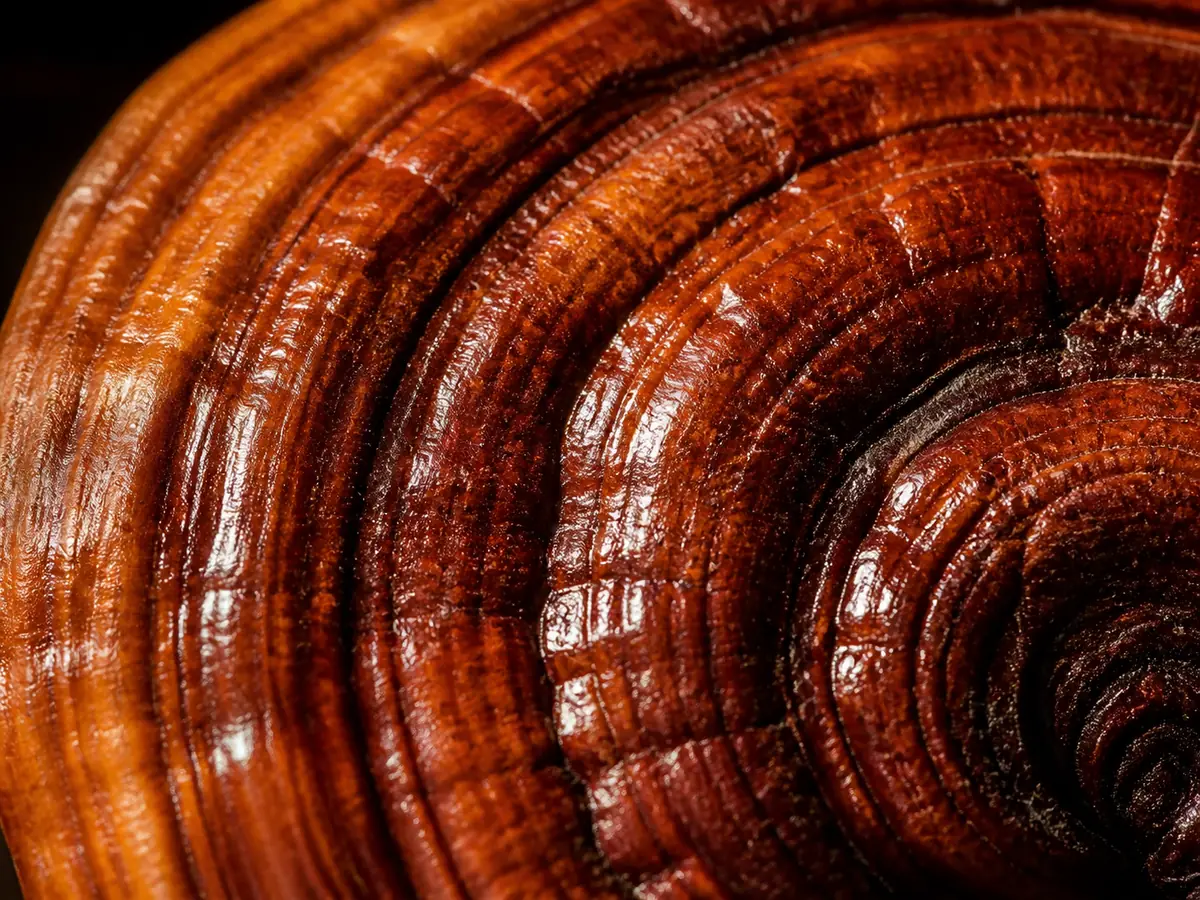
A 2024 dermatology conference abstract took it a step further. A Ganoderma extract suppressed 5-alpha-reductase isoform 2 in a murine fibroblast cell line, and the report compared that suppression with saw palmetto and with finasteride.
That comparison is the sentence doing all the marketing work, and it is worth reading slowly.
Warning
The finasteride comparison was made in a dish of mouse connective tissue cells, at concentrations the researchers chose and applied directly. It is not a comparison of what the two do to hair in people, and no published trial has measured hair outcomes in anybody taking a reishi product.
The saw palmetto half of that comparison deserves a note too. Saw palmetto has been studied in people for hair loss, and the results are mixed and generally weaker than the prescription option it is compared against.
So the abstract compared a mushroom extract against a botanical with modest human evidence and against a drug with strong human evidence, at a level where none of that human evidence applies.
A fibroblast is not a hair follicle. It is a general-purpose connective tissue cell, used because it is cheap, well characterized and easy to grow, and its response tells you the compound can affect that enzyme in cells at all.
That is a genuine result and a modest one. It establishes plausibility, which is where a research program starts rather than where a purchase decision ends.
What would have to be true for an extract to reach a follicle
Grant the enzyme finding completely, and a chain of steps still has to hold before a capsule changes anything on a head.
Reishi triterpenes are large, resinous, poorly water-soluble molecules. That is a difficult profile for oral absorption, and it is the reason these compounds are extracted with alcohol rather than water in the first place.
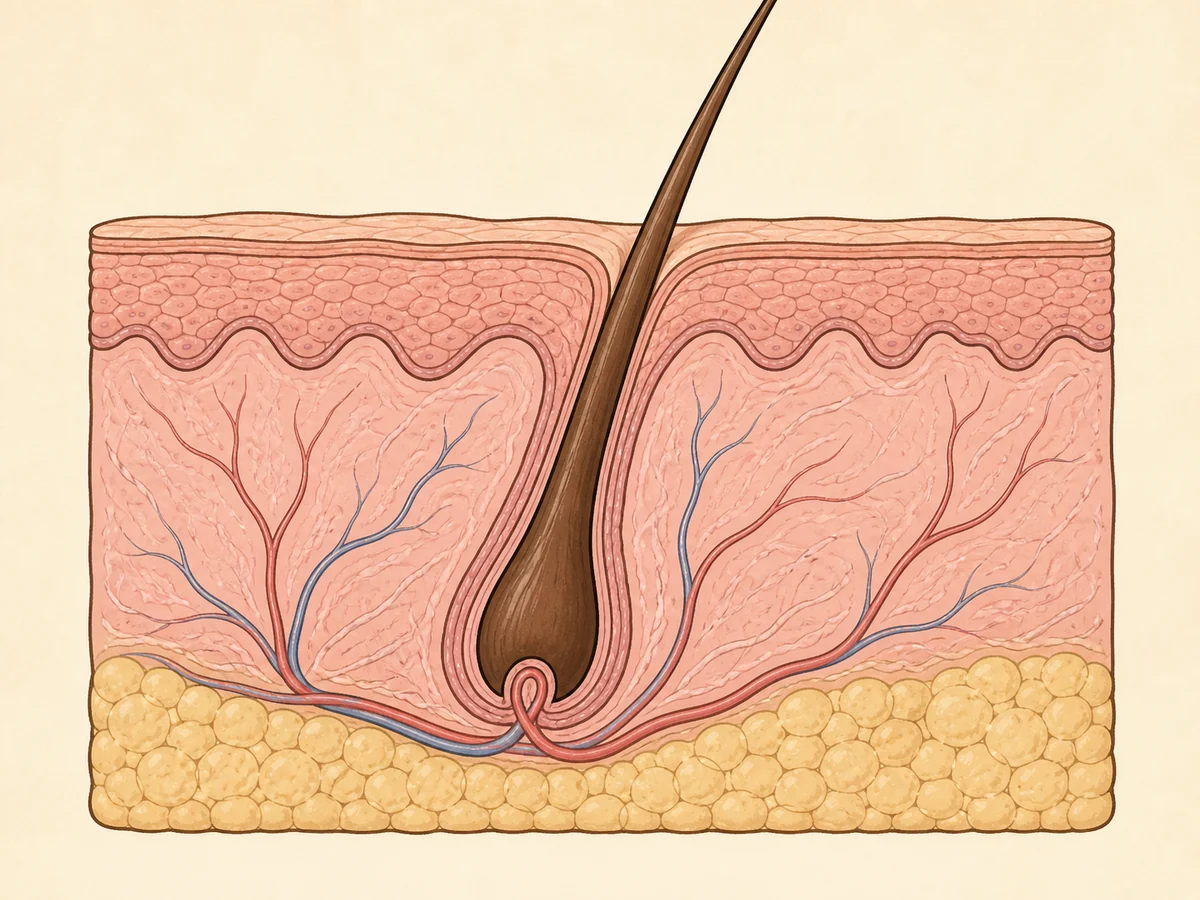
The destination is specific. A hair bulb sits a few millimeters below the surface with a dermal papilla at its base, and it is supplied by a single small capillary loop rather than by any generous blood flow.
There is a working example of why the route matters. Minoxidil is applied to the scalp rather than swallowed, precisely because putting the compound where the follicles are removes most of that chain.
- An applied product only has to cross the skin surface, which is a much shorter problem than digestion, first-pass metabolism and systemic distribution.
- A swallowed product has to reach every tissue in the body to reach one, which means the dose is set by whichever organ tolerates it least.
- That is why oral treatments for hair are prescription decisions and topical ones are not.
A culture dish skips every one of those steps.
The researcher adds a chosen concentration directly to the cells, which is exactly what a swallowed capsule cannot do.
Nobody has published a measurement of reishi triterpene concentration at a human dermal papilla, which means the chain is not broken so much as untested at its most important link.
That is the honest position, and it cuts both ways. It is not proof that nothing happens, and it is a complete absence of evidence that anything does.
Medicinal MushroomsWhich Reishi Benefits Hold Up in Human Studies?Which hair loss you are actually looking at
The question people ask is which mushroom helps hair. The question that changes the answer is what kind of loss they have.
- Androgenetic alopecia
- Patterned and gradual, driven by follicle sensitivity to androgens, at the crown and temples
- Telogen effluvium
- Diffuse shedding across the whole scalp, usually two to three months after a trigger
- Alopecia areata
- Discrete round patches, an autoimmune process rather than a hormonal one
- Traction alopecia
- At the hairline and parting, caused by sustained pulling from styling
The triggers behind telogen effluvium are the practical part.
Illness, surgery, childbirth, a crash diet, a thyroid problem or a nutrient deficiency can each set it off, and the delay of two to three months is why people rarely connect the two.
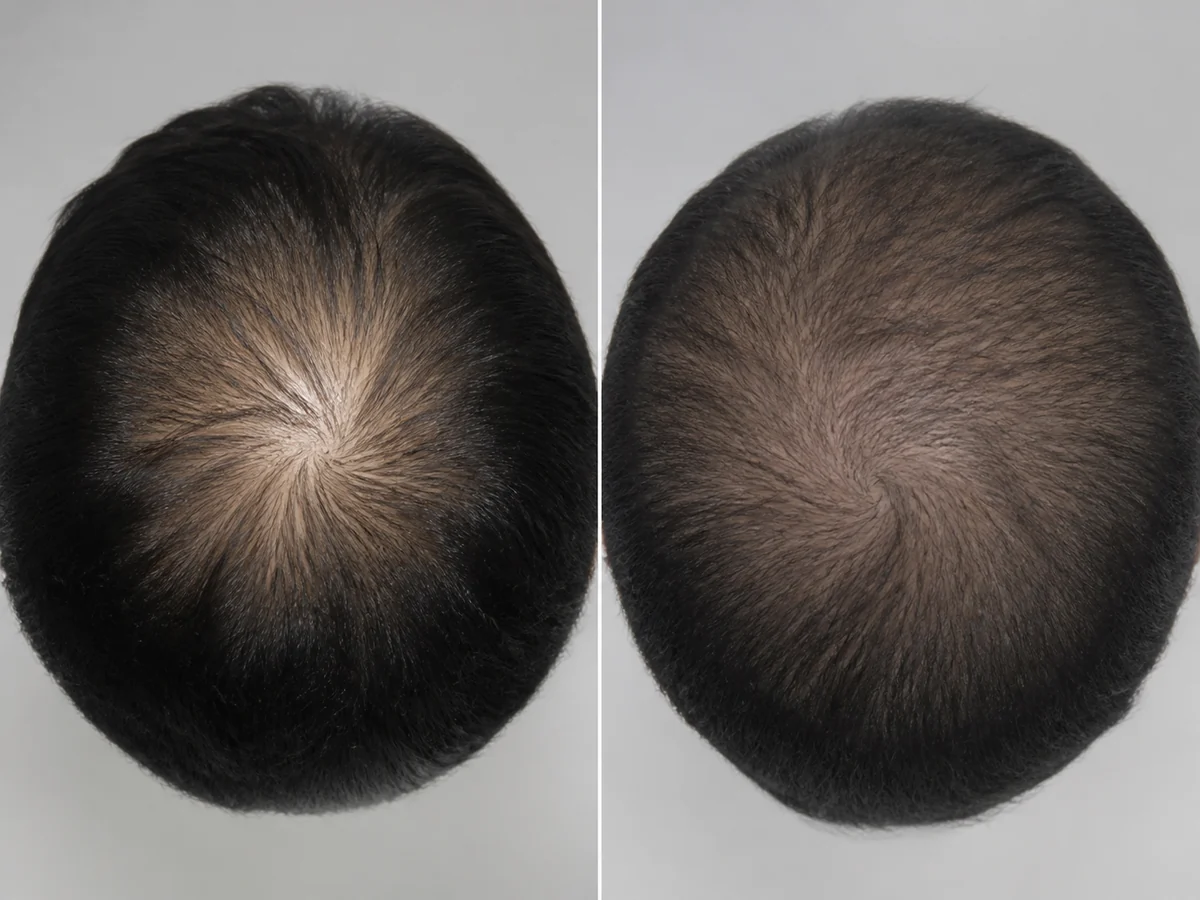
They can also occur together, which is the case that confuses people most. A patterned thinning can be quietly underway for years while an illness or a diet change adds a shedding episode on top of it.
The practical distinction is what comes out.
Diffuse shedding produces hair on the pillow, in the shower and on the brush in visibly increased quantity, while patterned loss produces gradual thinning without a dramatic change in what sheds.
These are not variations on one condition. An androgen-driven pattern and a shedding episode with a specific trigger have different mechanisms, different courses and different responses.
No single supplement can be the correct answer to both, which is a problem for a product marketed at everybody who is losing hair.
The two are also not always distinguishable in a mirror, particularly early, and particularly when somebody has both at once. That is the specific thing a dermatologist is good at and a website is not.
The one nutrient thread with real follicle biology
There is one thread in this topic with genuine follicle biology behind it, and it is not about mushrooms specifically.
The vitamin D receptor is expressed in follicular keratinocytes and in the dermal papilla cells at the base of the follicle. It takes part in the signalling that drives hair follicles through their growth and rest cycle.
That is evidence about receptor biology in the relevant tissue, rather than proof that a mushroom product treats hair loss. Severe vitamin D deficiency has been associated with diffuse shedding in clinical studies.

Mushrooms enter this thread as a food.
Ultraviolet light converts ergosterol in a mushroom into vitamin D2, so mushrooms grown or dried in light carry substantially more than mushrooms grown in the dark.
That makes them a useful dietary source and nothing more specific than that. Vitamin D status is a blood test rather than a shopping decision, and correcting a measured deficiency is a different action from adding a mushroom capsule.
One caution belongs with it. Correcting a measured deficiency is a different proposition from taking vitamin D while already replete, and the second has no reason to help anything.
Vitamin D also has an upper limit of its own, so this is not a nutrient where more is safely better.
Ask whether a relevant test is appropriate before buying a mushroom product. Ask about the test rather than about the mushroom.
Medicinal MushroomsMushrooms for Brain Health, Ranked by EvidenceWhat a stacked hair supplement can do to hair
This is the part of the topic that runs in the opposite direction from the marketing.
Selenium has a tolerable upper intake level of 400 micrograms a day for adults. Above that range, hair loss is a recognized sign of excess, alongside brittle or shedding nails and neurological symptoms such as numbness in the hands and feet.
The mechanism is specific rather than vague. Excess selenium pushes follicles into their resting phase, which produces exactly the diffuse shedding somebody buying a hair supplement is usually trying to stop.

The route to an excess is ordinary rather than reckless.
A hair supplement, a multivitamin, a mushroom blend and a single-mineral product can each carry selenium at a sensible amount, and nobody adds up the total across four labels.
- Read every label currently in the routine for selenium content, in micrograms, and add them together.
- Include foods that concentrate it, since a couple of Brazil nuts can carry more than a day's requirement on their own.
- Treat a combination of shedding, nail changes and tingling as a reason to stop stacking and to raise it with a clinician.
Selenium is not the only ingredient in these stacks worth reading. Vitamin A has its own upper limit, and excess intake over time is a recognized cause of hair loss, which puts two of the routine's own ingredients on the list of possible causes.
Biotin is the third, and its problem is different. It does not cause hair loss, but high-dose biotin interferes with a range of laboratory immunoassays, including thyroid tests and the troponin test used to assess chest pain.
That matters twice over here. A thyroid result distorted by biotin can hide the very thing causing a shedding episode, and a distorted troponin result is a patient safety problem in an emergency room.
Tell any clinician ordering blood work what you are taking, and ask whether a supplement needs pausing before the sample.
The shedding from selenium excess is generally reversible once intake returns to a normal range, over a period of months rather than weeks. That is worth knowing before adding a ninth bottle to a shelf assembled to fix the problem.
What has actually been shown to work
Compare the untested claims with established options for evaluating hair loss.
Topical minoxidil and oral finasteride are the treatments with substantial randomized evidence in androgenetic alopecia. They were measured with hair counts in marked areas and standardized photography, in trials running to hundreds of participants.

Neither is a cure and both come with terms. They take months before anything is visible, they stop working when they are stopped, and finasteride in particular carries side effect considerations that belong in a conversation with a clinician rather than in an article.
The timeline is the part people abandon before it resolves. Visible change is generally assessed at six months and judged at twelve, and shedding often increases briefly in the first weeks as follicles reset.
Somebody who stops at week six because it looks like it is making things worse has run the wrong experiment, and drawn the wrong conclusion from it.
For shedding that follows an identified trigger, the effective step is usually dealing with the trigger. Correcting a deficiency, treating a thyroid problem or getting through the recovery period does more than any product added on top.
That is what a met evidence standard looks like in this field, and it is the standard the mushroom claims should be read against.
What to do instead of buying a mushroom hair product
The useful next steps are cheap, and none of them involves a purchase.
Start with the measurement, because without it nothing else on this list can be judged.
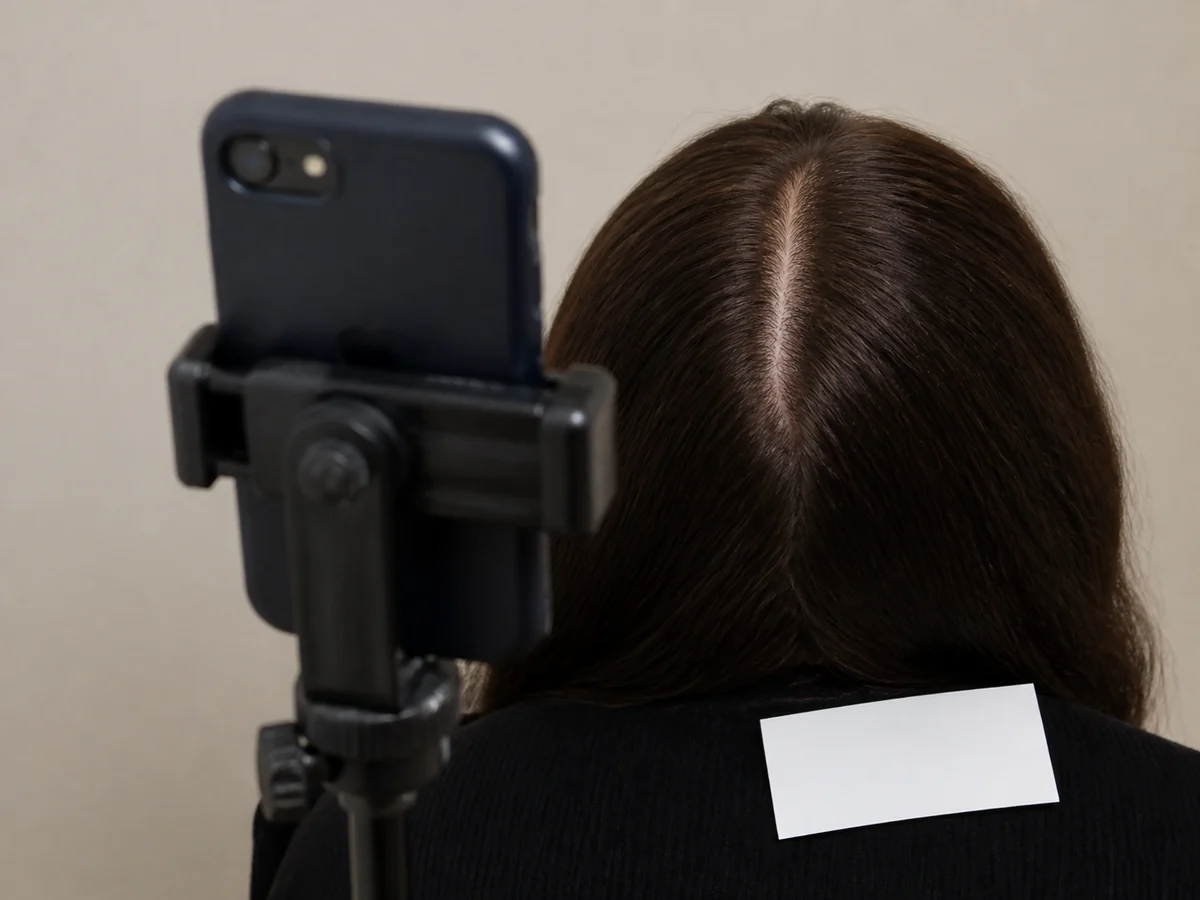
The photograph is the part most people skip, and it is the part that makes everything else readable. Same part line, same light, same distance, once a month, with the date in the frame.
Without it, three months of memory is the measuring instrument.
Memory is unusually bad at slow change in a mirror, particularly when somebody is looking for a change they want to see.
- Part the hair in the same place every time, using a fixed landmark such as the same distance from the hairline.
- Shoot in the same light, which in practice means the same room at the same time of day rather than whatever is available.
- Keep the phone at the same distance, and put the date in the frame so the sequence cannot be reordered by accident.
With that running, the rest of the list is a short sequence of cheap checks.
If you do get an appointment, bring three things: the supplement list with amounts, the monthly photographs, and a rough date for when the shedding started. Those three between them answer most of what a clinician needs to narrow the pattern.
It is a better use of ten minutes than describing the change from memory.
If you want to take a mushroom product anyway, take it as food rather than as treatment, keep everything else constant, and tell whoever is managing your hair that you have added it.
That leaves you with an answer at the end of the window rather than a shelf.
Sources & References
- Liu and colleagues, 5-alpha-reductase inhibitory effect of triterpenoids isolated from Ganoderma lucidum The original enzyme-level finding behind every reishi DHT claim.
- Journal of Investigative Dermatology 2024, Ganoderma lucidum extract and 5-alpha-reductase isoform 2 Inhibition measured in a murine fibroblast cell line, with the saw palmetto and finasteride comparison made at that level.
- Review of vitamin D receptor signalling in hair follicle health and alopecia Receptor expression in follicular keratinocytes and dermal papilla cells, and its role in hair cycling.
- National Institutes of Health Office of Dietary Supplements, selenium fact sheet The 400 microgram tolerable upper intake level and hair loss as a documented sign of excess.
- National Institutes of Health Office of Dietary Supplements, vitamin A fact sheet The upper intake level for preformed vitamin A and hair loss among the signs of chronic excess.