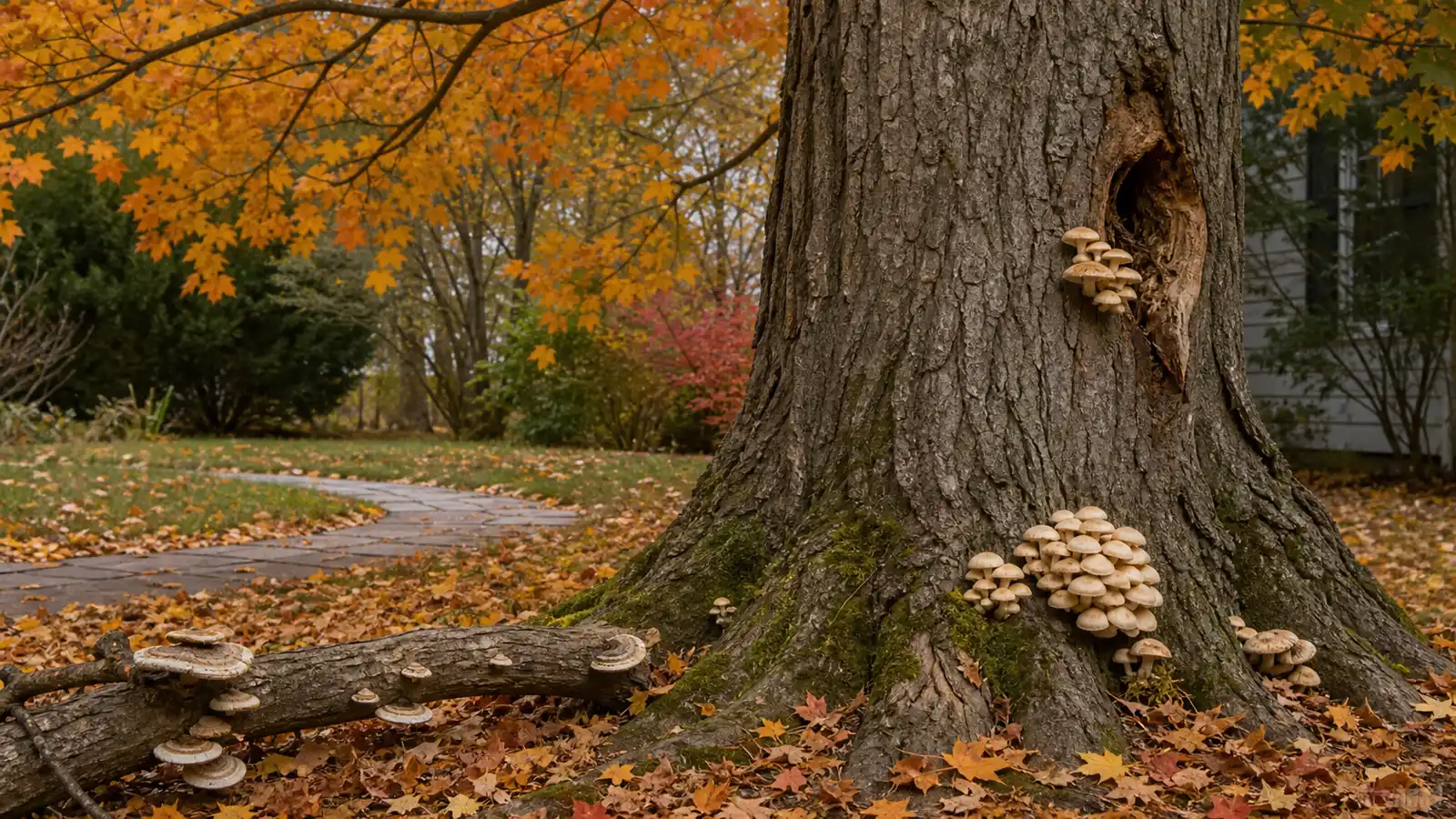
Maple is a useful substrate clue, but many maple fungi also use other hardwoods. Prove whether the specimen attaches to soil, root flare, wound, dead branch, stump, or log before comparing oysters, dryad's saddle, conks, crusts, or clustered fungi.
Fruiting at the base of a living maple can be both a mushroom-identification problem and a tree-health warning. Record the whole tree and seek qualified assessment near people or property when structural defects accompany it.
Maple supports many hardwood fungi, but few can be identified from maple alone. The strongest field clue is the exact growth point, whether that is soil, root flare, a wound, a dead branch, or a fallen log.
That location also tells a homeowner whether the discovery is mainly a foraging record or a tree-health concern.
Maples differ from oak and birch in another useful way. Most maples form arbuscular mycorrhizas, so a generic soil mushroom beneath maple should not automatically be called a maple root partner.
Prove What the Mushroom Is Attached To
Trace the fruiting body to its source and confirm the tree. Opposite branching, paired buds, leaf shape, samaras, bark, and local species range are more dependable than a single leaf on the ground.
Sugar, red, silver, Norway, and Japanese maples differ in bark, size, and site use. Record the species when possible because a small ornamental and a mature street tree create different substrate and risk contexts.
Maple leaves can blow into conifer beds or collect against a stump. Opposite twigs and paired buds on the supporting tree remain useful after leaves have fallen.
The attachment map below turns those five checks into one whole-tree view.
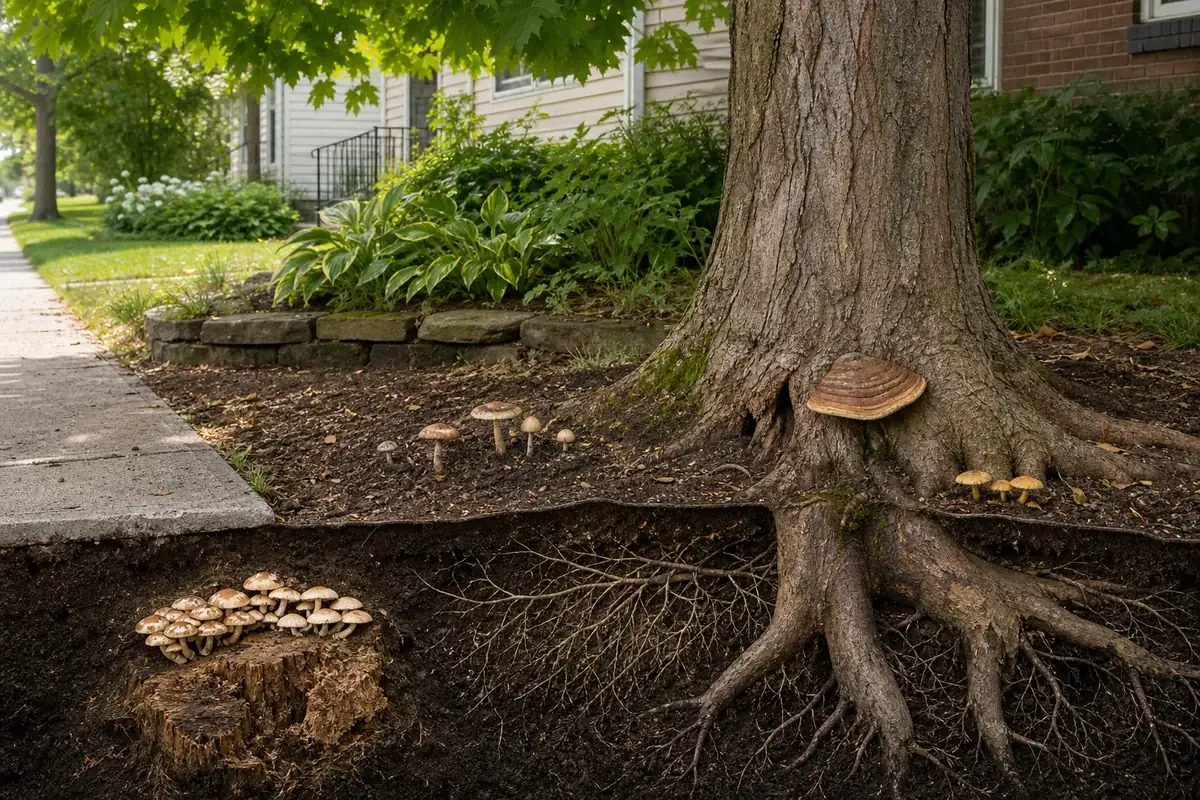
A cluster emerging through mulch may trace to a root, an old stump, or landscape wood chips. Note where firm wood begins rather than describing every cap within the canopy as maple-attached.
ForagingMushroom foraging laws in Germany: protected species and small quantitiesRead Wood-Using Forms by Attachment and Underside
Oyster mushrooms can form overlapping, gilled shelves on dead or declining maple. Dryad's saddle produces broad tan caps marked with darker scales and large angular pores, often around wounds, stumps, and fallen hardwood.
Oyster caps often overlap like shingles and expose gills that run toward the side attachment. Stem position, spore print, flesh, odor, and local wood-growing lookalikes still need agreement.
Dryad's saddle changes rapidly from tender pale margins to tough, insect-damaged fans. The dark feather-like scales and large pores are more stable than size, but neither feature proves maple as the host.
Artist's conk is perennial and develops a pale pore surface that bruises brown when fresh. Its hard woody body contrasts with annual fleshy shelves, while the living tree context raises a separate decay question.
Compare the forms at the same scale before relying on their very different cap surfaces.
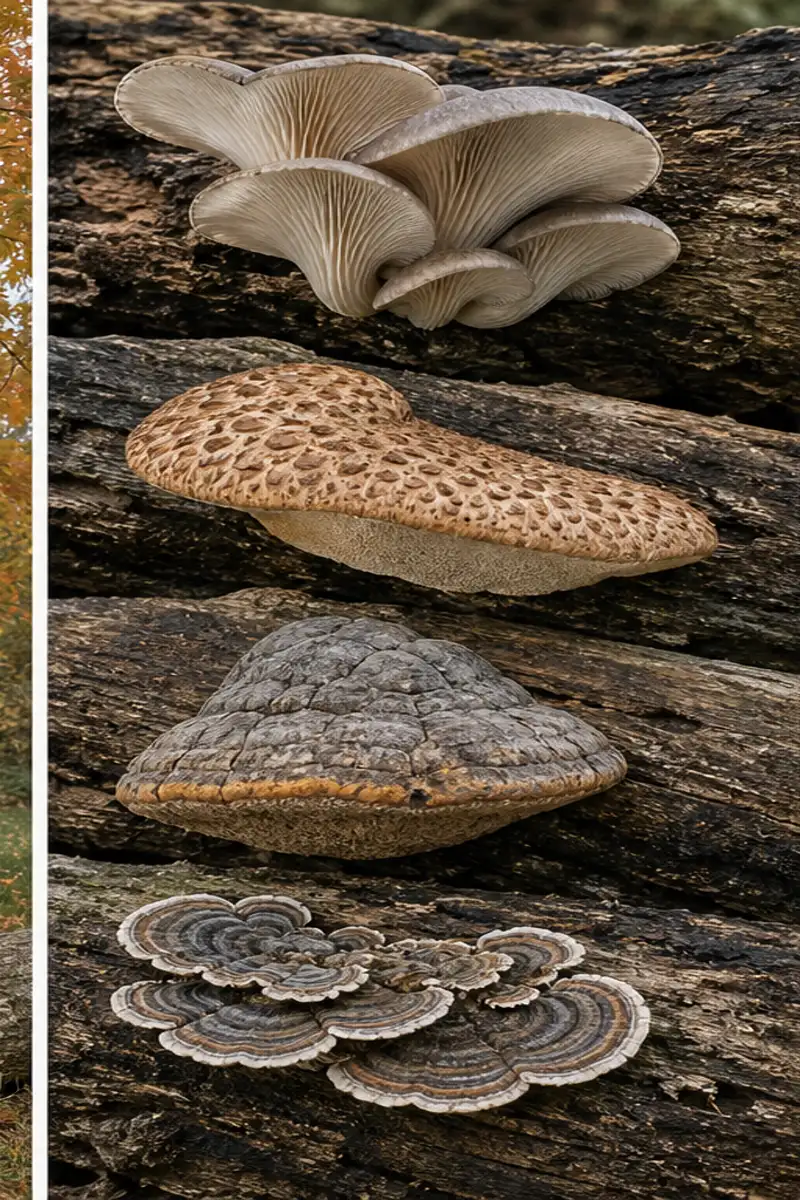
An edible reputation belongs to an identified species, not to the maple substrate. Old oysters can accumulate insects and decay, while orange shelf fungi on hardwood include forms that need careful regional separation.
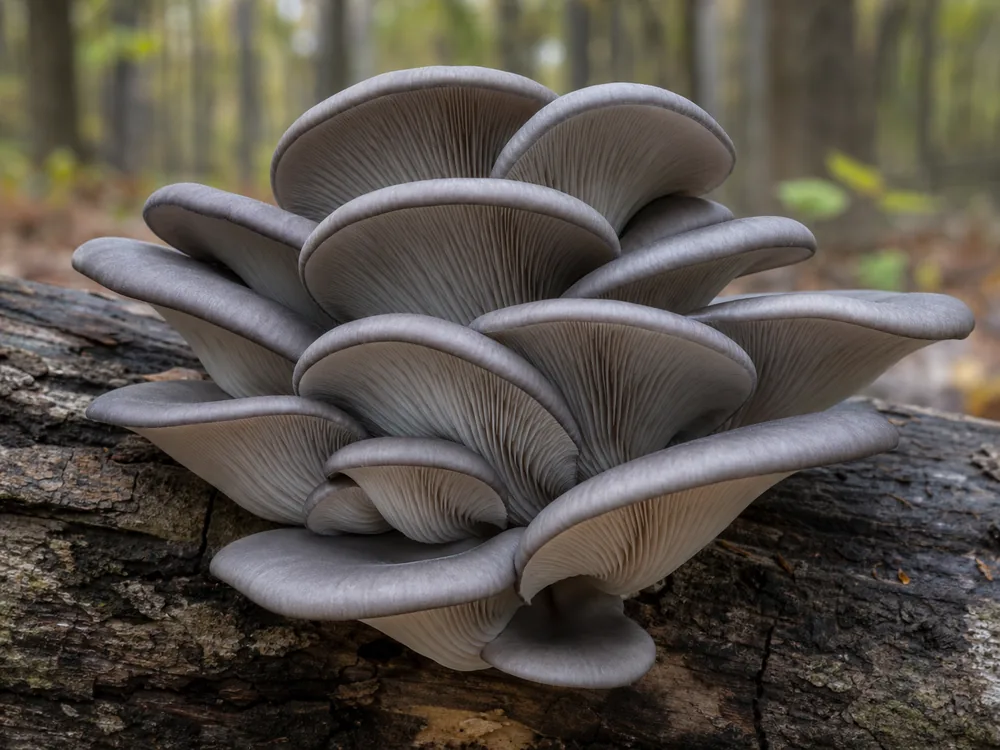 Layered gilled fans on maple deadwoodOyster MushroomConfirm attachment, decurrent gills, flesh, odor, spore print, and condition
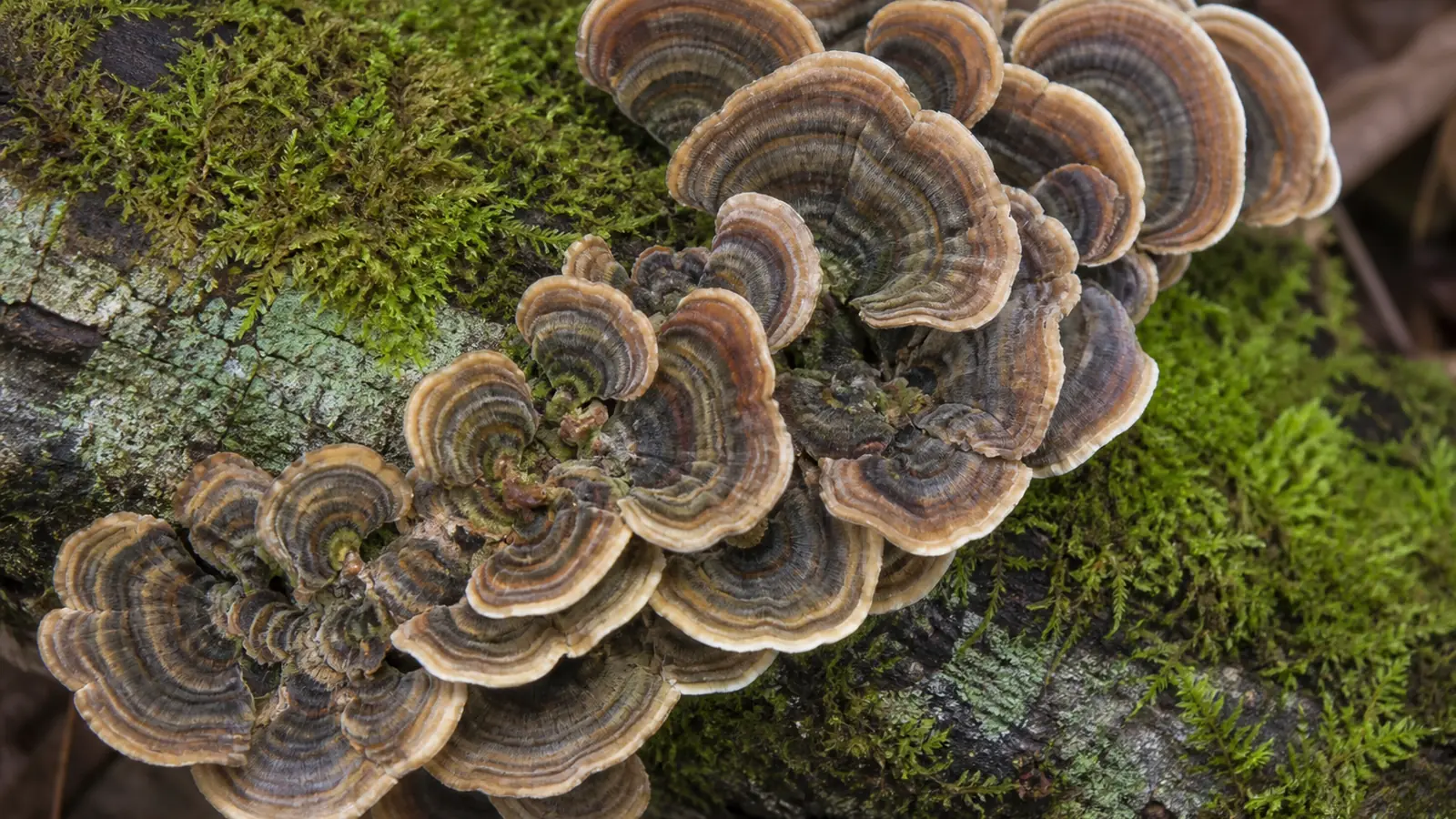 Thin zoned fans on dead maple woodTurkey TailVerify the fine pore surface because smooth crusts can imitate the color bands
Thin zoned fans require an underside check because false turkey tail lacks the same true pore surface. Photograph the underside in shade so glare does not erase fine texture.
ForagingMushroom foraging laws in the UK: what is actually legalA Yard Maple Adds a Tree-Risk Decision
Honey fungi can produce clustered caps around maple roots, trunks, and stumps, sometimes with white mycelial fans beneath loose bark or dark root-like rhizomorphs. Similar clusters occur from buried wood, so neither honey color nor a ring of caps proves Armillaria.
An intact stem may show a ring, fibrous texture, and clustered base, but regional Armillaria species and lookalikes remain difficult. Do not peel sound bark merely to search for mycelial fans.
Repeated fruiting in the same root zone is more informative than one wet-week flush. Add dates and tree symptoms so a plant diagnostician can separate a persistent root problem from decomposition of one buried stump.
Large conks at the base can indicate butt or root decay. When the maple shades a house, street, play area, or parking space, combine the fungal record with crown dieback, cavities, cracks, root injury, lean, and recent branch failure.
Maples often develop included bark at tight branch unions and cavities after large pruning cuts. Those defects may matter even when the mushroom fruits elsewhere, so inspect the whole crown rather than only the base.
Construction, grade changes, mower wounds, compacted soil, and chronic irrigation can damage roots or create fungal entry points. Record these site changes because the fruiting body cannot reconstruct them.
| Observation | Foraging meaning | Tree-care meaning |
|---|---|---|
| Cluster from buried stump with no living trunk | Wood-decay substrate is likely | Manage the stump only if it affects site use |
| Repeated cluster at living root flare | Preserve full specimens and attachment evidence | Inspect roots, bark, crown, and growing conditions |
| Perennial conk on trunk base | Identify pore surface and annual layers | Arrange qualified assessment near targets |
| Soil caps scattered beyond flare | Host remains uncertain | Observe unless other tree symptoms exist |
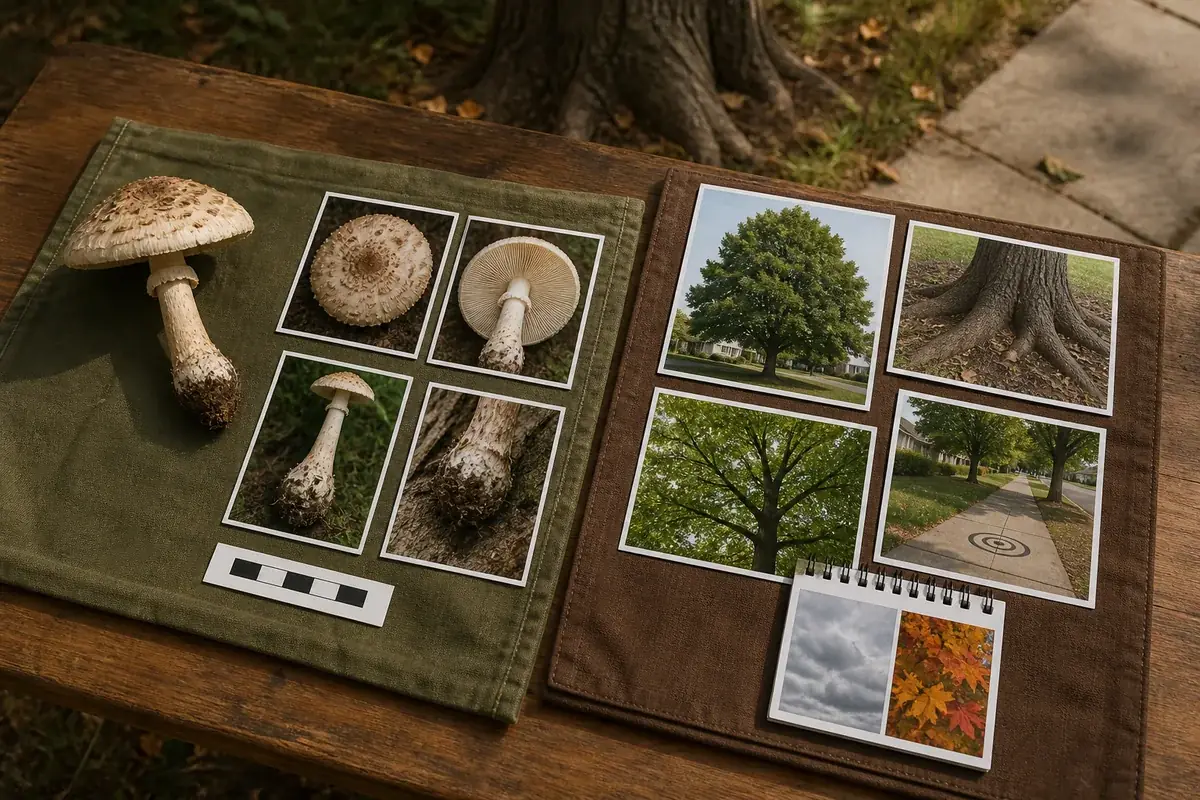
The yard scene below combines basal fruiting with crown and target evidence that a specimen close-up would omit.

Build One Record for the Fungus and Another for the Tree
Note
Maple is insufficient for species identification | Many fungi use several hardwood genera, so attachment, underside, complete base, fresh changes, region, and microscopy may still control the identification.
Maple wood can be hidden by ivy, mulch, soil, and old wound tissue. Clear only loose material and avoid cutting roots or peeling live bark to chase an identification.
Take one wide photograph before moving leaves or stems. That untouched scene preserves cluster spacing and shows whether fruiting follows a buried root line, wound edge, stump perimeter, or scattered soil pattern.
Fresh close-ups should include the underside, stem base, attachment, cap edge, and any bruising change over several minutes. Indoor photographs taken hours later can miss latex, odor, color, and fragile veil tissue.
Use a spore print only after field characters are preserved. A print can separate some gilled possibilities, but it cannot replace attachment, stem base, and fresh-tissue observations.
Evidence is recorded through linked host photographs, attachment photographs, fresh mushroom characters, date, weather, and separately labeled specimens.
Where the Maple Clue Stops
Maple stops being a strong host clue in several common situations:
- The same fungus also colonizes beech, oak, poplar, willow, or other hardwoods
- A source reports only the Acer genus and does not show a preference for one maple species
- Bark has fallen away and the wood cannot be traced confidently to a source tree
- Storm damage, buried roots, pruning wounds, mower injuries, or compacted soil obscure the original substrate
Region, tree condition, underside structure, and microscopic characters may still own the species decision. Record uncertainty instead of upgrading a host guess.
Return to photograph new growth when the first specimen is too old or incomplete. A fresh margin, intact veil, unweathered pores or gills, and complete base often resolve more uncertainty than collecting several deteriorated caps.
Microscopy may be required when several hardwood species share the same visible form. Saving a mature but not rotten cap can preserve spores for that later step.
Two Decisions Need Two Specialists
Do not cut living maple tissue to obtain a mushroom, and do not remove a conk as a treatment. The visible structure can return because the fungus remains in colonized wood.
Leave sound deadwood when it poses no target conflict and land rules allow it. Dead branches and logs support insects and later fungi, while a hazardous hanging limb still needs competent tree work.
If the goal is food, require independent confirmation of every diagnostic character. If the goal is tree safety, use a qualified arborist to assess the whole tree and its targets rather than waiting for a mushroom name.
A regional mycologist owns the specimen identification, while a qualified arborist owns the structural tree-risk decision.
Those professionals may reach different but compatible conclusions. A fungus can be identified accurately while the tree remains safe to monitor, or the tree may require action before the fungus is named to species.
Confirm the tree, prove the attachment, and record tree condition. Maple narrows the substrate question and supplies context for tree-risk assessment, but it does not identify the fungus.
Sources & References
- University of California Integrated Pest Management Wood-decay fungi, fruiting locations, and tree management.
- USDA Forest Service Decay fungi, wood strength, and fruiting evidence.
- University of Minnesota Extension Armillaria signs, hosts, and management context.
- International Society of Arboriculture Whole-tree risk assessment and target-based mitigation.