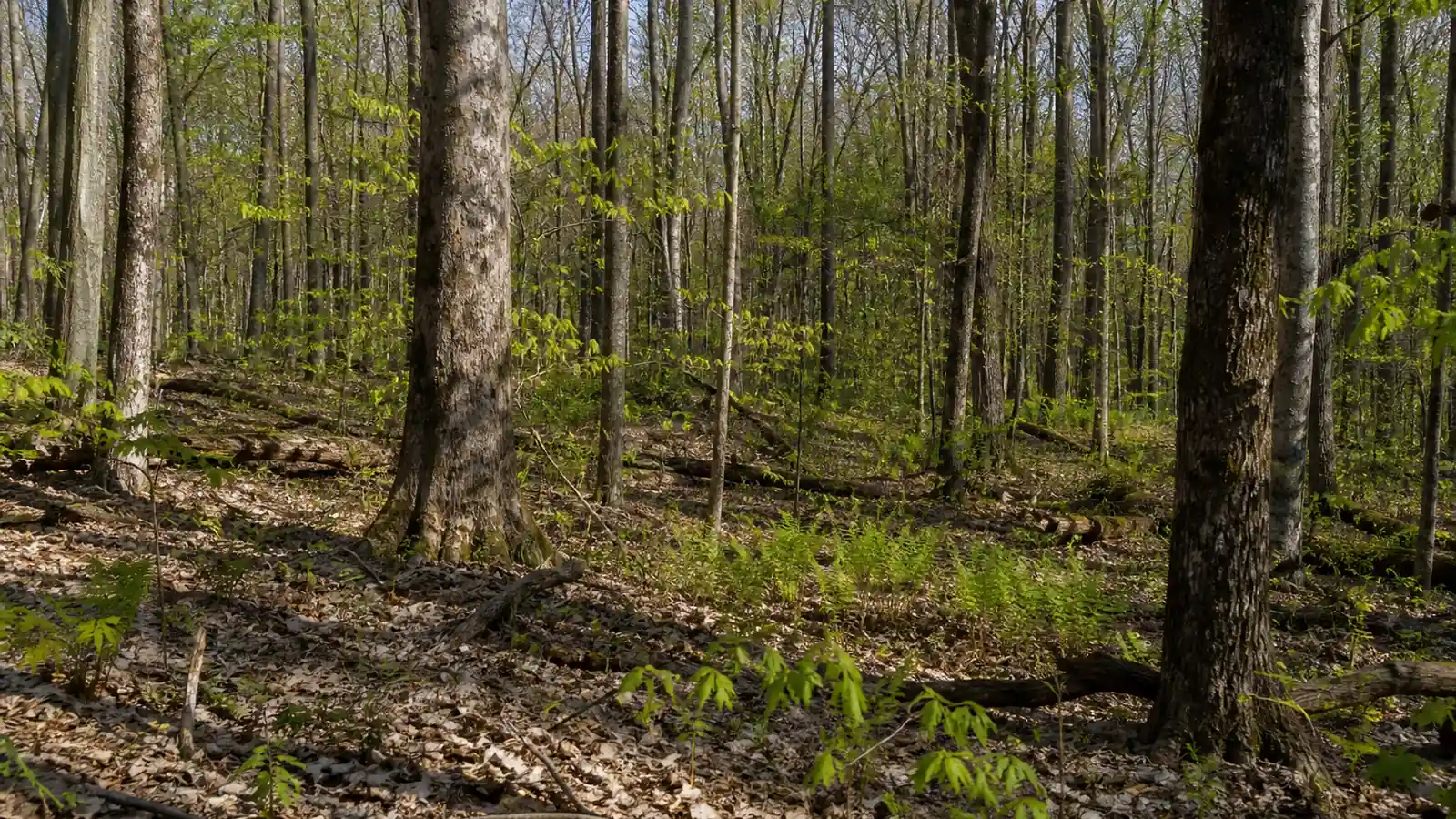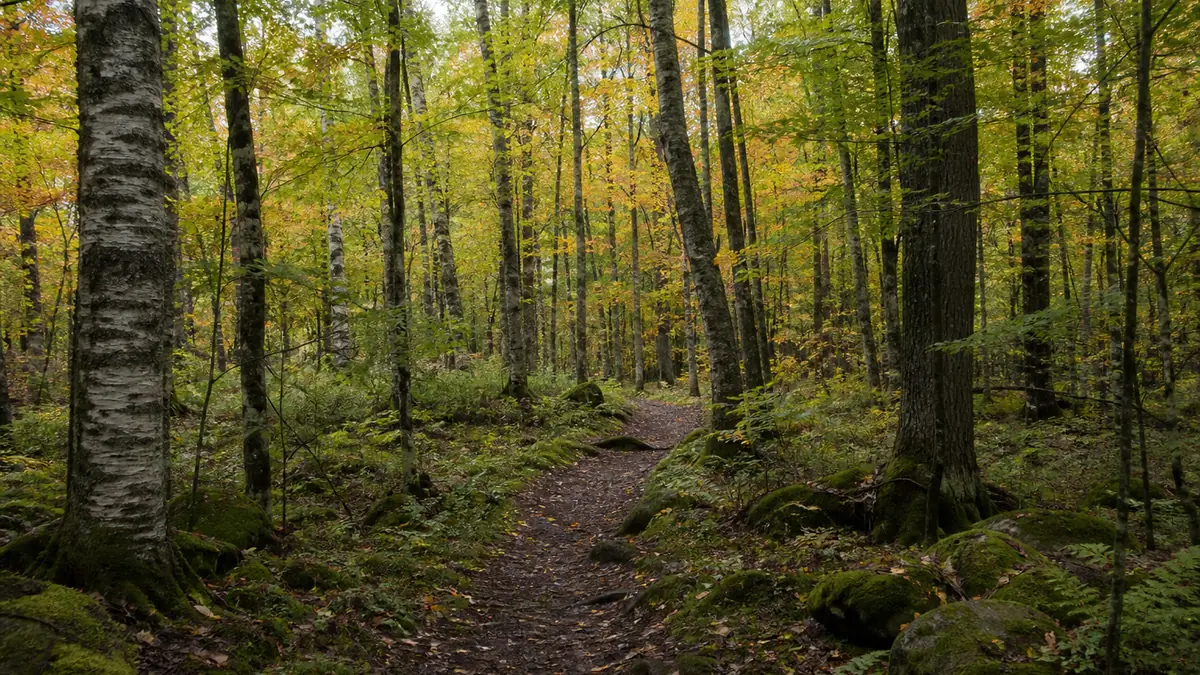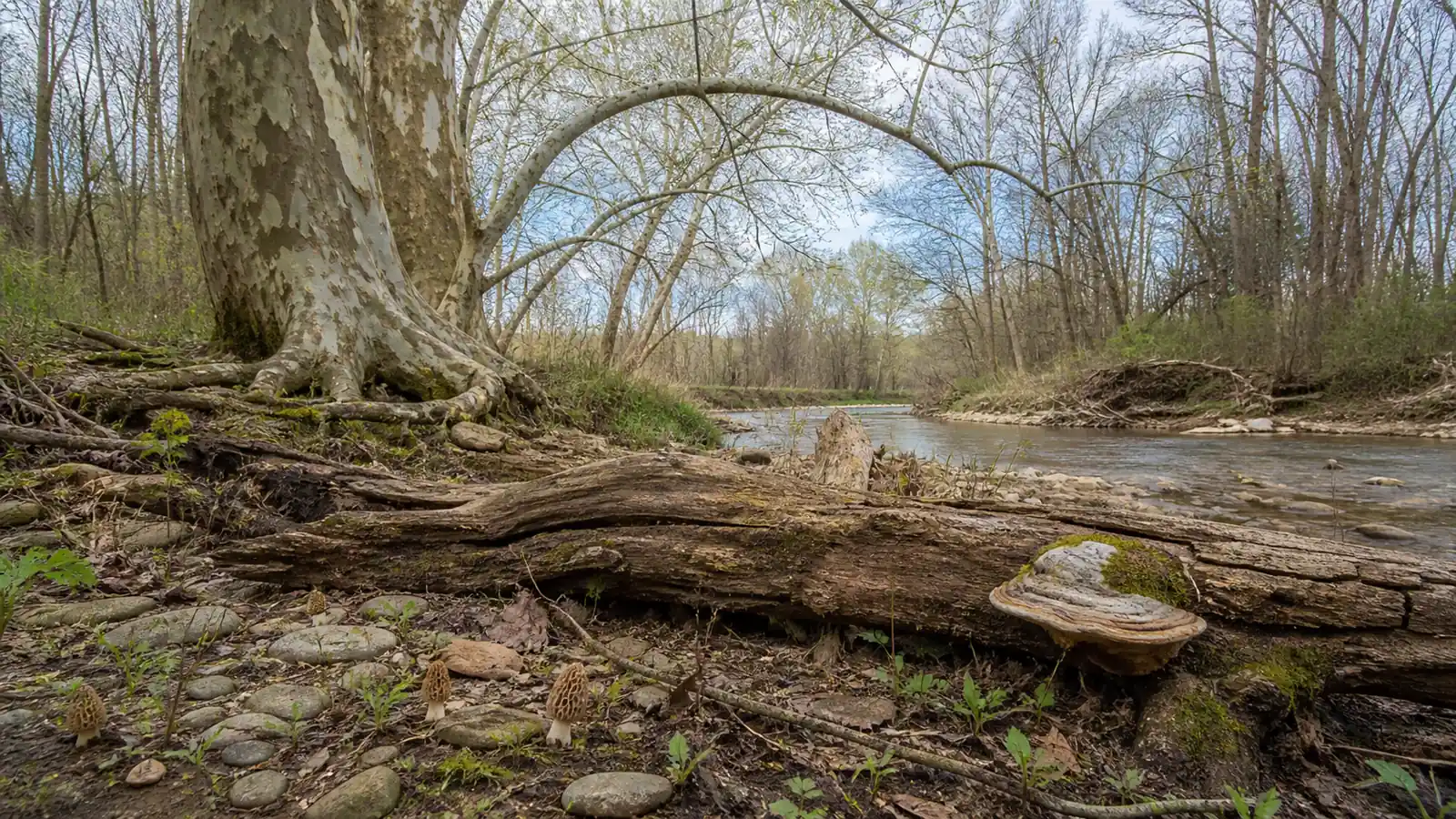
Sycamore can guide a forager to moist creek-bottom habitat, but nearby morels need not use sycamore directly. Dryad's saddle and other decomposers grow from sycamore wood.
Confirm the tree across scales, divide the floodplain into moisture bands, prove attachment, and keep species, site-safety, and tree-risk decisions separate.
Sycamores are valuable mushroom-search landmarks because their pale mottled crowns and broad creek-bottom habitat can be seen from far away. That makes them good navigation trees, but it also creates a common error: treating every nearby mushroom as a sycamore associate.
Use the tree to locate a floodplain, then prove the fungus-to-substrate relationship at ground level. Morels in the same bottomland and a dryad's saddle attached to sycamore wood represent different kinds of evidence.
Recognize Sycamore From a Distance and Up Close
American sycamore has exfoliating upper bark that exposes cream, tan, olive, and white patches. Lower trunks often remain darker and blockier, while large leaves have broad shallow lobes and round seed balls hang on long stalks.
In winter, the pale upper crown and dangling seed balls can mark creek bends before the forest floor is visible. London plane and other planted plane trees can look similar, so record setting and attached characters rather than relying on camouflage bark alone.
| Scale | Sycamore evidence | Limit |
|---|---|---|
| Landscape | Pale mottled upper crown in a low floodplain | Dead limbs and other pale-barked trees can mislead at distance |
| Trunk | Flaking plates above darker rough basal bark | Bark varies with age and exposure |
| Twig | Alternate buds and a ring-like leaf scar around the bud | A clear close-up is needed |
| Seasonal | Broad lobed leaf and one seed ball per stalk on American sycamore | Hybrids and plane trees require regional comparison |
The scale sequence confirms that the distant landmark and the close botanical evidence belong to the same tree.

Morels Use the Creek Bottom, Not a Simple Sycamore Rule
Foragers report morels in sycamore bottomlands, but the tree may be marking moisture, flood disturbance, open spring light, and rich alluvial soil rather than acting as the only host.
Search transitions where water moved but did not scour away all litter. Slight benches above the active channel, old overflow paths, moss edges, and disturbed soil near aging hardwoods can differ sharply across one bend.
The landscape view holds elevation and moisture differences steady around one creek bend.
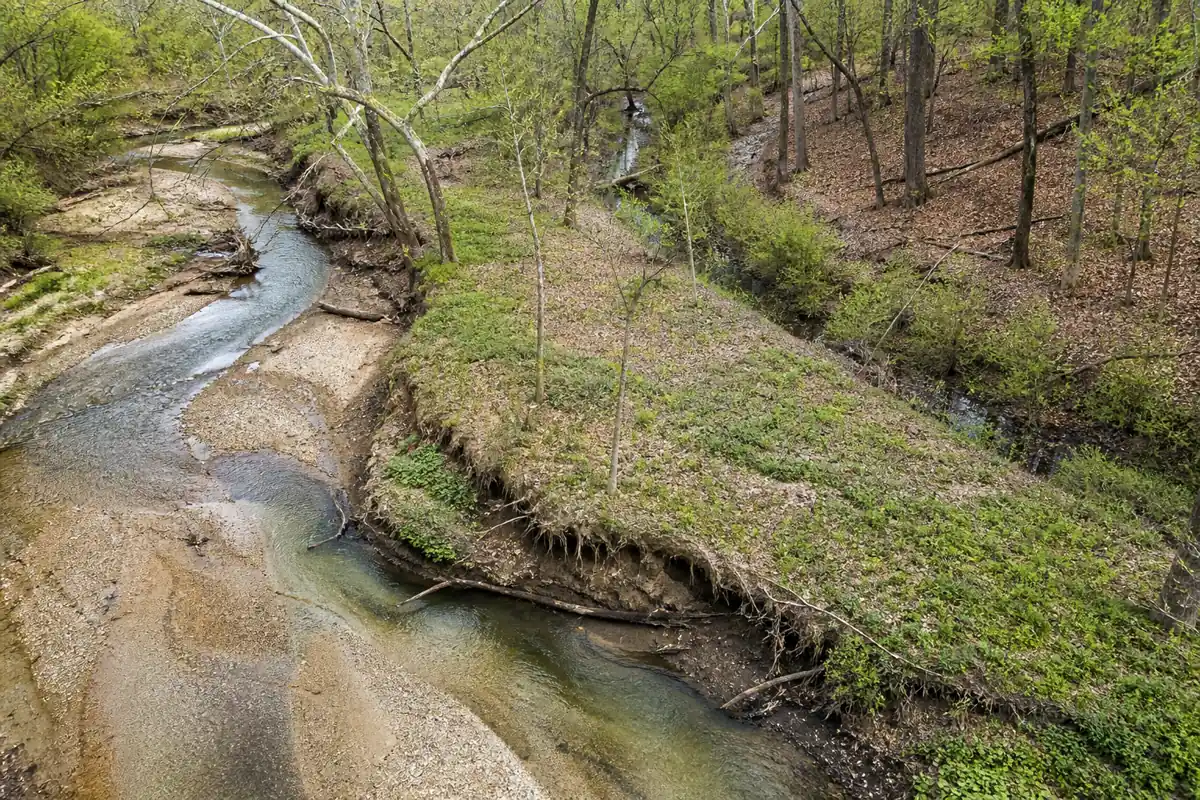
A true morel still needs a pitted cap, attached cap structure, and a hollow lengthwise interior. Creek-bottom habitat cannot exclude false-morel forms or other brown spring fungi.
Cut one representative specimen lengthwise when collection is legal. A continuously hollow interior supports a true-morel identification, while chambers, cottony tissue, or a loosely hanging cap require a different path.
Morels can be absent from an apparently perfect bend for years. Soil disturbance, competing vegetation, spring temperature, moisture history, and events affecting nearby trees can matter more than the presence of one sycamore.
Warning
Floodplain location is not food clearance | Avoid polluted runoff, road edges, industrial fill, treated landscapes, and sites with unresolved land use. Confirm legal access and species identity separately.
Dryad's Saddle Grows From Sycamore Wood
Dryad's saddle, Cerioporus squamosus, is a large spring wood-decay fungus recorded on several hardwoods, including sycamore in regional sources. It can emerge from standing dead wood, a living tree's dead heartwood, stumps, and fallen logs.
The cap is fan to saddle shaped with dark brown scales over a lighter surface. Beneath it are pores, not gills, and the stem base can become dark where it joins the wood.
The macro view keeps cap scales, pores, stem base, and sycamore attachment together.

Young tender margins and old fibrous centers differ greatly, so age belongs in the identification record. The appearance of a large fruit body on a living tree also indicates established internal decay, not a surface growth that can be cured by removal.
National Park Service guidance notes that dryad's saddle can reach a foot or more across. Missouri's field guide describes caps from about 2.5 to 12 inches, large angular pores, a short off-center stem, and a white spore print.
Those measurements make the hypothesis testable. They do not make every scaly shelf on a sycamore the same species.
A High Fruiting Body Can Be a Tree-Risk Clue
Sycamore develops large limbs and often stands beside paths, roads, picnic areas, and fishing access. A conk at a cavity, pruning wound, or trunk seam can coincide with weakened internal wood.
Do not climb, strike, or pull on the tree to inspect a high shelf. Photograph the entire crown, fruiting height, attachment zone, cavities, cracks, dead limbs, and the area a failure could reach.
The whole-tree view connects each fruiting height to the occupied area beneath it.
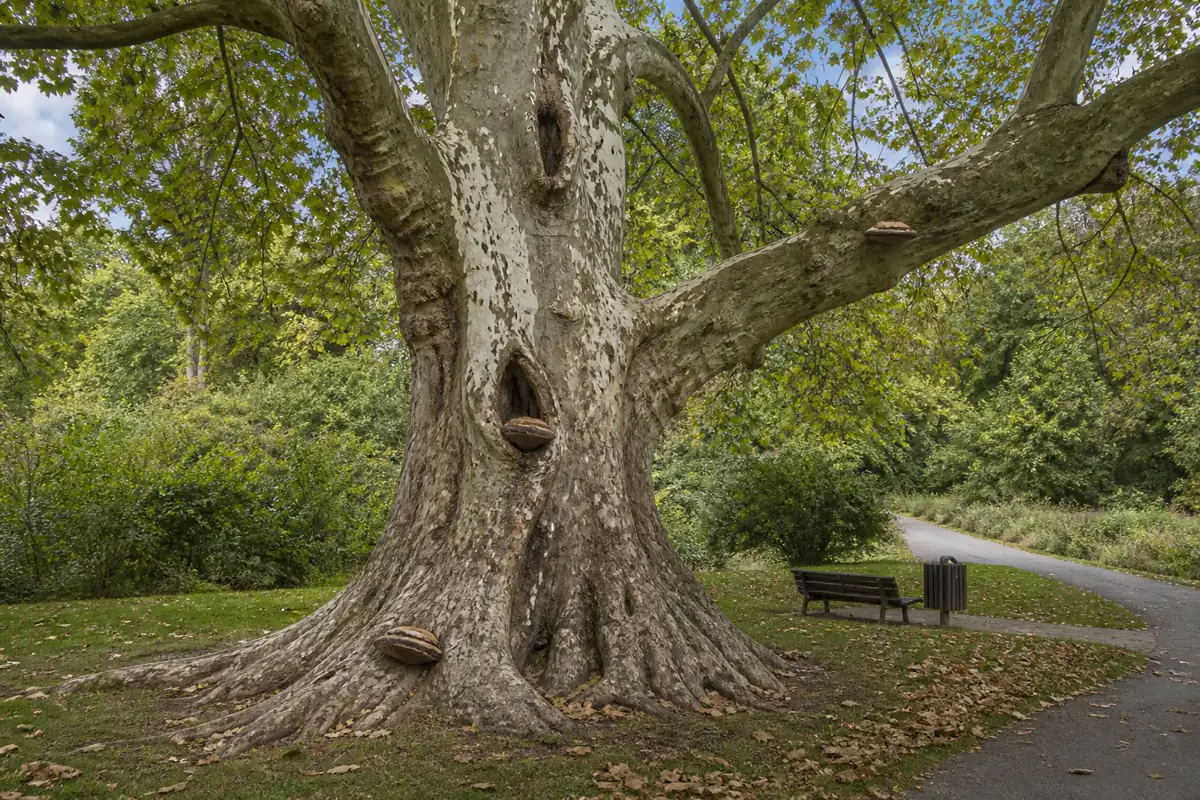
The image records position, while the next decision requires a separate professional assessment.
Note
Identification and risk assessment answer different questions | A mycologist may name the fungus, while a qualified arborist evaluates remaining wood, loading, targets, and management options.
Dead Sycamore Wood Supports More Than One Form
Fallen sycamore can carry oysters, thin brackets, crusts, jellies, and clustered gilled mushrooms as decay progresses. The pale peeling bark may remain recognizable after the wood has moved in a flood.
Inspect the underside and the wood. Firm recently fallen branches, softened sapwood, hollow logs, and buried fragments represent different decay stages.
| Form on wood | Required evidence | Frequent failure |
|---|---|---|
| Pale fan | True gills or pores, stem position, attachment, spores | Calling every fan an oyster from the top view |
| Thin zoned bracket | Pore surface, hairiness, flexibility, and thickness | Confusing a false turkey tail with a pore-bearing species |
| Crust | Fertile surface, margin, cracking, and wood hardness | Ignoring it because it lacks a cap |
| Ground-level cluster | Shared base and buried wood trace | Calling it soil-grown without exposing attachment |
The log view keeps decay stage and fertile surface in the same record.
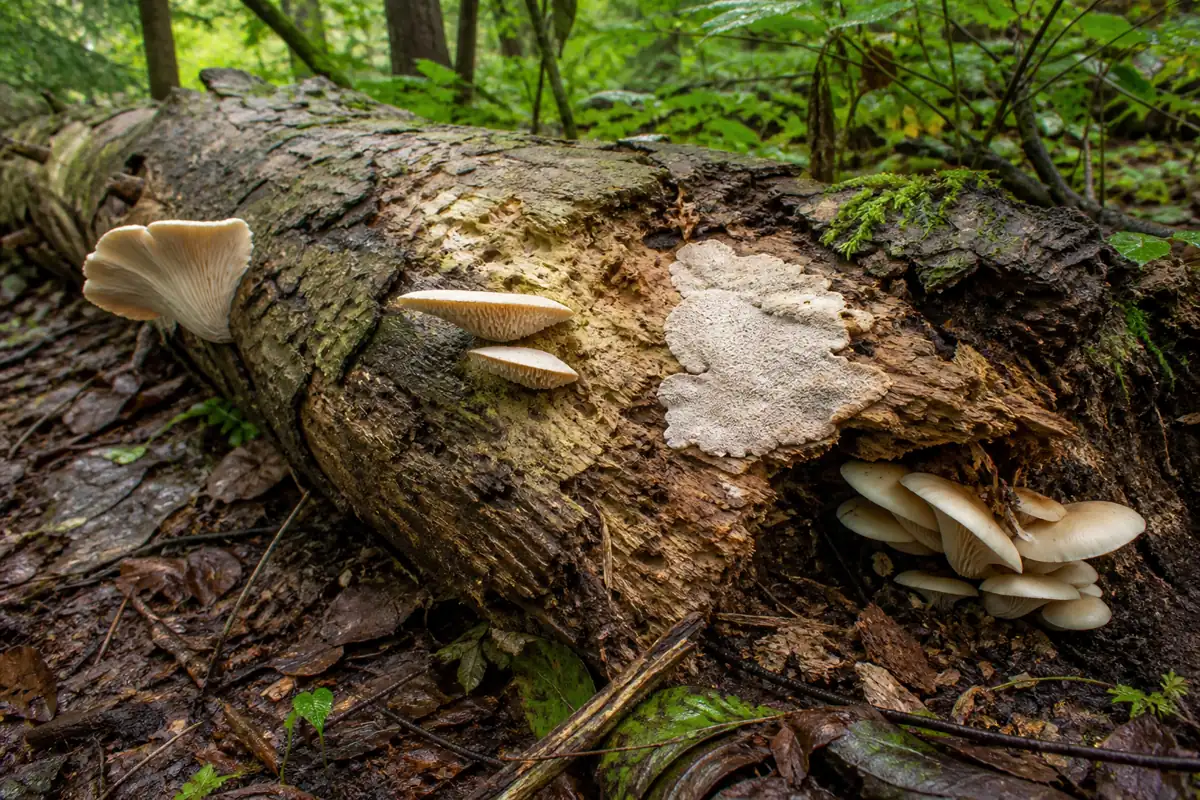
When a pale gilled fan is intact, the oyster mushroom profile is a relevant comparison. It remains a hypothesis until attachment, gills, spores, texture, region, and lookalikes agree.

A Sycamore Candidate Grid Separates Ecological Jobs
Sycamore bottomlands combine soil, litter, living roots, wounded trunks, standing deadwood, and flood-carried logs. Grouping candidates by those jobs is more useful than presenting one flat list of names.
These are observation profiles, not edible recommendations. A familiar silhouette does not replace underside, attachment, spore, age, and regional evidence.
Flood History Can Move the Wood but Not the Evidence
A log beneath a sycamore may have arrived from upstream. Pale mottled bark can persist on sycamore wood, but bark can also detach, bleach, or become coated with silt.
Photograph both ends of a log, retained bark, branch scars, wood grain, nearby debris direction, and the height of the last water mark. The goal is to show why the host claim is plausible, not to make a floating log fit the nearest standing tree.
| Flood effect | Identification problem | Useful record |
|---|---|---|
| Log moved between tree stands | Nearest canopy is mistaken for original host | Bark, cut ends, debris alignment, and upstream context |
| Silt covers fertile surface | Pores or gills appear smooth | Unwashed underside, protected cap overlap, and a later fresh specimen |
| Buried branch produces a cluster | Wood decomposer appears soil-borne | Shared base, shallow substrate trace, and wide attachment view |
| Water damages fruit bodies | Color and texture no longer match a guide | Condition notes, intact younger examples, and a revisit after recession |
Do not enter an undercut bank to solve the puzzle. A safe unresolved record is better than a complete photograph taken below unstable soil or dead limbs.
ForagingMushroom foraging laws in the UK: what is actually legalThe Fruiting Calendar Has More Than One Clock
Dryad's saddle is conspicuous in spring and can fruit again, morels follow regional spring conditions, and deadwood fungi can respond to warm wet periods from spring into fall. Perennial conks remain visible outside their active fruiting period.
Canopy leaf-out changes both moisture and search visibility. Before leaves expand, the forest floor warms and distant crowns are easy to map; later, shaded logs may retain moisture after exposed benches dry.
A fixed date or days-after-rain rule cannot represent all five clocks. Record the event that changed the substrate and the specimen state it produced.
Food Safety Has Its Own Evidence Chain
Sycamore habitat can guide a search, but it cannot clear a mushroom for eating. Even an edible species needs a complete identification, fresh condition, legal collection, a suitable site, correct preparation, and attention to individual reactions.
For a morel, preserve the interior and cap attachment. For dryad's saddle, verify pores, age, and tender margin, then obtain expert confirmation before following any cooking advice.
For an oyster-like shelf, confirm true gills, direct wood attachment, spore deposit, flesh, and the whole cluster. Use the beginner identification guide to keep those observations connected.
Warning
Do not test an unknown mushroom by eating it | Animal feeding, smell, peeling, boiling, and app matches are not safety tests. If symptoms follow a wild-mushroom meal, contact emergency services or a poison center promptly and retain specimens, leftovers, photographs, and timing.
Search the Floodplain as a Repeatable Route
Begin above the waterline and walk parallel to the channel. Crossing repeatedly compacts banks, damages small fruit bodies, and increases exposure to undercut edges.
The route view shows how stable-ground observation and repeated photo points connect.

Use the same photo points on every visit. A sequence can show water recession, leaf-out, soil drying, log movement, and fruit-body aging without relying on memory.
Collection rules vary by property. Confirm access before removing mushrooms, and leave enough undisturbed context for others to inspect the site.
Turn the Sycamore Clue Into Identification Evidence
The final record should make clear which claim comes from which photograph. A distant crown proves navigation, not attachment.
A close view of pores proves anatomy, not land-use safety.
- Confirm sycamore from attached bark, twig, leaf, or seed-ball evidence appropriate to the season.
- Photograph all neighboring trees and the exact microtopographic band.
- Show mushroom attachment, cap, complete underside, stem or shelf base, interior when needed, and scale.
- Record recent rain, flood height, water recession, soil moisture, canopy leaf-out, and specimen age.
- Keep tree-risk observations, food-site decisions, and species identification as separate conclusions.
Do not taste an unknown specimen or use habitat, odor, cooking, or animal feeding as a safety test. The tree is most valuable when it guides a careful search and remains one piece of a complete identification.
Sources & References
- U.S. National Park Service Dryad's saddle morphology, timing, decay, and risk.
- Missouri Department of Conservation Dryad's saddle field characters and habitat.
- USDA Forest Service American sycamore identification and bottomland ecology.