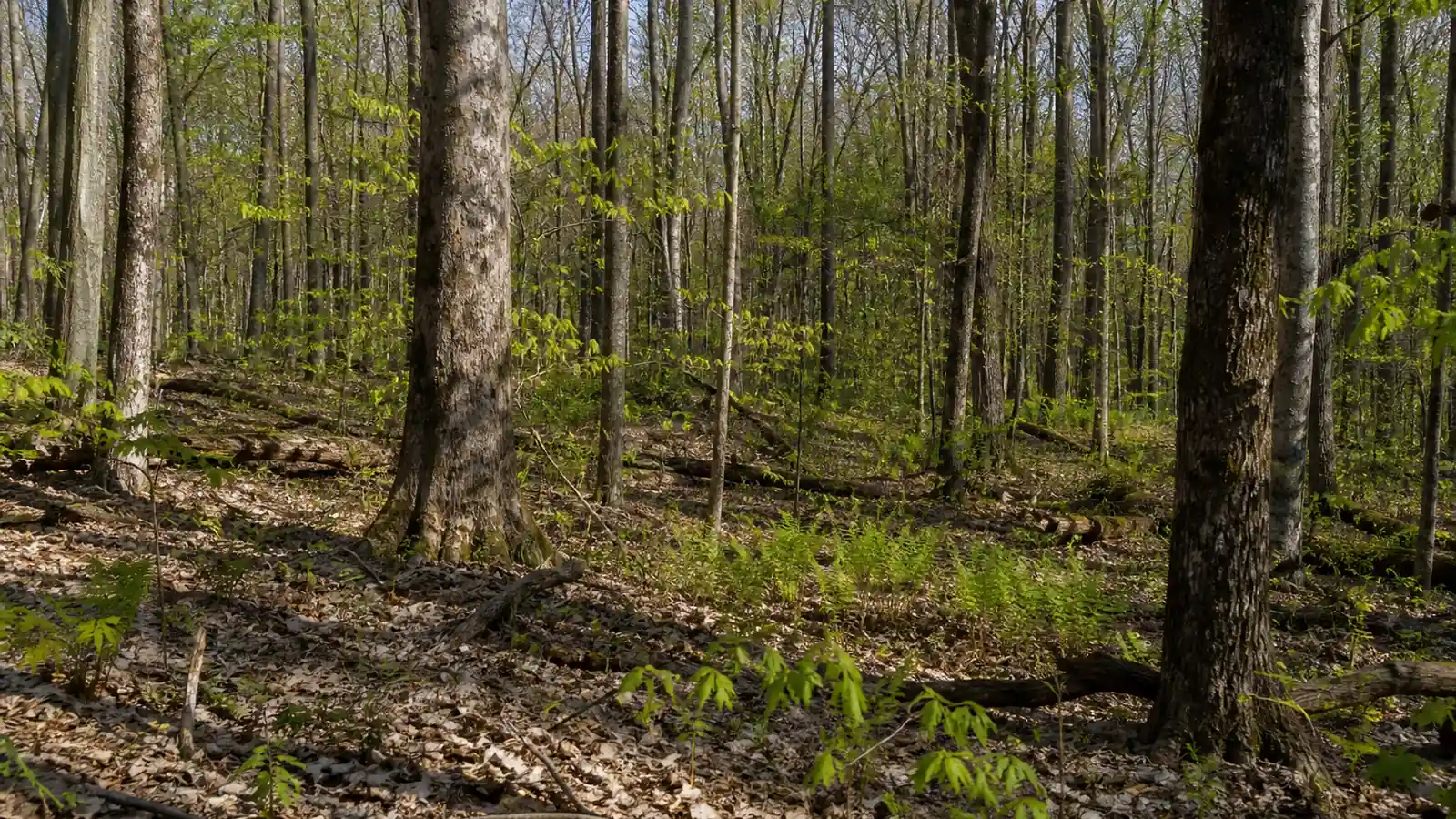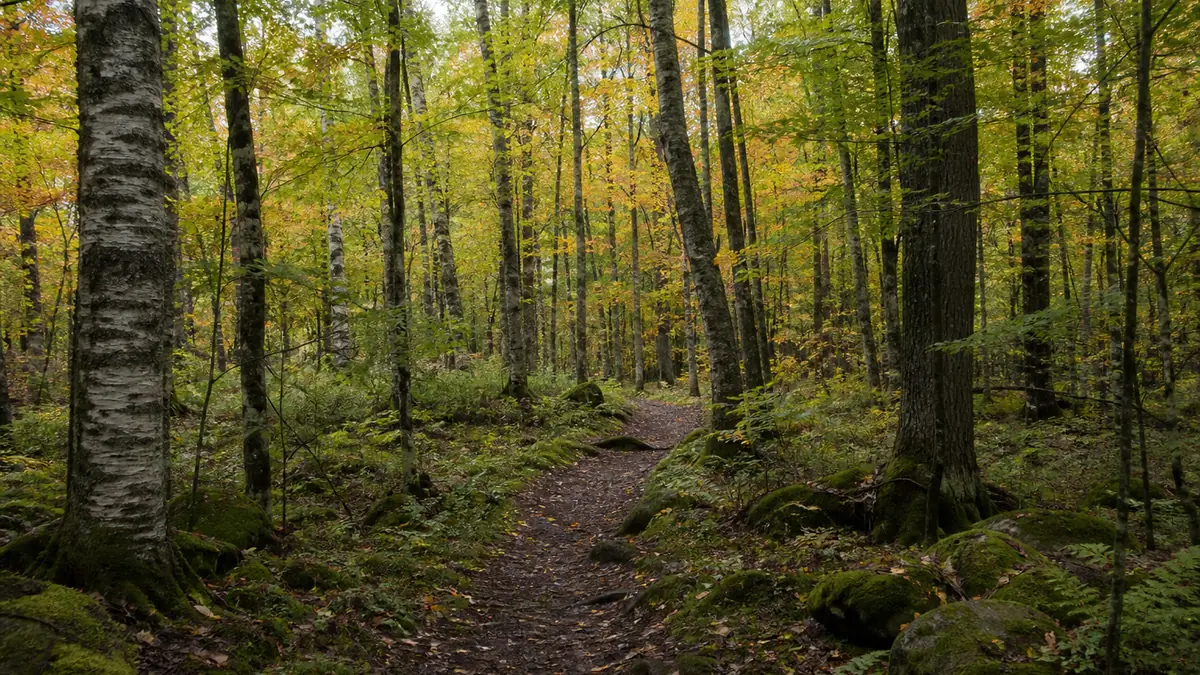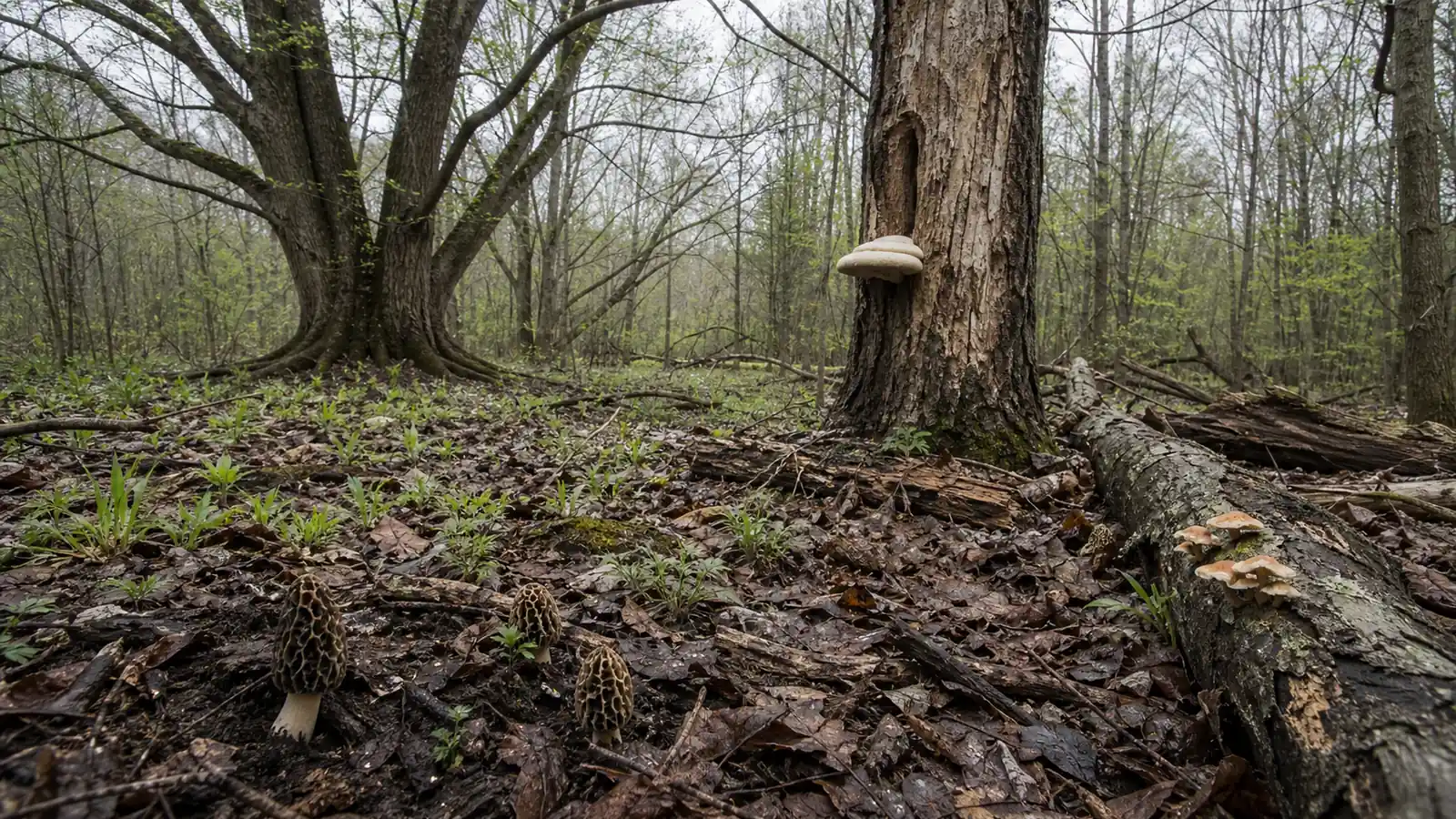
Elm habitat can point to morels in soil near stressed roots or to wood-decay fungi on wounds, trunks, stumps, and logs. Verify the tree and the exact growth point before choosing a mushroom candidate.
Recently dead elms with most bark still attached are the classic morel search stage, but no exact year count guarantees a flush. Elm association never proves a mushroom is edible.
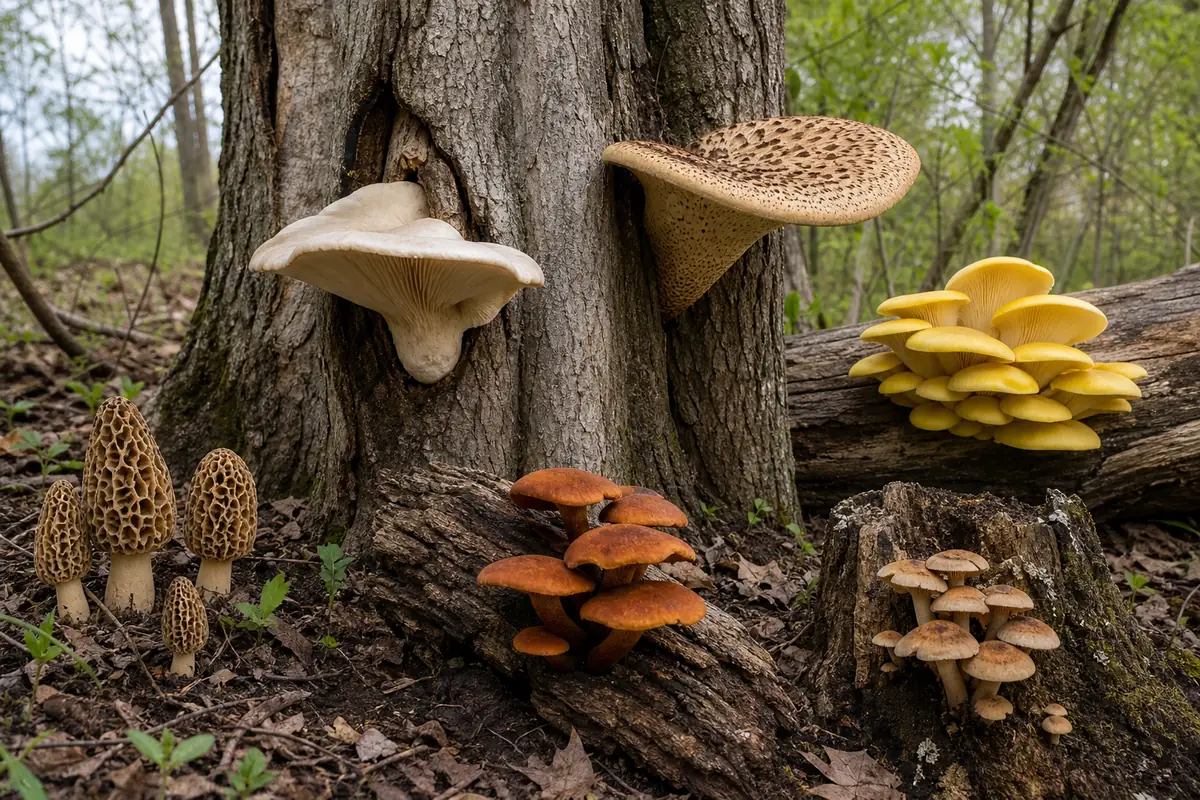
An elm can point to two different fungal neighborhoods, with morels fruiting from soil around roots and elm oyster, dryad's saddle, velvet shank, golden oyster, and mica caps using living or dead wood.
Start with the exact growth point, because a cap beside the trunk may rise from soil or a buried root while a shelf higher on the tree is attached to wood.
Elm is a useful habitat clue, but it does not identify a mushroom or establish edibility. Tree species, decay stage, season, region, underside, stem base, and spore deposit must agree before a name becomes defensible.
Which Mushrooms Grow on Elm Trees?
The best-known elm associates, morels, rise from soil within the root zone rather than growing from the tree itself.
Wood-attached mushrooms belong to a different set. Their position on a wound, trunk, root flare, stump, or fallen limb reveals which tissue they are using and often narrows the season worth checking.
Elm oyster usually forms one or a few thick, pale caps at a wound or branch scar, sometimes well above eye level. Its substantial central or off-center stem and gills that meet the stem separate its general form from the thin, lateral-stemmed shelves many people picture when they hear oyster.
Dryad's saddle forms broad cream to tan fans with darker scales and large angular pores, often emerging from a wound in spring or early fall.
Velvet shank produces sticky orange-brown caps in cool weather on dead or damaged hardwood. The dark velvety stem base and white spore deposit matter because deadly Galerina can share the same deadwood habitat.
Golden oyster makes conspicuous yellow clusters on dead hardwood during warm, humid weather. It is introduced in North America, has a strong association with dead elm in its invaded range, and should not be assumed present outside that documented range.
Mica caps can appear in crowded tan clusters at a stump, buried root, or heavily decayed base. Their fine sparkling veil particles wash away, and mature caps soon blacken and collapse, so a fresh field record matters more than the common name.
Even around one tree, the six forms occupy different places that the plate below keeps visible across soil, wounds, standing wood, and fallen wood.
Other fungi can use elm, including true oysters, brackets, crusts, jelly fungi, and small decomposers. Treat these six as strong field hypotheses rather than a complete inventory, since climate, continent, elm species, and wood condition change the local community.
How Can You Recognize an Elm Without Leaves?
A dead tree is hardest to identify when its value as a morel clue is highest. Use several independent elm characters, because gray furrowed bark also occurs on ash, hackberry, walnut, and other hardwoods.
American elm often holds a vase-shaped crown whose major limbs fork sharply upward, arch outward, and finish in much finer branch tips, although crowding and storm damage can distort that silhouette.
Mature bark is gray to gray-brown with long intersecting ridges. A small piece of already loose bark can show alternating light and dark layers in cross-section, a pattern often compared with stacked light and dark bands.
When leaves remain, check the lopsided base and double-toothed edge. One side of an American elm leaf reaches the petiole lower than the other, and smaller teeth sit along the larger serrations.
Before the spring canopy fills, flat papery samaras appear in clusters while slender twigs alternate along the branch and often form a slight zigzag.
- Step back and check for an upward-forking vase crown.
- Compare several bark areas rather than one damaged patch.
- Inspect the layered edge of bark that is already loose.
- Look on the ground for asymmetrical double-toothed leaves or papery samaras.
- Photograph twigs, buds, crown, and trunk so a local tree key can test the whole set.

These characters describe American elm most directly. Slippery elm, rock elm, Siberian elm, and European elms differ in leaf texture, bark, crown, fruit, and range, so use a regional tree key before recording the host at species level.
Dutch elm disease can add decline evidence, but it is not a tree-identification feature. A branch may wilt and brown before the rest of the crown, brown streaking can appear beneath symptomatic bark, and bark beetle activity may draw woodpeckers that leave rows of holes.
ForagingMushroom foraging laws in Germany: protected species and small quantitiesWhy Do Morel Hunters Check Recently Dead Elms?
Experienced morel hunters repeatedly report their best elm finds around trees that are still dying or have died recently. These trees commonly remain upright, retain most of their bark, and have lost leaves or begun shedding fine twigs.
The biological explanation remains less certain because some morels associate with living trees, other Morchella species or populations use dead organic material, and USDA reviews describe important gaps in morel ecology.
One proposed explanation is that a fungus associated with elm roots fruits heavily when the tree declines and the relationship changes. That idea is useful as a hypothesis, but bark stage is better field evidence than a claimed universal mechanism.
This sequence explains why an exact answer to how many years an elm produces morels is unreliable. The first spring or two after death is common field guidance, but the tree may have been declining before anyone noticed, and its visible stages advance at different rates.
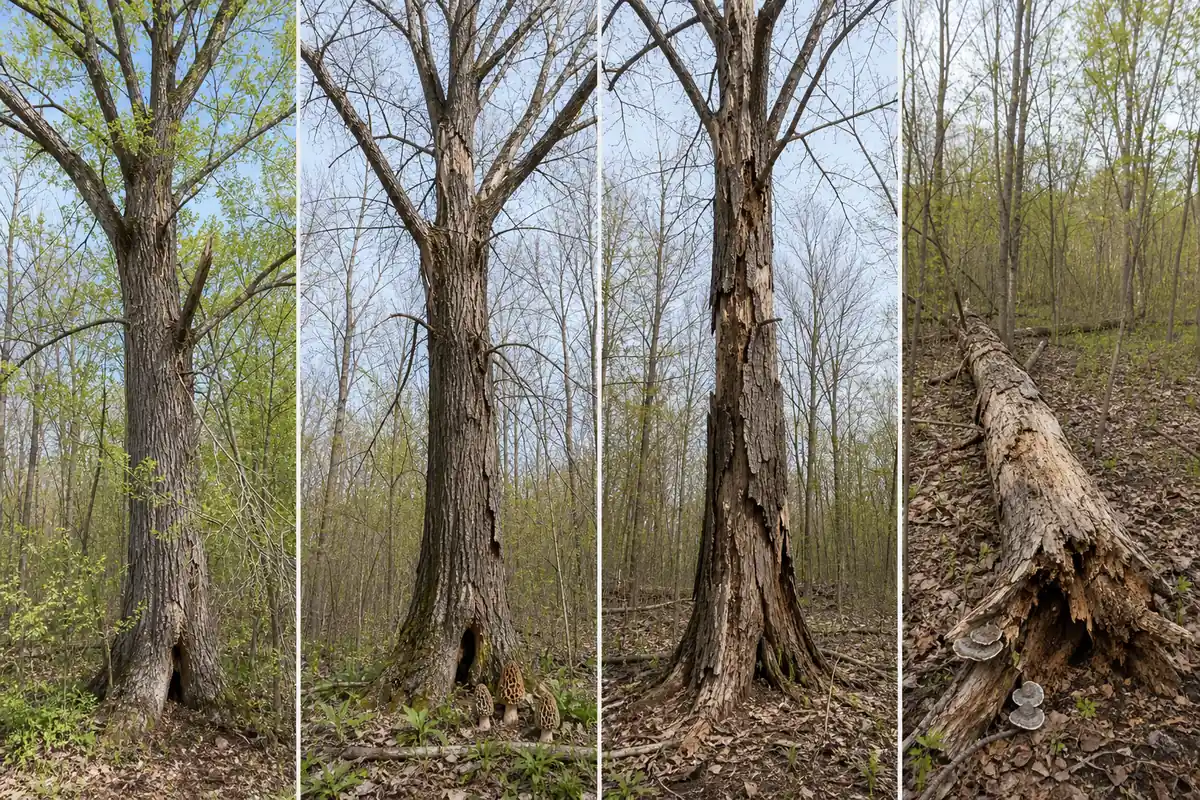
Soil warmth, recent rain, slope direction, elevation, latitude, and the local morel species can erase the apparent advantage of a well-staged elm in any given week or year.
Search the entire root zone slowly instead of circling only the trunk. Morels can stand several yards away, and leaf litter, mayapple, grass, and dappled light can hide their outline.
Do not strip bark, dig around roots, or move fallen wood to improve the site. Those actions do not create a morel flush and can damage habitat or violate land rules.
ForagingMushroom foraging laws in the UK: what is actually legalWhat Does a Mushroom on a Living Elm Mean?
A mushroom attached to living elm wood shows that a fungus has reached wood through a wound, dead branch tissue, root injury, or internal decay. It does not show how much sound wood remains.
Dryad's saddle commonly establishes at large pruning cuts, broken limbs, cankers, and other wounds. It causes white trunk rot, and advanced decay can form cavities even while part of the crown still carries leaves.
Attachment changes the concern because fruiting high on one dead branch points to a different failure zone than repeated brackets at the root flare, while a cluster on a cut stump has no standing crown above it.
Read the tree in zones before moving closer. Fruiting at a pruning scar directs attention to that branch attachment, a shelf beside a cavity marks a local trunk defect, and repeated caps around the root flare can point toward roots or lower-stem wood that helps support the whole tree.
The view below keeps those zones in one standing-tree scene, which makes the possible path from damaged wood to a person or structure easier to judge.

Photograph the whole tree before collecting anything. Include the fruiting height, wound, trunk base, crown, lean, nearby cracks, and every place a falling limb or trunk could reach.
One fruiting body does not make removal automatic, so a qualified arborist must assess the decay location, remaining wood, roots, crown, loading, and targets before recommending pruning, monitoring, or removal.
Warning
Keep clear of a suspect target zone | Arrange a prompt tree assessment when basal or trunk fruiting occurs with cavities, cracking, root movement, crown decline, or dead limbs above a path, building, vehicle, or play area. Do not strike, climb, or pull on the tree to test it.
Removing the mushroom does not treat fungus inside the wood. It also erases evidence that can help an arborist locate the affected area, so leave it in place when public safety allows.
Record the Find Before You Name It
The first photograph should show the mushroom and enough of the elm to prove whether it rises from soil, a buried root, the root flare, a wound, a stump, or a log. Close-up cap photographs taken after picking cannot recover that context.
Capture the specimen before rain, handling, or age changes it. Host is one character in a complete record, alongside growth form, underside, stem, base, flesh, odor, bruising, spore color, season, and region.
That order keeps the growth point and complete base from being lost before the close specimen views are made.
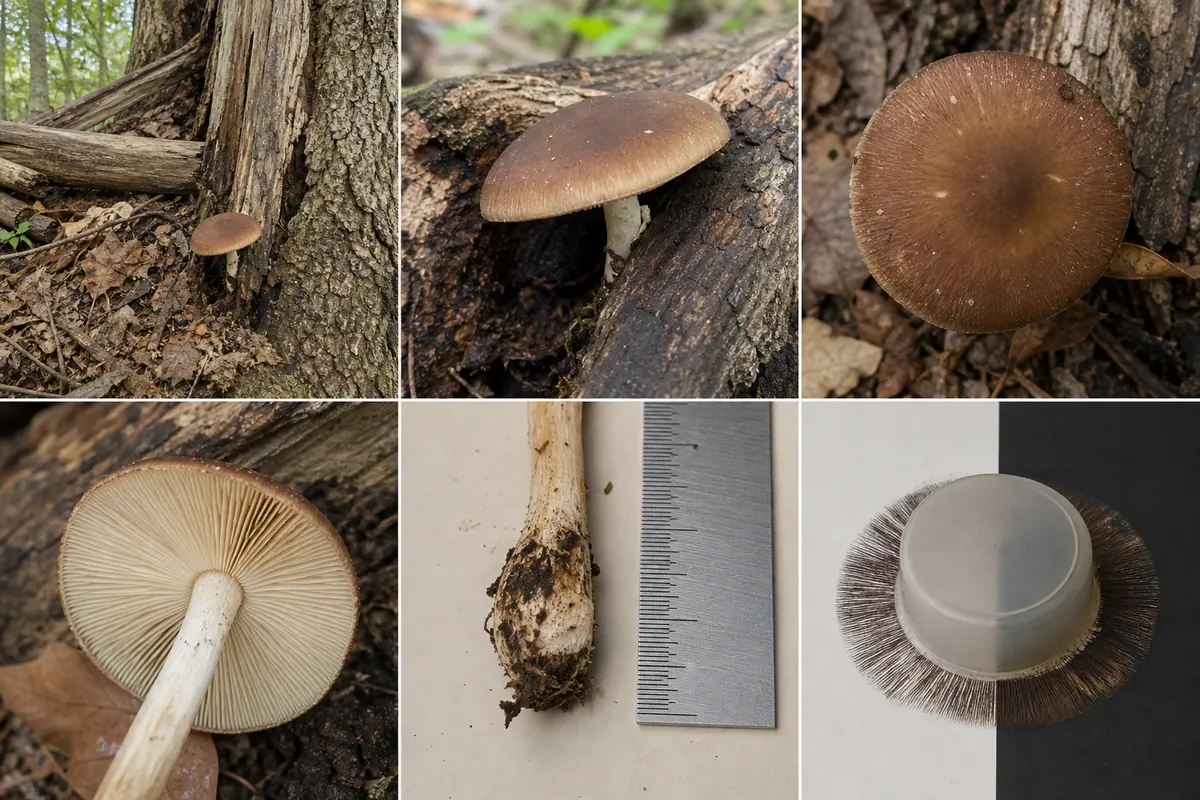
A spore deposit can separate major candidates, but it cannot identify a mushroom by itself. Velvet shank should produce a white print, while dangerous Galerina produces a rusty to brown deposit, yet a missing ring or pale young gills cannot safely close that comparison.
Check every mushroom in a mixed cluster because two species can fruit from the same elm wood and handling them together can attach one specimen's spore deposit or stem character to another cap.
Morel safety begins with true identification. True morels have a distinctly pitted cap and a hollow interior when cut from top to bottom, while Gyromitra and other false morels can have folded or lobed caps and chambered interiors.
Correct identification still does not make raw morels safe. The FDA has documented gastrointestinal and neurological illness after raw or lightly cooked true morels, so cook confirmed morels thoroughly and avoid spoiled, slimy, or damaged specimens.
Never taste an unknown wild mushroom or rely on a host tree, photograph, or image app as final authority. Use a current regional key and confirmation from a qualified local identifier before any eating decision.
Sources & References
- Iowa Department of Natural Resources Dead elm condition and field timing for morel searches.
- USDA Forest Service Morel ecology, host associations, uncertainty, and lookalike safety.
- University of Nebraska Lincoln American elm leaves, bark, crown, twigs, and fruit.
- UMass Extension Dryad's saddle on elm, trunk decay, and tree-risk assessment.
- University of Wisconsin Botany Velvet shank on elm and separation from deadly Galerina.
- U.S. Food and Drug Administration Wild mushroom identification, handling, cooking, and illness risk.