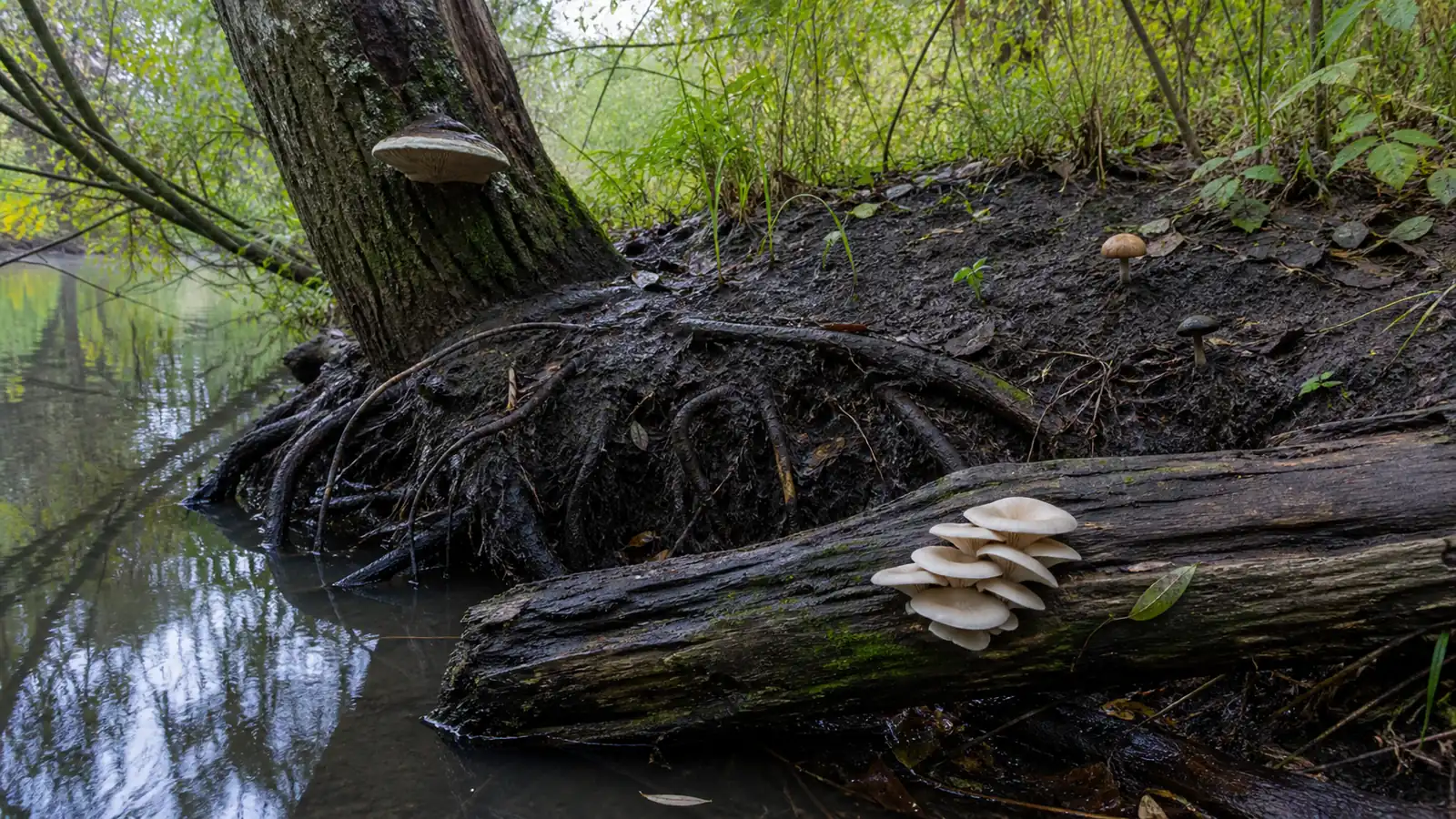
Willow wood supports perennial brackets and fast-changing deadwood fungi, while nearby soil mushrooms may only share a wet floodplain. Water position, exact attachment, and underside anatomy separate those explanations.
Record channel position, willow evidence, neighboring roots, substrate, specimen condition, and bank hazards before attempting a name.
Willow often marks the wettest line in a landscape, so mushrooms near it reflect both the tree and the water regime. Some fruit directly from willow wood, while others use saturated litter, buried flood debris, or roots of neighboring trees.
The practical distinction is on willow versus in willow habitat.
A bracket attached to a trunk has a wood relationship. A cap in wet soil beneath the canopy may have no direct connection to willow at all.
Use Willow to Read Water Before Naming a Fungus
Many willows favor streambanks, pond edges, floodplains, ditches, and seepage zones. Their presence can reveal a high water table or repeated flooding even when the surface looks dry.
Water sorts fungal habitat into narrow bands. Fresh silt near the channel, damp leaf litter above it, buried sticks at the bank edge, and drier terrace soil can support different organisms within a few steps.
| Position | Likely substrate change | Field consequence |
|---|---|---|
| Active channel edge | Fresh sediment, buried twigs, scour, and short-lived saturation | Fruiting can be damaged, buried, or detached after a flood |
| Willow root shelf | Moist soil, fine roots, litter, and exposed woody roots | Soil and wood attachment may be difficult to separate |
| Backwater hollow | Long water retention and soft debris | Small litter fungi and waterlogged wood decomposers may persist |
| Upper terrace | Better drainage and more neighboring tree roots | A soil mushroom may partner with oak, birch, poplar, or conifer instead |
These bands determine which substrate evidence should be photographed first.
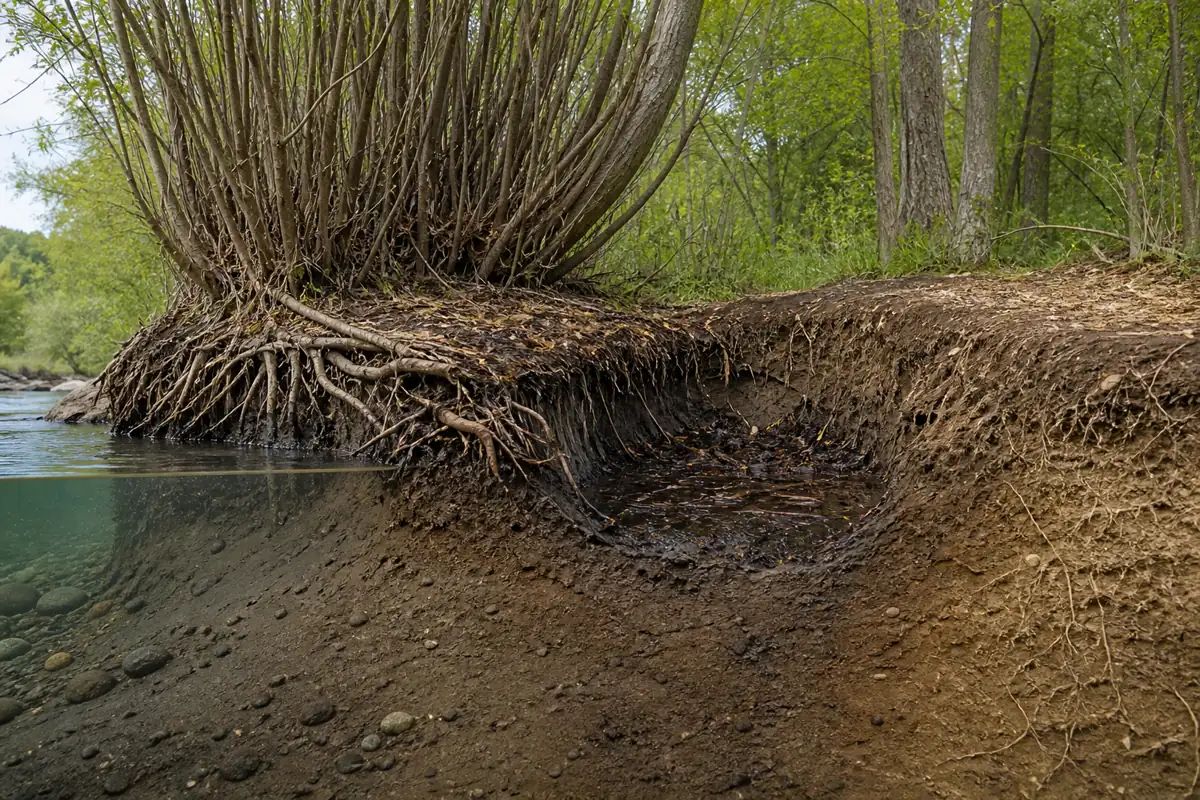
Record the recent water mark, silt line, debris direction, and whether the soil squeezes water. A single rain total does not reveal how long each band stayed wet.
Willow roots bind soft banks, but floodwater can expose, bury, or break them between visits. That movement changes whether a fruit body appears attached to a root, a transported stick, or mineral soil.
Photograph the bank profile before stepping onto it. The wide image preserves water height and substrate bands that disappear in a close mushroom portrait.
Confirm Willow and the Exact Attachment
Willow species vary from shrubs to large trees. Attached narrow leaves, flexible twigs, buds pressed close to the twig, catkins, and streamside form can support Salix, but regional keys are needed for a species.
On leafless wood, do not rely on a loose twig beneath the crown. Trace an attached branch to the trunk and photograph buds, bark, crown, and neighboring trees.
The four views keep attachment, moved wood, and host proximity from collapsing into one clue.
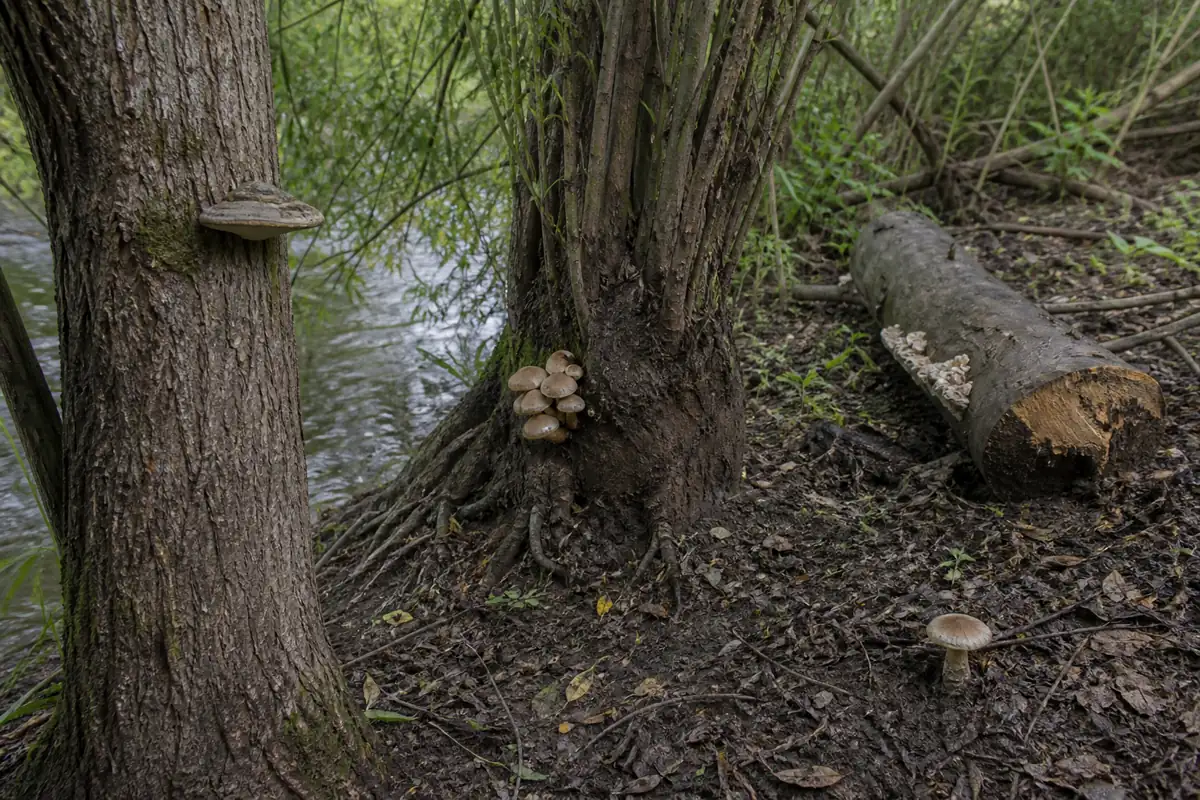
Flooded logs are a special trap. A willow-looking branch may have floated from upstream, while a willow root can lie buried beyond the visible trunk.
Use retained bark, attached twigs, buds, cut ends, branch scars, and the direction of flood debris together. If the wood cannot be confirmed, record it as unknown hardwood instead of assigning it to willow.
ForagingMushroom foraging laws in France: what the five liter rule meansPerennial Brackets Record Several Seasons
Willow can carry thick hoof-shaped brackets that persist and add new pore layers over multiple years. The willow bracket name is commonly applied to the Phellinus igniarius complex, but species limits and host records vary by region.
Warning
Wet banks add two hazards | Do not stand beneath cracked limbs or lean over an undercut bank to reach a conk. Photograph from stable ground and let a qualified arborist assess a valued or high-target tree.
A dark cracked upper surface, broad woody attachment, brown interior, and fine pore surface fit a perennial polypore better than a fresh soft mushroom. Counted layers can suggest repeated growth, but they do not provide a precise age.
The close view tests perennial anatomy rather than matching a dark silhouette.
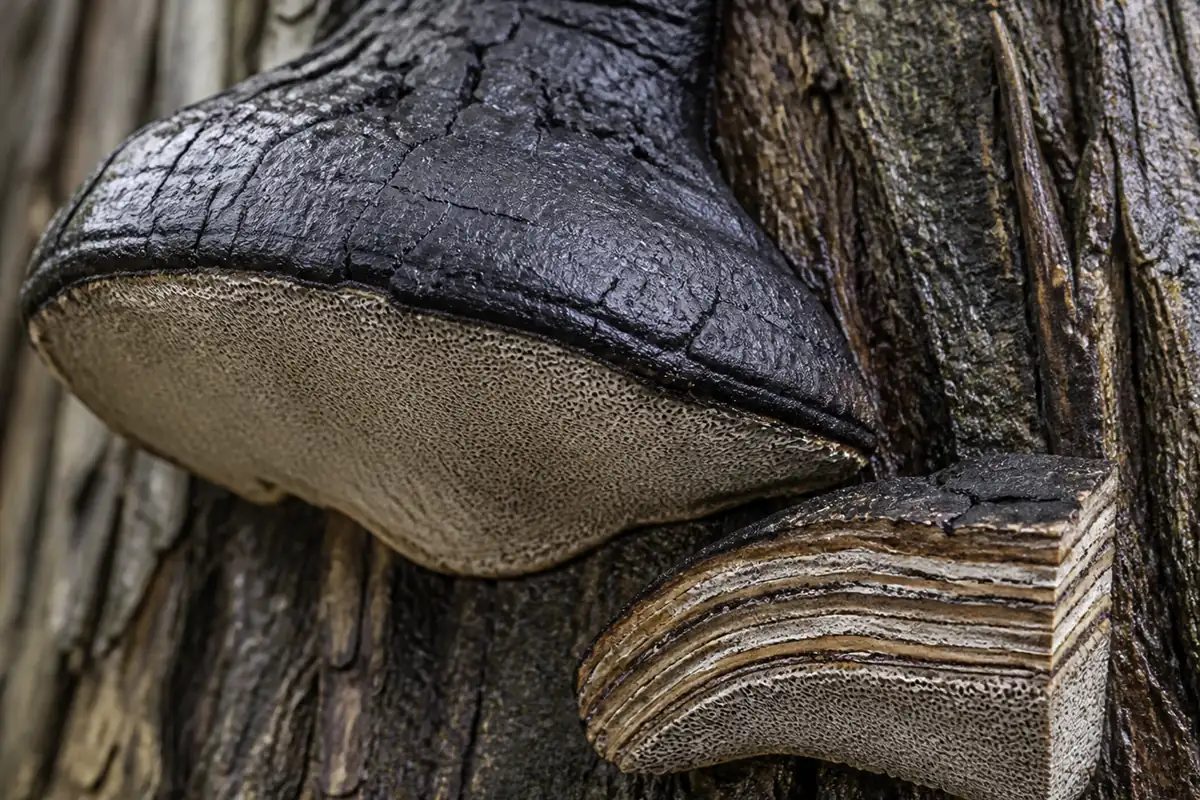
Fruit bodies on a living trunk indicate established wood colonization. They do not by themselves reveal how much sound wood remains, so a tree near a trail, bank access, building, or play area needs professional risk assessment.
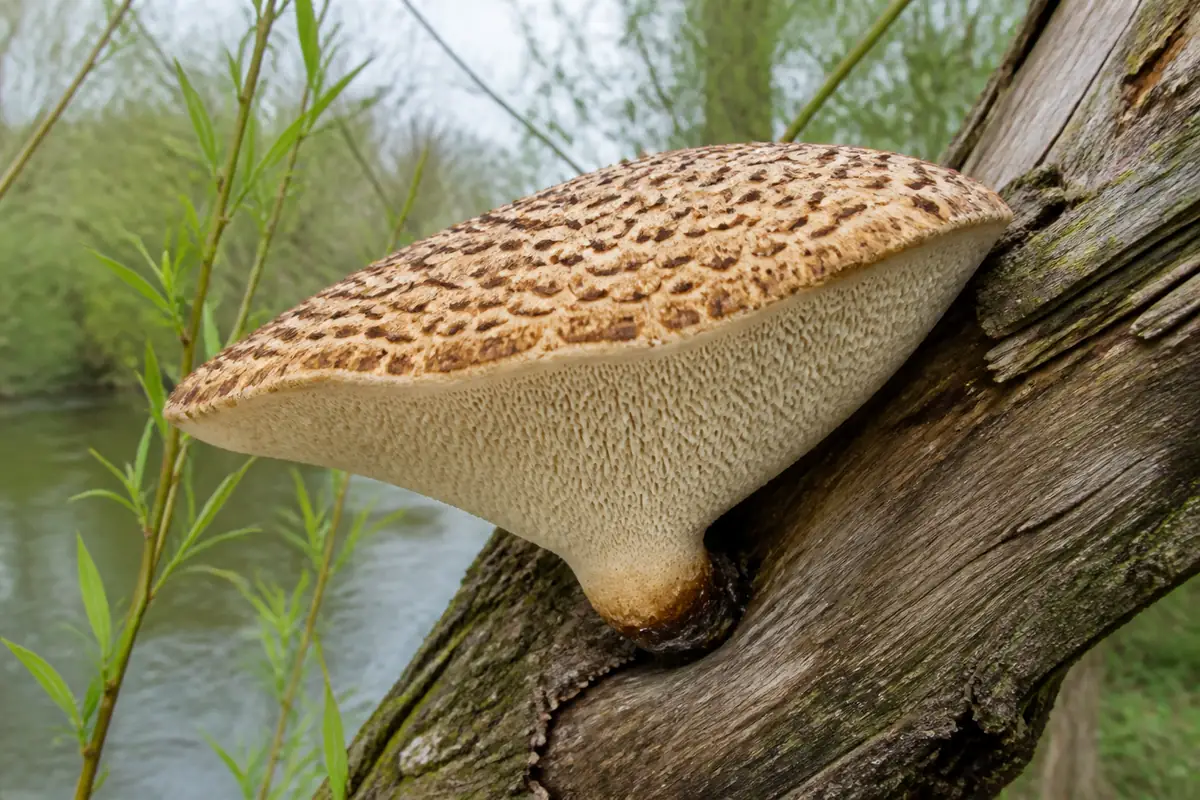
Dryad's Saddle Is a Separate Spring Bracket Hypothesis
Dryad's saddle, Cerioporus squamosus, is documented on willow among several hardwoods. It forms broad tan fans with dark flattened scales, a pale underside of angular pores, and a short off-center stem that darkens near its woody attachment.
The National Park Service describes fruit bodies a foot or more across, while Missouri's field guide gives a range of roughly 2.5 to 12 inches. Young caps can be nearly round before they expand into fan or saddle shapes.
| Character | Dryad's-saddle hypothesis | Reason to pause |
|---|---|---|
| Scaly tan cap | Dark scales form a pheasant-back pattern | Mud, cracking, or age can make another bracket look patterned |
| Large angular pores | Pores run toward the short stem | Fine pores, teeth, or gills indicate another group |
| Direct hardwood attachment | Fruits from deadwood or dead heartwood in living trees | Flood-moved wood may not belong to the nearest willow |
| White spore deposit | Consistent with the species | Spore color alone cannot settle the identification |
| Young tender margin | Fresh growing edge bends before the center | Old centers become fibrous and unsuitable for a food decision |
The candidate matters for both identification and tree condition. On a living willow, fruiting from internal dead wood can accompany heart rot and warrants attention to limbs, lean, cavities, and targets.
Do not merge this spring annual bracket with the perennial willow-bracket complex. One produces fresh fleshy shelves; the other builds hard persistent layers that can remain through several seasons.
Fresh Wood Fungi Change Quickly
Willow snags and fallen limbs can support pale oysters, blushing brackets, split-gill forms, jellies, and small clustered mushrooms. Their appearance changes after immersion, drying, frost, and silt deposition.
A pale tiered bracket that bruises pink beneath carries different evidence from a true gilled oyster. Wash nothing before photographing because mud, bruising, hairs, and pore color may disappear.
| Fresh character | What to document | Change that can mislead |
|---|---|---|
| White to cream shelf | Gills or pores, stem position, margin thickness | Silt can hide the fertile surface |
| Pink bruising beneath | Pressure mark and elapsed time | Old pores may brown without a clean pink response |
| Gelatinous lobe | Wet thickness, attachment, and color | Dry specimens shrink into a dark crust |
| Small clustered caps | Shared woody base and spore deposit | Buried flood debris can make them look soil-borne |
This comparison keeps wet-state changes tied to the fertile surface and substrate.
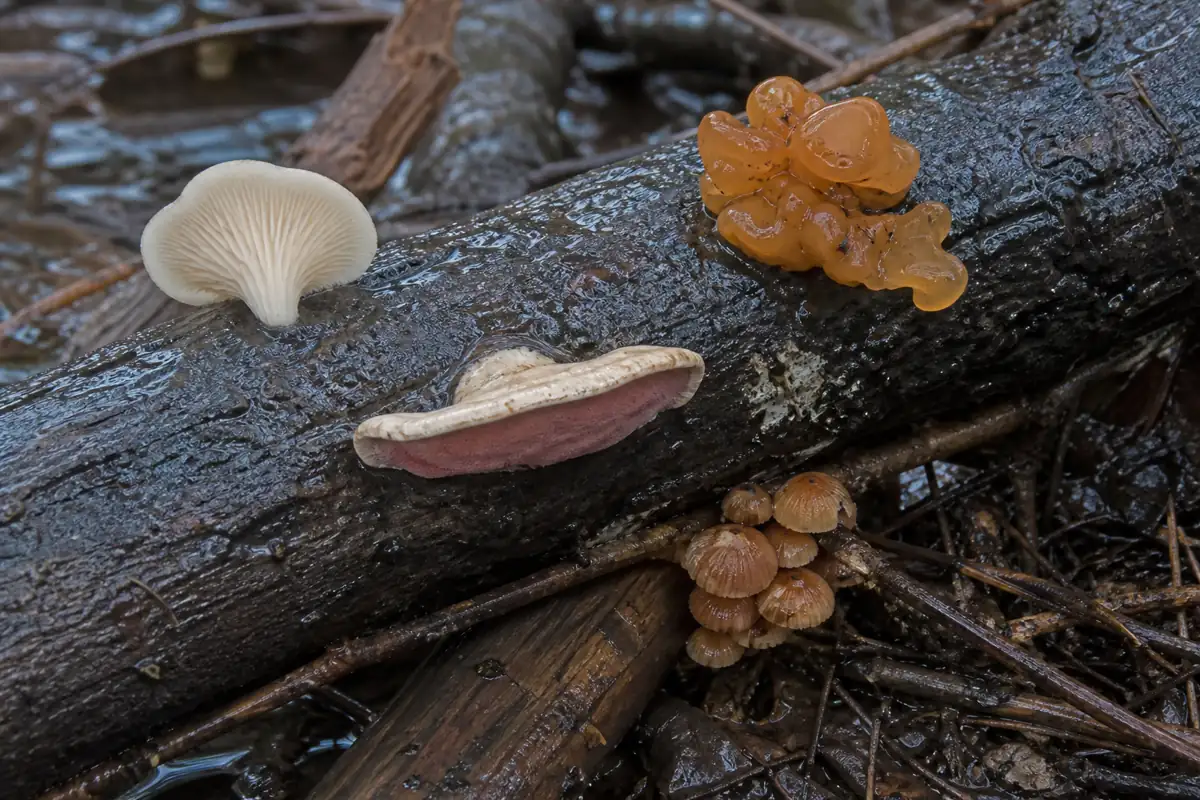
If an oyster-like cluster is present, compare it with the oyster mushroom profile only after confirming true gills, wood attachment, stem position, and spores.
ForagingMushroom foraging laws in Germany: protected species and small quantitiesA Willow Candidate Grid Keeps Substrates Visible
Wet willow habitat can produce fungi on living trunks, deadwood, buried debris, litter, and soil. Compare candidates against the actual substrate and record the features still missing from the identification.
The cards narrow the next observation, not the dinner decision. Brown caps, white gills, and clustered growth each occur in toxic as well as edible groups.
Fruiting on Living Willow Changes the Tree Question
Willows grow quickly and often develop cavities, included bark, storm wounds, and large low limbs. Internal decay can be extensive while the crown still carries leaves.
Ask Extension describes shelf mushrooms as external symptoms of internal wood rot. Removing the visible conk is comparable to removing a fruiting structure; it does not kill fungal tissue established inside the stem.
The species name cannot measure remaining sound wood. A qualified arborist should evaluate a living willow with significant fruiting near a path, building, road, fishing access, or play area.
Wet-Site Edibility Needs an Independent Check
Willow association does not make a mushroom edible. Floodwater can also move sewage, fuel, road runoff, sediment, and contaminated debris into apparently natural collection sites.
For any food candidate, resolve species, freshness, legal access, site history, and preparation separately. A specimen submerged in dirty water or collected from roadside runoff is a poor food choice even if the name is correct.
Use the beginner identification workflow to record cap, fertile surface, stem, complete base, interior, spore deposit, substrate, growth pattern, and region. Follow the foraging safety rules before a wild collection reaches a kitchen.
Warning
Symptoms require prompt medical help | If someone becomes ill after eating a wild mushroom, contact emergency services or a poison center now. Keep uncooked specimens, cooked leftovers, photographs, and the meal timeline.
Soil Mushrooms May Be Following the Wet Ground
Caps scattered beneath willow can decompose saturated litter or partner with other roots. Willow proximity becomes weak evidence when alder, birch, cottonwood, oak, or conifers share the site.
Trace the substrate without digging a trench. Mineral soil, moss, willow leaf litter, buried twig, and exposed fine root should remain distinct in the record.
“Under the tree†labelIt hides whether the specimen used soil, litter, or wood
Flood timing aloneHigh water can transport fruit bodies and woody debris
App identification from one capWet surfaces flatten color and texture differences
Host circlePhotograph all trees whose crowns or roots could reach the point
Complete basePreserve bulbs, cups, cords, and shared cluster attachment
The host-circle view shows why proximity alone cannot choose among those roots.

Some willow-associated root partners are small brown mushrooms whose identification depends on microscopic characters. Treat that group as a reason to preserve specimens for expert study, never as an edible category.
Mineral soil, saturated moss, willow litter, and buried wood can meet within inches. Keep those surfaces visible in separate photographs rather than cleaning the scene into one uniform background.
Observe How Water Changes Diagnostic Characters
Immersion does more than make a mushroom wet. It can wash spores from a cap, pack pores with silt, flatten gills, leach pigments, soften flesh, and move an entire fruit body away from its substrate.
Drying creates a different set of changes. Jelly fungi collapse into thin dark crusts, pale caps crack or yellow, and brackets harden from the attachment outward.
| State | Character most at risk | Better evidence |
|---|---|---|
| Submerged | Natural color, free spore deposit, and original position | Wide flood context plus a later intact specimen |
| Silt-coated | Pores, gills, hairs, and bruising | Photograph protected overlaps before any gentle cleaning |
| Fresh after recession | Texture, attachment, and active margin are most legible | Capture top, underside, edge, base, and scale immediately |
| Dried or frozen | Flesh consistency and original color | Keep context, note condition, and avoid forcing a fresh-state name |
This state record explains apparent differences between visits. It also prevents two weathered stages of one fungus from being counted as two species.
Revisit After Water Falls, Not by a Fixed Rain Rule
The useful clock begins with saturation and recession. During high water, mushrooms may be submerged or banks unsafe.
As water drops, fresh silt, exposed wood, and damp litter become visible at different rates.
A repeated viewpoint makes recession, access, and specimen condition comparable.
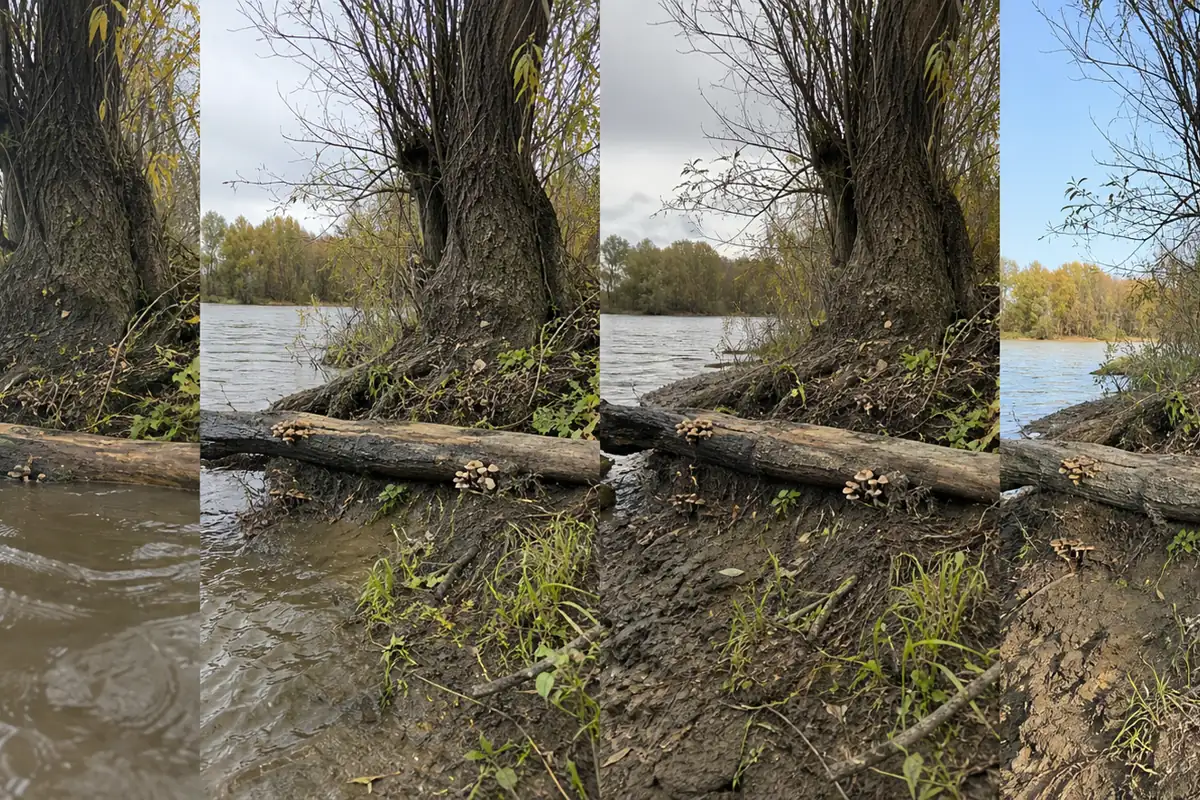
Do not use a universal days after rain promise. A shaded clay bank and a sunny sandbar release water at different speeds.
Close a Willow-Site Identification Safely
Build the final record from landscape to pore or gill. That order preserves the evidence most likely to be lost when a specimen is removed.
- Photograph channel, bank shape, flood marks, willow crown, attached leaves or buds, and neighboring trees.
- Show exact attachment at trunk, branch, exposed root, log, buried wood, litter, moss, or soil.
- Capture top, fertile underside, margin, complete base, bruising, and a ruler before cleaning.
- Record water state, soil firmness, recent weather, decay stage, odor from a safe distance, and spore deposit when relevant.
- Keep collections from separate logs or substrate bands in separate paper packets.
Do not taste an unknown mushroom, and do not treat boiling, peeling, animal feeding, or willow association as a safety test. A field record can support expert identification, while the tree and bank hazards require their own decisions.
Sources & References
- University of Minnesota Extension Willow and wet shoreline habitat.
- U.S. National Park Service Willow wood host, pores, and tree-risk context.
- University of Minnesota Extension Willow decay fungi and tree symptoms.