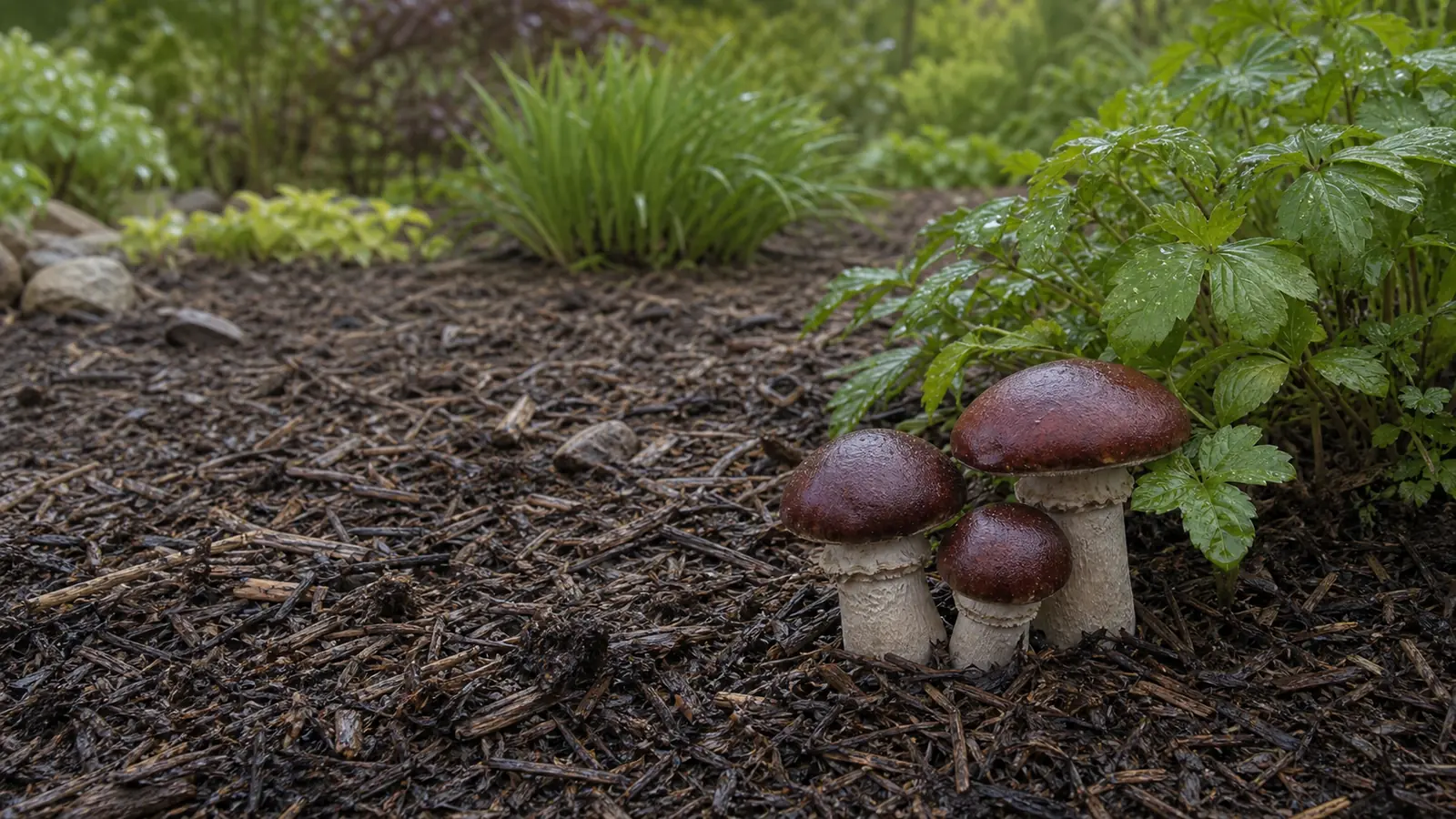
Wine caps commonly fruit during cool, wet periods in spring and fall, but a mature colonized bed and moisture below the chip surface matter more than a fixed month.
Wine cap season is usually strongest during cool, wet stretches in spring and again in fall, but the calendar only opens the search because a mature bed still needs moisture through the wood chips and a sustained shift toward fruiting temperatures.
A planted bed can stay quiet through perfect weather while it colonizes, and an established bed can fruit outside the usual months during an unusual cool spell. Treat the patch as a living forecast rather than an appointment.
How to read a wine cap bed today
Start with three observations you can verify at the patch. Check the recent temperature trend, lift the top chips to feel the lower layer, and look for evidence that the fungus already occupies the bed.
Tiny wine cap primordia can hide beneath lifted chips as pale, firm knots and buttons before they develop the burgundy to reddish-brown cap associated with young Stropharia rugosoannulata.
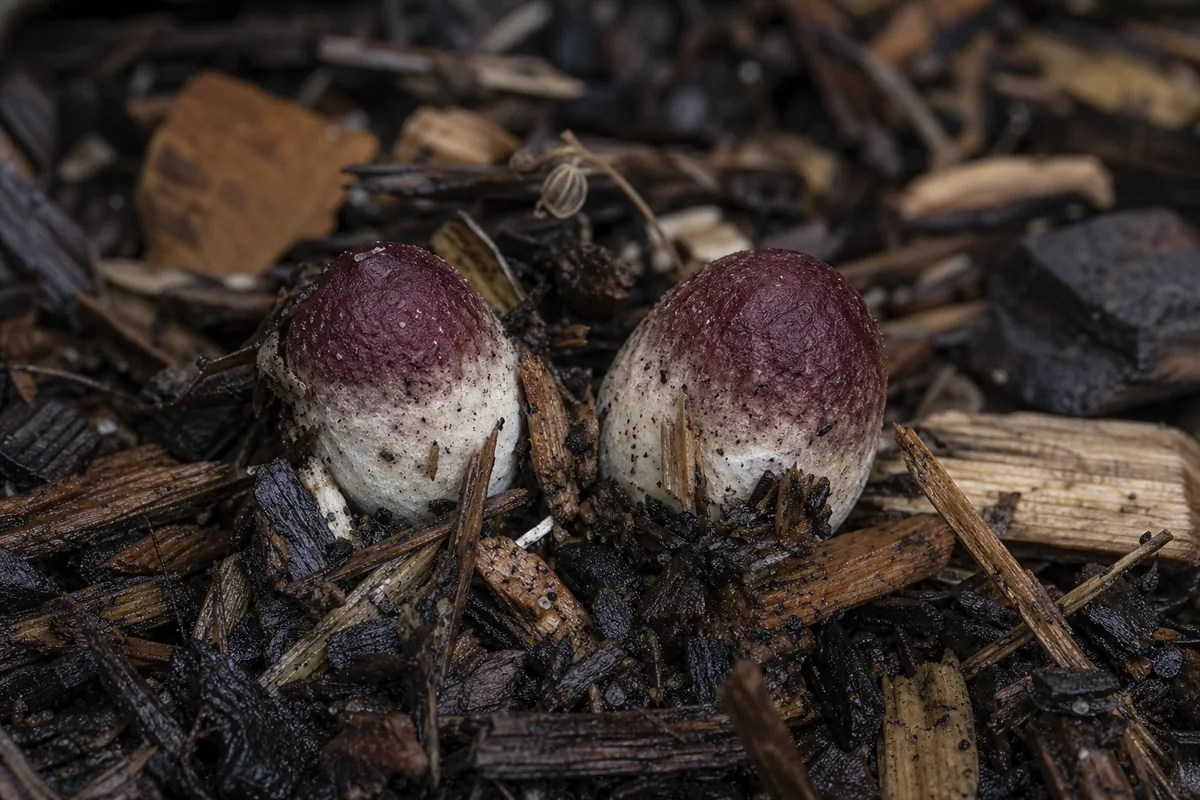
Do not rake deeply to hunt for them because the search can damage the developing cluster and expose the lower bed to drying. Move only a small loose chip when necessary, then replace it.
The strongest immediate signal is agreement among the observations because a mature, evenly damp bed after several mild days deserves a close check, while a new bed with no visible colonization needs time even if rain and temperature look ideal.
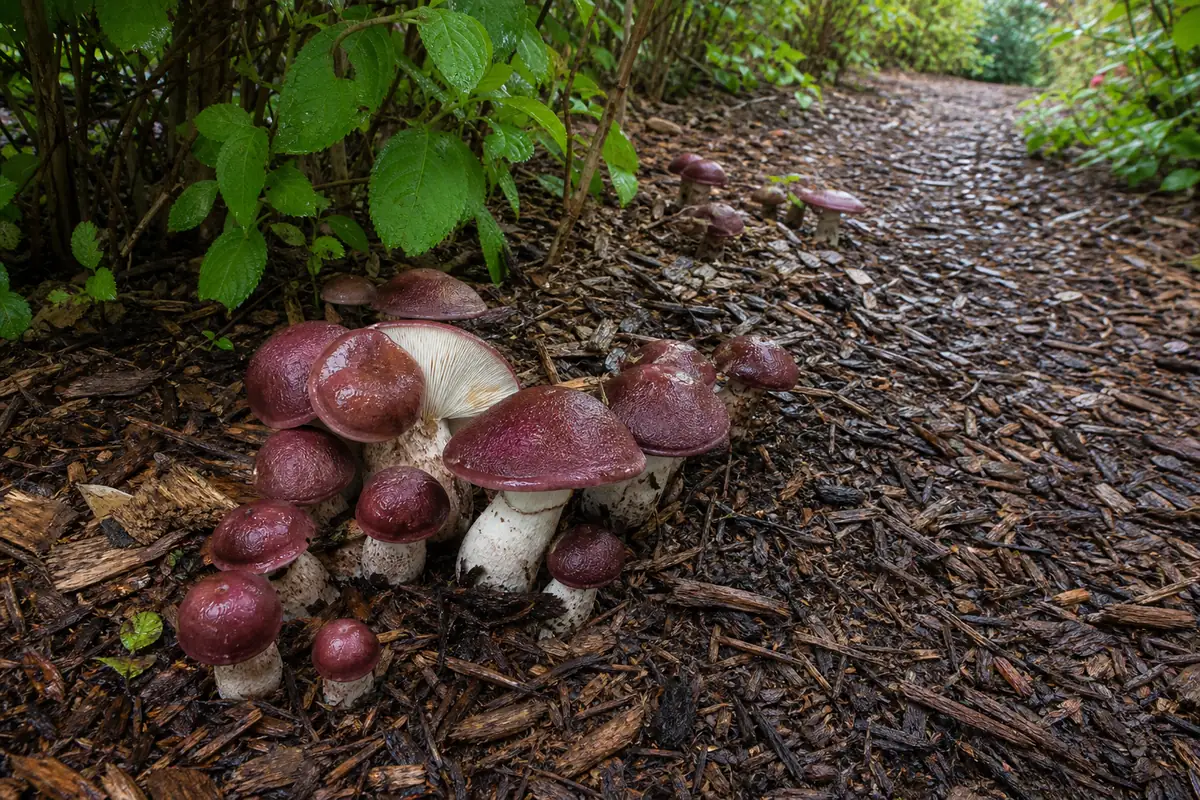
Once buttons break the surface, check daily or every other day because warm conditions can move caps from compact buttons to broad, open specimens before a weekly visit.
- Check beneath leaves and loose chips without disturbing the white network.
- Compare shaded and exposed edges because they dry at different rates.
- Record the first buttons, the first harvest-size caps, and the end of the flush.
These records turn next year's broad calendar into a local pattern. They also show whether a patch responds more strongly to spring warming or autumn cooling.
ForagingHow Should Beginners Start Mushroom Foraging in the Field?The broad wine cap calendar
Across temperate North America, spring and fall are the two most useful windows for wine caps. Ohio State Extension describes production from spring to fall, while practical peaks tend to gather around the cooler, wetter parts of that span.
| Climate pattern | First useful checks | Second opportunity | Main limit |
|---|---|---|---|
| Cold-winter northern areas | Late spring after the bed thaws and nights moderate | Late summer into fall cooling | Frozen substrate and short shoulder seasons |
| Temperate Midwest and Northeast | Spring rain through early summer | Early to mid-fall after heat breaks | Hot dry midsummer weather |
| Mild coastal or southern areas | Late winter into spring during cool wet periods | Late fall into early winter where frost is limited | Heat and irregular rainfall |
| High-elevation gardens | After local thaw, later than nearby lowlands | Early fall before repeated hard freezes | A compressed frost-free interval |
These climate patterns are not guaranteed month ranges because a shaded irrigated berry bed may remain productive after an exposed path dries, while a high-elevation bed can lag weeks behind the town below it.
Spring fruiting often follows a period when the underground network has resumed active growth and moisture becomes steady. A bed inoculated early in the growing season may fruit later that year, but Cornell reports that first fruiting can take anywhere from about two months to a full year.
Summer does not automatically end the season because a cool, rainy interval can produce mushrooms from a mature, heat-protected bed, though exposed fruit bodies may grow fast and open sooner in warm air.
Fall supplies a different transition because nights lengthen, evaporation slows, and repeated rain can recharge the chip layer after summer. That combination can reopen a bed that looked inactive for months.
The broad spring mushroom season can help frame local weather, but wine caps respond to their own substrate and bed history. Their useful calendar begins where those conditions overlap.
Temperature changes open the window
The underground mycelium and the visible mushroom do not use temperature in the same way because a recent review reports mycelial growth across roughly 5 to 35 C, with an optimum near 26 C, while primordium formation is associated with a cooling shift into about 10 to 20 C.
That contrast explains why a bed can spread through warm weather without producing caps. Vegetative growth prepares the substrate, then cooler conditions help change the fungus from occupying chips to forming mushrooms.
Note
Do not treat 20 C as a switch. Bed temperature, strain, moisture, shade, and the duration of the cooling trend all affect whether primordia form.
For the temperature cue, use a three-day or seven-day trend because several moderate days and cool nights carry more information than a brief cold front followed by renewed heat.
At the patch, compare air readings with what the mulch is doing. A thick shaded bed changes temperature more slowly than bare ground, which can delay its response in spring and protect it from a short warm spell in fall.
Wine cap fruiting changes with higher temperatures because controlled conditions around 24 C produced faster, more slender mushrooms that tended to open earlier than cooler-grown specimens.
This does not provide a field identification character because size and shape vary for many reasons. It tells you why warm-weather checks should be closer together once mushrooms begin to emerge.
Key takeaway
A sustained transition into cool, moist weather is more useful than one temperature reading because primordia respond to conditions inside a mature bed.
The temperature cue also separates this page from a planting calendar. If the goal is to establish a new patch, substrate preparation and spawn placement belong to growing wine caps, while seasonal monitoring begins after that work has had time to colonize.
Rain must reach the colonized layer
Rain can initiate fruiting in outdoor beds, but a darkened surface is weak evidence because the useful weather change occurs where wine cap mycelium meets damp substrate below the top chips.
Lift a small handful of chips from the wine cap bed to learn whether a dry surface covers a cool, flexible lower layer or a wet surface hides a dusty center.
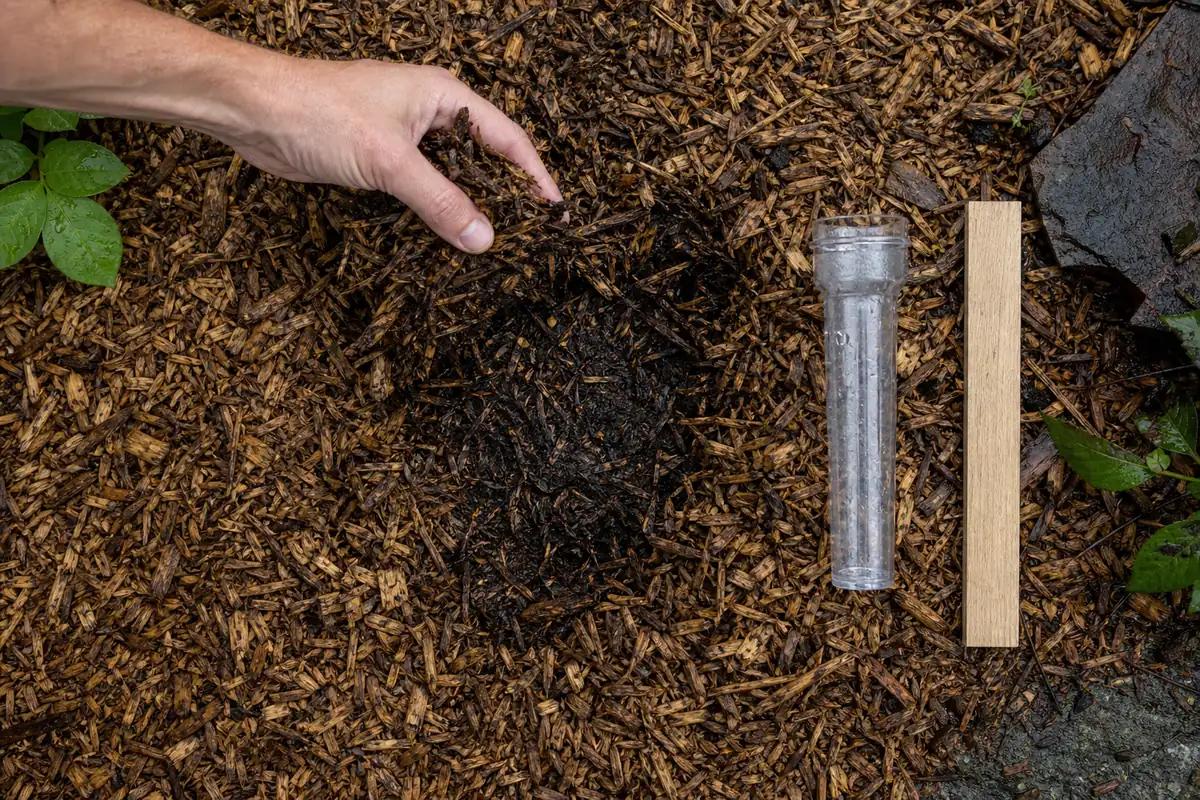
The bed should hold moisture without becoming a stagnant basin. Water fills pore spaces when drainage is poor, reducing the air available around the woody material and making a flooded patch different from a thoroughly damp one.
- Probe more than one spot, including a shaded center and a dry edge.
- Water slowly enough to soak the chip depth rather than wash the surface.
- Recheck after wind because exposed paths lose moisture faster than sheltered beds.
- Keep runoff from contaminated soil, treated lumber, and pet waste out of food beds.
Depth and timing matter when you irrigate. A slow soaking in the morning gives water time to enter the bed, while repeated shallow sprinkling can wet only the visible chips and encourage a false sense of readiness.
Shade from vegetables, berry shrubs, or fruit trees reduces evaporation, but the useful site also stays open enough that mushrooms do not sit in stagnant, waterlogged material.
The general response of mushrooms after rain varies by species and habitat. For wine caps, rain becomes persuasive only when temperature, colonization, and woody food already support fruiting.
ForagingWhich Wild Mushrooms Should Beginner Foragers Learn First?Bed age decides whether good weather matters
Two beds in the same yard can respond differently because weather cannot replace the hidden preparation that joins scattered spawn into an established network.
Cornell gives a wide first-fruiting range of roughly two to twelve months after inoculation. Spring installation often allows a same-season crop, but late planting, dry weather, old chips, heavy disturbance, or a cold climate can push the first flush into the following year.
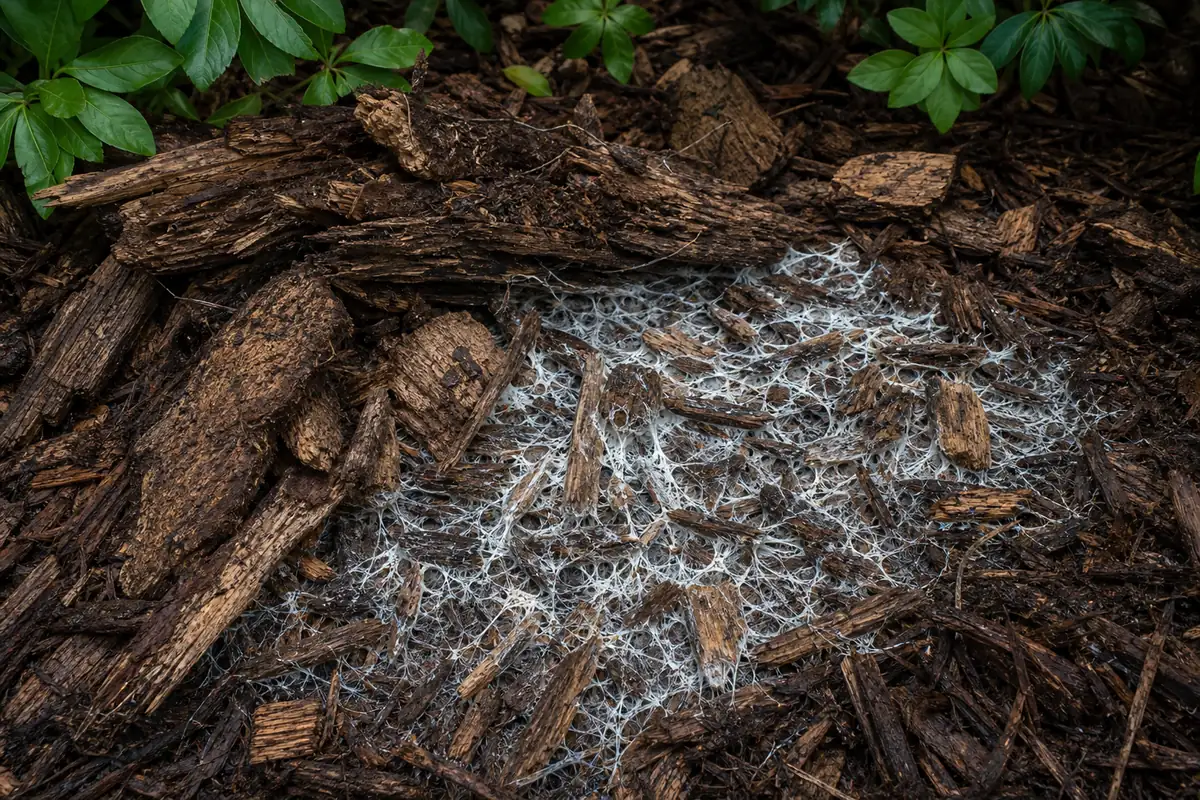
Look for white growth that binds adjacent chips and extends beyond the original spawn pockets. Do not use color alone because several molds and other fungi also occupy mulch, and disturbing a large area merely to inspect it costs moisture.
- Establishment
- First fruiting may occur in 2 to 12 months rather than on the planting date
- Persistence
- An established patch can live and fruit for several seasons
- Food supply
- Fresh woody material supports continued growth after the original chips break down
Bed history changes the forecast because a patch that produced last fall has demonstrated colonization, while a six-week-old bed has not earned the same expectation from identical rain.
An older patch can also stop responding because its food has been consumed or the site has changed. Thin, decomposed chips, repeated tilling, drought, soil compaction, or removal of shade can narrow a previously reliable season.
Add fresh untreated hardwood chips according to cultivation guidance when maintaining a known bed, but do not bury active fruit bodies during a flush. The purpose is to feed and protect the underground network, not to force mushrooms on a chosen date.
This distinction prevents a common false diagnosis. A quiet young bed is often early, while a quiet mature bed after several good weather cycles deserves inspection for dryness, depleted substrate, disturbance, or drainage problems.
When the second season opens
Autumn becomes the second major opportunity when summer heat retreats and rain restores the bed because warm-season mycelial growth can then meet cooler conditions favorable for primordia.
Watch night temperatures and bed moisture together because one rainy day during continuing heat may change little, while a week of cooler nights and damp chips can move a mature patch toward a flush.
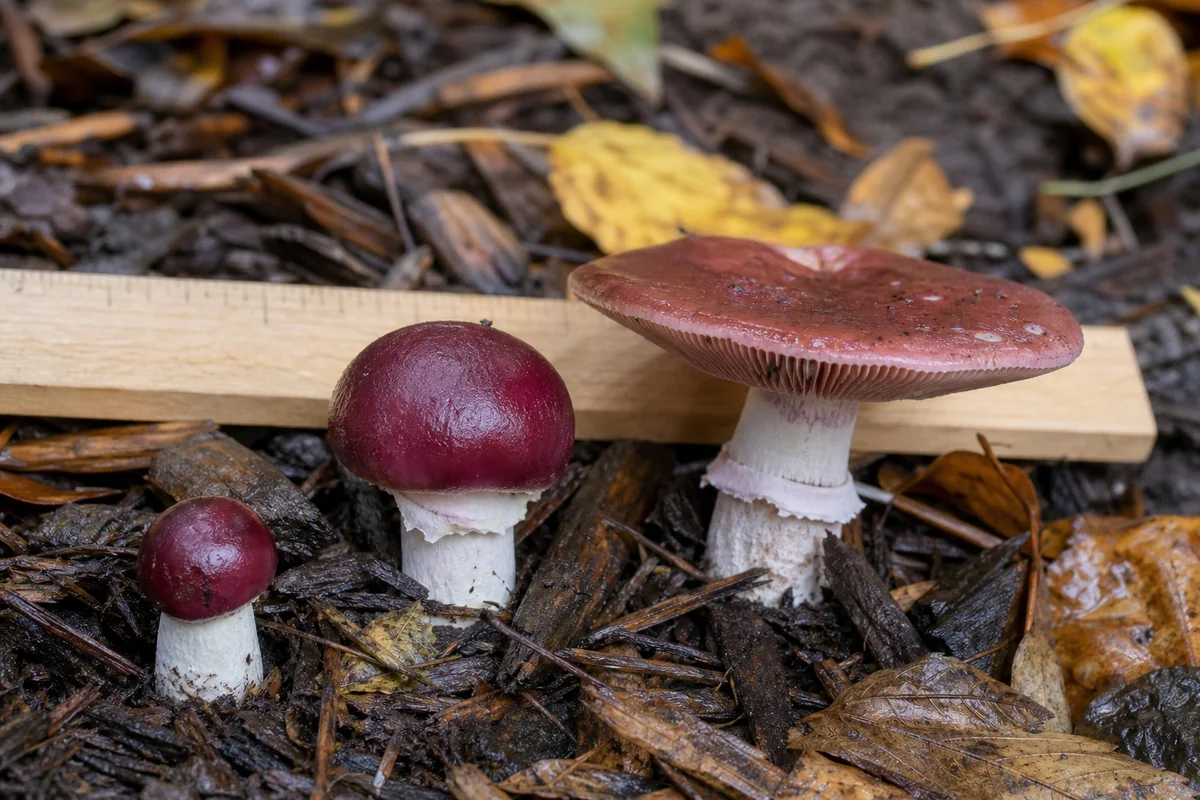
Cool fruit bodies often remain compact longer than mushrooms developing in warmer conditions. Even so, insects, slugs, wind, and intermittent sun can age exposed specimens, so fall does not remove the need for frequent checks.
The first hard frost may damage exposed caps without killing the entire underground network. A protected bed can remain viable and fruit again in a later suitable period, which is different from promising another flush after every thaw.
The autumn opportunity can extend toward winter in mild climates, while repeated freezing closes practical fruiting in cold regions even though mycelium survives below the protected chip layer.
Other fall mushrooms may share the same cool, wet interval. Their presence confirms that fungi are responding to weather, but it does not prove that a wine cap bed is ready or that a mulch-bed mushroom is Stropharia rugosoannulata.
ForagingWhen Is Oyster Mushroom Season?A seven-day forecast for one patch
Consider an established berry-bed patch that fruited last year. After a hot dry month, the area receives steady rain, daytime highs fall into mild conditions, nights cool for several days, and the lower chips feel evenly damp.
That patch deserves a check now because all four pieces of evidence agree. The prior crop establishes maturity, the rain reached the substrate, cooling supports primordium formation, and shade slows renewed drying.
| Patch evidence | Decision for the next seven days | Reason |
|---|---|---|
| Mature, damp, cooling, buttons visible | Check daily or every other day | Fruiting has started and caps can expand quickly |
| Mature and damp, cooling, no buttons | Recheck in two or three days | Conditions fit, but initiation is not visible |
| Young bed, damp, cooling | Monitor weekly without digging | Colonization time remains the limiting factor |
| Mature bed, surface wet, lower chips dry | Soak appropriately, then reassess | The rain did not reach the active layer |
| Mature bed with standing water | Correct drainage and wait | Saturation is not useful moisture |
| Mature bed after repeated hard freezes | Record and wait for the next seasonal window | Exposed fruiting conditions have closed |
Change the patch-age fact by imagining that the same bed was installed six weeks ago, when the weather would still support growth but a near-term flush would be less likely within Cornell's broad establishment window.
Change another fact and make the lower chips dry. The cooling trend remains interesting, yet irrigation or meaningful rain must restore moisture before repeated scouting makes sense.
This method avoids a points system that pretends certainty because bed maturity, moisture, and temperature interact, so three weak signals do not automatically outweigh one missing requirement.
Keep the record simple with date, recent rain, approximate temperature trend, bed moisture, visible stage, and harvest condition. After two seasons, the notes can reveal whether the local patch favors one strong flush or several smaller responses.
Where seasonal checks pay off
Wine caps decompose woody organic material, so permanent mulched places such as garden beds and forest edges deserve attention before generic open soil.
The best monitoring sites combine food, moisture, and a stable position. Berry rows, fruit-tree mulch rings, perennial beds, wood-chip paths, compost edges, and garden shade can hold that combination when the material is untreated and the ground drains.
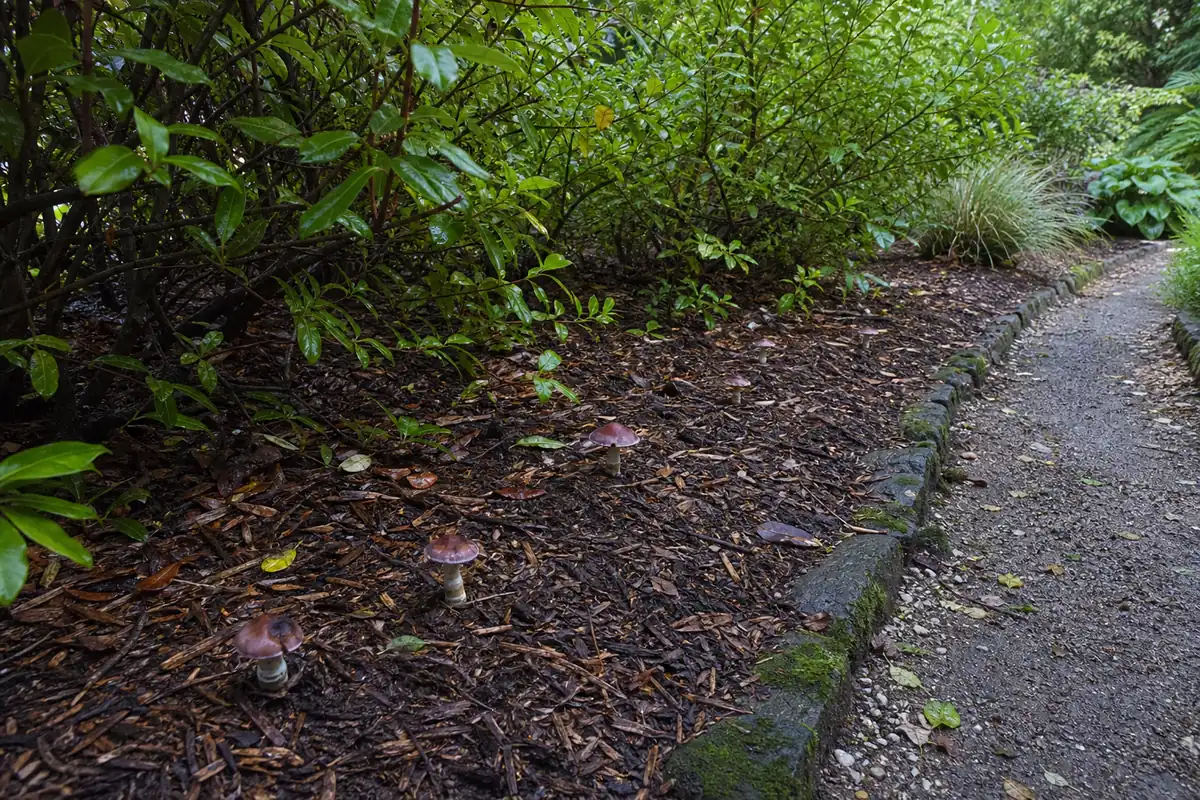
- Prioritize woody mulch that has remained in place long enough to colonize.
- Compare protected edges with sunny portions of the same bed.
- Skip dyed or chemically treated material when the mushrooms might enter food.
- Obtain permission before checking landscaped property or harvesting from shared beds.
Tilling breaks the network that carries resources through the substrate, which is why Cornell recommends permanent beds rather than garden ground that is turned over regularly.
A forest-edge find can be plausible, but habitat never completes identification. Landscaped mulch supports many unrelated species, and new mushrooms can arrive even where wine cap spawn was intentionally installed.
Use the broader wine cap mushroom profile for habitat and field characters while keeping this seasonal forecast focused on when a plausible patch deserves attention.
A perfect date cannot identify a wine cap
Peak wine cap weather does not make a mulch-bed mushroom edible because many species can emerge from garden mulch, including beds intentionally inoculated with Stropharia rugosoannulata.
Preserve the whole specimen and observe several ages when possible. Young wine caps can show a burgundy cap, while older caps fade and flatten, so a search based on cap color alone can fail as the flush matures.
The species commonly develops a substantial ring on the stem and a dark purplish-brown spore print. Those features belong in a complete identification that also considers gills, stem base, substrate, geographic context, and possible lookalikes.
Warning
Never eat a mulch-bed mushroom because it appeared in the right season or inside a planted patch. Obtain expert confirmation when any required character is uncertain.
| Seasonal observation | What it supports | What it cannot prove |
|---|---|---|
| Fruiting after cool rain | The weather suits a possible flush | Species identity |
| Mushroom inside an inoculated bed | Wine cap is a plausible candidate | That no other fungus is present |
| Burgundy young cap | One expected feature | Edibility or a complete identification |
| Dark purplish-brown spore deposit | A useful diagnostic character | Identity by itself |
| Several mushrooms at different ages | A better set of evidence | Safety without expert-level comparison |
A wine cap identification assessment must resolve the complete character set rather than borrow certainty from the calendar, while a mushroom spore print adds evidence without replacing the rest of the specimen.
Keep unknown mushrooms separate from food and photograph the cap, underside, stem, base, surrounding mulch, and group arrangement before the specimens deteriorate. General mushroom foraging safety still applies in a home garden because cultivation history changes likelihood, not the standard of proof.
Sources & References
- Cornell Cooperative Extension, Method for Cultivating Stropharia Mushrooms Establishment interval, habitat, maintenance, persistence, and identification caution.
- Cornell Small Farms, Outdoor Production Outdoor wine cap substrate, inoculation timing, and the two-to-six-month fruiting range.
- University of Illinois Extension, Bed Farming Outdoor bed construction and weather-triggered fruiting.
- Zhang et al., The rise of Stropharia rugosoannulata industry in China Temperature and moisture evidence for mycelial growth, primordia, and fruit-body development.