
 Poisonous

What is a lilac bonnet mushroom?
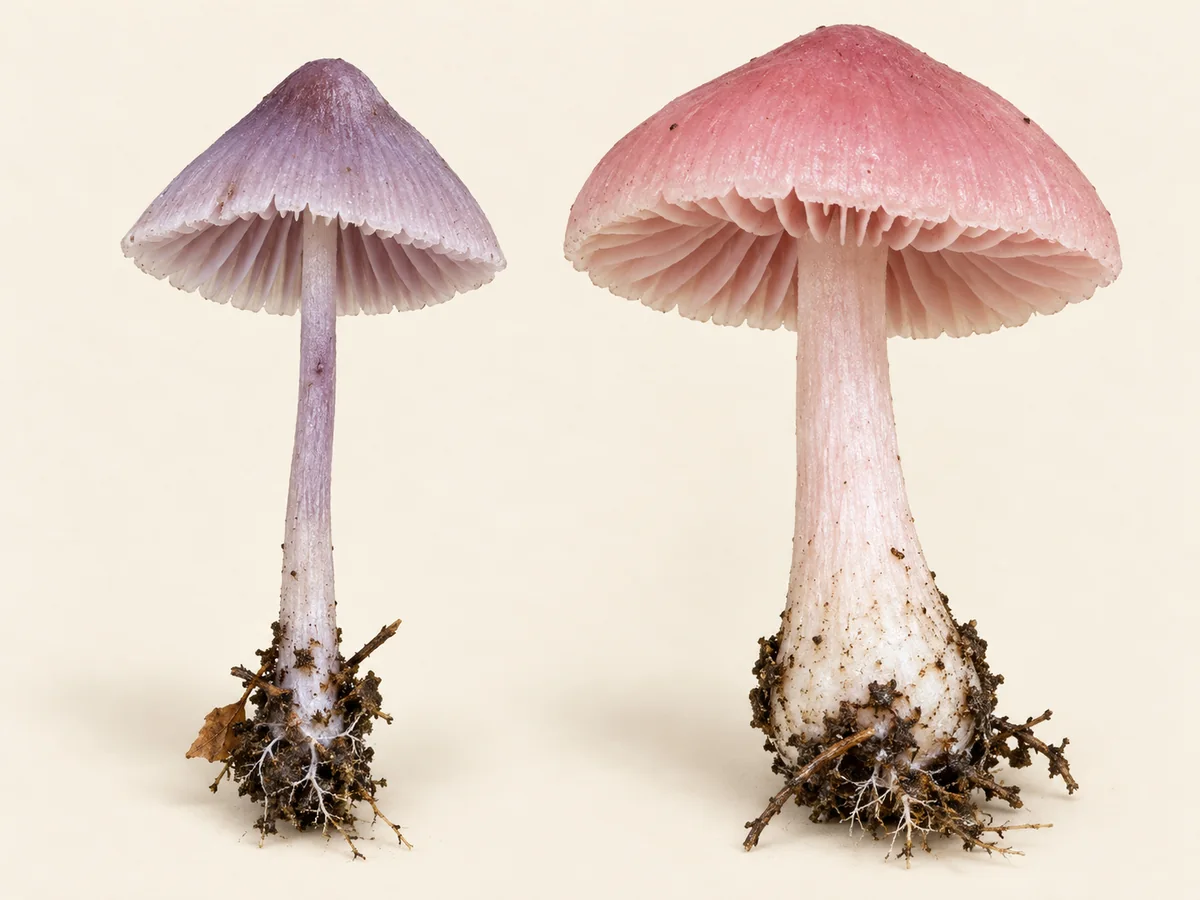
Lilac bonnet takes its name from a color that varies far more than the name suggests. One fresh cap may be lilac or violet-gray, while another from the same species looks pinkish, yellowish, bluish or nearly white. Your identification has to rest on the features that remain after the purple fades.
Those features start with a striate cap that changes with moisture, then pale attached gills, a slender hollow stem, white spores and a radish-like odor. Your complete identification ties all of them to one intact specimen and its habitat. Write down what the mushroom grew from as well, since leaf litter, buried wood and living roots point to different lifestyles.
Matching on color first is one of the identification habits that mix up look-alike bonnets. It can pull a faded M. pura away from the right comparison. It can also push an unrelated violet bonnet toward this name.
The species is saprotrophic, so the caps you see are short-lived spore-bearing structures that grow from decaying organic material. Their small size does not make them harmless, and the pretty lilac color tells you nothing about edibility. For a food decision you need not solve every taxonomic wrinkle, because lilac bonnet counts as poisonous and any uncertain small bonnet stays outside the basket.
Which features identify a lilac bonnet?
Begin with several fresh fruit bodies when the patch allows it. One cap can hide how much color, shape and size change with water content and age. Comparing a few side by side shows you the range before you judge any single one.
The specialist description by Aronsen and Læssøe gives a cap about 10-50 mm across. It starts curved or broadly bell-shaped, then can flatten, keep a low central bump or sink slightly in the center. Its smooth surface is hygrophanous, which means its color changes as water leaves the tissue.
The cap margin is commonly translucent-striate, because light and moisture show the gills through the thin edge as radial lines. Striation and hydration belong together. Moist caps may show stronger lines and richer color. Dry or weathered caps can turn pale enough to lose the very feature behind the common name.
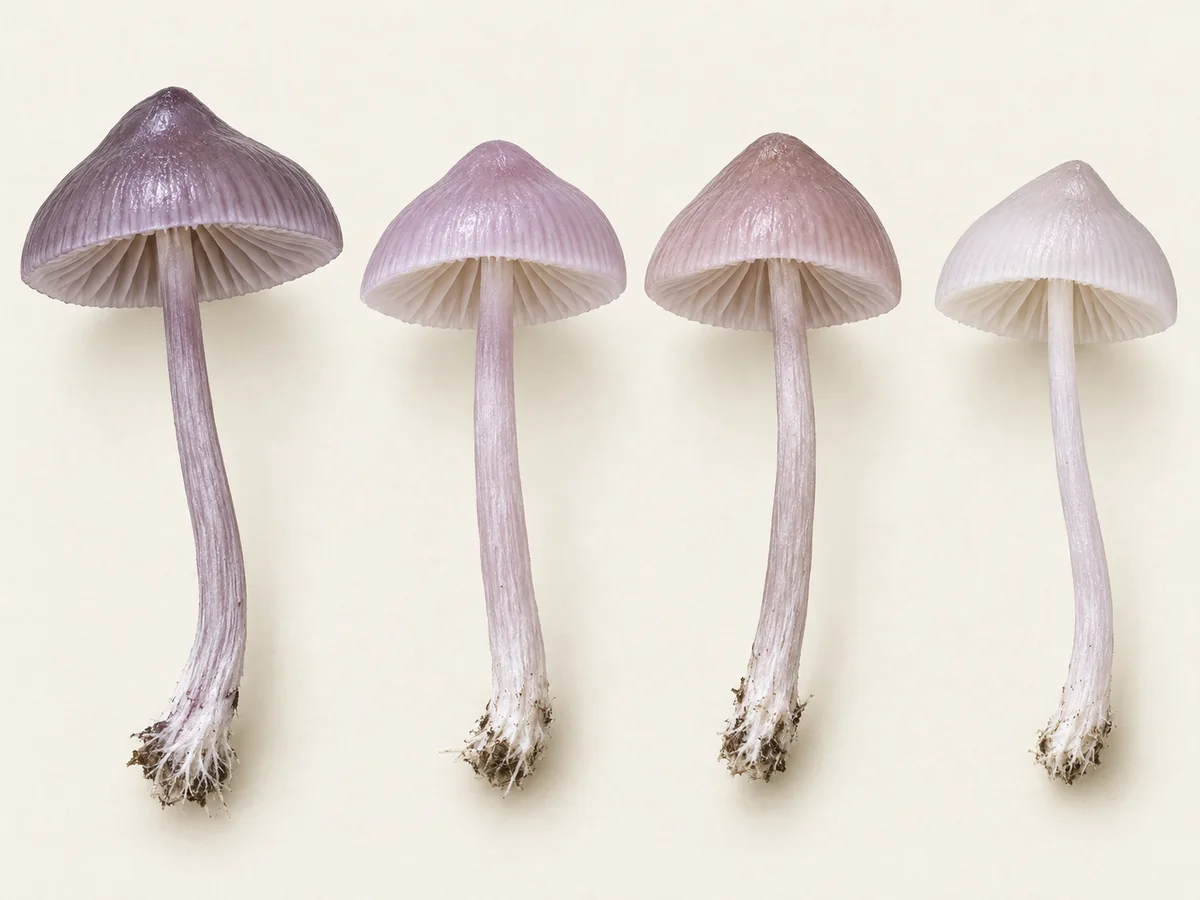
Look underneath before handling changes the mushroom. The gills begin pale whitish and may take on pink or violet tones. They rise to meet the stem and can attach directly, form a shallow notch or run down briefly as a small tooth.
That gill attachment supports the name without being unique to it. Several bonnets have attached pale gills. The observation only counts when it agrees with the cap, stem, odor and habitat.
The stem is usually 4-9 cm long but only a few millimeters thick. It is hollow, fairly tough for its size, and colored from whitish through pinkish or violet, with long coarse white fibers gathered around the base. Recover that base gently, since a stem snapped above the litter loses those fibers and hides whether it grew from leaf litter, needles or a scrap of decayed wood.
Guides often compare the odor with radish, especially after you bruise the cap or gills gently. You can waft the odor toward your nose without tasting the mushroom. Guides that report its taste describe it; they are not telling you to try it.
Its white spore print fits Mycena pura. Many unrelated gilled mushrooms also drop white prints. The print places the specimen in a broad group, and it proves neither this species nor its safety.
Photographs can support this process, but they rarely cover all of it. Suppose the photo shows an overexposed cap, someone cut off the base and nobody noted the habitat. Any confident species label on that photo would claim more evidence than you have.
Safety notes on Lilac Bonnet
The authors of a molecular study of a confirmed Mycena pura specimen describe the species as a cause of gastroenteritis-type mushroom poisoning. That finding supports a firm no-food decision. The paper does not establish a safe dose, a predictable symptom sequence or a household treatment.
Its poisonous status answers the kitchen question before anyone has a perfect species name. Uncertain violet Mycena also stay out of food, because related species and weathered lookalikes can overlap in the field.
Possible gastrointestinal illness may include nausea, vomiting, abdominal pain or diarrhea. Even so, the absence of early mushroom poisoning symptoms does not clear an exposure. Mixed collections may contain a different species with another time course.
After a possible ingestion, contact a poison service immediately. In the United States, call Poison Control at 1-800-222-1222. Call emergency services for collapse, seizure, breathing difficulty or inability to wake the person.
Keep remaining mushrooms, meal leftovers and photographs if you have them, but do not delay the call while you try to finish an online identification. The poison specialist can arrange identification and clinical advice from the exposure history. Your job is to make the call and keep the evidence.
Where and when does lilac bonnet grow?
Lilac bonnet fruits from decaying material in woodland litter. The monograph records it among leaf humus and needle beds in deciduous and coniferous woods, and in more open heathland, from summer into autumn. That broad range rules out a simple tree rule.
You may find the caps beneath broadleaf trees or conifers. The fungus is breaking down dead organic matter, though, so the nearest trunk gives you no species label. Its underground mycelial network lasts after the short-lived caps collapse, and picking a cap leaves the fungus in the litter layer.
An Argentine national parks biodiversity record places it mainly on decaying Nothofagus and other broadleaf litter, with occasional fruiting from very rotten wood. That record shows its range of habitats within Argentina. It does not make Nothofagus a requirement anywhere else.
Moisture and temperature control when the caps appear. Guides to summer mushrooms and autumn fruiting explain why the same site can look empty until rain and suitable temperatures arrive together. Treat the date as context and never as proof, because a lilac bonnet outside the usual months still needs its structures checked, and one inside them does not earn the name automatically.
Leaf litter also changes the specimen after it emerges. Splashing soil, drying wind and age can dull the cap. Carrying it home can break the fragile margin and rub away the basal fibers.
Key takeaway
Photograph the mushroom in place before lifting it. The first image keeps the growth pattern, litter type, nearby trees and fresh color, and nobody can rebuild those later on a table.
Is lilac bonnet safe to eat?
Lilac bonnet is a poisonous mushroom, and boiling or frying does not turn it into a small edible. Its size, pretty color and abundance in woodland change nothing about that. Cooking cannot correct a wrong identification, and no tested household method gives a safe serving.
Do not mix uncertain bonnets into a meal for later sorting. Broken caps and stems become even harder to match once they are in a pan, so a mixed dish can hide what anyone ate. Keep each doubtful collection apart from any food.
If someone may already have eaten one, move from identification to the first-aid response. Contact the poison service before symptoms start and follow its instructions. Do not induce vomiting or try an online remedy.
Note who ate the mushrooms, roughly when, how the cook prepared them and whether other species were in the dish. Leftover uncooked specimens and clear photographs can guide the specialist, but gathering them must not delay the call. The name may stay at Mycena or at a species group during the first medical conversation, and clinicians can still treat the person while a mycologist works on the specimen.
Why is the Mycena pura name difficult?
Mycena pura belongs to a close group of bonnets whose colors and proportions overlap. Its field name fits a recognizable typical form. Atypical or weathered material can be much harder to place.
Some authors once ranked Mycena rosea as a form or variety of M. pura. Modern accounts usually keep it separate, backed by DNA evidence and differences in chemistry. They also admit how hard the pair is to split with one visible cutoff.
That history explains why microscopy cannot name every specimen. The two share similar spore sizes and tissue structures, so the name can depend on fresh form, ecology, geography and, in hard cases, molecular evidence. For your own field record, uncertainty is a valid result. Writing Mycena pura group or Mycena species keeps what the evidence supports without pretending that a cap photo resolved the whole complex.

