
 Poisonous

What is a rosy bonnet mushroom?
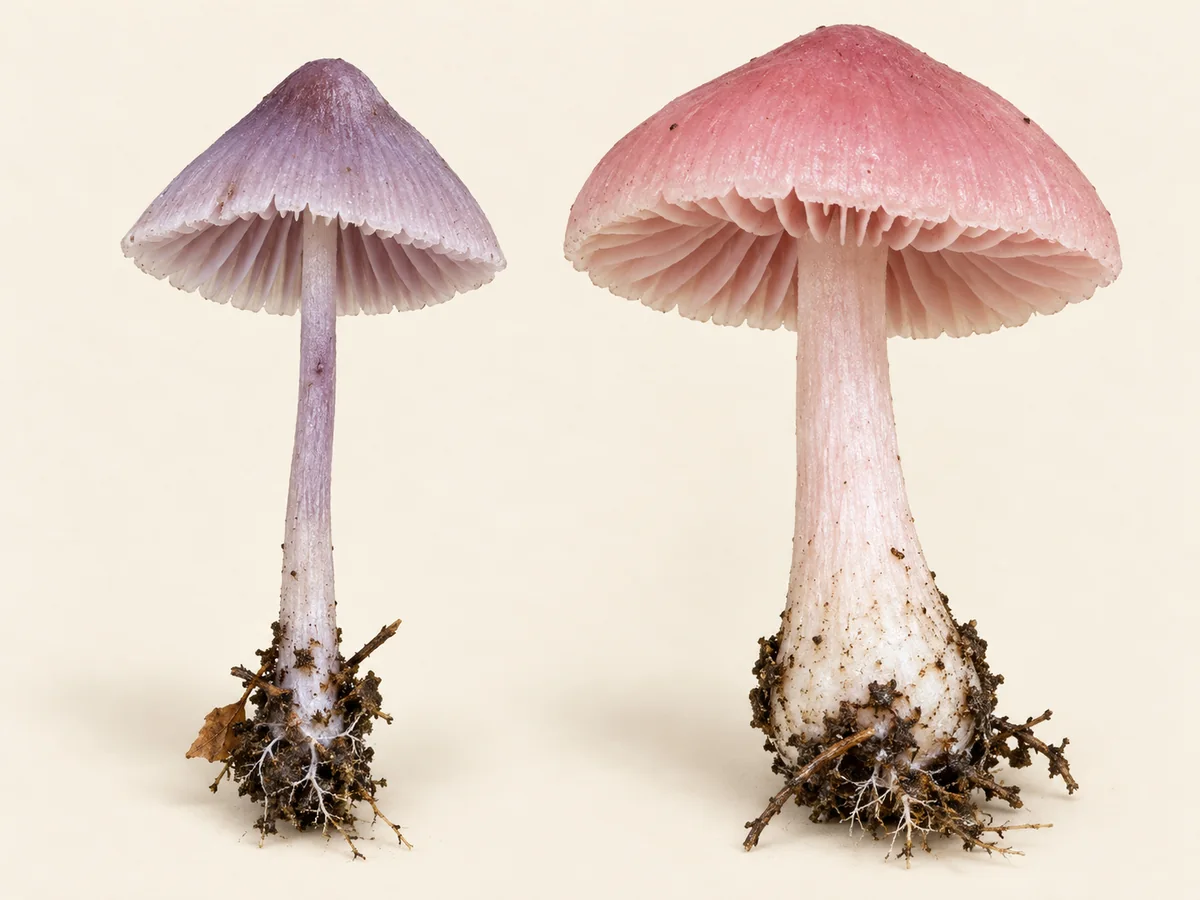
Rosy bonnet ranks among the larger, sturdier members of a genus better known for delicate caps and threadlike stems. Its broad rose-pink cap and pale, solid stem can look distinctive, especially in beech or oak litter. That simple look causes the main risk, since several bonnets can be pink and Mycena pura can drift into nearly the same color range. So the identification has to rest on more than the first impression.
Every complete identification starts with the intact mushroom and its setting. You need the cap surface, the underside, the entire stem base, the smell, what it grows in, the nearby trees and the region. Judging by pink alone invites the same mistake of trusting one bright color that people make with purple, red and yellow mushrooms. Camera white balance, shade and drying can also shift the photo color away from what you saw in the woods.
The pattern to look for is uniform rose color plus robust proportions. Typical rosy bonnets have caps broader than many small bonnets, pink gills and a firm stem that widens toward its fibrous base. Even a perfect match leaves it poisonous. While you work on the name, an uncertain specimen stays out of any food collection.
Which features identify a rosy bonnet?
Start with a fresh mushroom before the trip home bends the stem or rubs litter across the cap. When you find several, photograph the whole group so you can see whether size and color stay consistent. The species account by Aronsen and Læssøe gives a cap about 25-60 mm across. It starts convex, may keep a low central bump and often flattens, sometimes with a shallow dip around the center.
The surface looks smooth and can seem waxy. It is also hygrophanous, meaning it changes color as it dries, so a moist cap may look deeper rose or lilac-pink and then fade as water leaves. With age the center can turn a dingy yellow. That fits the species, yet decay, sun and handling also change color, so the rest of the mushroom still has to agree.
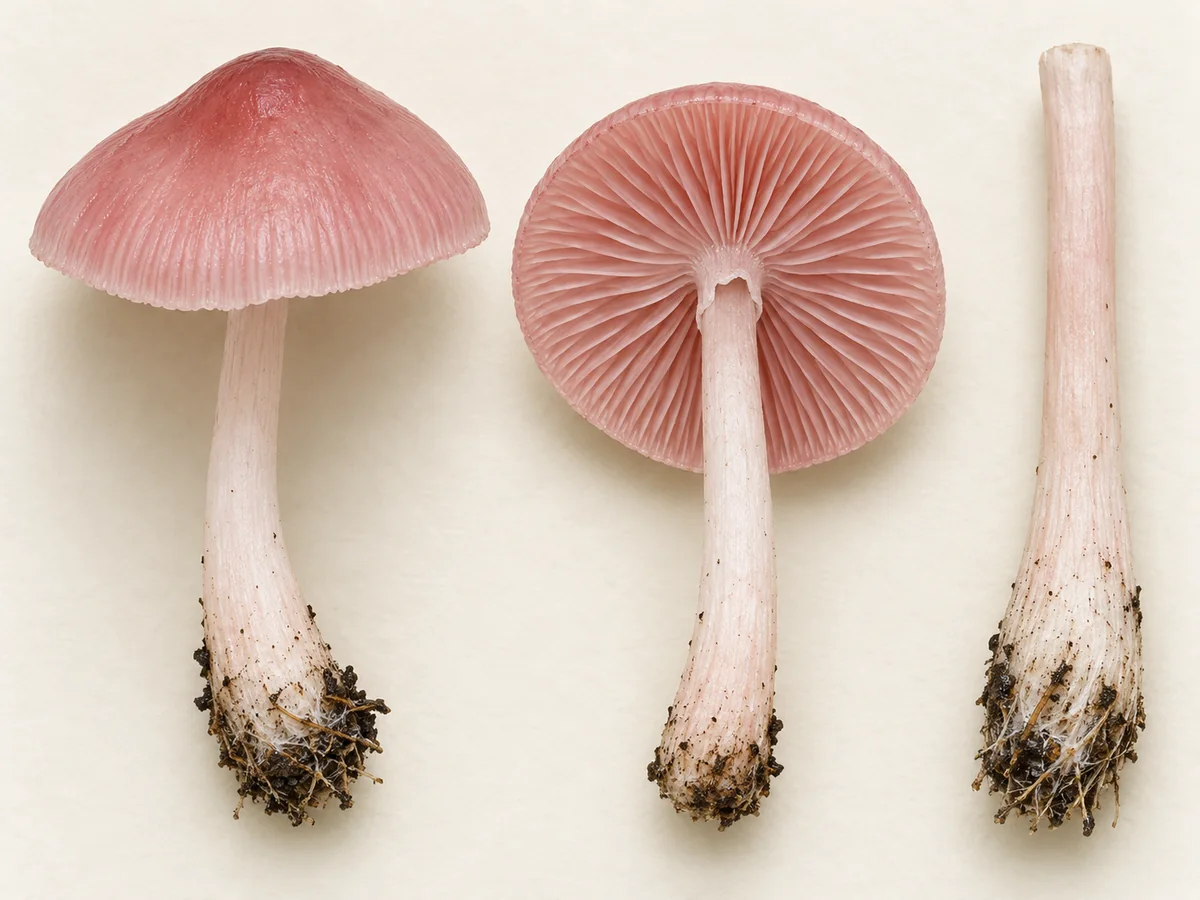
Its margin carries shallow translucent lines, with no deep pleats. You see those lines best when the cap is moist and lit from behind, and an opaque photo can hide them. Underneath, roughly 30-40 pink gills reach the stem and meet it with a shallow notched gill attachment. Cross-veins between the gills often show more clearly on older caps.
The stem gives you much of the contrast with lilac bonnet. It is commonly 6-10 cm long and 4-10 mm thick, firm, hollow and white to pale pink, often yellowish low down and wider toward the base. Coarse whitish or yellowish fibers cling around that base. Pulling the mushroom straight up can strip them away or leave the broad base under the litter, so loosen the surrounding material first.
The smell resembles radish. Gently bruising part of the cap or gills releases it, and you do not need to taste a poisonous mushroom to record an odor. Its white spore deposit points to a pale-spored bonnet and rules out pink-capped mushrooms with brown or rusty spores. The print cannot separate M. rosea from M. pura, since both sit in the same close group.
If your mushroom is too old to keep its color, cap texture or stem base, the honest result may stop at the Mycena pura-rosea group. Age only removes evidence. It never adds back what the fresh specimen would have shown.
Safety notes on Rosy Bonnet
Gut effects can include nausea, abdominal pain, vomiting and diarrhea. Muscarinic signs may include sweating, drooling, tears, small pupils or a slow heart rate. Your online symptom list cannot identify the mushroom or choose the treatment, though. Do not wait for mushroom poisoning symptoms before calling, because a mixed collection or a mistaken species can bring a different illness on a different timeline.
After a suspected ingestion, contact a poison service immediately. In the United States, call Poison Control at 1-800-222-1222; call emergency services for collapse, seizure, breathing difficulty or inability to wake the person. Keep any remaining specimens, meal leftovers and photos you already have. The call comes first, and the poison service can bring in a mycologist alongside the medical response.
Where and when does rosy bonnet grow?
Rosy bonnet usually grows alone or scattered in broadleaf woodland litter. Oak and beech come up again and again in its records, and the specialist account notes that its habitat often has calcareous soil. Those links tell you which comparisons to run without proving the identity. The cap you find under beech can still belong to another litter-feeding mushroom, and the nearest tree may not describe the whole wood.
Norway's national species assessment records more than 170 observations among litter and moss in several forest types and lists the species as Least Concern there. That gives good regional evidence, though it says nothing about worldwide abundance. The fungus feeds through mycelium inside dead organic matter. Its pink caps are seasonal spore-bearing structures, so they can vanish while the feeding network stays alive in the litter.
It commonly fruits from summer into autumn. Guides to summer mushroom fruiting and autumn mushrooms explain the wider moisture and temperature pattern, and no calendar date can name a species. Your wide habitat photo adds what a close cap shot misses, including the litter layer, moss, bare soil and any oak, beech or other broadleaf trees around the find.
Do not scrape away a large patch of litter to follow the fungus. Lift only what you need for a complete specimen, put the disturbed material back and leave the rest of the group standing.
Is rosy bonnet safe to eat?
Rosy bonnet is a poisonous mushroom with no supported way to prepare it as food. Boiling, frying, drying or pickling does not turn an uncertain pink bonnet into something you can eat. Its radish-like smell does not make it a seasoning either. That smell counts as a field character, while edibility depends on the species and its toxins.
After a possible ingestion, take the steps that come before any symptoms appear and ask for help before you try to identify the mushroom. The poison service needs the person's age, symptoms, meal time and possible amount far more urgently than a perfect Latin name. Keep any remnants and photos apart from food. Note whether several kinds of mushroom went into the meal, because a mixed dish weakens how well one species can explain the illness.
Do not induce vomiting or give a home remedy unless the poison specialist tells you to. Treatment depends on the person and the illness, and a generic instruction copied from a field profile cannot replace that judgment.
Why has Mycena rosea been linked with Mycena pura?
Rosy bonnet has long stood beside Mycena pura in comparisons, because the two share radish odor, similar spores and overlapping pink-lilac forms. Some older treatments even reduced M. rosea to a form or variety of the more variable species. Current specialist accounts usually keep M. rosea separate. Its more uniform pink color, larger sturdy body, widened stem base, chemical differences and DNA evidence all support that split.
The boundary still has more nuance than a color chart. Unusual specimens can cross the usual visible pattern, and routine microscopy may show little that cleanly separates the pair. So when you record a find, attach a confidence level to the name. Well-documented typical collections can support M. rosea, while damaged or in-between material belongs under the M. pura-rosea group until a specialist reviews it.

