
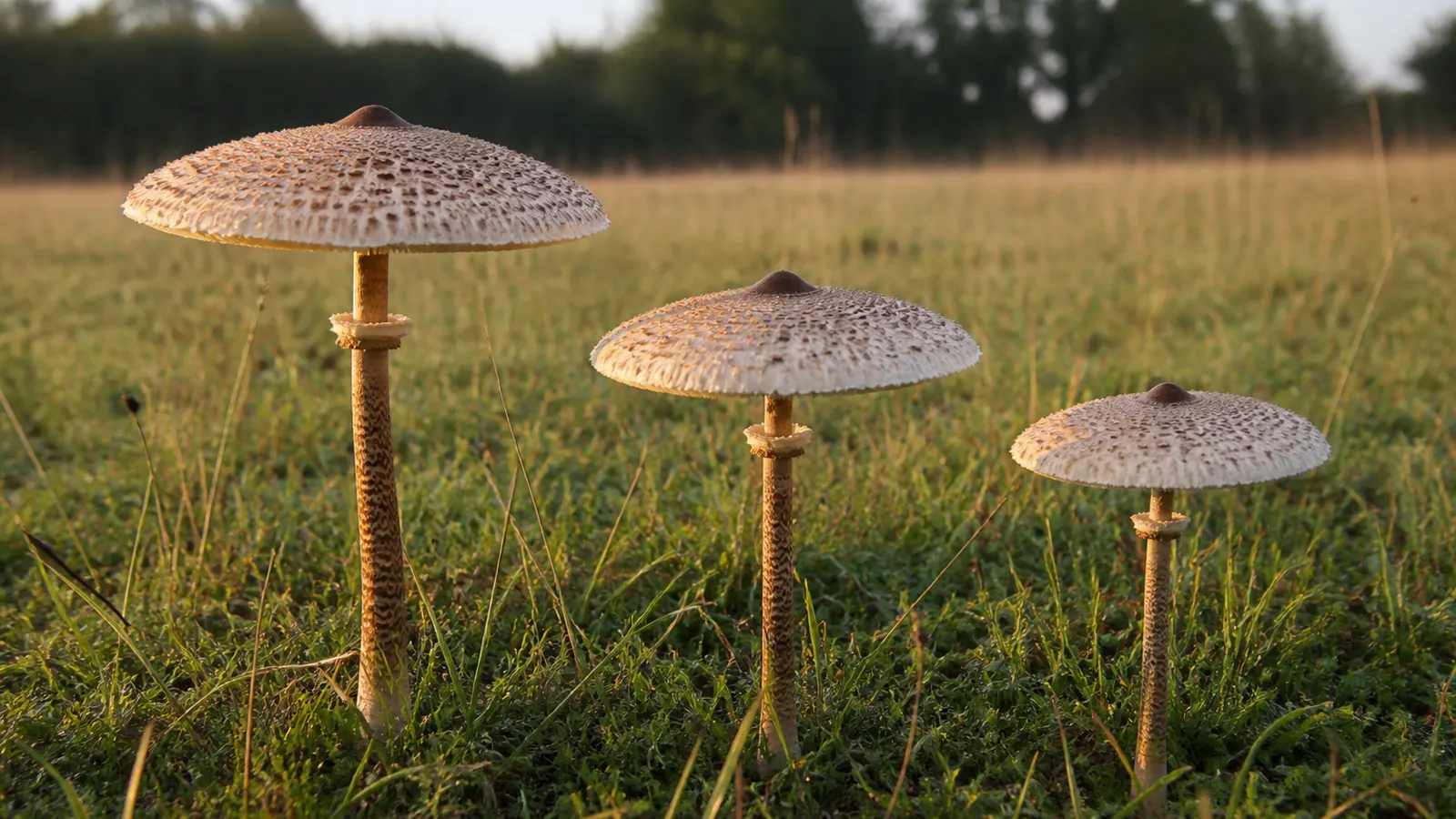
A parasol standing in rough grass is one of the few wild mushrooms you can name from a distance. It is knee high, the cap opens as wide as a dinner plate, and it looks exactly like the photograph in the book.
That is the problem rather than the reassurance it sounds like.
Three large scaly mushrooms with rings fit that description, and only one of them is the mushroom people mean when they say parasol. The raw question has a different answer for each of the three.
Can you eat parasol mushroom raw?
No. Raw parasol is reported to cause stomach upset, and the writers who say otherwise are describing something much narrower than a plateful.
Five things have to be true before any of that matters, and they are not in a random order.
The first line of that list is not there for tidiness. Nothing below it means anything until the species is settled.
The disagreement among writers about the raw question is real, and it is worth quoting rather than smoothing over.
Some writers insist that the parasol can even be eaten raw, though other writers insist it is toxic unless cooked.
A current species reference on raw parasol mushrooms
Both halves of that sentence are in print. The cited reference recommends erring toward cooking.
What the raw camp means is a young cap, in a small quantity, from a mushroom whose species has already been settled.
None of those three conditions comes free. The species condition is where people actually get hurt.
Buttons get left standing, which is a rule about a completely different danger.
A parasol that has not opened is a white egg-shaped thing on a stalk, and so is a destroying angel at the same age. The rule among foragers is to pick parasols open and walk past everything closed.
Size is doing quiet work in that rule as well.
Several small ringed and scaly mushrooms in the same family are lethal, including the fatal dapplerling, and none of them approaches a parasol for size. A scaly mushroom with a ring that fits in the palm of a hand is a different question from one that reaches your knee, and the small ones are answered by leaving them alone.
Nothing at full size is ambiguous about being open.
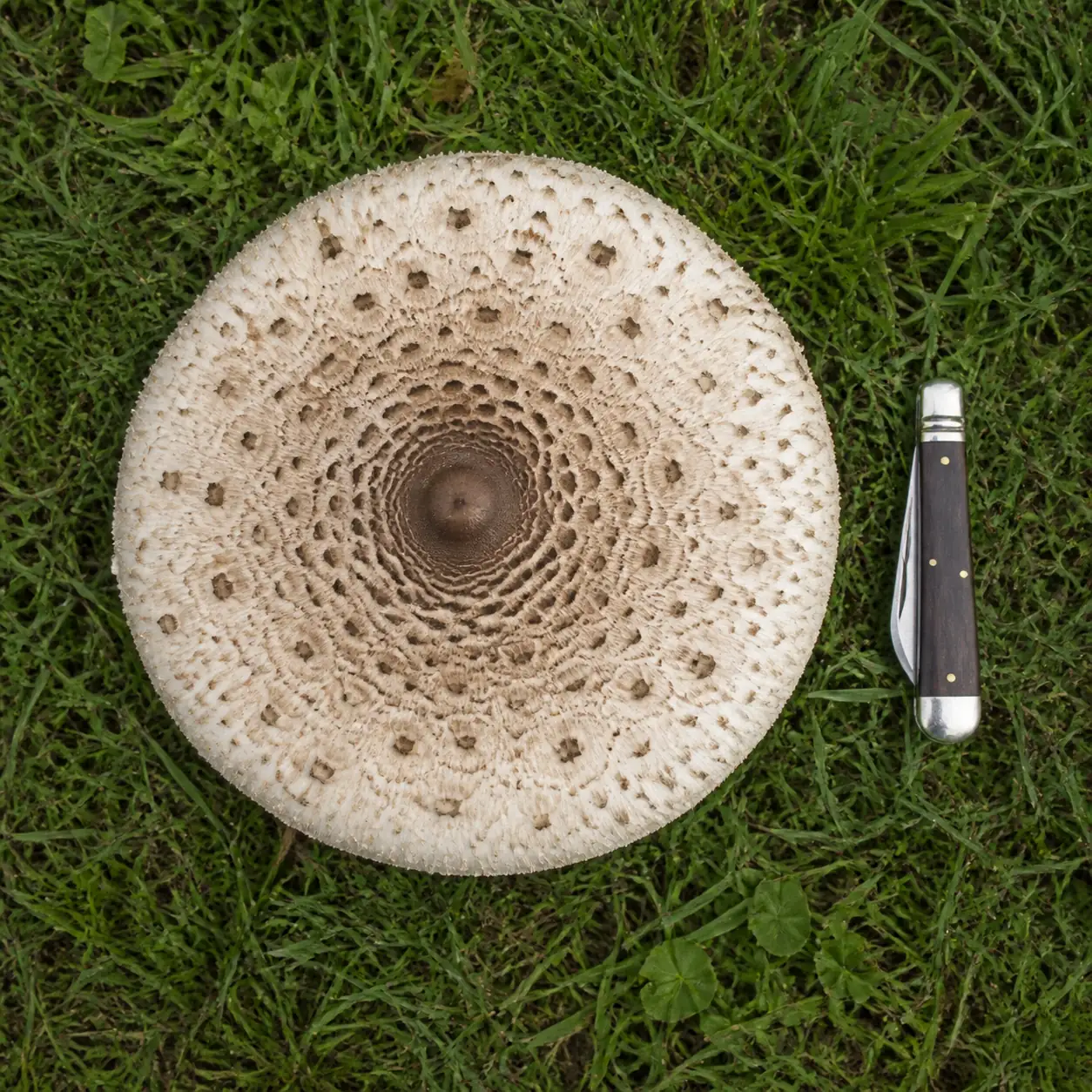
A mature cap spans four to ten inches across and the stem stands up to a foot tall. From standing height the flat cap, the raised bump at its center and the loose ring on the stem are all visible at once.

The height itself is doing more work than it looks.
Very few grassland mushrooms carry a cap that wide on a stem that thin, which is why the silhouette reads from twenty paces. It is also why people pick them without getting close enough to check anything.
SafetyCan You Eat Bay Bolete Raw? The Blue Stain Is Not the ReasonRaw, lightly cooked, and properly cooked
The three states are not three points along one line.
Raw and barely cooked sit close together, and properly cooked sits somewhere else entirely. The table is the short version of this whole page.
| Raw | Lightly cooked | Cooked through | |
|---|---|---|---|
| True parasol | Reported to upset stomachs | Usually fine, not always | A choice edible |
| Shaggy parasol | Not eaten raw by anyone | Upsets a minority | Upsets a minority |
| Green-spored parasol | Severe, with bloody stools | Vomiting and diarrhea | Vomiting and diarrhea |
Resolve the identification before considering how to cook it.
Heat moves the top row and it barely touches the bottom one. The mushroom in the bottom row is also the likeliest of the three to be sitting in a basket in North America right now.
For the true parasol the reaction is a gut reaction rather than an organ one.
That makes it thoroughly unpleasant rather than dangerous for a healthy adult. The mushroom poisoning symptoms involved are nausea, cramps, vomiting and diarrhea, and they pass on their own.
Timing is the part of that worth memorizing rather than the symptom list.
Gastrointestinal reactions to the large scaly parasols arrive one to three hours after the meal. Anything that starts much later than three hours is a different problem entirely, and it deserves one phone call rather than a mushroom page.
Quantity matters more here than with most species.
A sliver of young raw cap and a bowl of raw slices are not the same experiment, and the writers who report eating it raw are always describing the sliver. Nobody in any of the sources describes eating a mature raw cap whole.
The one that actually poisons people
Use the scientific name when checking the species.
Warning
Chlorophyllum molybdites, the green-spored parasol, is the most frequently eaten poisonous mushroom in North America. It fruits in lawns, parks and meadows after summer and fall rain, it grows to the same imposing size as a true parasol, and eaten raw it produces severe symptoms including bloody stools within a couple of hours.
Cooked, it causes vomiting, diarrhea and abdominal pain, often severe, one to three hours after the meal. Deaths from it are incredibly rare and have mainly been among small children and dogs.
That one to three hour figure is worth holding against the onset windows that matter more, because a reaction that waits six or eight hours is a different class of problem.
The reason this one of the three gets eaten so often has nothing to do with recklessness.
It is large, it is handsome, it comes up on watered lawns and park edges where people already walk, and it looks like a mushroom that field guides describe as choice. A cap between three and twelve inches across with coarse brown scales on a whitish ground is a fair description of both mushrooms.
One feature separates it from everything else with certainty.
The green-spored parasol is the only large mushroom that leaves a green spore print. Nothing else the size of a dinner plate does that, which makes the test unusually clean for a genus that is otherwise full of near-identical species.
The gills are a weaker version of the same test.
They start white on a young mushroom and turn dark and green only with maturity, so a fresh specimen passes a gill check it deserves to fail. The print does not have that weakness, because the spores are already green whatever color the gills happen to be.
Taking one costs a sheet of paper and a night.

Cut the cap off the stem, lay it gills down on paper that is half white and half dark, cover it with a glass and leave it overnight. Green on the white half ends the discussion, and white on the dark half is the answer you were hoping for.
Some people parboil the green-spored one, pour the water away and eat it anyway.
That is a thing that happens rather than a recommendation. The sources that mention it are reporting behavior, and a heat-labile protein having been found in the mushroom is not the same as knowing that boiling makes it safe.
SafetyCan You Eat Beech Mushrooms Raw? Not Poisonous, Just BitterSnakeskin stem, sliding ring, white flesh
Three features separate a true parasol, and three more that people lean on separate nothing at all.
The stem is the strongest of the three. A parasol stem carries dense brown banding on a pale ground, a pattern every field guide ends up calling snakeskin, and the green-spored parasol's stem is plain.
Nothing else about the stem comes close to it for reliability.
The ring is the second. It is double edged, and on a mature mushroom it slides freely up and down the stem when you push it with a thumb.
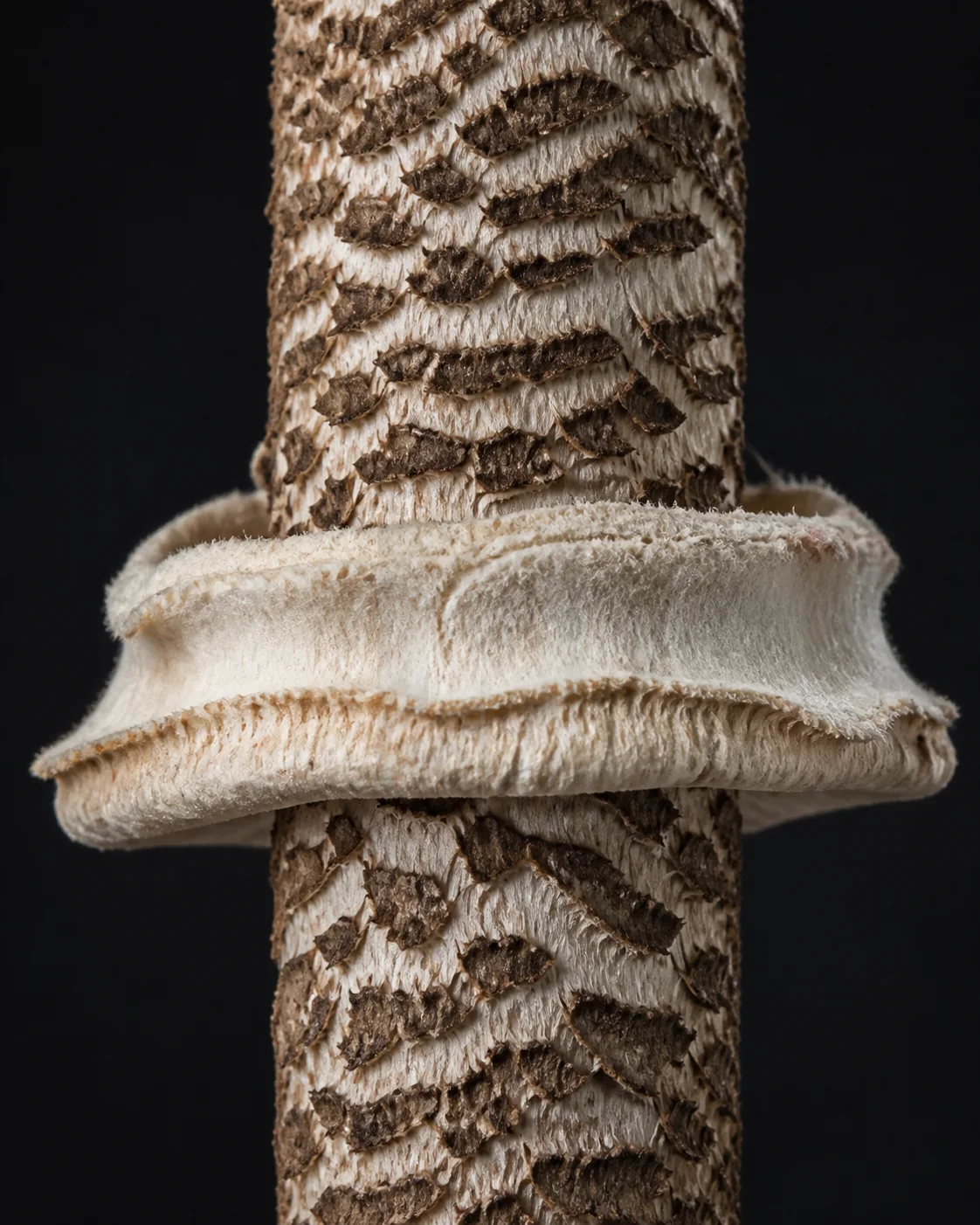
A ring that has come loose sometimes drops off the stem entirely and sits in the grass.
It is worth being blunt about what a ring proves, because the answer is close to nothing.
All three of these mushrooms carry one, and so do a long list of others growing in the same fields. A ring tells you the mushroom is not one of the ringless ones, and it does not tell you which of these three you are holding.
Size, scaliness and a grassland habitat fail in exactly the same way, and all three get used as tests anyway.
The flesh is the third real feature. Cut a true parasol lengthwise and the white flesh stays white, where a shaggy parasol reddens or browns along the cut within a minute or two.
The parasol cap is worth reading properly rather than glancing at.
A parasol cap starts nearly spherical and pale brown, and as it expands the darker skin over the crown breaks into concentric brown scales on a cream ground, leaving the unbroken patch at the very center as a raised bump. Coarse brown scales on a whitish cap describe the poisonous one just as well, which is why the pattern is a family trait and not an identification worth leaning on.
The white gills are worth a look on the way past.
They are broad, crowded, white to pale cream, and free, which means they stop short of the stem instead of running down onto it. That is shared with the poisonous one, so it confirms you are in the right group rather than the right species.

The stem base is swollen into a bulb, which is normal here and alarming elsewhere.
On an Amanita a swollen base sits in a sac and that sac is the feature that matters. On a parasol the base is simply thicker than the rest of the stem, with no bag around it and no separate membrane.
The print closes whatever the other checks leave open.
A true parasol drops a white or very pale cream print, and the poisonous one drops green. Those are two different entries in the spore print index, and telling them apart costs an evening of doing nothing.
SafetyCan You Eat Beefsteak Polypore Raw? Yes, If You Slice It ThinShaggy parasol is a different bargain
Books and markets use the name shaggy parasol for a related mushroom, and it needs its own verdict rather than a share of this one.
It is a good edible for most people, and it disagrees with a minority however carefully it has been cooked. That is a different shape of answer from anything above.
The visible difference is on the stem and in the cut.
Shaggy parasol is stouter and shorter in the stem, without the banding, and its flesh changes color where a knife goes through. Field references describe it as borderline edible for exactly that reason.
The reaction people report is not only a stomach one.
One forager describes an allergic reaction after eating parasols in which the hands, the feet and the inside of the ears became unbearably itchy. Reports like that are what turn the small first portion from a courtesy into a rule.
The rule applies per person rather than per species.
Somebody who has eaten shaggy parasol happily for twenty years tells you nothing at all about whether you can. Eat a small amount, well cooked, the first time you try it, and give it a day before eating any more.
That advice has a second use.
It also catches the case where the mushroom was never a shaggy parasol in the first place, because a small portion of the wrong mushroom is a bad evening rather than a hospital admission.
Cooking a cap the size of a dinner plate
A mature parasol does not fit the way most mushrooms get cooked.
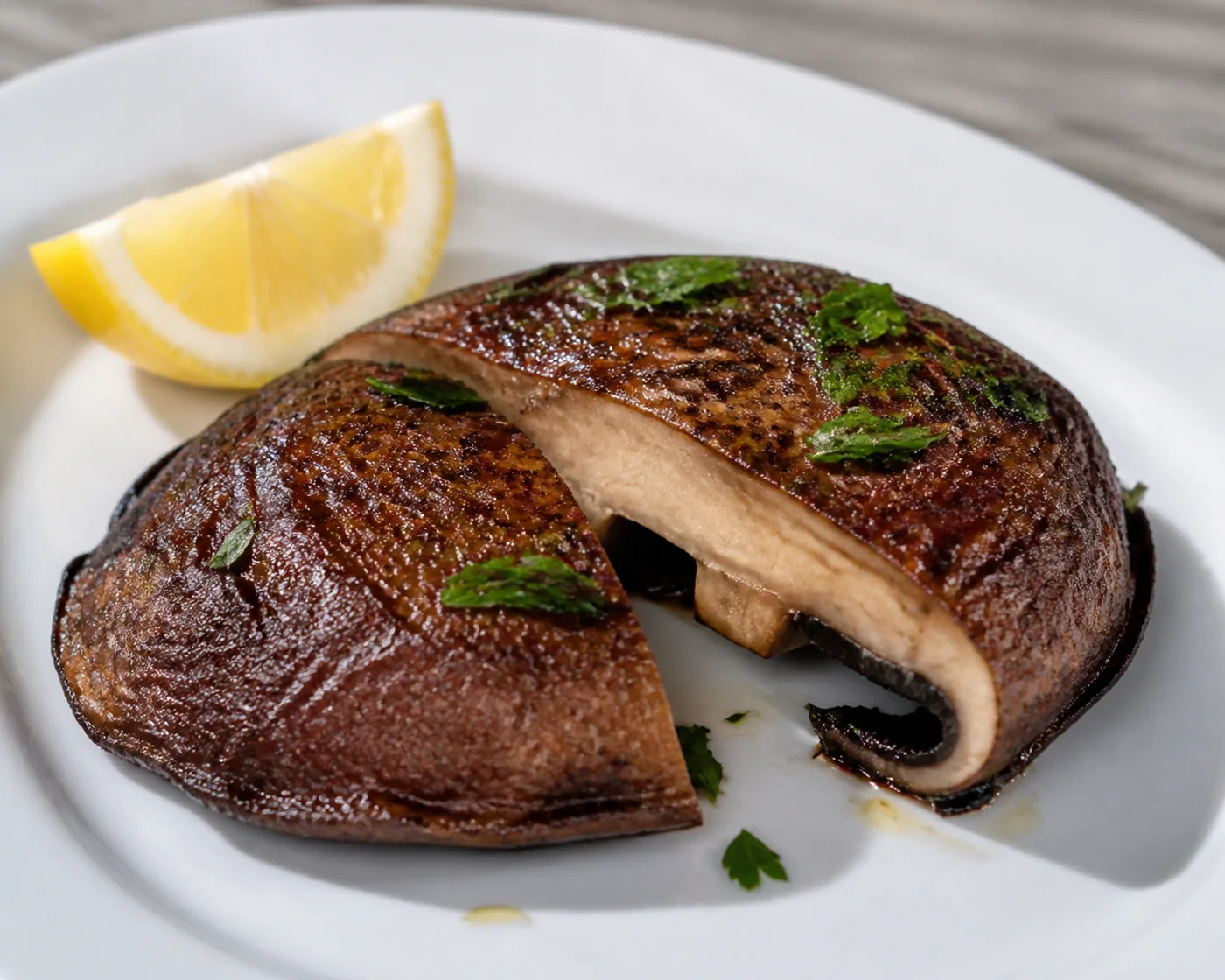
Slicing a ten inch cap gives you a bowl of thin dry strips, because there is very little flesh in it and most of the volume is air. It gets cooked flat and whole instead.
That is why almost every recipe for it ends up looking like schnitzel.
The cap goes into a wide pan in butter, gill side up, and stays there until it browns through and the gills darken. Several minutes a side is normal and there is nothing to be gained by hurrying it.
Some people crumb it first and some batter and deep fry it, and both are answers to the same shape problem.
Some people also stuff and roast the young ones whole, which British foragers call drumsticks.
That is a real preparation and it sits badly against the rule about leaving unopened mushrooms standing. The people doing it are picking from a patch they have watched open for several seasons, which is not the situation anyone reading a page called can you eat parasol mushroom raw is in.
The safe version of that recipe is to wait until the cap opens and lose the shape.

Doneness here is visible rather than timed.
A cap that is still pale and floppy in the middle has not had enough heat, and the reported stomach upsets belong to that state rather than to properly cooked mushrooms. Browned edges and a firm center are what you are waiting for.
The stem is a separate decision, and most people get it wrong twice.
Parasol stem flesh is tough, white and fibrous, and often hollow, so it never softens in a pan however long it sits in one. It comes off at the cap and goes in the bin.
The bin is the second mistake to make with that stem.
That tough fibrous stem is exactly what stock wants, and a handful of them simmered for an hour makes a better mushroom broth than the caps ever would. Most pages that tell you to discard the stems stop at the word discard.
Drying is the other thing the shape is good for.
A cap that wide dries fast and evenly on a rack. Dried parasol keeps its sweetness in a way that a lot of species do not.
What a parasol is worth once it is on the plate
Correctly identified parasols can be worth collecting, but preparation advice is species-specific.
- Cap
- Four to ten inches across, cream with concentric brown scales and a raised center
- Stem
- Up to a foot tall, thin, snakeskin banded, bulbous at the base
- Ring
- Double edged and slides freely on a mature mushroom
- Spore print
- White to very pale cream, never green
- Season
- July into November, in pasture, woodland clearings, verges and stable dunes
- Rating
- Listed as a choice edible in field references
The taste is sweet and the smell is not much help.
One reference calls the odor undistinctive and another describes it as maple syrup, which between them tell you that smell is not a test. Nothing about the flavor identifies it.
That rating is a high one for this cluster.
Most of the mushrooms answered in these raw pages are worth eating rather than worth hunting, and that rating puts the parasol in the second group. Cooking cannot correct a mistaken identification.
Read the preparation condition together with the edibility rating.
Settle the species with a print, cook the cap through until it browns, and the raw question stops being interesting.
Sources & References
- Macrolepiota procera, Parasol Mushroom, First Nature The identification reference used here. Gives the 10 to 25 cm cap, initially spherical and pale brown with the darker crown breaking into scales, the broad crowded free white gills, the double-edged ring that often becomes movable and drops, the pale stem with small brown scales giving a banded snakeskin appearance to 30 cm tall with a bulbous base, the tough white fibrous and sometimes hollow stem flesh, the white to very pale cream spore print, the undistinctive odor and sweet taste, the July to November season, the grassland and woodland clearing habitat, and the choice edible rating with stems kept for soup.
- Parasol and Shaggy Parasol mushroom, Edibility, Distribution, Identification, Galloway Wild Foods The source for the shaggy parasol caution and the cooking. States that shaggy parasol does not agree with some people and that the way to be sure is to eat just a small amount, well cooked, the first time. Carries a reader report of an allergic reaction after eating parasols in which the hands, feet and inside of the ears became unbearably itchy. Gives the dense brown snakeskin stem, the prominent movable double ring, the bulbous base, the unchangingly white flesh, and the frying, battering and stuffing preparations including the young drumstick stage.
- Macrolepiota procera, The Parasol Mushroom, Healing Mushrooms The source for the split on raw, stating that some writers insist the parasol can even be eaten raw while other writers insist it is toxic unless cooked, and concluding that it is best to err on the side of cooking. Also the source describing the smell as maple syrup, which the identification reference does not, and calling shaggy parasol borderline edible.
- Chlorophyllum molybdites, Wikipedia The source for the lookalike. States that it is the most frequently eaten poisonous mushroom in North America, that it causes vomiting, diarrhea and abdominal pains, often severe, one to three hours after consumption, that deaths are incredibly rare and have mainly occurred in small children and dogs, and that eaten raw it produces severe symptoms including bloody stools within a couple of hours. Also gives the 8 to 30 cm whitish cap with coarse brownish scales, the gills that are white and usually turn dark and green with maturity, the fact that it is the only large mushroom with a green spore print, the lawn, park and meadow habitat after summer and autumn rains, and the plain stem lacking the snakeskin pattern.
- Can You Eat Parasol Mushrooms, Ready Set Feast States that parasol mushrooms contain a toxin that can cause stomach upset if eaten raw and that they should be cooked thoroughly, and describes the poisonous lookalike as having a red cap, green gills and a black stem, which matches no real species.