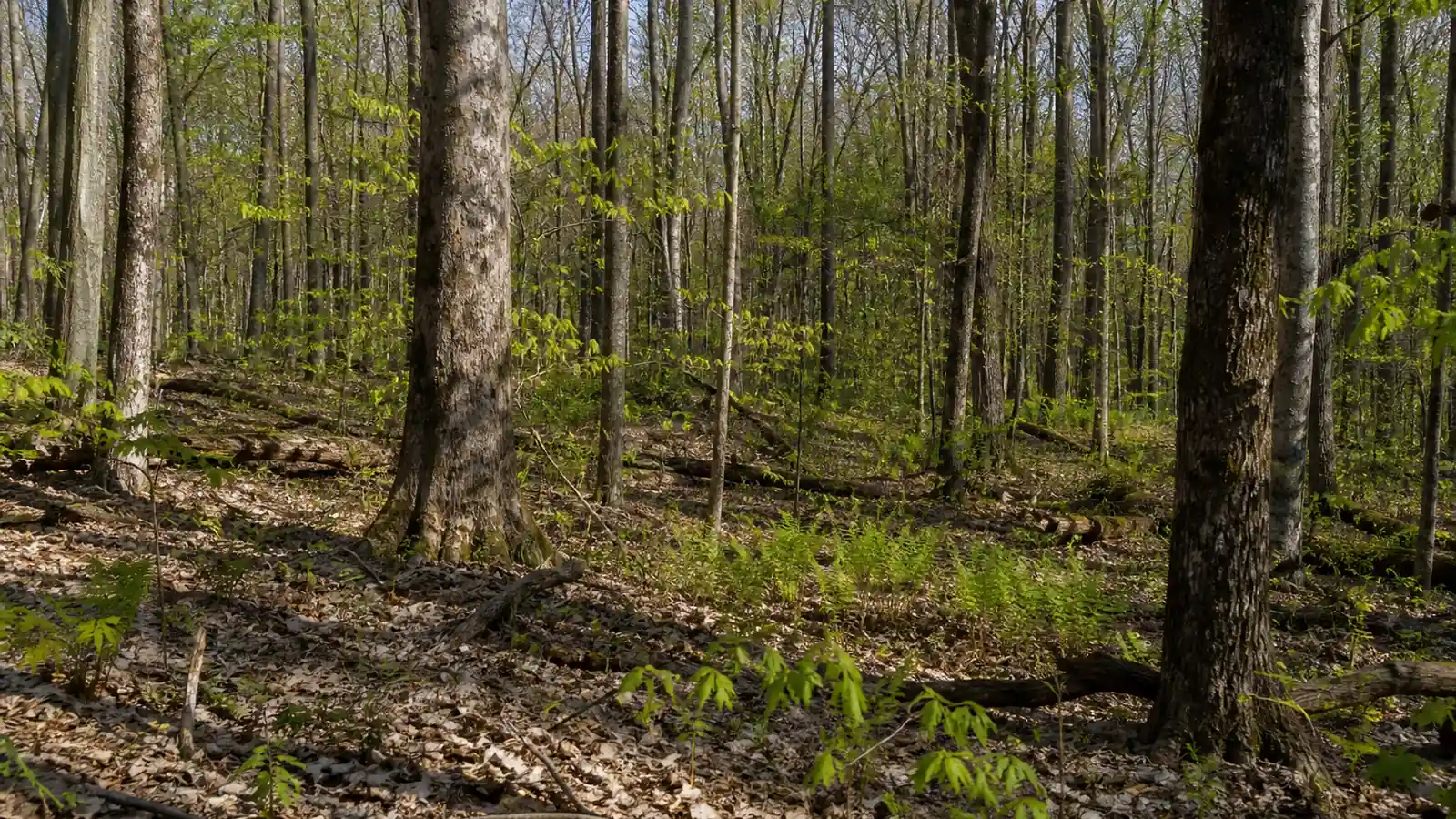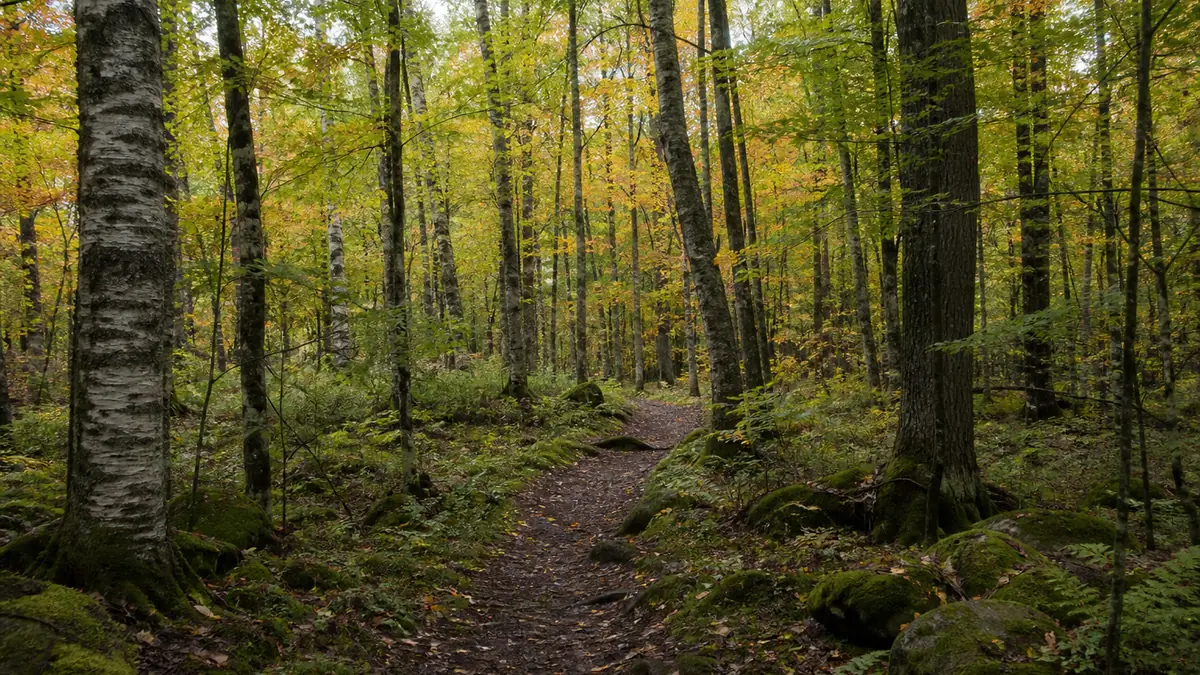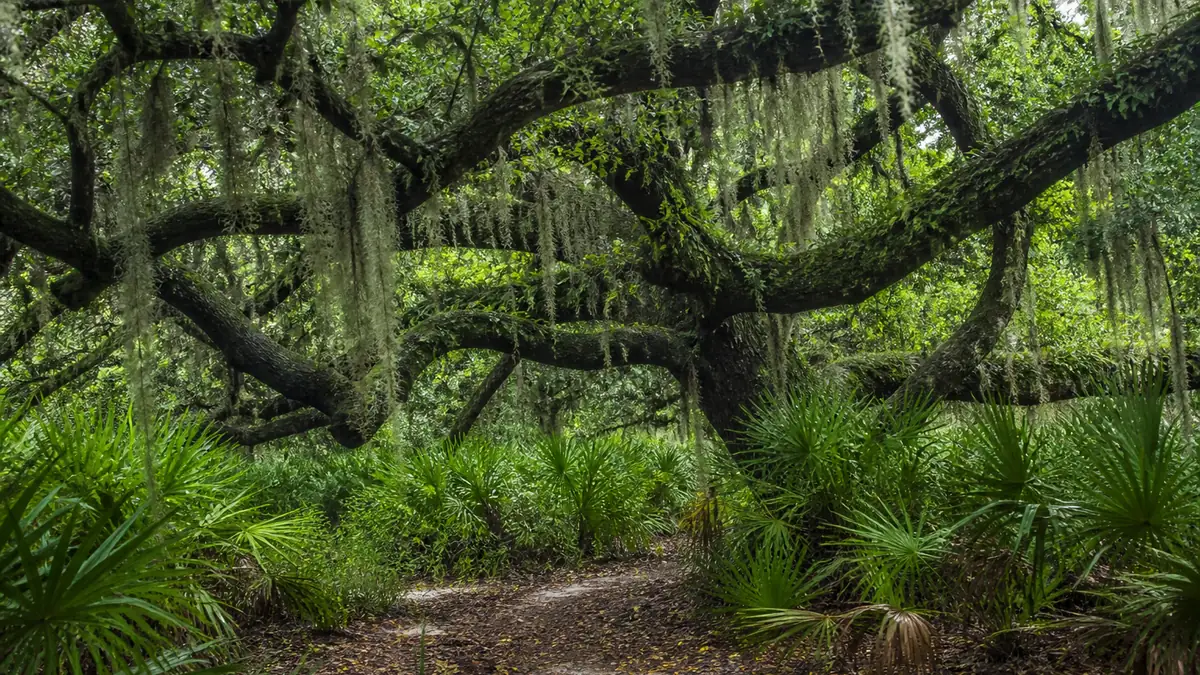
Florida has no cold trigger, so its mushroom season follows rainfall instead. The chanterelle group is most prolific from roughly May through September, with twelve Cantharellus and Craterellus species recorded in the state and oaks and pines as the main partners. Walk live oak hammock, pine flatwoods and coastal scrub two to five days after real rain. Rule out jack-o-lantern and rust gill fungi by asking whether the mushroom grew out of wood. Treat state parks as closed for collecting and plan a real trip around the three national forests.
People move to Florida, wait for October, walk into the woods and find nothing.
The season came and went while they were waiting. It ran through the months they had been taught to treat as the off season, in the heat, in the rain, when nobody up north would bother going out.
- The Florida window
- Warm wet months, roughly May through September.
- The trigger
- Rainfall rather than a drop in temperature.
- The main target
- The chanterelle group, with twelve species recorded in the state.
- The partners
- Oaks and pines, plus a coastal species on sea grape.
- The hazard nearest home
- Large pale ringed mushrooms on watered lawns.
When is mushroom season in Florida?
Summer. That one word is what makes a northern guide useless in this state.
Florida chanterelles are most prolific during the warmer and wetter months of the year, roughly May through September. That is the state's rainy season, and it is also the part of the year when a northern forager has put the basket away.

Cold is never the limiting factor in most of the state, so nothing has to wait for a temperature drop and water is what runs short instead.
That inverts the way you use a forecast. Up north you count nights; here you count days since the last real soaking, and the useful number is usually somewhere between two and five.
Read across a Florida year and it breaks into four unequal parts:
- Spring, March to April, dry and unproductive in most of the state, whatever a northern chart says about it.
- Early wet season, May to June, when the first storms arrive and the first flushes follow them.
- Peak, July to August, hot and soaked, and the part of the year worth clearing a weekend for.
- Late season, September into October, tapering with the rain and better in the panhandle than in the south.
South Florida stretches that window at both ends and the panhandle shortens it, which is the only part of the northern pattern that survives the drive south.
One thing the calendar cannot promise is a given weekend. A dry fortnight in the middle of the wet season shuts a productive patch down completely, and the same patch will produce heavily four days after the rain returns.
That is why Florida rewards short local trips over planned expeditions. A site twenty minutes away that you can visit on a Tuesday evening will out-produce a site two hours away that you visit once a month.
Tip
Afternoon thunderstorms in June and July are localised, so a downpour over one county tells you nothing about the next one. Watch the radar rather than the regional forecast, and go back to the ground that actually got wet.
Where do the mushrooms actually grow?
Under the trees that host them, which here means oak and pine before anything else.
The chanterelle group forms partnerships with living tree roots, and in this state the primary hosts are oaks and pines. The same fungi are also found with hickory, beech, birch, ironwood, willow and sea grape, which quietly widens the map.

Three settings cover most of what is worth walking:
- Live oak hammock, shaded and damp, with deep litter and the heaviest chanterelle production in the state.
- Pine flatwoods with saw palmetto, more open, drier underfoot, and quick to respond after a storm.
- Coastal scrub with sea grape and pigeon plum, which hosts a Florida species that grows nowhere north of here.
Of those three the flatwoods change most between visits, because managed burns keep the palmetto low and the floor open, and a stand burnt one or two seasons ago is far easier to walk and to see across.
Satellite view does most of this work before you leave the house. A dark closed canopy beside a wet lowland is worth more than any list of place names somebody else has published.
What is worth looking for?
Chanterelles. In Florida that word covers a group rather than a single species.
The state has nine Cantharellus species and three Craterellus species on record, which is a genuinely unusual amount of variety for one place. They range from small and pale to large and deep orange.
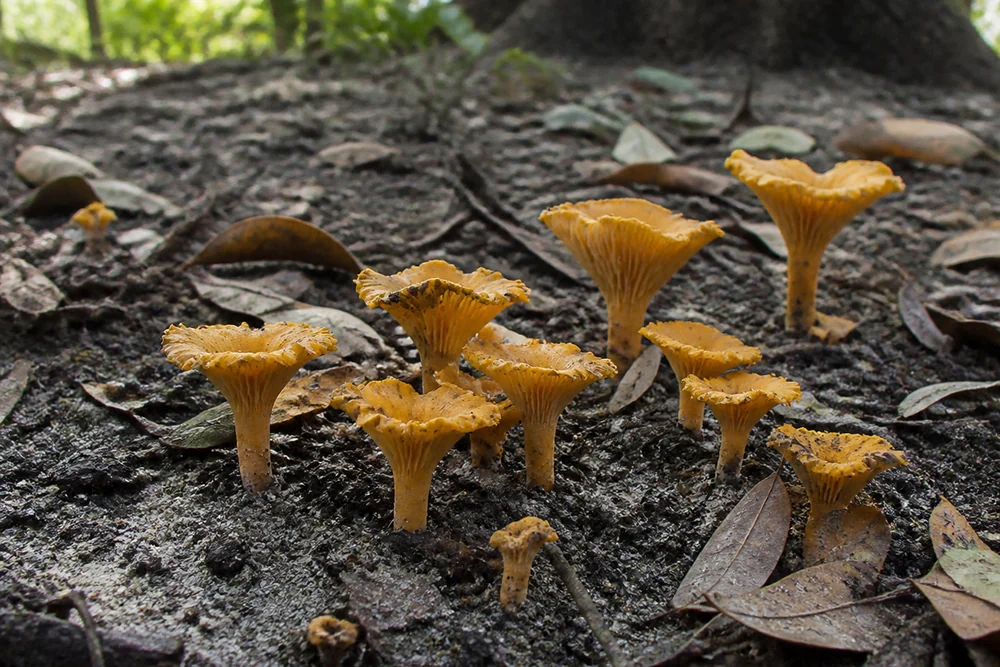
What holds across the group is more useful than what separates them: blunt ridges running down the stem instead of separate blades, a smell people call fruity, and flesh that tears in strings rather than snapping.
Note
None of these can be farmed. They live on living tree roots, which is why every chanterelle you have ever eaten was picked by somebody, and why a productive patch is worth remembering rather than stripping.
Check the chanterelle identification features alongside the season and habitat. Finding one in a likely place does not establish its identity.
ForagingMushroom foraging laws in Germany: protected species and small quantitiesWhich lookalikes matter here?
Two groups of impostors matter here. One question separates you from both of them.
Jack-o-lantern mushrooms and rust gill fungi both resemble chanterelles in Florida, and both of them grow on wood. Chanterelles rise out of soil and litter.
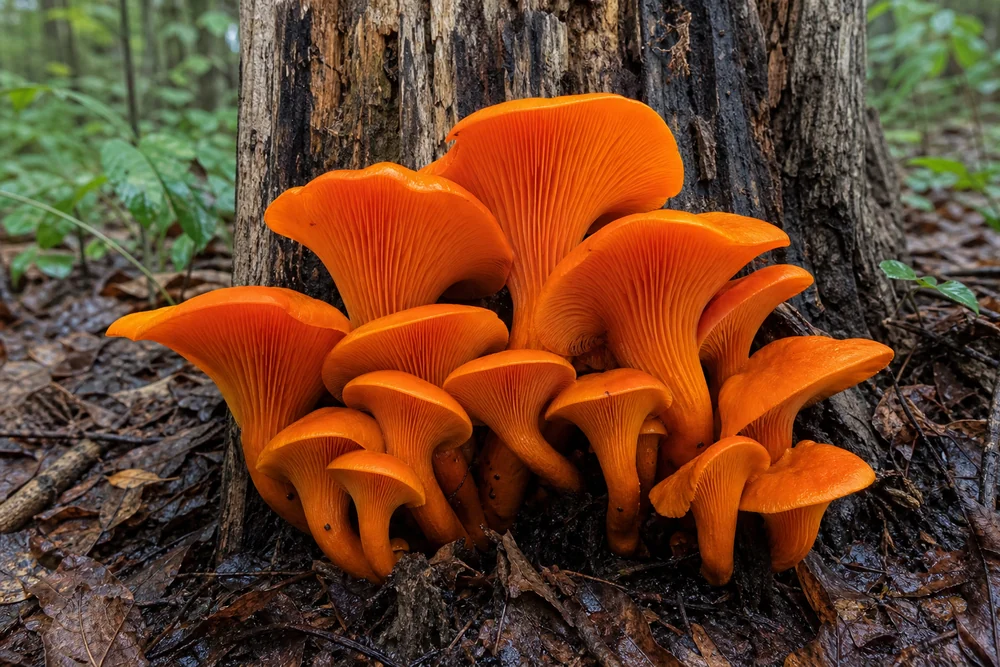
The full side-by-side comparison is worth reading once before the season rather than trying to recall it in the field.
The second difference is underneath. A chanterelle has blunt ridges that are part of the cap and will not come away; an impostor has true gills, thin blades you can separate with a fingernail.
Check what it is growing out of before anything else
Turn one over and try to lift a single blade away from the cap
Leave the whole cluster if it came off wood
Judge by color, which is the least reliable feature here
Assume a buried root counts as soil, because it does not
Take a single specimen home to sort out later
The cluster habit is worth learning on its own. Jack-o-lanterns come up in tight bunches of a dozen or more fused at the base, while chanterelles come up scattered, each one on its own stem with soil between them.
Anyone who does get it wrong should treat it as a poisoning rather than as a bad dinner, and the symptoms and timings matter a great deal more than the name of whatever caused them.
Warning
Jack-o-lantern and rust gill fungi cause serious stomach and gut symptoms. Neither is usually fatal, and both can put an adult in hospital for a night that they will remember for a long time.
What else is worth picking here?
Chanterelles get the attention. They are not the only thing a Florida summer produces.
The most useful of the rest is chicken of the woods, which produces more weight per find than everything else on this page combined. It grows in bright overlapping brackets on live oak, and it is one of the easiest finds in the state to be certain about because nothing else here looks remotely like it.
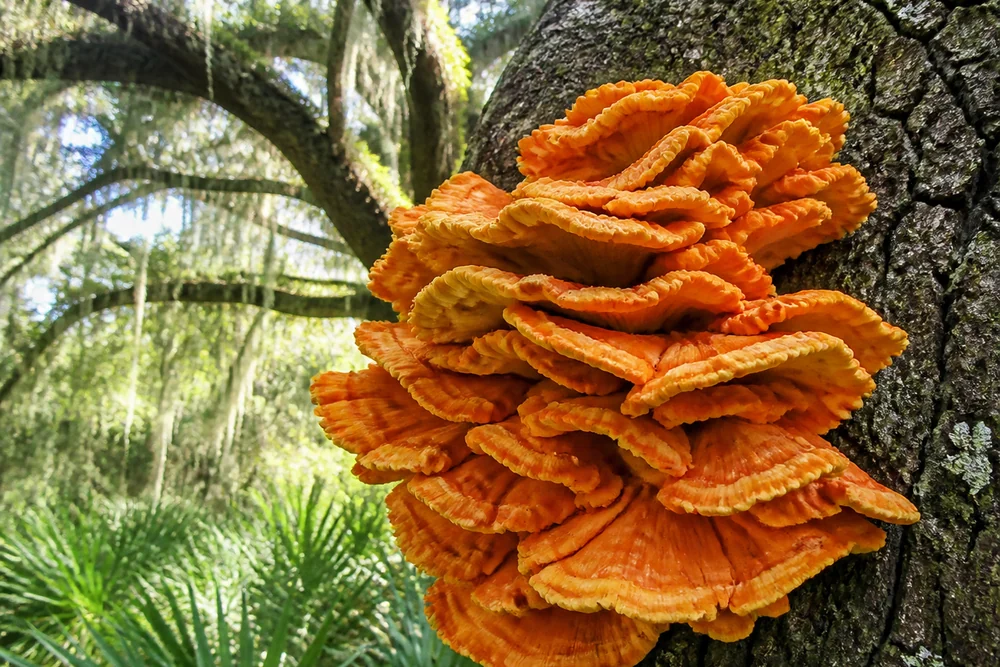
Milk caps come up under the same oaks as the chanterelles. They bleed a colored latex when the flesh is cut, which is the feature that names the whole group.
Boletes appear on sandy pine ground through the same wet months, carrying pores underneath instead of gills or ridges.
What these share is the reason they suit this climate. Every one fruits on rain rather than on cold, so the calendar at the top of this page governs the whole list rather than the chanterelles alone.
One habit carries across all of them. Florida heat shortens the time available to keep a picked mushroom fresh.
ForagingMushroom foraging laws in the UK: what is actually legalWhat grows on Florida lawns?
The most dangerous mushrooms most Floridians will ever meet, growing on their own irrigated grass.
Large pale mushrooms with scaly caps and a ring on the stem come up in arcs and rings on watered lawns through the same wet months. The green-spored parasol is one of the most common causes of mushroom poisoning in the country, and Florida's irrigation habits suit it well.
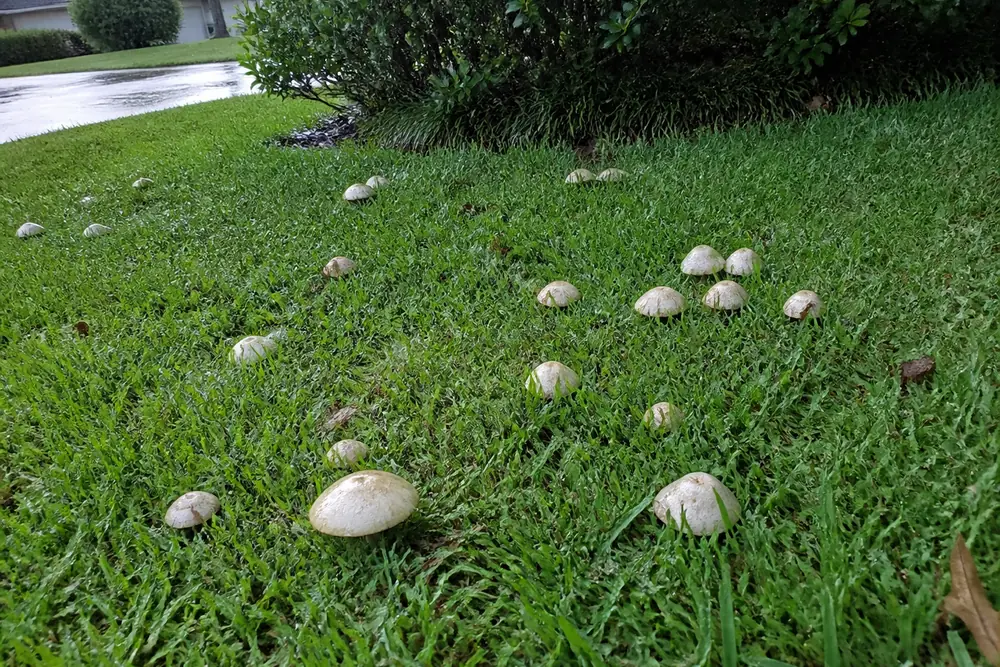
It gets eaten because it looks reassuring. It is large, clean, pale and growing in a tidy place, and it resembles both the edible parasols and, to a hurried eye, something from a supermarket tray.
The detail that settles it is the spore color, which is why the species page on the green-spored parasol is worth ten minutes before your lawn produces its first ring of the year.
Dogs are the other half of the lawn problem. A dog that eats a lawn mushroom rarely gets identified in time, so the practical answer is to knock the caps over on mowing day rather than to learn which ones matter.
Does the heat change how you carry a basket?
Yes. It is the part of a Florida trip that most transplanted foragers get wrong exactly once.
A Florida season is a hot season by definition, so the walk out is the point at which a good haul starts deteriorating. Chanterelles picked at ten in the morning can be soft and sour by mid afternoon in a closed car.
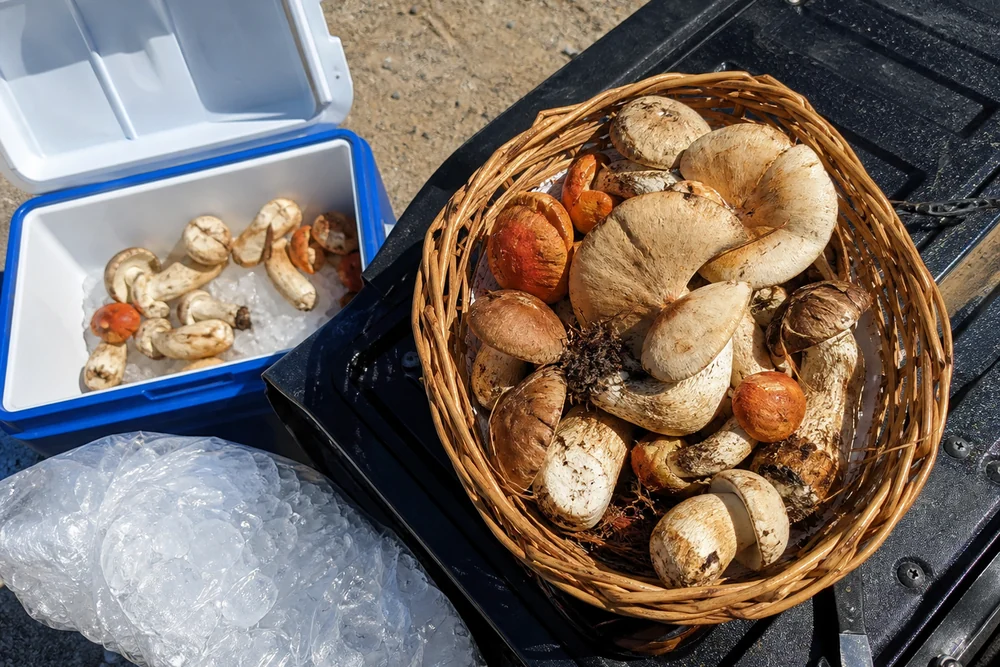
Three habits between the picking and the kitchen cover most of what gets lost:
- Carry a shallow open basket rather than a bag, so warm damp air can leave rather than collect, which is one of the two real arguments for the classic basket.
- Keep the basket in shade at every stop, including the tailgate while you drink water.
- Put a cooler in the car with a frozen block in it, and move the basket into it for the drive home.
The first hour at home matters as much as the drive. Clean and sort before anything else, because one soft mushroom will take the rest of the basket with it overnight, and cooking the good ones straight away beats any storage trick.
Anything you are not eating tonight is a kitchen question rather than a foraging one, and cooking chanterelles covers what to do with a full basket.
Where are you allowed to pick?
That depends on whose land you are standing on, and Florida's two big options answer very differently.
Florida's park rules state that all plant life is the property of the State of Florida and that no person shall transplant or remove any plant life from any park. The state park system administers that as a general no collecting position.

The federal forests answer the same question in the opposite direction, which is what makes them the realistic option for a planned trip.
| Florida state parks | National forests in Florida | |
|---|---|---|
| Written position | Plant life is state property and may not be removed | Federal forest product rules apply |
| Practical answer | Treat as closed for collecting | Personal use collecting is the normal case |
| Who confirms it | The park office | The district ranger office |
| Scale | Individual parks | Close to 1.2 million acres across three forests |
Readers sometimes notice that the written rule talks about plant life and never mentions fungi. That is a real gap in the wording, and it is a bad thing to rely on, because the park system applies the rule as written policy on the ground.
Between those two sources you have the season and the ground, which is most of what a Florida trip needs settled in advance.
Key takeaway
The national forests are the realistic ground for a planned Florida trip. Apalachicola, Ocala and Osceola together cover close to 1.2 million acres, and the district office is the one call that settles what is allowed on the day you are going.
Those three forests also happen to sit on the right ground. Apalachicola is pine flatwoods at scale, Ocala carries sand pine and scrub oak, and Osceola holds the wet pine and cypress edges that hold moisture longest after a storm.
Water management district land is the third option people forget, and its rules vary by district rather than by state, so it is worth a phone call in the week before a trip rather than a guess on the morning of one.
A basket that survives the drive still needs an evening, and sorting a foraged haul is where a hot-weather day is won or lost.
Everything else here is ordinary practice rather than Florida practice, and the beginner's routine covers it better than a regional page can.
Sources & References
- The Common Chanterelles (Cantharellus and Craterellus) of Florida (UF/IFAS EDIS PP369) University extension publication used for the Florida species list of nine Cantharellus and three Craterellus species, for the host trees including oak, pine, hickory, beech, birch, ironwood, willow and sea grape, for the May to September fruiting period, and for the jack-o-lantern and rust gill lookalikes that grow on wood and carry true gills.
- Florida Administrative Code 62D-2.013, Park Property and Resources State rule used for the provision that all plant life is the property of the State of Florida and that no person shall transplant or remove any plant life from any park, and for the observation that the written text addresses plant life without naming fungi.
- National Forests in Florida (USDA Forest Service) Federal agency site used for the three national forests in the state, Apalachicola, Ocala and Osceola, their combined extent of close to 1.2 million acres, and the district ranger office as the point of confirmation for what personal use collecting is allowed.