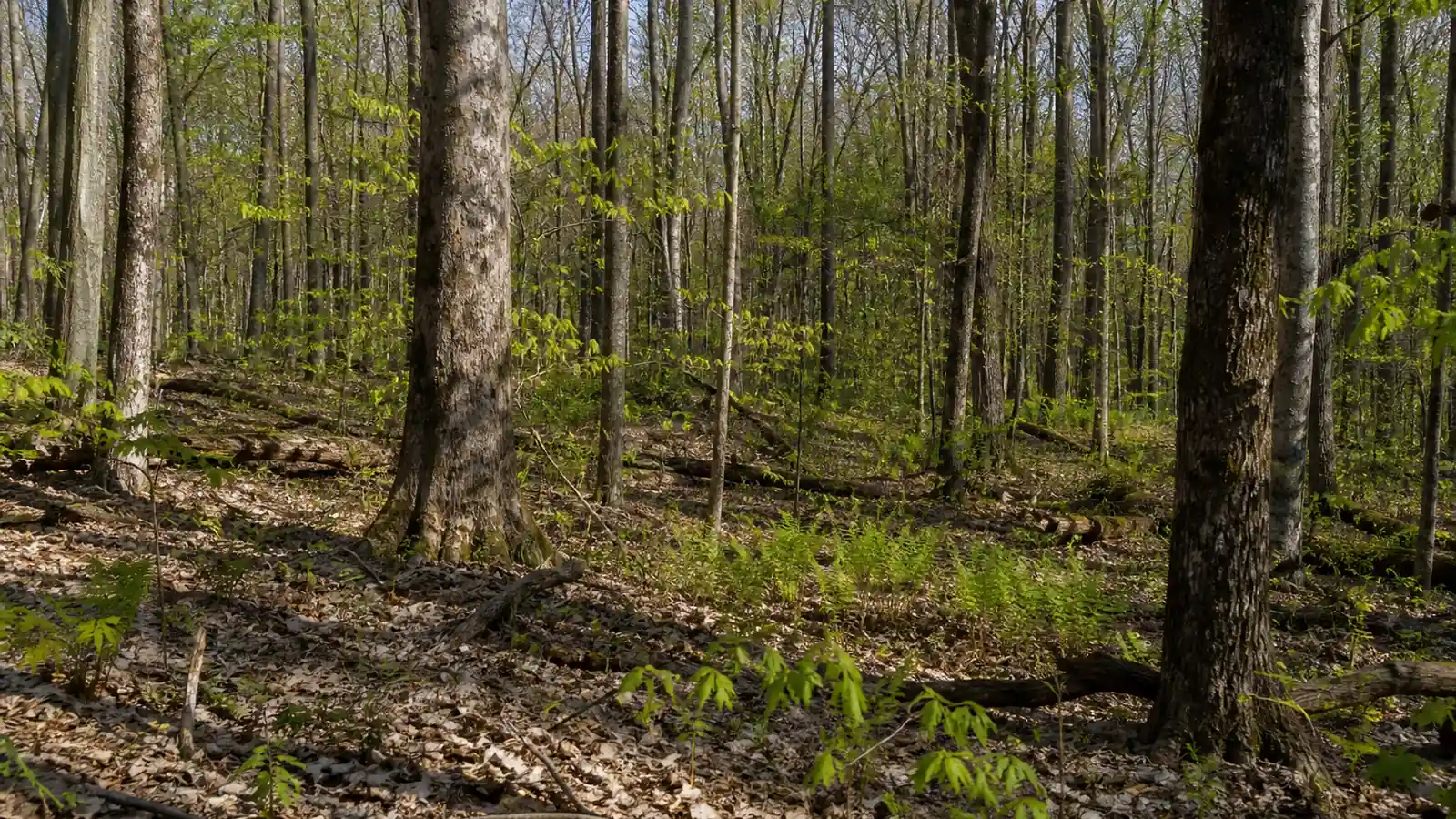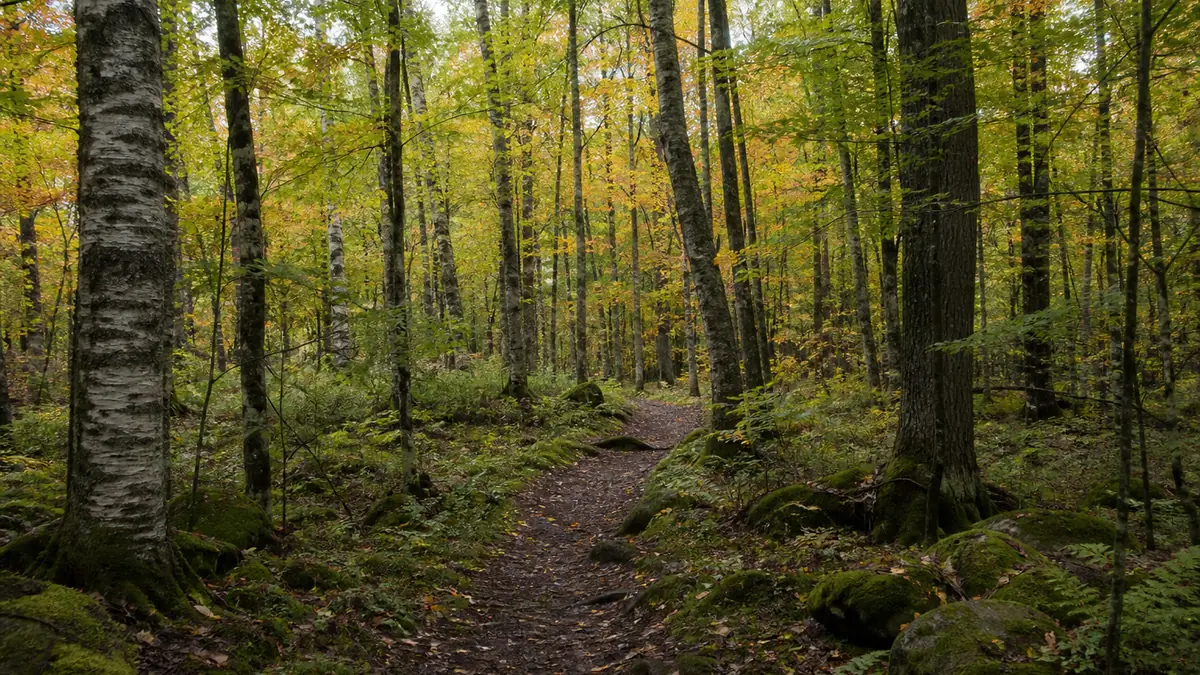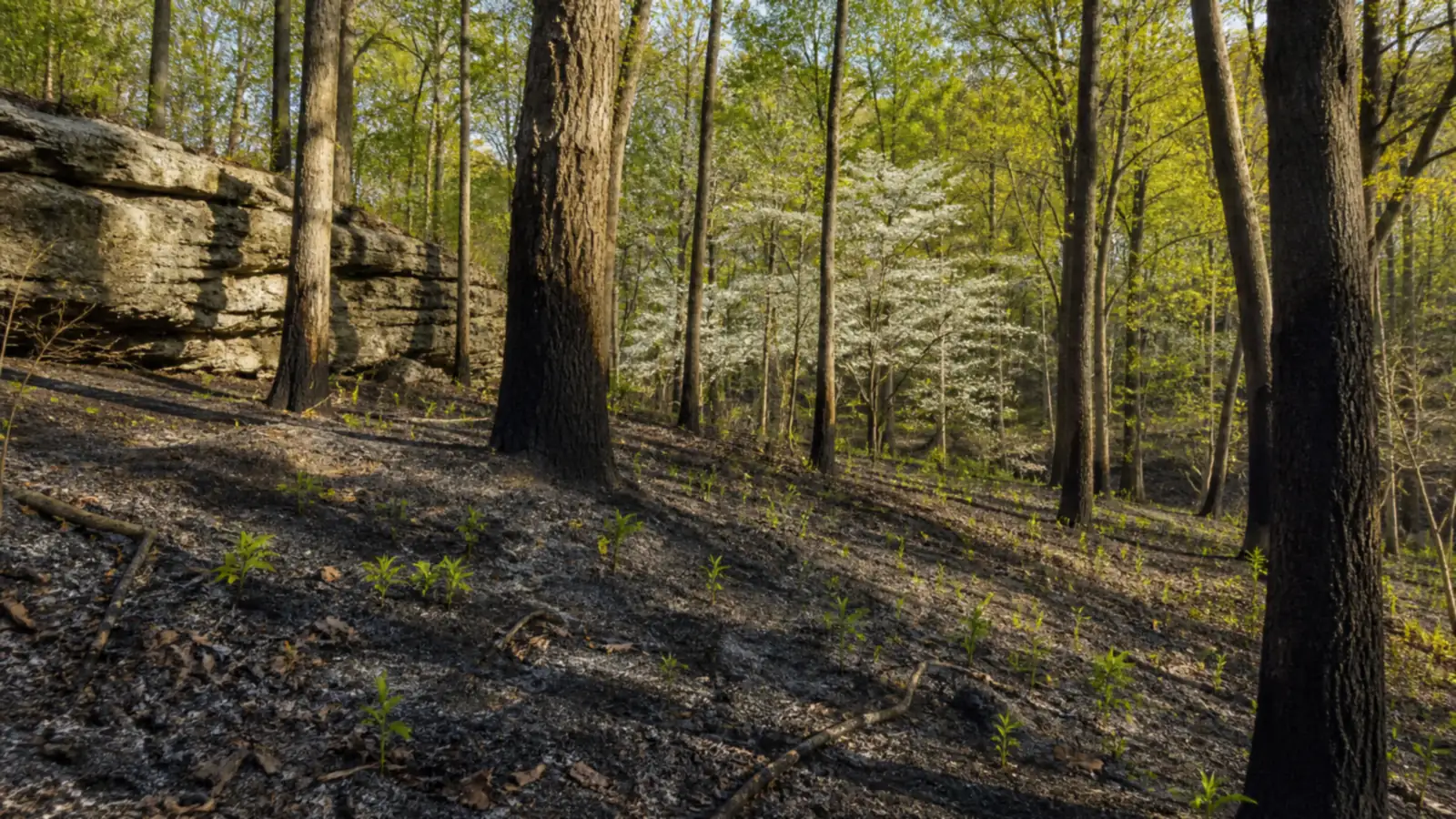
Missouri morels run from late March through early May, with the main push from around mid April. Because the state offers more open woodland than anyone can walk, the useful question is not where morels were found before but what happened to a piece of ground in the last twelve months, since fire, flood and logging all tend to produce heavily the following spring.
Missouri morels run from late March through early May, with the main push starting around mid April. That much is easy to look up.
The harder question is where to point a Saturday, because Missouri gives a hunter more open woodland than any one person can walk in a lifetime.
The answer that works is not a place. It is a question about what happened to a piece of ground in the last twelve months.
What disturbed ground does for morels
Key takeaway
Choose Missouri ground by what changed on it last year rather than by where you found morels before. Missouri conservation guidance names flooding, fire and logging together, and all three tend to produce heavily the following spring.
Morels respond to disruption. A fire, a flood or a timber cut all do the same basic thing, which is to take the lid off a piece of ground.
Canopy comes off, light and warmth reach ground that spent decades in shade, and the fungus already living in that soil gets conditions it has not had in years.
The fungus was already there before the disturbance. Morel mycelium can sit in soil for years without fruiting, and what fire or flood changes is the conditions rather than the presence of the organism.
That is also why the second spring is weaker than the first.
The flush is a response to a change, and once the ground has adjusted, the reason for the response has gone.
The window is short and it is specific. In most cases the heavy year is the first spring after the event, and by the second or third spring the ground has settled back toward ordinary.
That is what makes disturbance useful as a way of choosing where to go.
A burn that happened last April is a piece of information with a date on it, while a spot that produced four years ago is only a memory.
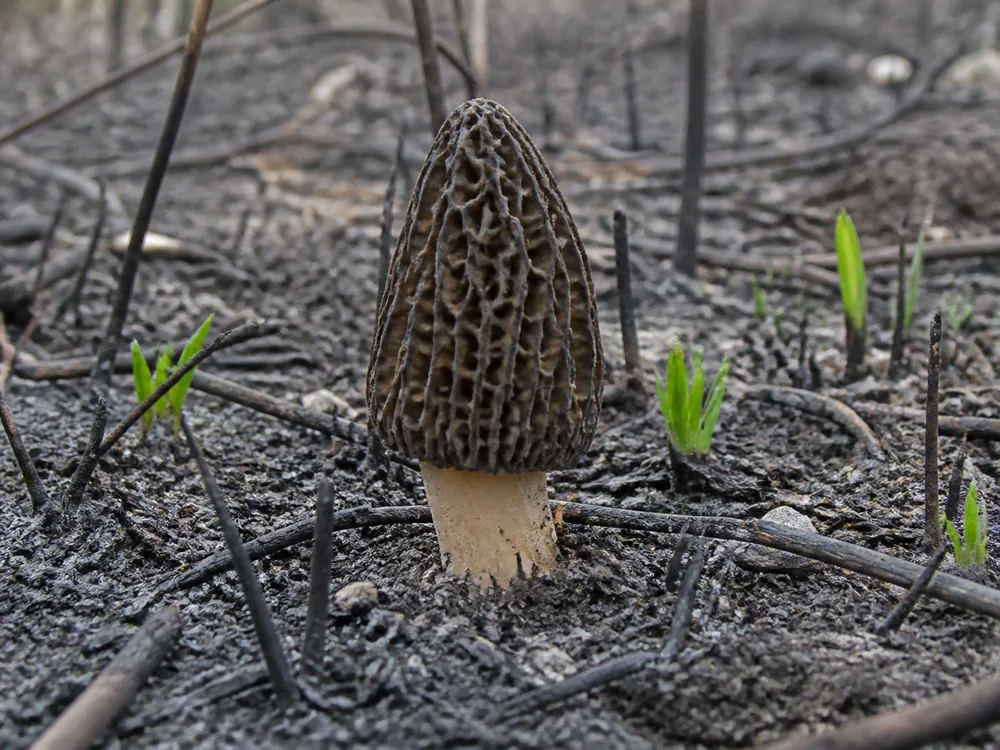
Burned ground also stays open for a short time only. Brush and sprouts close back in quickly in Missouri, which is part of why the second spring falls off so sharply.
The mushrooms themselves look different on burned ground. Black morels dominate there, and hunters expecting the tan honeycomb of a river-bottom yellow often walk over them because they match the ash almost exactly.
Nothing about this replaces the ordinary hosts. It sits on top of them, as a way of deciding which of Missouri's many woods is worth the drive this particular spring.
ForagingMushroom foraging laws in France: what the five liter rule meansWhich disturbances Missouri actually produces
Missouri manufactures all three kinds at a scale most states do not.
Prescribed fire is the one worth learning first, because it is deliberate. Conservation staff burn on a plan, which means the ground was chosen, the date is recorded, and the same units come around again on a rotation.
That is very different from waiting for a wildfire.
Flooding is the largest of the three by area. Two of the biggest rivers in North America run through the state, and a spring rise can lay silt across bottomland measured in river miles rather than in acres.
Scale is what makes Missouri unusual for this kind of ground.
A single conservation area can carry several burn units on a rotation, so a hunter with a few areas within driving distance has fresh ground somewhere most years.
Timber harvest is the quietest of the three and the most overlooked. A cut tract has no ash and no silt to mark it, so it reads as ordinary woods to anyone who did not notice the stumps.
Blowdown belongs on the list even though nobody plans for it. A spring storm that lays over a few acres of timber opens the canopy the same way a cut does, and that ground is worth checking the following year.
None of the three is rare here. Between conservation ground, two major river systems and a working timber industry, most of the state sits within reach of something that changed last year.
Southeast Missouri and the ground across the river in Kentucky share the same bottomland pattern, so reports from either side describe conditions the other one is about to get.
How to find last year's burn units
This is the part most hunters skip, and it is the part that makes the method work.
Start on a screen rather than in the truck. Conservation area management plans describe the burn units on a property and the rotation they sit in, which tells you where fire is likely to have been applied.
Management plans are public documents and they are more useful than they sound. They describe the units on a property, what staff intend to do with each one, and how often fire comes around.
Recent satellite imagery does the rest. A burn from the previous growing season still reads as a darker patch against the surrounding woods, and comparing two seasons of imagery makes the boundary obvious.
Two seasons of imagery beats one.
A single recent picture shows a dark patch, and a comparison against the year before tells you whether that patch is new.
A burn unit from last spring still reads clearly on the ground a year later.
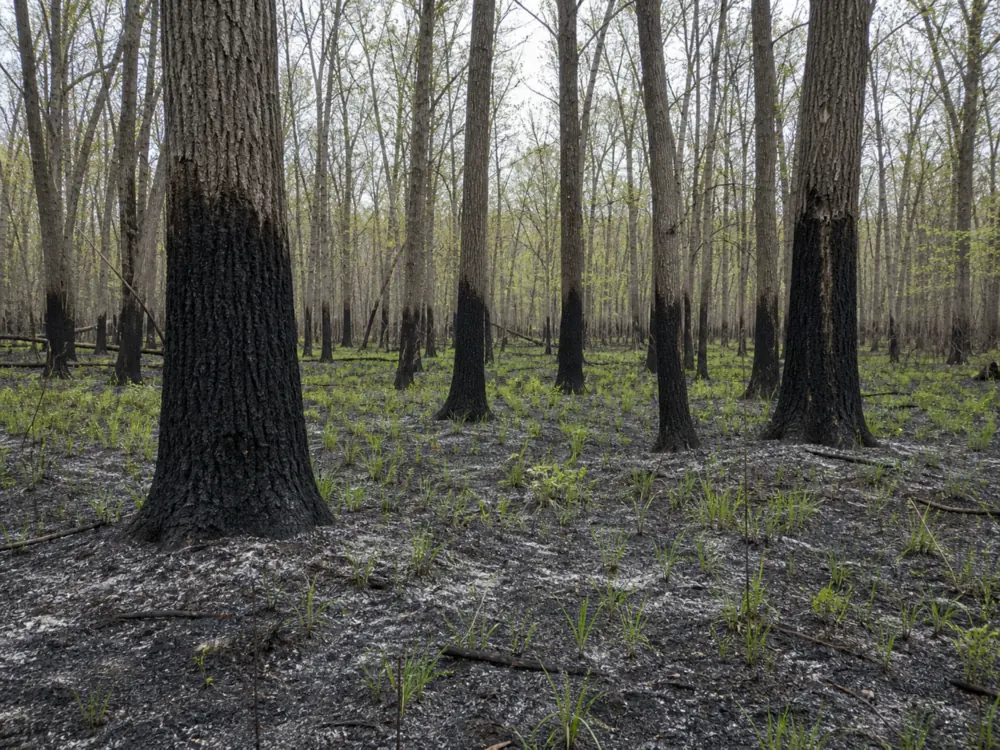
Ask staff directly when the plans are thin. Conservation area managers know where fire went last year, and a short phone call answers in a minute what an afternoon of driving might not.
Age is the detail people get wrong. A burn from this spring is too fresh and a burn from three years ago has closed back over, so the target is ground that burned during the previous growing season.
Walk the edges as well as the middle. The boundary between burned and unburned ground often produces better than either side on its own, because it has the light of one and the litter of the other.
ForagingMushroom foraging laws in Germany: protected species and small quantitiesFlood ground runs on its own clock
Flooded bottoms and burned uplands both produce, but they do not behave alike and they should not be walked at the same time.
Fresh silt is the thing to look for. A spring rise lays a pale layer of fine sediment over the litter, and that silt holds moisture long after upland ground has dried out.
Silt depth is worth reading as well as silt presence. A thin dusting over the litter is the useful condition, and several inches of heavy deposit can bury the ground rather than prime it.
Not every bottom floods every year, and that is the point. The bottom that took water this spring is a different proposition from the one beside it that stayed dry, even though both read as river woods on a map.
The flood line tells you where to stop.
Debris caught around trunks, flattened grass and a clean silt margin all mark how high the water reached, and the ground above that line is ordinary woods.
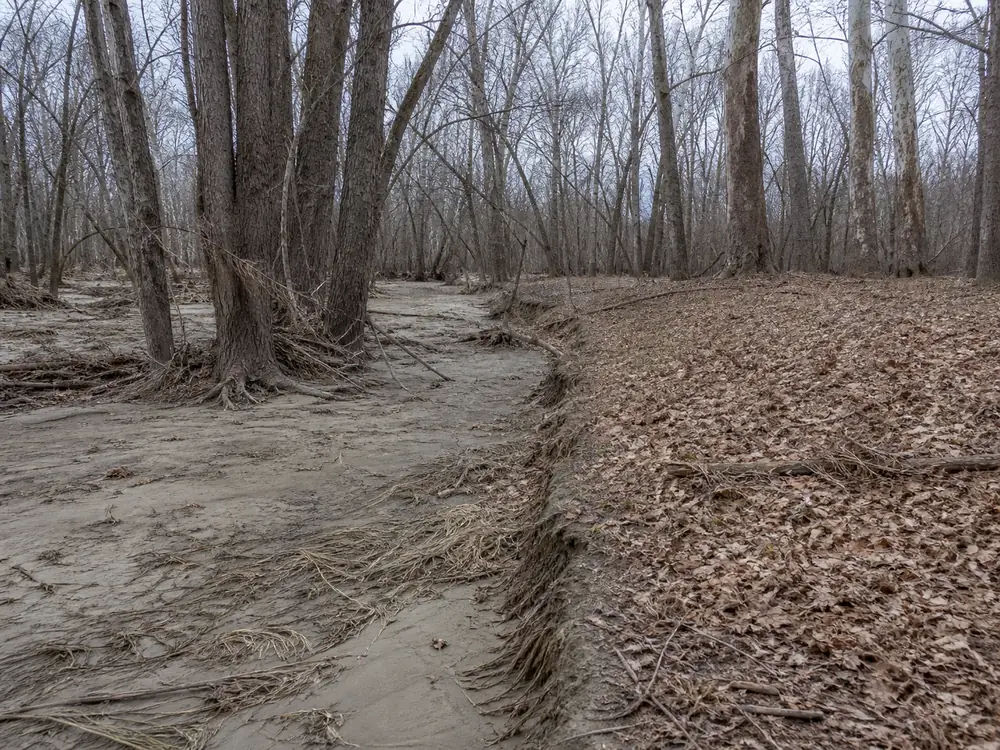
Backwater and side channels deserve their own look. Water that sat quietly in a slough leaves different ground behind it from water that ran hard through the main bottom.
Timing separates a good flood from a bad one. Water that came through in late winter and drained leaves primed ground, while water still standing in late April has scoured the litter and drowned the season on that bottom.
Because the silt holds moisture, flooded bottoms usually carry the last productive week of a Missouri spring. When the uplands have gone dry and crisp, the bottoms are often still working.
That makes them the right ground to save rather than the right ground to start on.
ForagingMushroom foraging laws in the UK: what is actually legalWhen the Missouri season runs
Late March opens it in the south, the main run generally starts around mid April, and early May closes it in most years.
- Statewide window
- Late March through early May
- Main run
- Generally from around mid April
- Air pairing
- Daytime in the low seventies with nights in the fifties
- Peak marker
- Lilac in bloom
- Early ground
- South and west slopes, before the shaded faces
The temperature pairing matters more than either number alone. Warm afternoons on ground that froze overnight do very little, and the low seventies by day with fifties at night is the combination that moves things.
Lilac in bloom is the marker worth carrying, because it costs nothing to check and it lands on the right week.
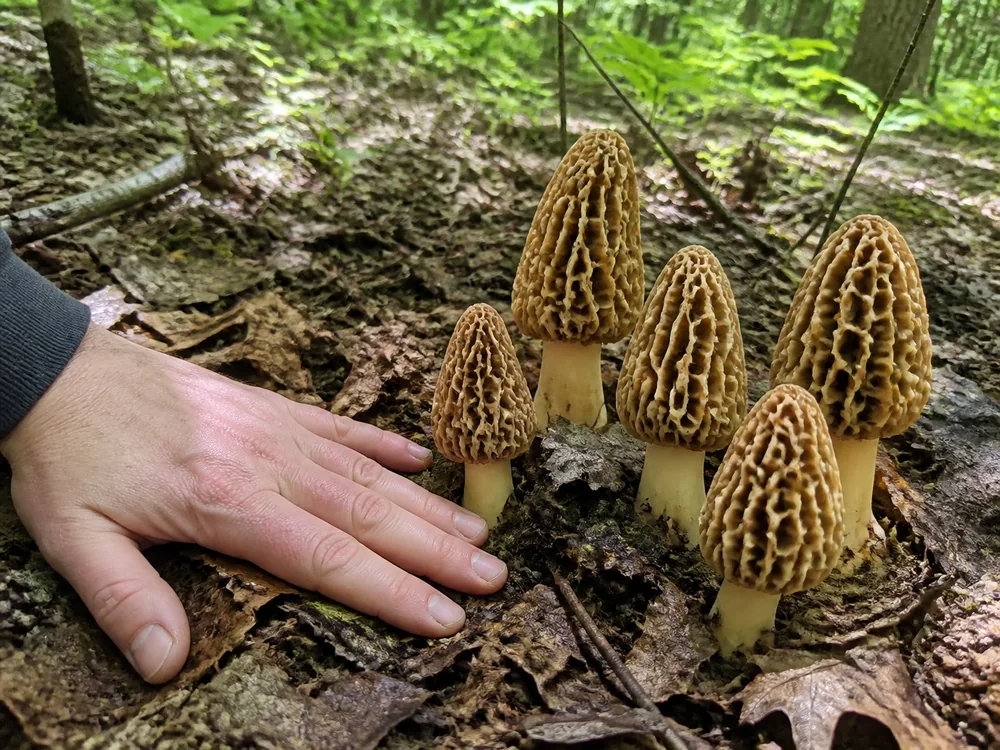
Rain sets the pace inside that window. A soaking rain on ground already sitting warm brings a flush within the week, and the days after that rain are worth more than any particular date.
Expect the response to lag behind the rain.
Morels answer over several days rather than overnight, so the weekend after a warm rain generally beats the morning after it.
Slope aspect adjusts the week rather than setting it. South and west faces warm first and produce early, and the north and east faces hold on later, which gives one property a second run if you change faces instead of changing properties.
Missouri's season is longer than the ones to the north, which changes how it should be worked. Six weeks end to end means a hunter can afford to save the shaded faces and the bottoms rather than clearing everything at once.
Small gray morels are the usual first find of the year. They are young and they will keep growing on damp shaded ground, so leaving some and coming back often returns more than clearing them early.
Northern Missouri leads Iowa by roughly a week, so hunters near that line can read the two calendars together and get a preview of what is coming.
Which trees carry the rest of the season
Most springs, nothing near you burned or flooded. That is when the ordinary host list does the work.
- Dying and recently dead elm, which is still the single best tree in the state
- Ash, now dying widely and behaving much the way elm does
- Cottonwood and sycamore on river terraces and creek bottoms
- Domesticated apple at old homesteads and abandoned orchards
Elm remains first for the same reason it does everywhere. A large tree in decline puts a wide circle of root system into failure, and that whole circle can turn productive while the tree goes.
An elm is only worth walking during a narrow stretch of its death. Bark still attached with a bare crown is the productive stage, and once the bark has fallen away and the trunk stands bare, the ground around it has usually moved on.
Ash now sits close behind elm across most of the state, and it is worth walking on the same schedule.
Old apple is the Missouri entry people forget. A homestead orchard tree can keep producing for many years after the house is gone, which makes an overgrown farmyard worth more attention than its size suggests.
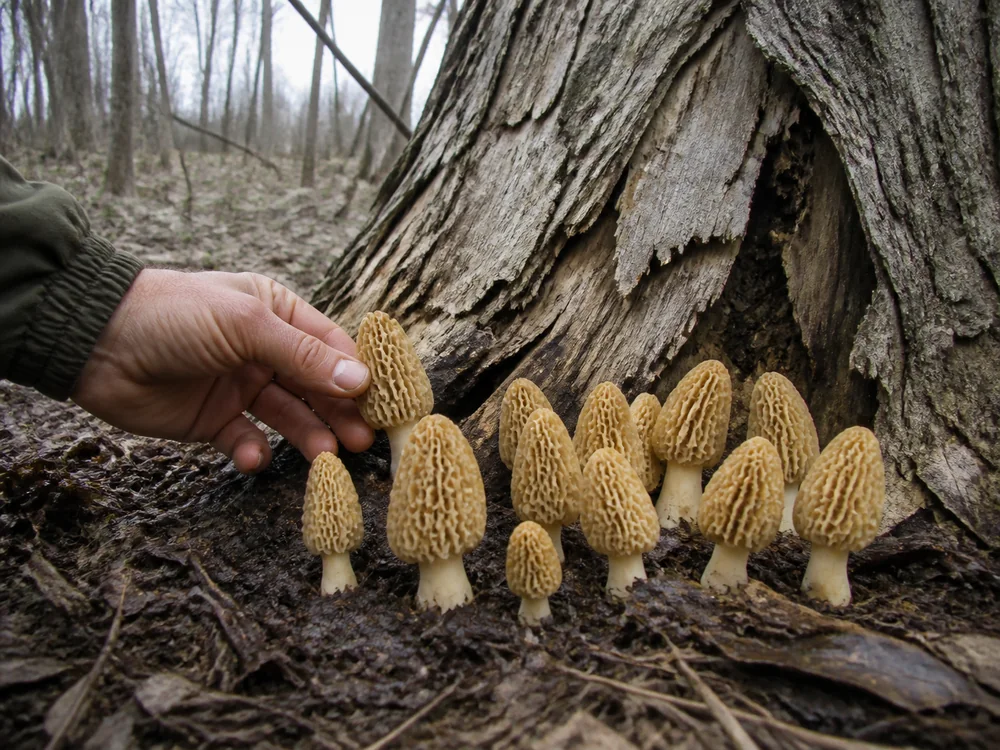
Sycamore is the easiest of them to pick out from a distance, because its mottled white bark shows through bare April woods long before anything else does.
Missouri's true morels are the same handful of species across the state, so the trees change between the Ozarks and the northern plains while the mushroom does not.
Missouri's spring woods hold the same handful of morels, burned ground or not, and they arrive in an order.
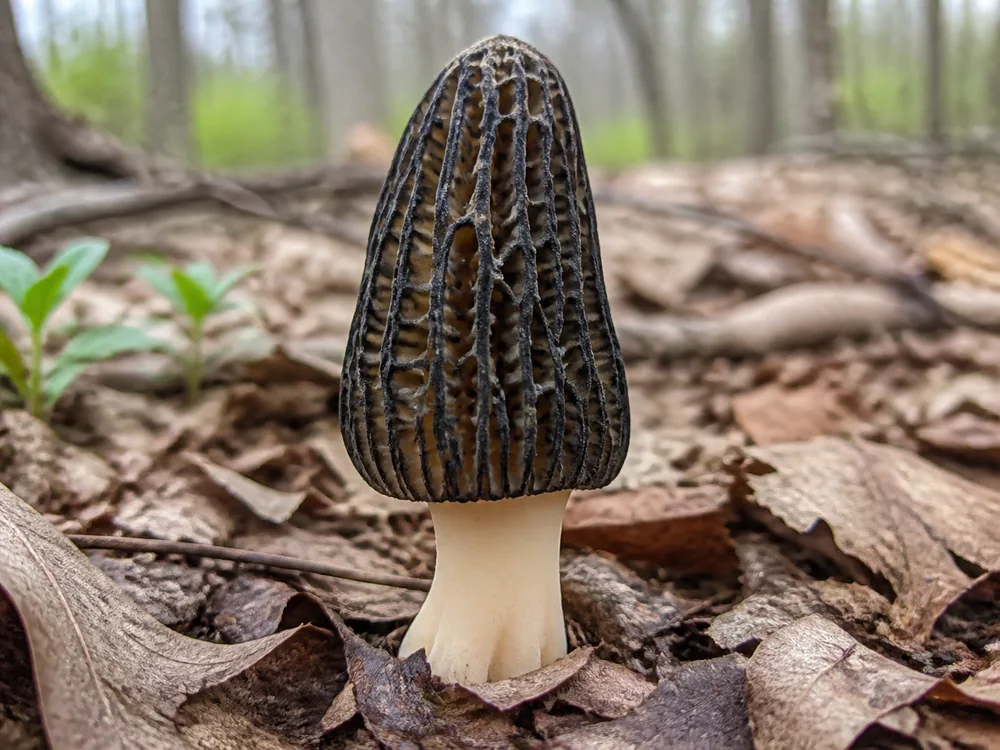 First upBlack morelEarliest of the run, and easy to walk over in dark litter
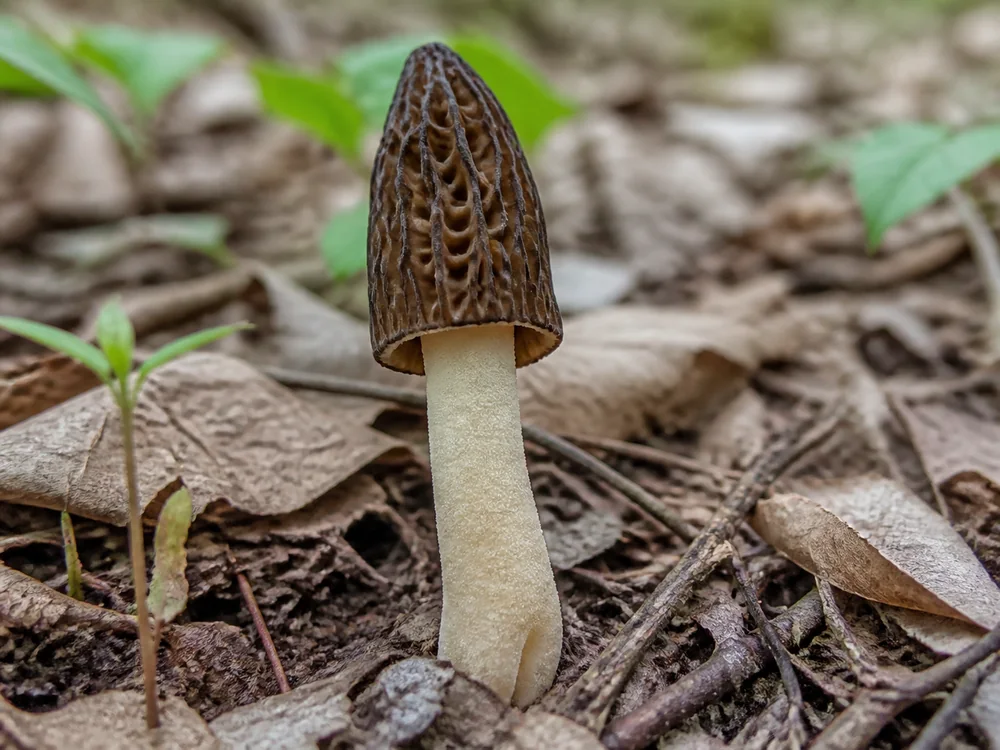 Middle of the runHalf-free morelCap hangs loose below where it joins the stem
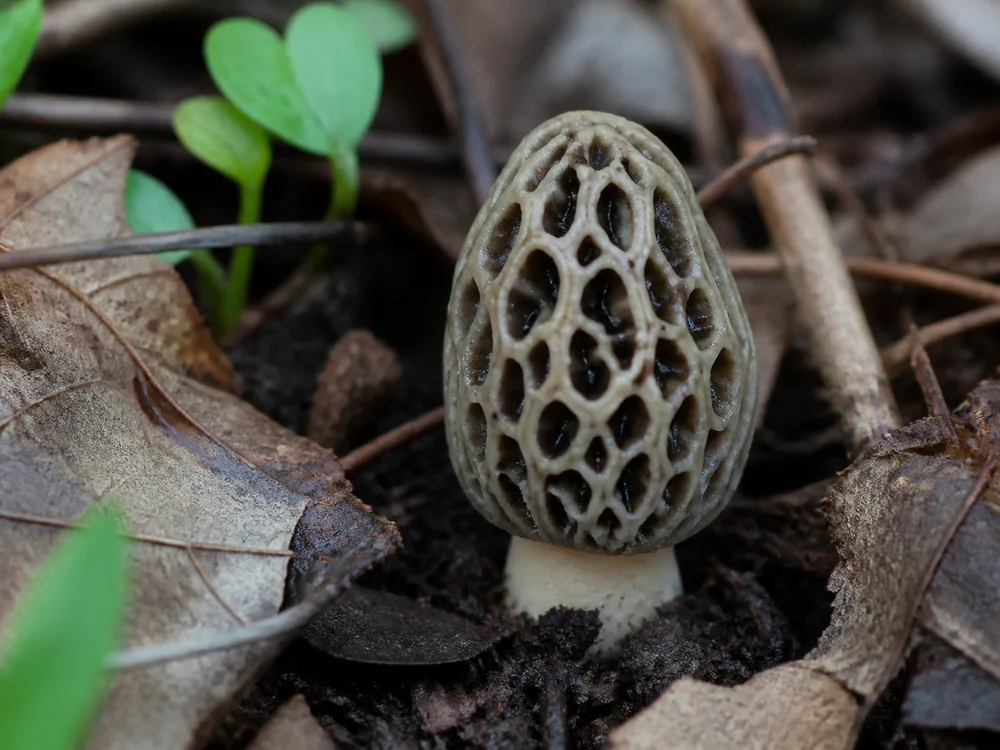 Early to middleGray morelThe young form most people find first
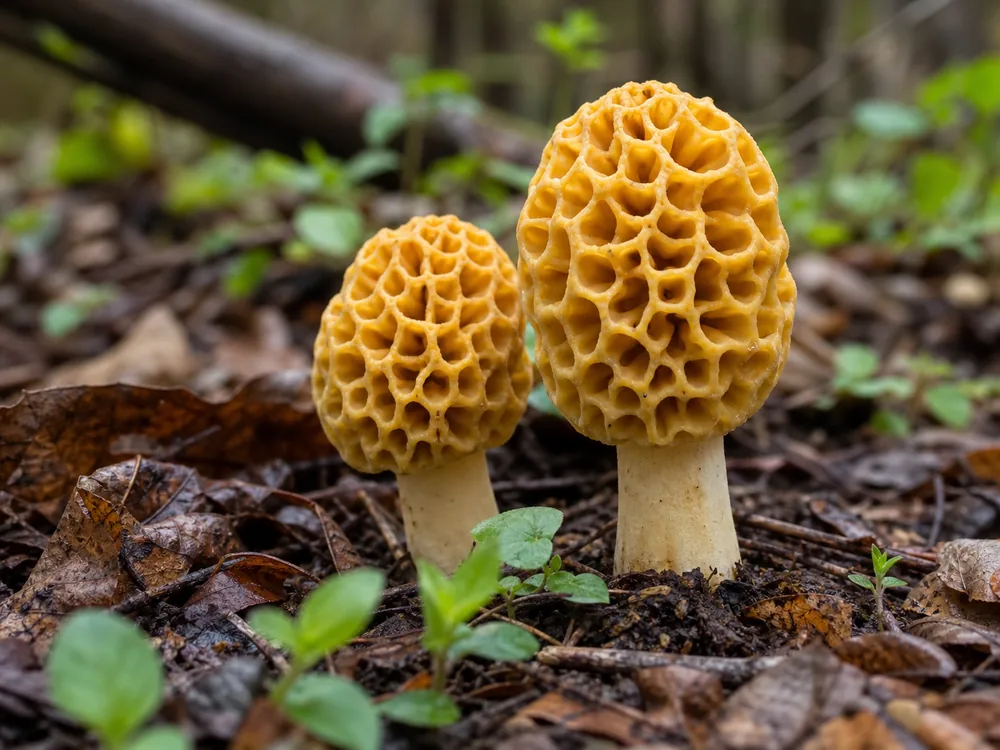 Last and largestYellow morelCarries the end of the season
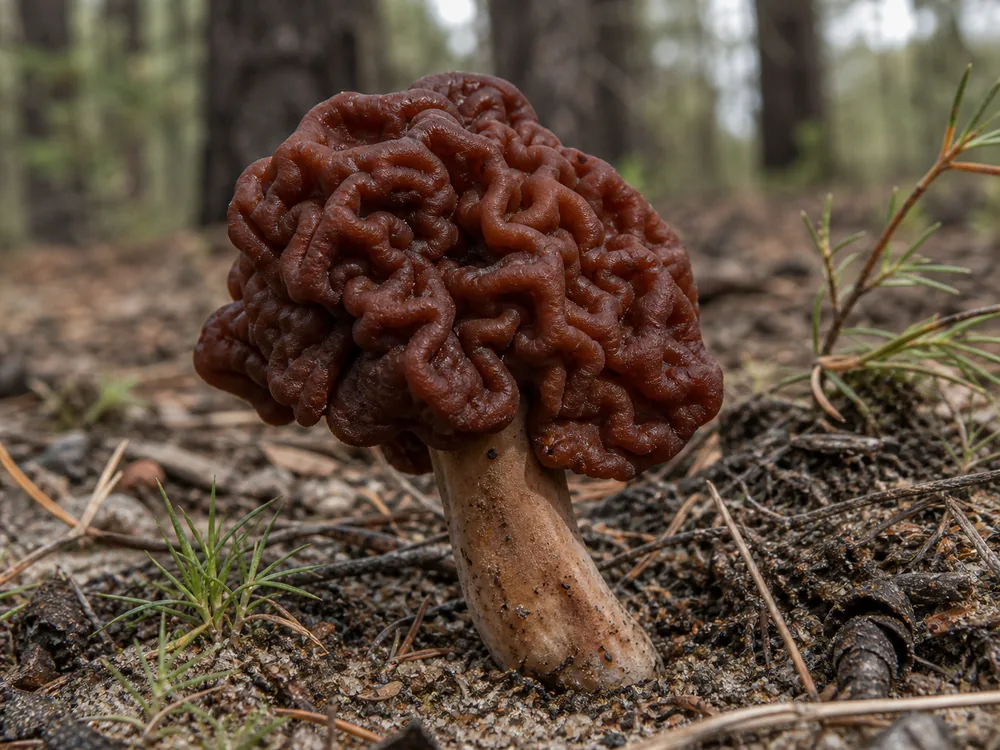 Same weeks, never edibleFalse morelWrinkled and lobed, with no honeycomb pits
Half-free morels turn up through the middle of the run, and finding them usually means the larger yellows on that ground are still ahead of you. Cut or pinch at ground level rather than pulling, which is what Missouri conservation guidance recommends and which leaves the ground undisturbed for the following spring.
What to settle before anything reaches the pan
Missouri has a specific false morel worth knowing by name. The big red false morel is a native species, it is toxic, and it comes up in the same weeks and the same woods as the real thing.
The test is the same one it always is.
Cut the mushroom lengthwise from cap tip to stem base.
A true morel is hollow, and Missouri conservation guidance puts it exactly that way. A false morel has chambers in its stem and cap rather than one continuous empty space.
The toxin behind that rule is gyromitrin, which the body converts to monomethylhydrazine. Cooking does not make a false morel safe, so a chambered specimen is a discard rather than a cooking problem.
| Check | True morel | False morel |
|---|---|---|
| Cut lengthwise | One continuous hollow chamber | Chambers or cottony fill in stem and cap |
| Cap surface | Honeycomb pits with raised ridges | Wrinkled, folded and lobed like a brain |
| Color | Gray, tan or yellow | Often reddish, rusty or purple-brown |
| Cooking | Safe only when thoroughly cooked | Not made safe by cooking |
Half-free morels cause an annual scare here.
Their cap hangs loose below the point where it joins the stem, which looks alarming to anyone who has just learned that a free-hanging cap is a warning sign, but a half-free is hollow the whole way down.
Cooking still matters for the ones that pass. Raw morels sicken people who identified the mushroom correctly, so cooking morels thoroughly is not optional.
Eat conservatively the first time you take morels from new ground. Cook a small portion, skip alcohol with that meal, and give it a day before making a habit of it.
If symptoms start hours after eating rather than minutes, treat the delay as the warning it is and call Poison Control at 1-800-222-1222.