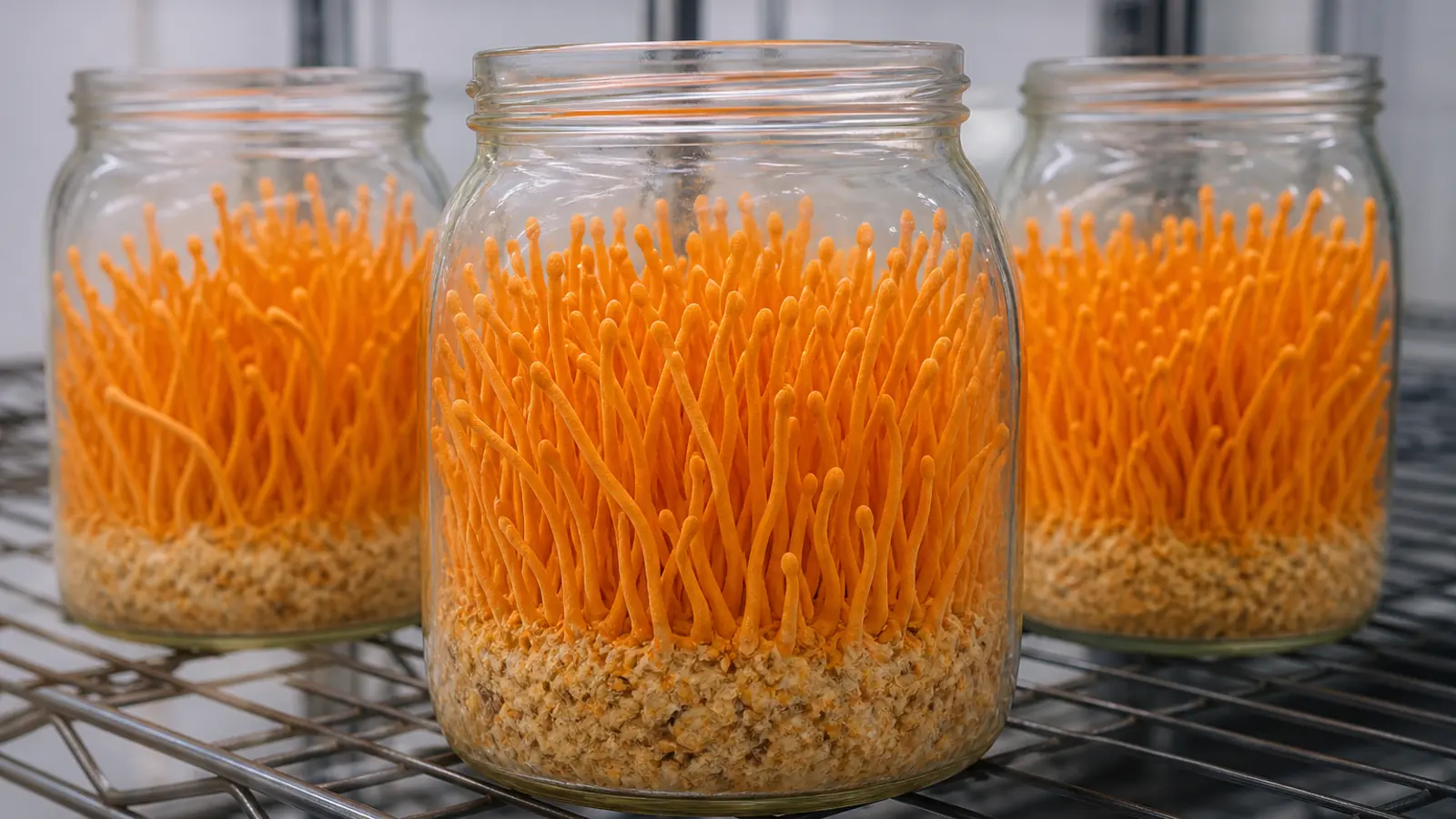
Home-grown cordyceps is Cordyceps militaris produced from a fruiting-proven culture in shallow sterile rice-medium jars. Colonize cleanly in darkness, move complete white jars into a controlled light stage, and require orange primordia before treating a jar as productive.
The cordyceps crop that can be grown in shallow jars is Cordyceps militaris.
Its white mycelium colonizes a sterile rice medium first, then controlled light and fruiting conditions support upright orange stromata.
A clean white jar is only the midpoint. The practical job is to protect fruiting capacity from culture selection through harvest and to recognize when a jar has colonized without becoming productive.
Which cordyceps can actually be grown in jars?
Key takeaway
Grow Cordyceps militaris, not a trade-name mystery | Buy a fruiting-proven culture with a scientific label, strain or lot, production date, and handling instructions.
C. militaris is the orange club-forming species used in many artificial fruiting studies.
It is different from Ophiocordyceps sinensis, the high-altitude insect-associated fungus often sold under the same broad commercial word. A seller who lists only cordyceps has not supplied enough identity evidence for this jar process.
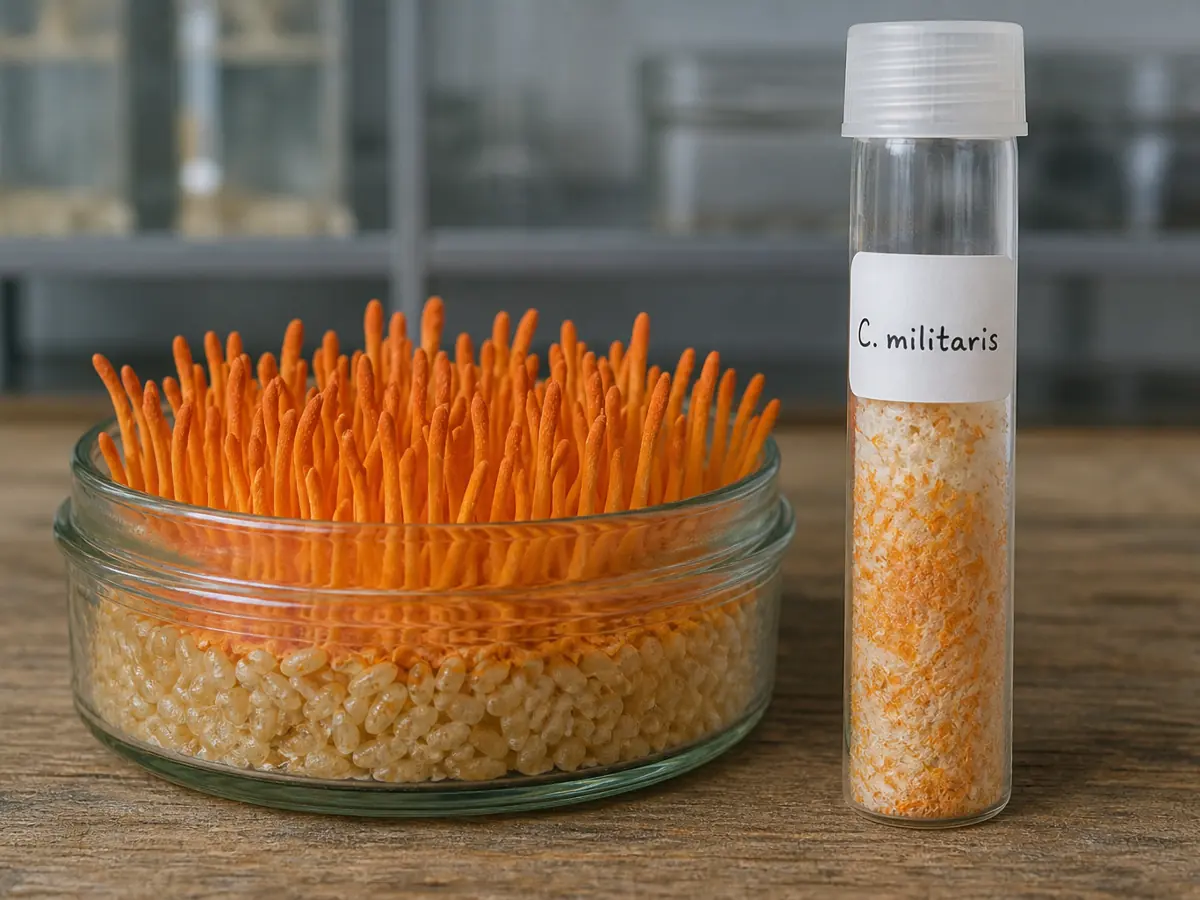
Keep the culture label in the first batch photograph and copy its lot information into every jar record. Orange color later supports the stage assessment, but it cannot repair a missing identity record at the start.
| Material | What it can establish | What it cannot establish |
|---|---|---|
| Labeled fruiting culture | Species, lot, and demonstrated production | Future yield in your room |
| White liquid culture | Viable-looking growth | Fruiting capacity |
| Orange commercial powder | Product color | Living culture identity |
| Wild insect fungus | A field specimen | Suitability for a rice-jar method |
The jar method does not require infecting insects.
It supplies an artificial solid medium that supports mycelial growth and fruit-body development under controlled conditions.
Keep medicinal claims outside the crop decision. Producing the correct species does not establish a therapeutic dose, personal safety, or the composition of a supplement extract.
Growing MushroomsWhat Does a Mushroom Farm Actually Cost to Start?Should you buy a fruiting culture or expand your own?
A recent fruiting-proven commercial culture is the strongest starting point.
Ask whether the supplier has produced normal stromata from that lot or parent culture, because fast growth on agar or in liquid is a different trait.
Repeated subculture can lead to degeneration, which may reduce pigmentation, alter growth, or remove fruiting ability while white mycelium still expands. Culture age and transfer history therefore belong in the production record.
One mating study found that opposite mating-type isolates produced fertile stromata while single or same-type isolates failed in its system.
A home grower does not need to perform mating tests. The result explains why two clean-looking cultures may not have equal reproductive capacity and why supplier fruiting history matters more than liquid-culture density.
Start with several small equivalent jars rather than one large vessel. Replication tells you whether one jar was contaminated and protects the whole project from a single closure or inoculation failure.
What belongs in a Cordyceps militaris rice jar?
Published fruiting systems commonly use brown rice plus a measured nutrient liquid in shallow containers.
The visible grain is only one part of the method, and substituting an improvised broth can change nitrogen, sugar, minerals, water activity, and contamination pressure together.
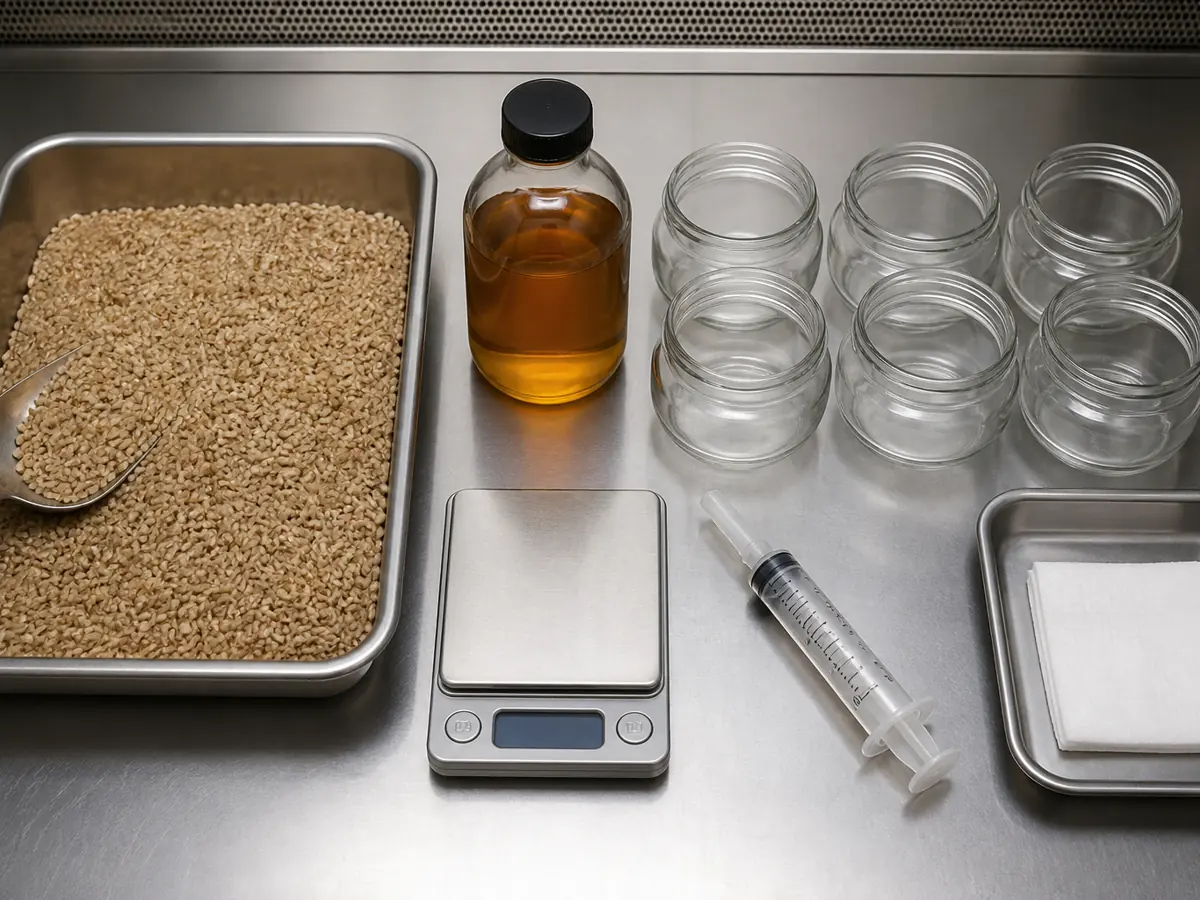
Build one batch from a single written formula and distribute it by weight. When jars differ in grain depth or liquid volume, a later height or density difference cannot be assigned confidently to the culture or the fruiting room.
| Jar variable | Record it as | Why it changes the crop |
|---|---|---|
| Rice | Dry mass and type | Controls structure and available solids |
| Nutrient liquid | Full formula and volume | Controls water and dissolved nutrition |
| Depth | Filled depth and jar diameter | Controls fruiting surface and gas path |
| Headspace | Closure and empty volume | Supports later upright stromata |
| Replicates | Jar IDs from one batch | Separates jar failure from batch failure |
Use a scale and written formula instead of filling by eye.
A shallow even layer gives the culture a broad surface for initiation and keeps the jars comparable. Leave the planned headspace empty because the orange clubs need room to rise without contacting the lid.
Do not pack an ordinary grain-spawn jar to the shoulder and expect the same crop. The intended product is an upright fruit body, so headspace, surface area, and later illumination are part of the design.
Mix until water is distributed without a free pool. A waterlogged base removes air spaces and can support bacterial decline even when the upper surface turns white.
Growing MushroomsHow Do Mushroom Sawdust Blocks Work from Mix to Fruit?How do you sterilize and inoculate shallow jars?
One research system sterilized its brown-rice jars at 121°C before clean inoculation.
That temperature belongs to a complete pressure process, and a brief chamber reading does not prove that the center of every jar received adequate treatment. Load pattern, jar size, starting temperature, venting, pressure, and holding time all affect what the medium receives.
Use equipment rated for pressure processing and follow its manufacturer instructions. The cultivation guide can identify the biological requirement, but it should not replace the operating and safety manual for the vessel you own.
Weigh and label
Record batch, formula, fill, and jar number before treatment
Close for the process
Use the supported lid and gas-exchange arrangement
Run the validated cycle
Preserve loading, pressure, temperature, and full time
Cool while closed
Wait until the medium is safely within culture limits
Inoculate cleanly
Introduce only the verified culture in a prepared clean field
Seal and distribute
Close immediately and spread inoculum according to the method
Prepare a clean landing area before the cycle ends so cooled jars do not wait among dirty tools.
Separate treated containers, culture vessels, discard containers, and finished jars in the order they will be handled. This layout shortens open handling and prevents a used pipette or culture vessel from crossing back over completed jars.
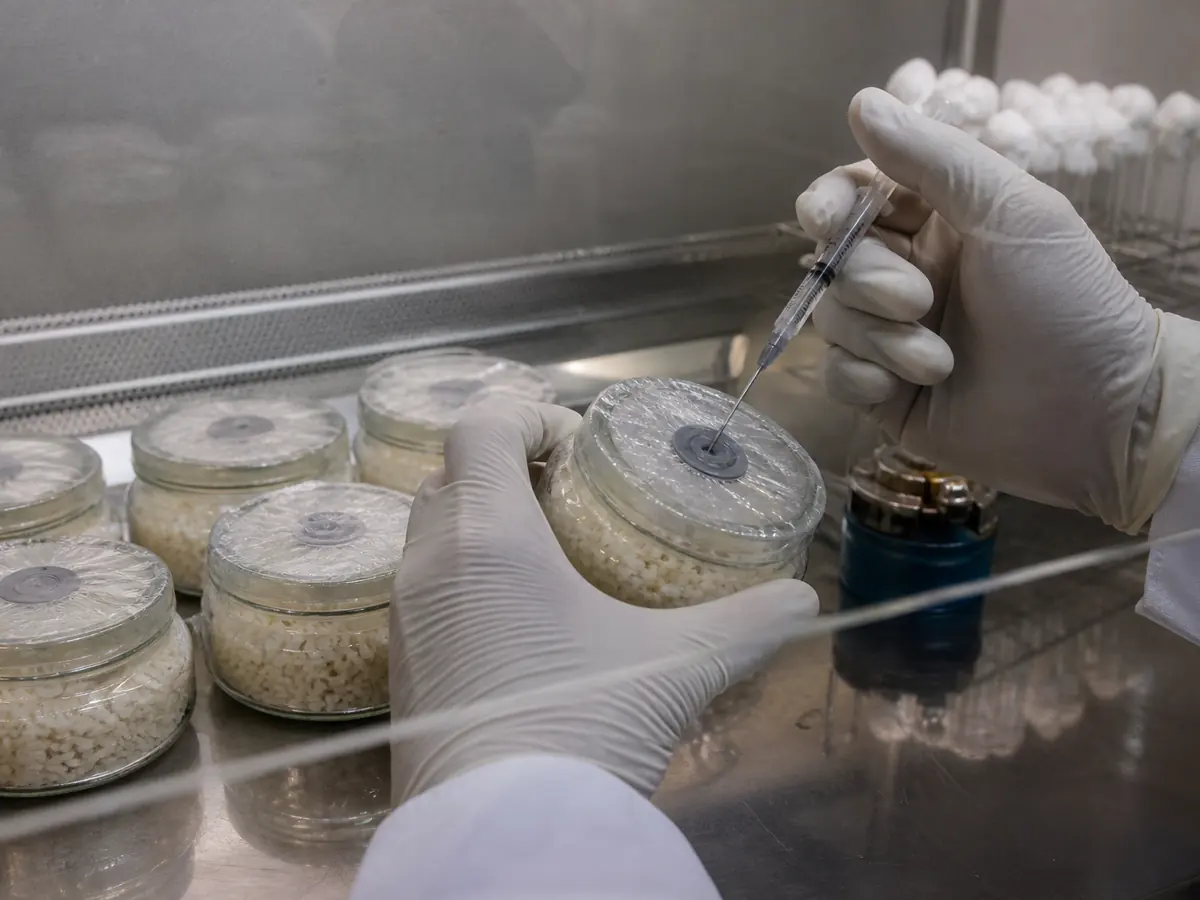
Do not inoculate a warm jar because the glass feels cool. The center can remain hot enough to injure culture after the outside has lost heat.
Keep a newly inoculated batch together but leave enough space to see every jar. If one develops a separate colored colony or wet channel, isolate it closed rather than opening it over clean units.
When does dark colonization end?
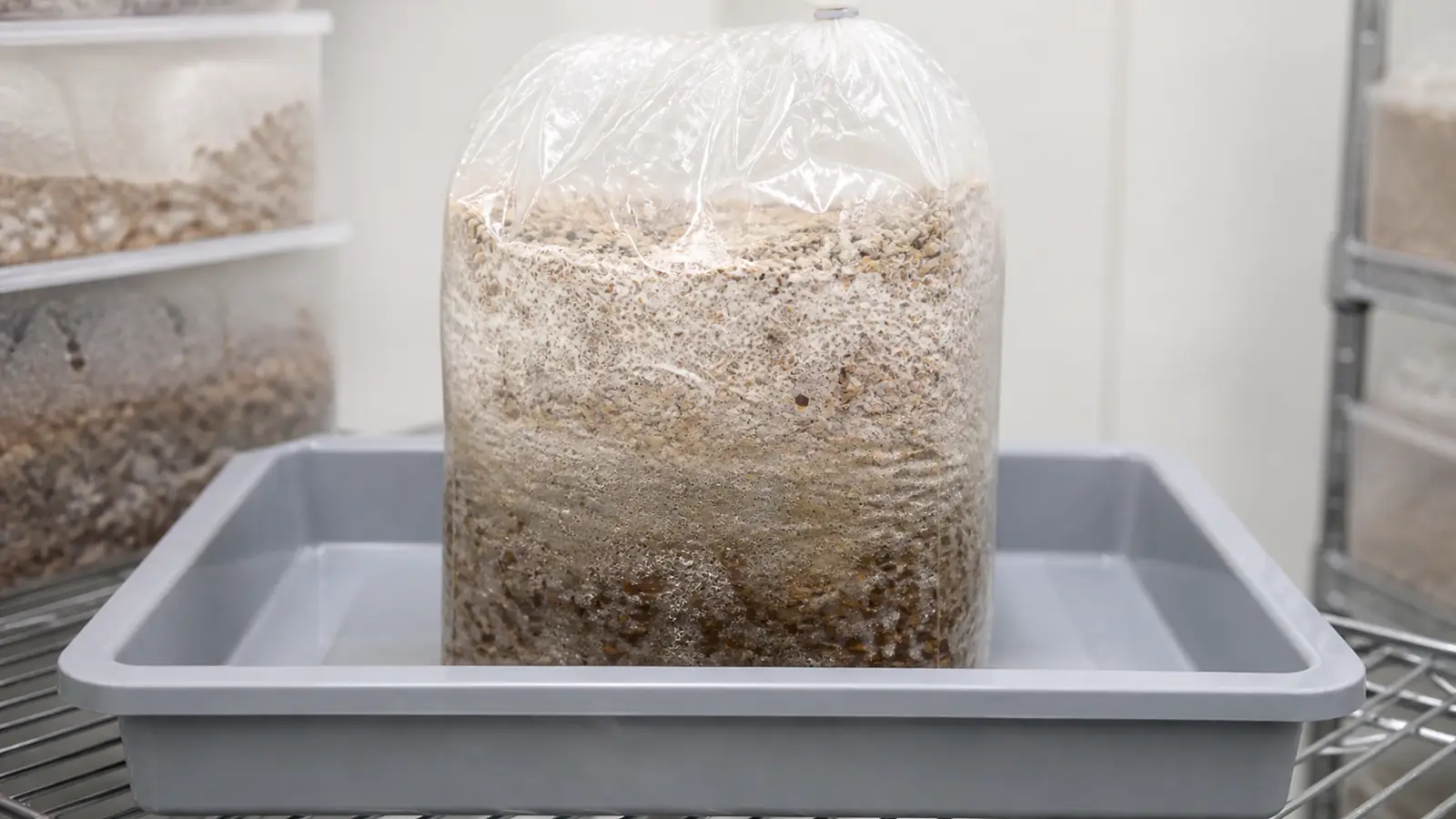
Dark incubation supports vegetative colonization before the fruiting signal.
In one study, jars remained in darkness at about 20°C for two weeks, but the visible gate was still a clean evenly occupied medium. Attach both numbers to that culture and formula rather than treating day fourteen as permission to light an unfinished jar.
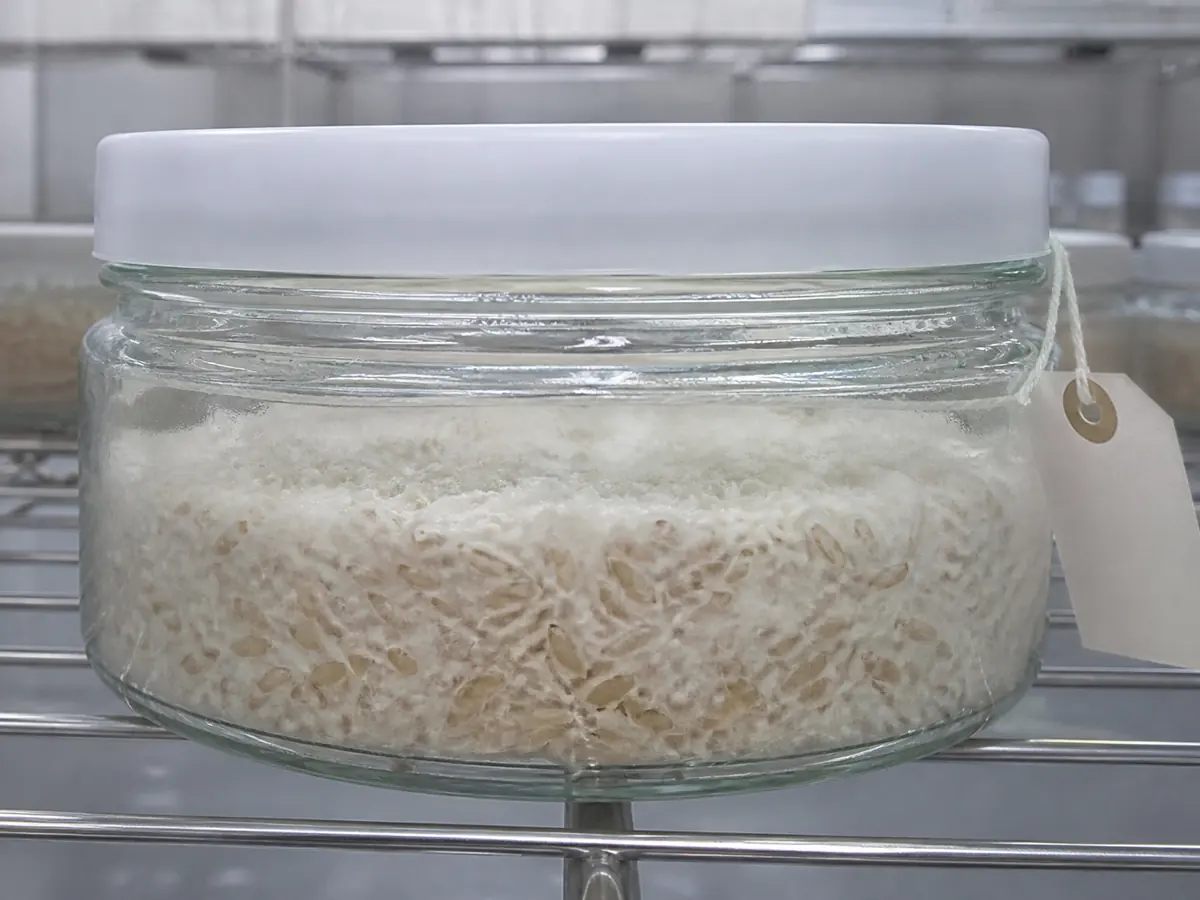
View the jar from the side and below as well as through the lid. Surface whitening can hide a loose wet base, while coherent occupation should connect through the shallow medium without an independent translucent channel.
Inspect through the closed glass under neutral light.
Healthy growth connects across the rice, while green, black, pink, or wet translucent areas form independent boundaries that require isolation.
- Active
- White growth advances between dated views
- Complete
- The shallow medium is coherently occupied without a loose wet pocket
- Too early
- Only the inoculation zone or surface is white
- Isolate
- A colored colony, foul odor through the closure, or wet collapse expands
White coverage is not the harvest and does not prove future fruiting. It establishes that the jar can be evaluated for the next stage without an obvious competitor.
Move the batch only when the supported colonization period and visible coverage agree. Early light may alter development before the culture has occupied the intended medium, while indefinite darkness prevents the deliberate fruiting transition.
Growing MushroomsHow Do You Build an Outdoor Mushroom Bed That Lasts?How do light and air turn white growth orange?
Light affects pigmentation, orientation, initiation, and fruit-body development in C. militaris.
One controlled system used about 500 lux after dark colonization and observed fruit bodies roughly two weeks later. Another controlled study found that illumination patterns across colonization, initiation, and fruiting changed production, so light timing belongs in the batch record as well as intensity.
That measurement is useful context, not a universal lamp setting. Distance, spectrum, photoperiod, jar material, shelf reflections, and strain response determine what reaches the crop.
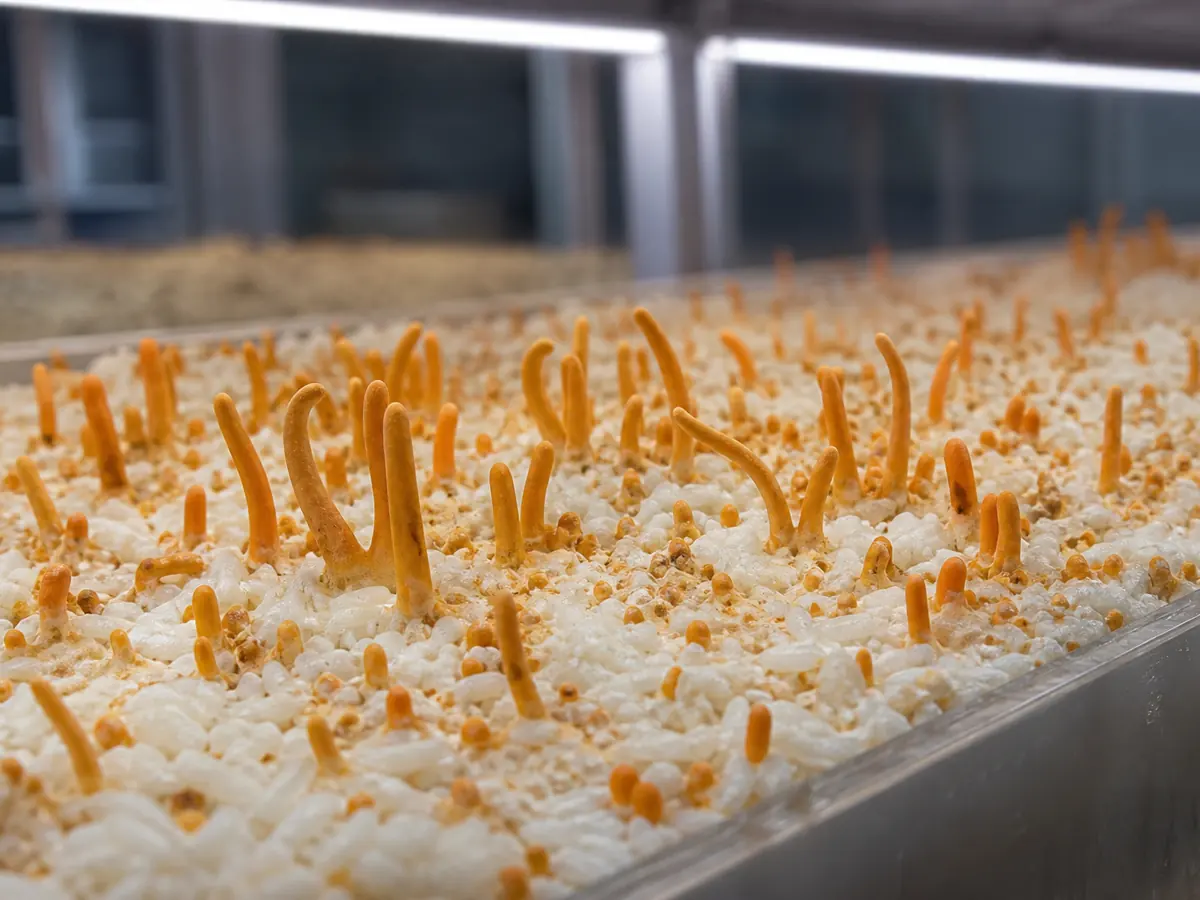
Record the first orange points separately from the first upright clubs.
That distinction shows whether a jar initiated and then stalled or never responded to the light transition at all.
| Crop response | Interpretation | Action |
|---|---|---|
| White surface gains orange points | Initiation is beginning | Hold stable light and environment |
| Short clubs rise separately | Productive development | Preserve spacing and gentle exchange |
| Surface stays white | No proven fruiting response | Review culture, stage, and light record |
| Clubs lean strongly | Uneven light or crowding | Correct orientation without overheating |
Allow gentle filtered exchange according to the jar system while protecting the surface from drying. Sealing completely can limit fruiting, while opening broadly invites contamination and moisture loss.
Use diffuse illumination on a stable daily schedule. A close hot lamp can raise jar temperature and evaporation even when its lux reading appears reasonable.
Check illumination at the crop surface across the front, center, and back of the shelf.
Uneven orange initiation or clubs leaning in one direction can reveal a light-distribution problem that a single center reading misses.
Track heat beside the jars during the light period as well as in darkness. A lamp or enclosed shelf can raise the local temperature after the room sensor appears stable, which changes both evaporation and the stress experienced by developing stromata.
Why do clean-looking jars fail to make stromata?
A clean white jar can fail because the culture has degenerated, lacks suitable reproductive capacity, entered light too early, received ineffective illumination, or encountered an environmental mismatch.
Hidden bacterial stress and growing contamination may also produce pale growth without a normal orange transition.
Check the culture and its growth history before changing the environment. Confirm the species and fruiting history first, then compare sibling jars, then check colonization completeness, and only after that review light, temperature, exchange, and moisture.
Warning
Do not chase a biologically incapable culture with endless climate changes | If equivalent clean jars from the same line repeatedly colonize but never initiate, retire the line or return to a proven parent.
Use sibling jars to decide where that failure belongs. A single wet jar beside orange productive siblings points to a container-level defect, while an entire clean lot remaining white under the same supported transition makes culture capacity or a shared stage error more likely.
| Pattern | Stronger explanation | Useful test |
|---|---|---|
| Every jar stays white | Culture or stage problem | Compare with a recent proven parent |
| One jar stalls wet | Jar-level contamination | Isolate and compare siblings |
| Orange points form then stop | Fruiting environment or culture weakness | Review heat, light, moisture, and response timing |
| Success declines after transfers | Degeneration | Return to lower-passage stored culture |
Compare failures at the batch level before changing the room.
One wet jar among productive siblings points toward a jar event, while every clean jar from one culture staying white points upstream toward culture capacity, stage timing, or a shared preparation error.
Do not add nutrient liquid to a colonized jar to rescue it. Opening changes the contamination boundary, and excess liquid can create bacterial conditions without restoring fruiting genes.
Retire a jar immediately when foreign sporulation, foul odor, or structural collapse appears. Retire a culture line when replicated clean trials under its supported method fail while a proven comparison succeeds.
Separate jar retirement from culture retirement in the record. One failed closure removes one jar, while repeated clean nonfruiting across equivalent jars questions the line itself and justifies returning to a stored productive parent.
When should orange stromata be harvested?
Harvest when the stromata are upright, firm, strongly orange, and mature for the culture, but before they collapse, soften, or darken into decline.
One research schedule harvested around six weeks after inoculation, although the crop condition remains the safer endpoint.
Compare the center and edge of the jar because crowding, light direction, and moisture can produce uneven maturity within one container. Record collapsed, sterile, or unusually pale clubs separately instead of averaging them into one yield number.
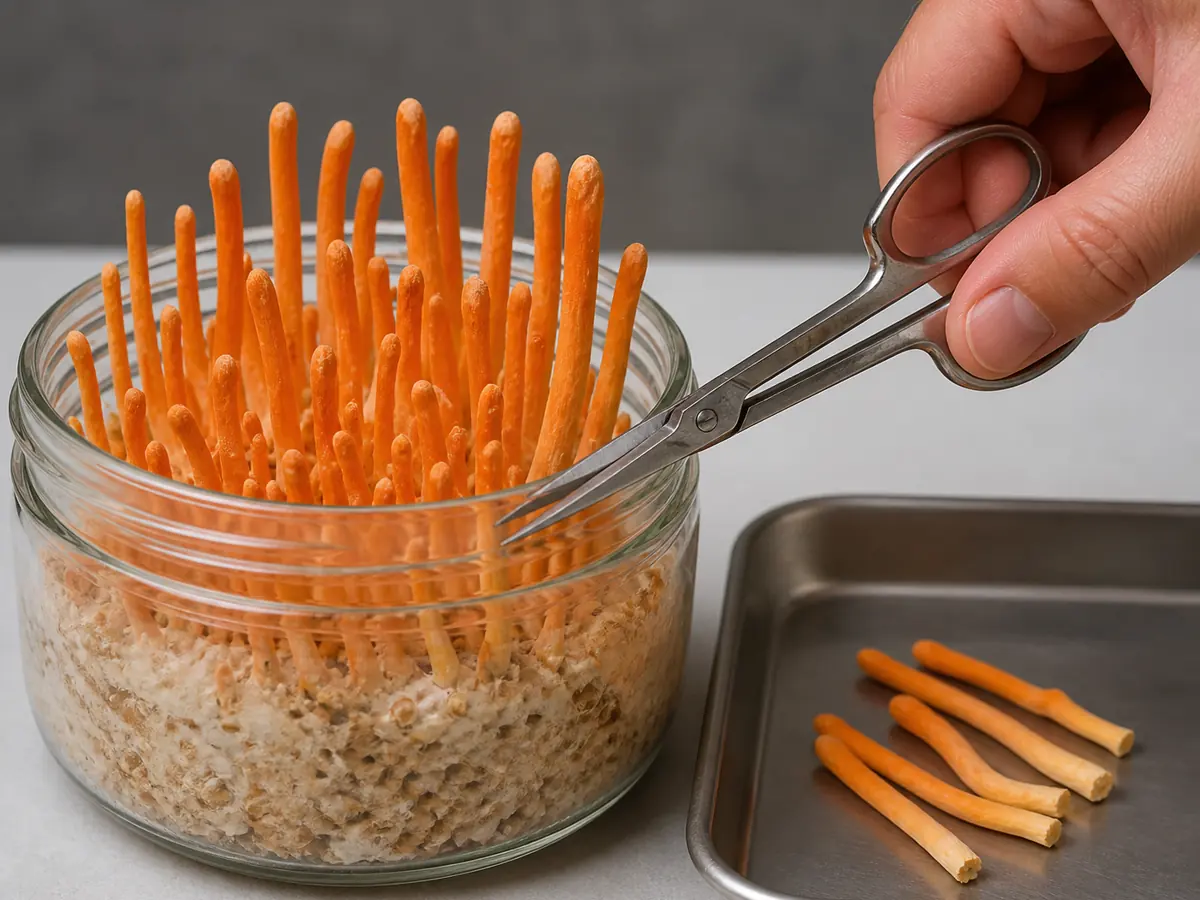
Keep each jar separate during harvest so one defect does not enter the whole batch. Cut with clean tools above the medium and reject stromata touching a wet, discolored, or foul substrate area.
- Photograph the intact jar before opening.
- Record inoculation, light transition, first orange point, and harvest dates.
- Note height, density, color, and any sterile stromata.
- Handle or dry the harvest promptly under a supported food process.
Yield alone cannot select the next culture.
A slightly smaller crop with repeatable form and clean replicated jars is a stronger production parent than one spectacular jar surrounded by failures. Preserve a low-passage parent and label the productive transfer so later decline can be compared with a known successful generation.
The completed record should connect the culture lot to every stage change. That chain turns the next run into a controlled improvement instead of another guess at rice, light, and temperature.
Keep yield, normal-form percentage, contamination count, initiation timing, and transfer generation together. A high total weight from one abnormal jar is weaker production evidence than several clean jars that initiate and mature within a narrow, repeatable window.