Volvariella volvacea is a tropical crop. Keep its prepared straw or cotton-based substrate warm through spawn run, manage a slightly cooler but still warm fruiting stage, and harvest firm closed eggs before the cap expands.
Paddy straw mushroom is a tropical crop whose successful temperatures look unusually warm beside oyster, shiitake, or button mushroom instructions. Cooling it at fruiting or after harvest can undo otherwise sound work.
The practical method follows heat through the bed, then uses the enclosing volva as a fast maturity signal.
Humidity alone cannot rescue a bed that has lost the warmth its culture needs.
Why is paddy straw a tropical crop?
- Cultivated subject
- Verified Volvariella volvacea spawn
- Thermal evidence
- Measure representative bed center, edge, and room air
- Harvest boundary
- Firm closed volva before the first split
This species evolved and is cultivated widely in tropical and subtropical conditions. A room considered warm for many specialty mushrooms can still sit below the productive range for paddy straw mushroom.
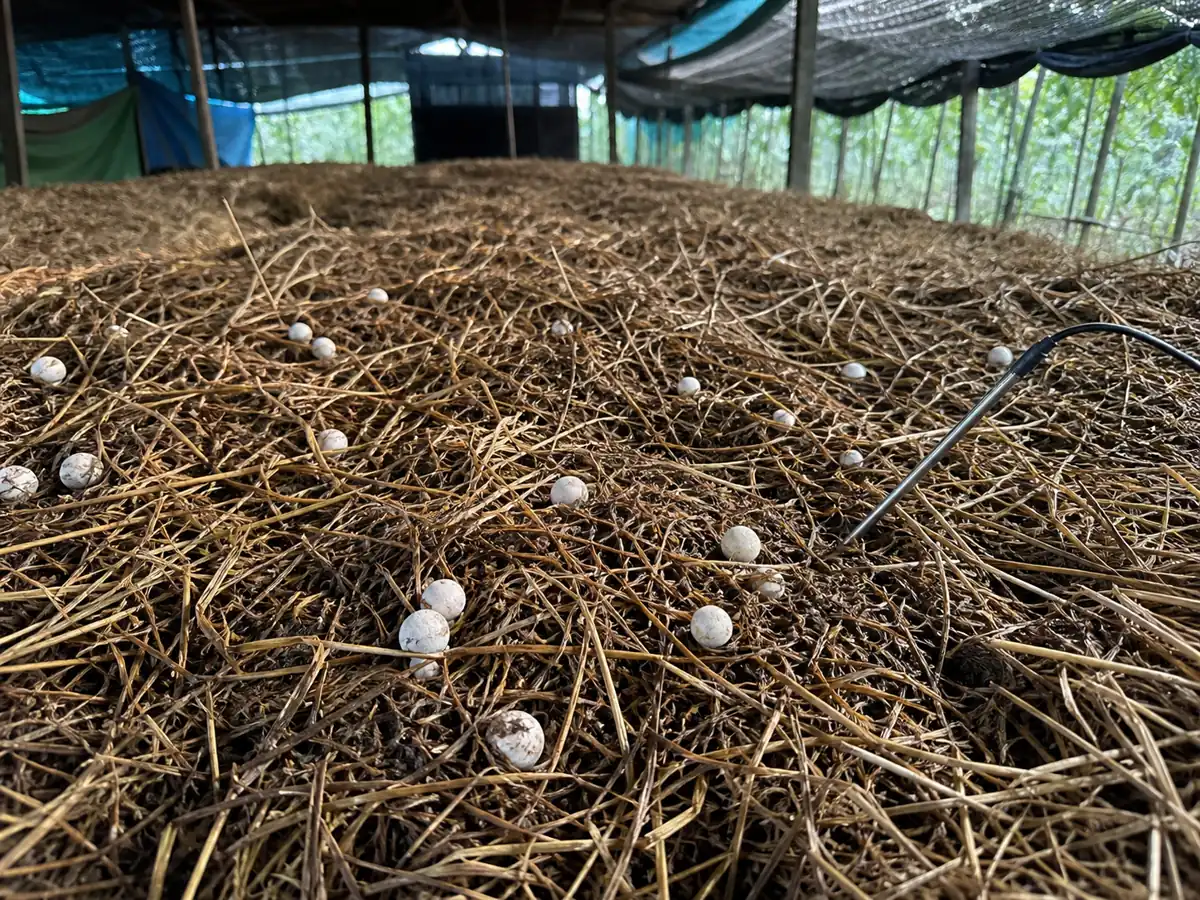
Air temperature and substrate temperature are separate measurements.
Active colonization, bed mass, insulation, water evaporation, and outdoor night loss can push the center above or below the surrounding air.
| Stage | Published guidance | What to verify locally |
|---|---|---|
| Spawn run | Commonly 30 to 35 C | Representative bed-core temperature and growth pattern |
| Fruiting | Commonly 28 to 32 C | Crop-height air, surface condition, and egg development |
| Harvest handling | Chilling-sensitive species | Local food-safety method and rapid use plan |
One growth study found the fastest *V.
volvacea* mycelial growth around 35 C in its tested media. That result supports the tropical boundary, but it does not authorize every bed to be held at exactly 35 C regardless of strain or internal heat.
Select a site that can hold warmth without sealing people or mushrooms into stagnant air. Heating a small enclosure must include safe equipment, air replacement, fire protection, and measurements at several bed locations.
Night loss deserves its own trial before inoculation.
Run the empty room and a wetted test bed through the coolest part of the day so the planned insulation and heater can be assessed without risking spawn.
Record the daily high, low, and the difference between bed center and edge. A single midday reading can hide a cold dawn or a self-heating core that crosses the intended band for hours.
Warmth also raises water loss and biological activity.
Every heating plan therefore needs a matching approach to drainage, humidity, and replacement air rather than a sealed plastic room.
Choose a strain from a supplier that can state its tested temperature and substrate system. A common species name does not guarantee that two cultures respond identically to the same warm room.
Growing MushroomsWhat Does a Mushroom Farm Actually Cost to Start?Which substrate preparation fits the site?
Rice straw is traditional, but wheat straw, cotton waste, cotton gin residues, peanut shells, and other cellulose-rich materials have supported V. volvacea in research or production. The useful question is which complete preparation system the site can execute reliably.
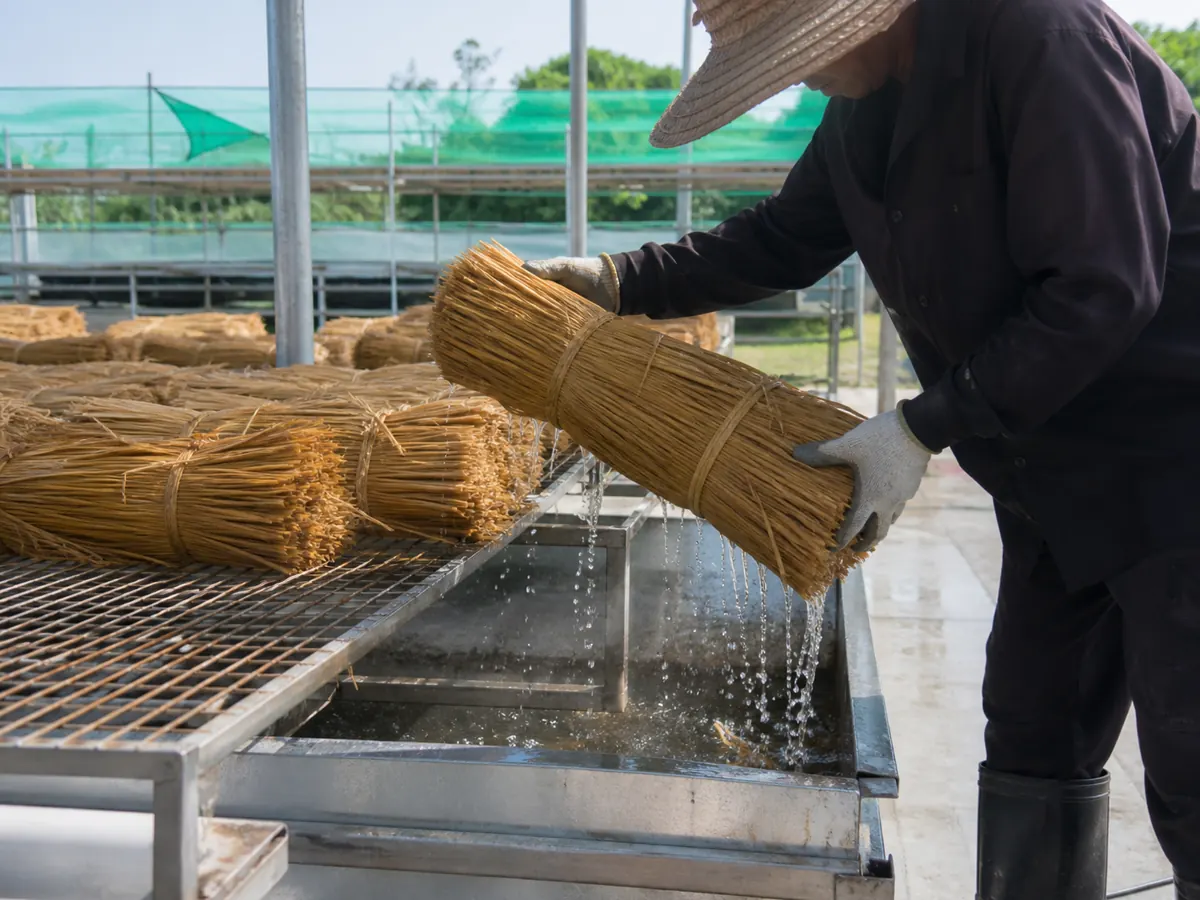
A research comparison found fast growth on wheat straw, peanut shells, and especially cotton gin trash.
Material performance still depends on strain, particle structure, moisture, treatment, nutrition, and the size of the cultivation mass.
Choose pasteurized or managed compost preparation from one validated method. Untreated wet straw carries competitors, while a half-completed compost route can produce unstable heat and chemistry.
Long fibers create channels that hold air and structure, but large dry cores resist colonization.
Chopping or bundling changes both water penetration and bed geometry, so do not copy an ingredient list without its physical preparation.
Keep four substrate records together so a failed zone can be traced to the bed that produced it.
- Record the dry material source, particle form, and any supplement before hydration.
- Record drained wet mass and actual bed area rather than estimating thickness by sight.
- Mark treatment time, temperature evidence, cooling or conditioning interval, and spawn lot on the same batch record.
- Separate raw straw, treated substrate, and spent material in both space and tools so loose fibers do not travel backward through the workflow.
Keep one measured batch small enough to inspect before scaling. A large warm bed can hide anaerobic pockets and is harder to correct once spawn has been distributed.
Measure the wet mass after draining and divide it by the actual bed area.
That record makes a later heavy cold zone comparable with the intended loading instead of relying on how thick the straw looked.
Supplement should enter only through a complete tested system. Adding an unmeasured nutritious material can raise competitor pressure and heat while changing the carbon structure the selected preparation was designed around.
Track how much dry material becomes one square meter of bed.
That production density helps explain heat retention and yield more honestly than reporting the ingredient name alone.
How should a warm bed be assembled?
The bed needs enough mass to buffer temperature, enough structure to admit air, and enough drainage to avoid a saturated center. Those demands pull in different directions, which is why simple advice to pack tightly is incomplete.
Distribute verified spawn according to its validated method instead of placing one dense pocket in the center.
Even introduction shortens the distance mycelium must cross and makes later gaps easier to interpret.
Prepare a clean base
Keep the bed above dirty standing water and away from untreated crop waste
Build comparable layers
Keep material thickness and compression consistent across the bed
Distribute spawn
Use the documented rate and pattern for the selected substrate
Place probes
Measure a representative center, edge, and room-air position
Cover as designed
Retain heat and moisture without removing all replacement air
Label the bed
Record culture, substrate batch, wet mass, assembly time, and probe locations
The center is usually the slowest place to exchange heat and oxygen. A surface that feels comfortably warm cannot prove that the core is neither cold nor overheated.
Water should remain within fibers and pore spaces rather than collecting under the bed.
If drainage continues heavily after assembly, the initial wet mass and preparation step need review before extra insulation is added.
Avoid direct floor contact where cool concrete can create an invisible lower zone. Use a washable raised structure that supports drainage and lets the underside be inspected.
Build one bed to a consistent width before increasing length.
A wider mass changes the distance to the center and can retain more heat even when total wet weight per room remains unchanged.
Compression should hold the structure together without squeezing out the air paths visible after preparation. If water appears under hand pressure across the assembled bed, the hydration or drainage stage needs review.
Cover materials also become part of the thermal budget.
A loose breathable cover, a dense insulating layer, and a sealed plastic sheet create different heat and gas patterns even when the room reading is identical.
Label probe depth and position on a simple bed sketch. Moving the sensor between checks can manufacture a temperature trend that belongs to location rather than biology.
Growing MushroomsHow Do Mushroom Sawdust Blocks Work from Mix to Fruit?What proves the warm bed is colonized?
Healthy V. volvacea mycelium follows and bridges straw fibers with fine white growth. It does not need to transform every visible surface into a solid white rectangle before the bed can be assessed.

Compare fixed locations on several dates. A moving boundary and increasing fiber connection support normal run, while a broad cold zone with sparse unchanged growth points toward the thermal map.
- Advancing
- New white bridges appear along fibers between checks
- Uneven
- One depth or edge remains raw while warmer areas advance
- Ready for fruiting management
- Representative zones are coherently occupied and the method's run is complete
- Isolate
- A sharp foreign color, sour wet collapse, or insect population expands
Active growth can raise bed temperature.
If the core climbs while surface growth looks normal, increase safe heat removal and spacing before assuming the culture needs more warmth.
Do not open and tear apart the bed repeatedly. Use edge samples, observation windows, probes, and a sacrificial process unit so the main crop keeps its contamination boundary.
The end of spawn run should combine appearance, temperature trend, odor during normal room work, and the strain method. A printed day count cannot explain a cold lower layer or a wet uncolonized pocket.
Compare the rate of growth with the thermal record.
A sector that was below range and later resumes after a measured correction is different from a sector that remains wet and unchanged under suitable warmth.
Do not respond to a slow edge by heating the whole room until the center overheats. Insulation, bed geometry, and local air leakage may own the difference more directly.
Spawn-run observations should include insects and condensate as well as white growth.
Warm wet rooms can support rapid pest cycles, and early evidence near drains or untreated material deserves action before fruiting.
When a sacrificial sample is used, open it away from clean beds and document the internal fiber condition. Its result informs the batch, but the opened unit should not be returned as though its barrier were intact.
How do eggs form from a colonized bed?
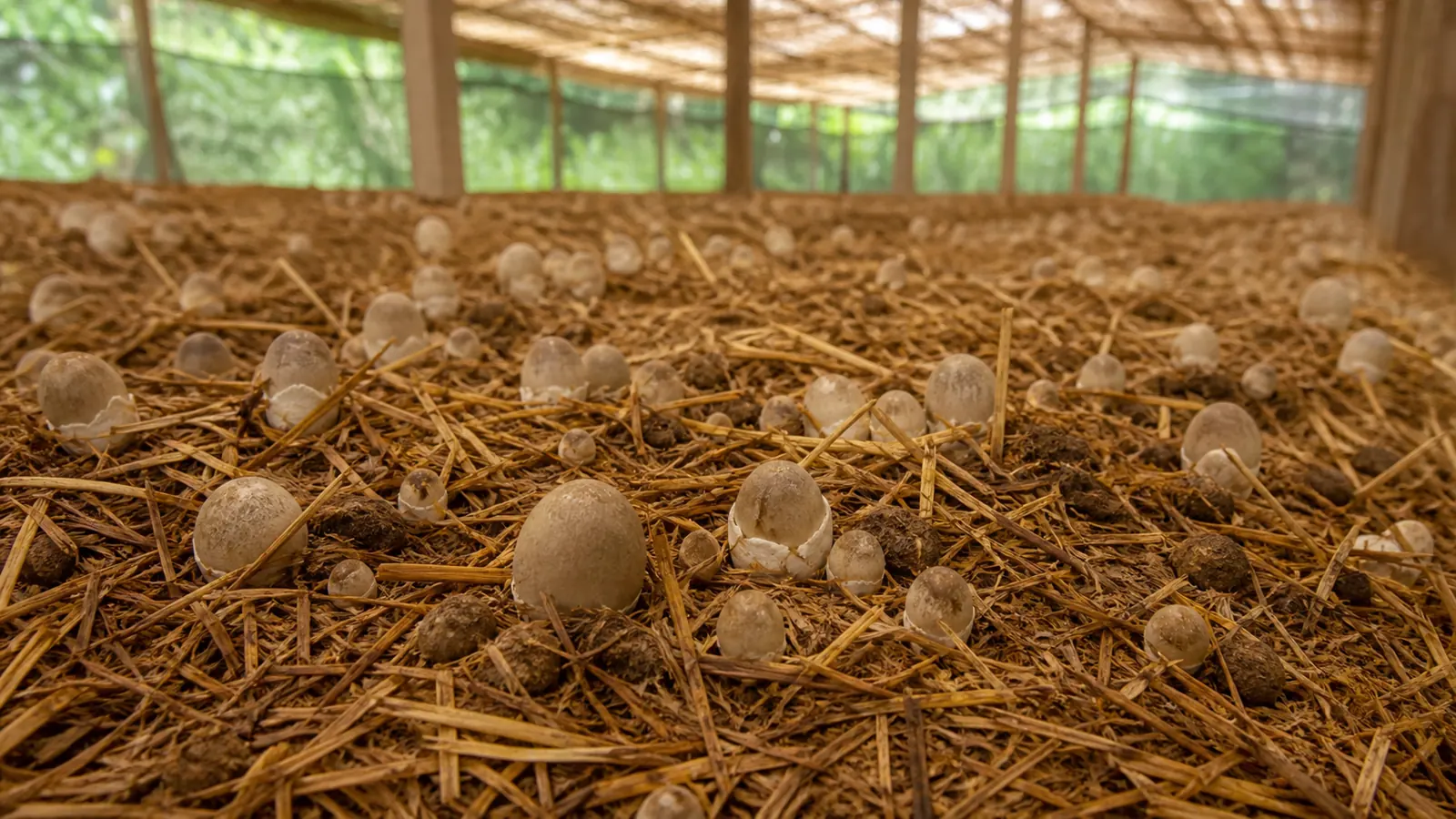
The young paddy straw mushroom begins as a pin and enlarges inside a universal veil. That enclosing tissue creates the firm egg form harvested in many markets.
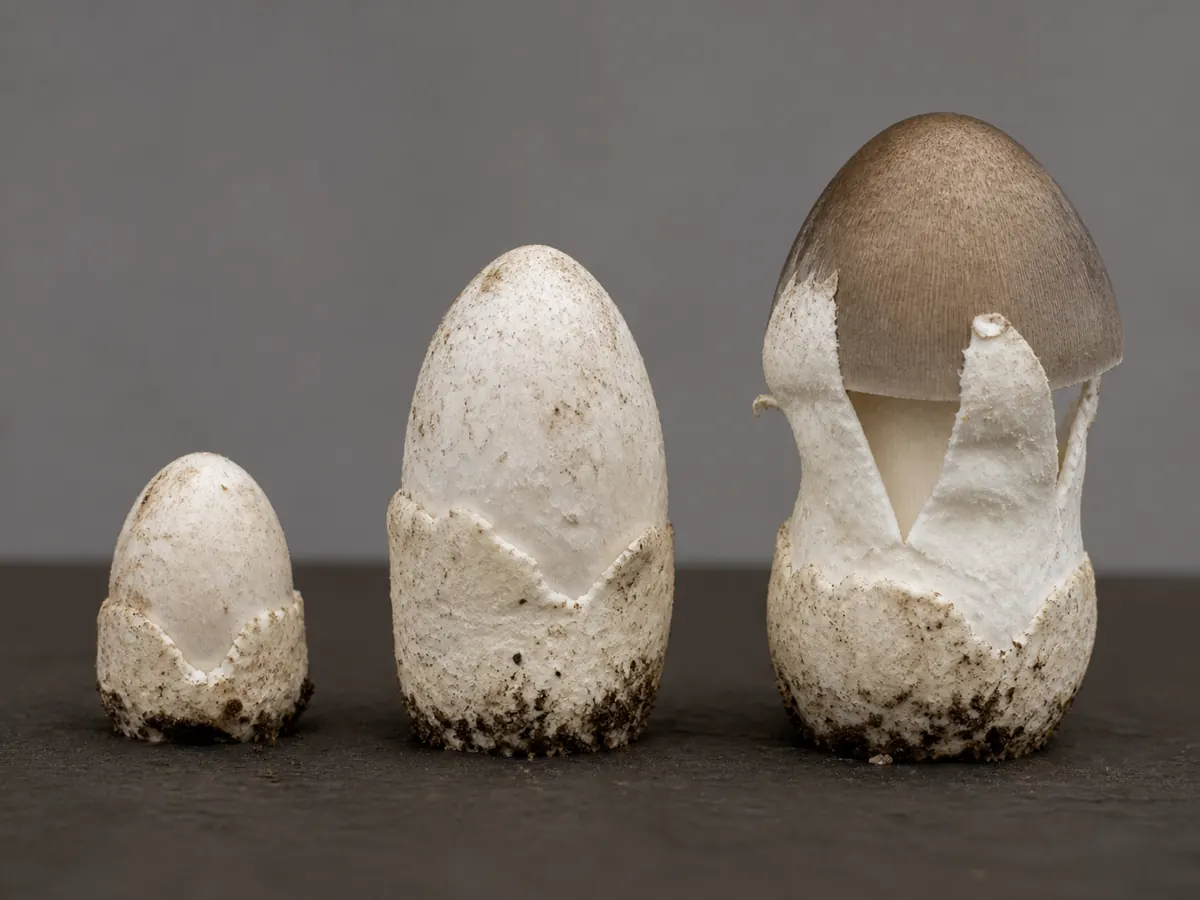
Fruiting remains warm, but the bed also needs suitable surface moisture, replacement air, and light for inspection and orientation.
Do not apply a strong cold shock borrowed from cool-fruiting species.
Reduce covers or change air only through the selected method, because sudden broad exposure loses heat and water together. A small change that creates organized pins is better evidence than a large change followed by an unreadable mixed response.
| Visible stage | What it proves | Next decision |
|---|---|---|
| Fine knots | The bed has begun fruit-body initiation | Hold stable conditions and watch distribution |
| Small eggs | Volva is enclosing the young mushroom | Protect from direct spray and drying |
| Rapidly enlarging firm eggs | Harvest checks must become frequent | Prepare clean collection and handling space |
| Veil splitting | Cap expansion has begun | Harvest immediately if closed eggs are the target |
Direct water can bruise young tissue and cool a localized sector.
Maintain the bed and surrounding air without leaving droplets trapped on enlarging eggs.
Map where eggs appear. A productive warm edge with an empty cold center points to bed construction or heating, while one isolated suspect patch points to a different upstream event.
Pin distribution should be compared with the earlier temperature map. When the same cold lower band later lacks eggs, the fruiting result confirms an upstream thermal problem rather than a need for more surface water.
As eggs enlarge, their demand on the bed changes quickly. Check surface condition and internal warmth at shorter intervals without placing wet probes against developing tissue.
Do not uncover every bed fully to improve inspection.
Use consistent viewing access and expose only the area required by the selected production method so observation does not become the main source of cooling.
The first veil split is a batch timing signal. Record how long the crop moved from visible pin to firm egg and from firm egg to split so the next harvest schedule follows the local strain and room.
Egg color must be judged with firmness, surface integrity, and the documented culture. A photographic color target alone can confuse normal pigmentation with damage or age.
Growing MushroomsHow Do You Build an Outdoor Mushroom Bed That Lasts?Which bed changes mean isolate it?
A cold-stalled bed and a contaminated bed may both appear slow, but their boundaries differ. Temperature problems often follow broad physical zones, while competitors can create an expanding colony with its own color and texture.
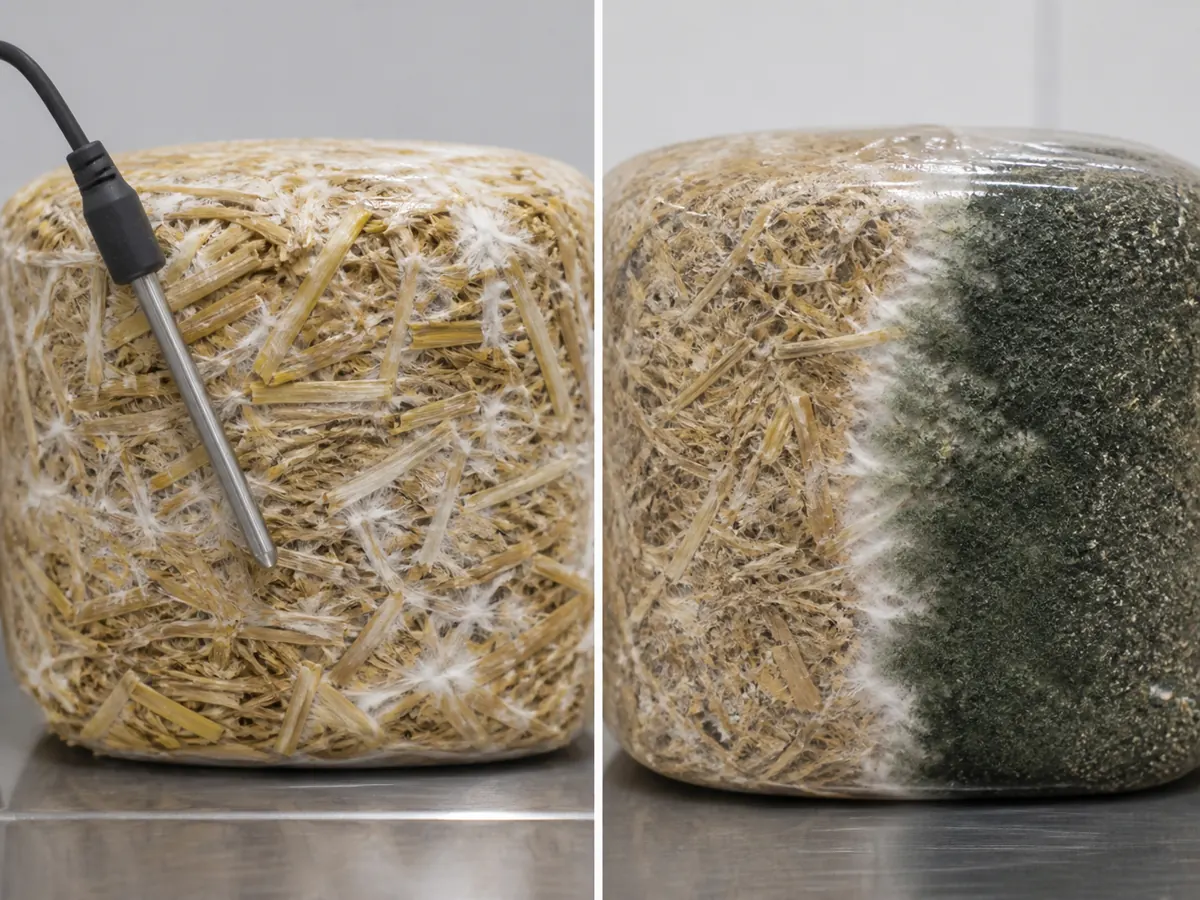
Follow the pattern before changing the whole room.
If several beds slow at the same lower edge, inspect floor loss and air movement; if one bag or sector develops a sharp green or black territory, isolate it sealed.
Warning
Warm rooms accelerate more than the crop | Bacteria, molds, and insects can also develop quickly, so cleanliness, drainage, and prompt containment remain essential.
An overheated wet core can turn dark, soft, or sour without a dramatic fuzzy surface. Stop adding insulation when the internal trend already exceeds the strain method and examine how bed mass and drainage were assembled.
Do not sniff an opened suspect unit.
Record the first location, photograph through the barrier, remove it from clean production, and review substrate preparation and handling at that stage.
Healthy eggs are firm and organized even when color varies from pale to gray-brown. Translucent softness, foul liquid, insect damage, or tissue collapsing before veil split changes the harvest decision.
Map moisture failures against bed structure.
A sour central pocket suggests drainage or compression, while dry stalled edges across several beds point toward heat and air loss.
Keep isolation material and tools outside the clean harvest route. A warm room makes rapid removal important, but carrying an uncovered failed sector past productive beds creates another exposure.
After removal, inspect neighboring units on a shorter interval.
The aim is to learn whether the event was isolated without opening or disturbing beds that remain sound.
Record treatment batch, spawn lot, assembly worker, probe history, and first defect location before disposal. A final photograph of an overgrown bed cannot replace that introduction-point evidence.
When should the eggs be harvested?
Harvest paddy straw mushrooms while the volva remains closed around a firm egg. The first split shows that the hidden cap is beginning its rapid expansion and the preferred egg endpoint is passing.
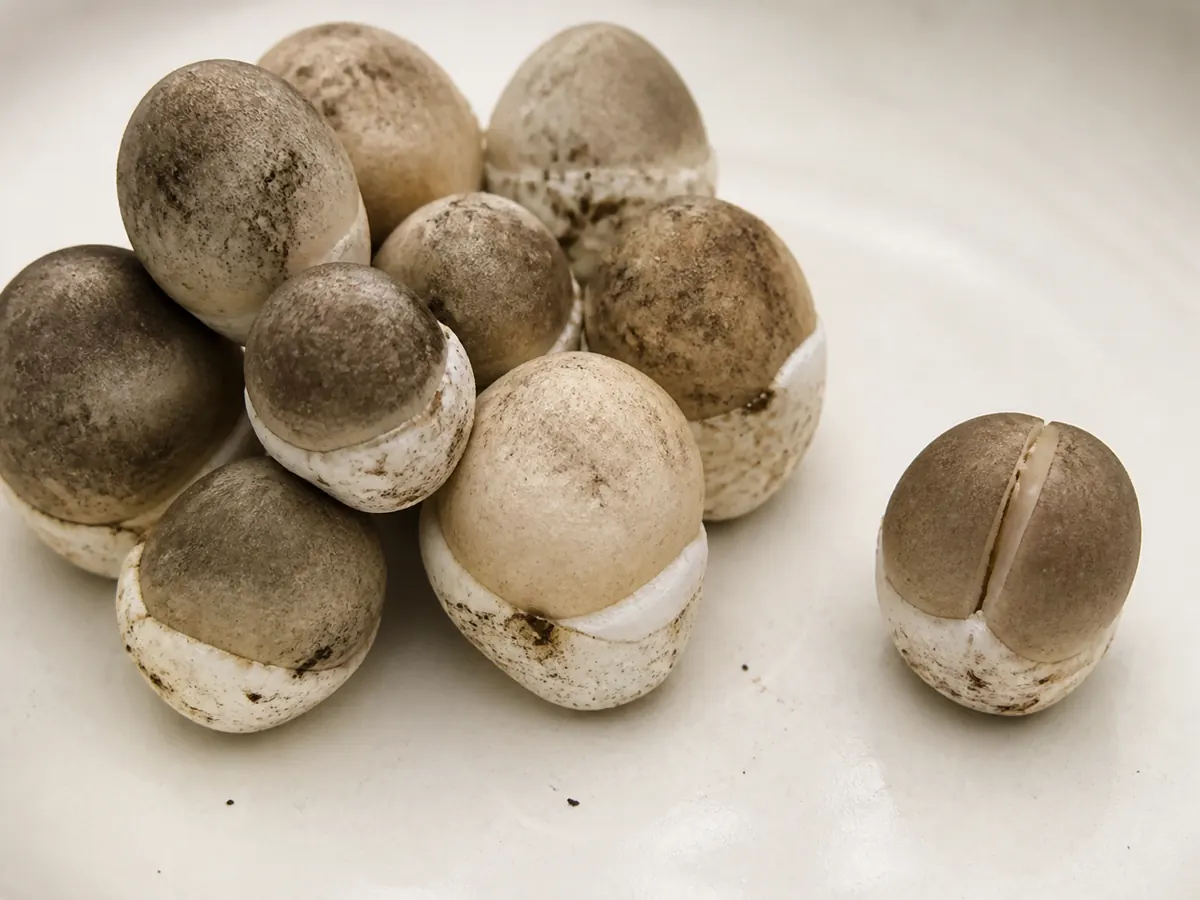
Check the bed more than once daily as eggs enlarge.
A morning crop of closed forms can include opening caps by evening under warm productive conditions.
Grade by firmness and veil integrity before maximum size. A large soft egg is not a better endpoint than a smaller firm one whose enclosing tissue remains complete.
Remove each mushroom with minimal disturbance to surrounding straw and developing eggs.
Dirty torn bases and crushed substrate increase cleanup work in a bed that will remain warm.
Plan labor before the flush begins. The correct room cannot protect quality when no one is available to make the maturity decision during the rapid final stage.
Use shallow clean collection containers so the warm eggs do not crush one another.
Separate split, soft, insect-damaged, or dirty specimens at the bed instead of hiding them beneath sound closed forms.
Weigh the usable crop and rejected tissue separately. Yield without maturity grade can reward a late harvest that produced heavier but less useful mushrooms.
Clean remaining holes with minimal disturbance and preserve the bed's air paths.
Heavy compression after harvest can turn a productive structure into a wet dense layer before a later wave.
How should a chilling-sensitive harvest be handled?
Paddy straw mushroom does not behave like many mushrooms placed directly into a 4 C refrigerator. Postharvest research documents low-temperature autolysis and substantial physiological changes at that temperature.
One preservation study compared 15 C and 30 C and found longer preservation at 15 C.
That controlled result supports a warmer cool-holding concept, but it is not a universal home shelf-life promise or a substitute for local food-safety rules.
Use clean containers, remove field heat through the validated handling method, and move the crop promptly to its intended use. Do not leave eggs piled in the warm grow room while deciding where to store them.
Decide the handling route before harvest because an ordinary refrigerator may be too cold for this species while an unrefrigerated room may be too warm for safe holding.
The method must satisfy both crop physiology and local food-safety requirements.
Do not treat the 15 C study condition as a home storage guarantee. Package airflow, starting maturity, sanitation, crop temperature, and the time already spent warm all change the remaining quality window.
Inspect held mushrooms for firmness, liquid, odor, and veil condition rather than relying only on elapsed time.
A lot that begins softening has reached a biological stop even when a printed schedule says more hours remain.
Keep the harvest lot and temperature history traceable through delivery or use. Once batches are mixed, a later quality failure cannot be connected to its bed, maturity grade, or holding condition.
| Postharvest observation | Meaning | Action boundary |
|---|---|---|
| Firm intact egg | Quality remains organized | Follow validated short holding and use plan |
| Rapid softening or liquid | Autolysis or spoilage is progressing | Do not extend storage experimentally |
| Sour or ammonia-like odor | Product quality has failed | Discard under food-safety guidance |
| Unknown temperature history | Holding evidence is missing | Do not promise remaining shelf life |
The bed may produce another wave if its structure, smell, temperature, and colonization remain sound. Remove harvest debris, restore only measured water loss, and preserve air paths rather than compressing the straw again.
Note
Protect both ends of the thermal window | The crop needs sustained tropical warmth to develop, but the harvest also needs a species-specific cooling plan that avoids ordinary refrigerator assumptions.