Why a small lawn mushroom deserves urgency
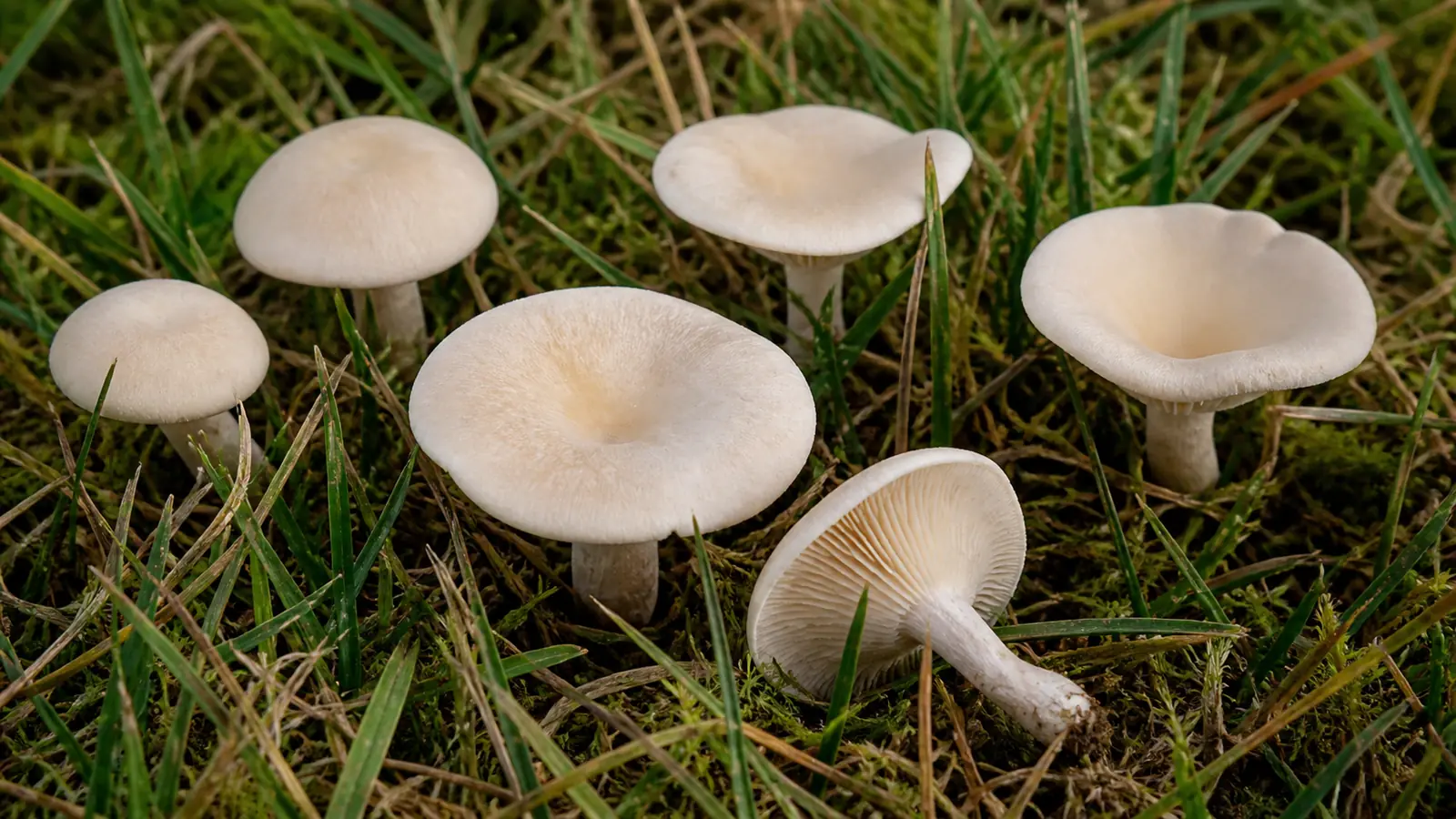
Ivory funnel hides in ordinary short grass rather than dramatic woodland. Small white to buff caps may form troops, arcs, or partial rings in lawns and pastures, sometimes fruiting beside edible species that share the same setting.
The cap starts convex and becomes flat or shallowly depressed. A dry, whitish bloom can wear away or crack into faint zones, exposing pale buff color beneath.
Crowded gills run down the stem, creating the funnel profile. The stem stays short and ringless, while the spore print remains white.
Size, surface, and descending gills must be read together. Rain can wash the cap, mowing can damage the stem, and a young specimen may not yet show a clear central depression.
The taxonomic name is not completely stable. Some sources separate Clitocybe dealbata from the very similar C. rivulosa, while molecular work places both in Collybia.
Warning
Whether a collection is called ivory funnel or fool's funnel does not change the poisoning response. Small pale funnels in grass must be kept out of food unless an expert resolves them.
Which cap and gill details matter?
Small, usually 2 to 5 cm across, white to ivory or pale buff, initially convex then flat or shallowly funnel-shaped, with a dry frosted surface that may crack into faint concentric zones.
Crowded, white to cream, and distinctly decurrent, running down the upper stem.
Short, pale, fibrous, and ringless, often slightly broader at the base and sometimes carrying grass or soil fibers.
Thin pale flesh with a mild or faintly mealy odor. Never taste it.
Inspect the gill attachment before relying on the cap. Ivory funnel has crowded blades that descend the stem, while several edible lawn mushrooms have more widely spaced gills that attach differently.
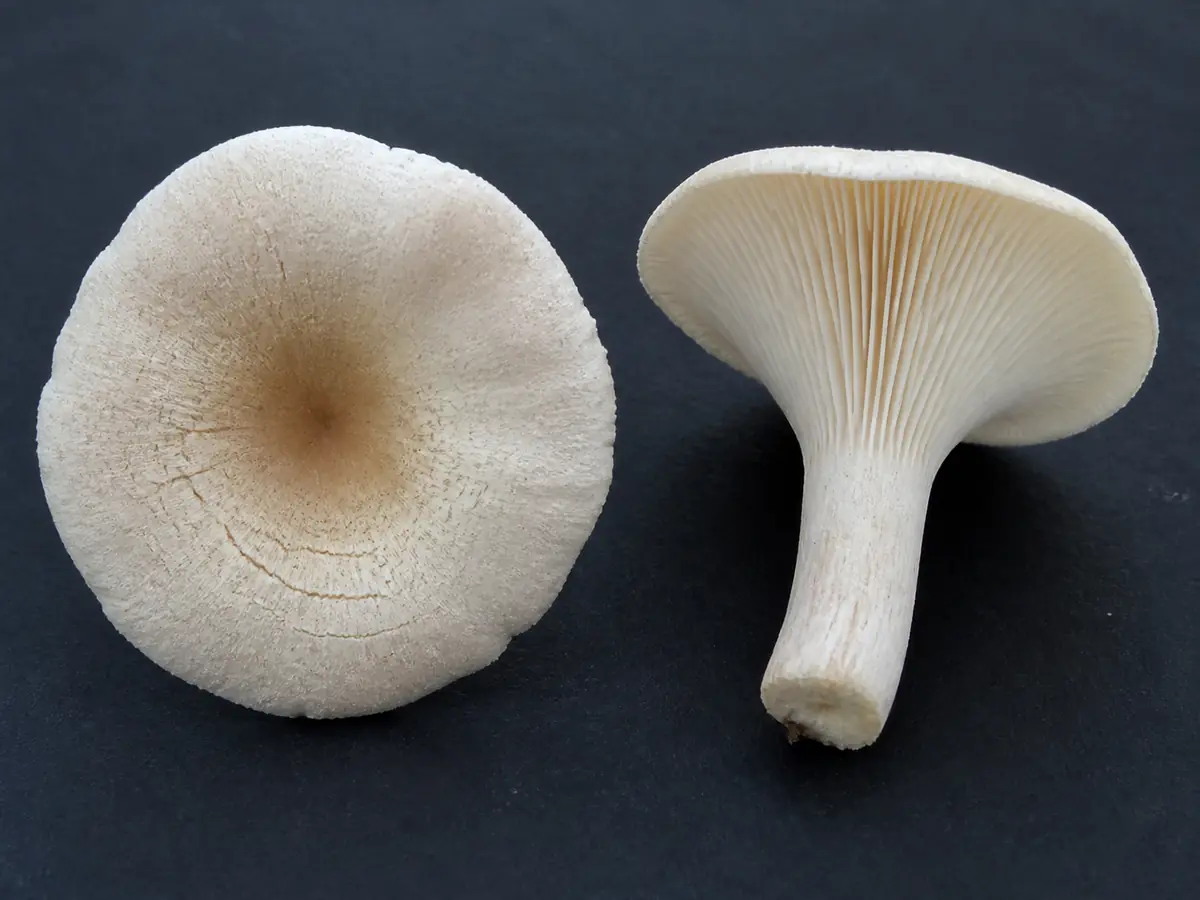
Caps are generally 2 to 5 cm across. Fresh surfaces look ivory or chalky, then weather to cream or pale buff with subtle zones and cracks.
The short stem is fibrous and lacks a ring. Pull it with the base and record whether the mushrooms form a troop, arc, or ring in short grass.
| Character | Ivory funnel | Why it can fail |
|---|---|---|
| Cap bloom | Frosted white surface over buff tones | Rain and age can wash it away |
| Central depression | Often develops with expansion | Young caps may remain convex |
| Decurrent gills | Run visibly down the stem | A poor side photograph can hide attachment |
| White spore print | Supports the pale funnel group | Several edible lawn species also print pale |
| Ring pattern | Troops, arcs, or rings | Growth pattern never establishes edibility |
A white spore print rules out pink-spored millers but does not distinguish all pale grass mushrooms. Microscopy can be necessary, especially where C. dealbata and C. rivulosa overlap in published treatments.
Do not identify it by the sweating nickname. Symptoms belong to an exposure, not a safe field test.
If someone may have eaten this mushroom, act now. Call Poison Control at 1-800-222-1222 (US) or emergency services before symptoms appear, and save a piece of the mushroom for identification.
What should happen after ingestion?
Contact Poison Control or local emergency services after any suspected ingestion. Keep the remaining mushrooms and meal scraps, note the time and amount, and photograph the cap, decurrent gills, grass pattern, and complete stems.
Do not give atropine, antihistamines, or another medicine at home. Clinicians may use atropine for significant muscarinic poisoning, but the decision and dose require medical monitoring.
Which edible lawn mushrooms cause confusion?
The lawn setting brings ivory funnel into contact with mushrooms that people intentionally collect. Fairy-ring mushroom is the frequent small edible comparison, while the miller creates a pale funnel shape with a different print.
A collection should be rejected when one ring contains more than one gill pattern. Fairy rings describe growth, not species.
Fairy-ring mushroom has widely spaced, thick pale gills and a tough flexible stem that can often be twisted without snapping. Ivory funnel has crowded decurrent gills and a more fragile overall build.

| Lookalike | Feature pointing away from ivory funnel | Limit |
|---|---|---|
| Fairy-ring mushroom | Widely spaced gills and tough flexible stem | Both can form arcs in the same lawn |
| The miller | Larger cap, mealy odor, and pink spore print | Small or weathered fruiting bodies can look pale and plain |
| Aniseed funnel | Blue-green cast and strong anise odor | Color and odor fade with age |
| Small waxcaps | Thick waxy gills and often brighter cap | Pale species still require a complete key |
| Fool's funnel | Extremely similar morphology and muscarine risk | Authorities differ on whether the names mark separate species |
Do not collect an edible ring by trimming off questionable stems in place. Keep each cap attached to its own stem and compare every specimen under good light.
Key takeaway
One crowded, decurrent-gilled white mushroom contaminates the confidence of a mixed lawn collection, even when the neighboring caps look like fairy-ring mushrooms.
What does muscarine do to the body?
Muscarine activates peripheral muscarinic acetylcholine receptors. It does not need to enter the brain to cause a powerful body-wide increase in gland secretions and smooth-muscle activity.
Sweating, tearing, salivation, abdominal cramps, vomiting, diarrhea, pinpoint pupils, wheezing, slow heart rate, and low blood pressure can develop rapidly. Breathing risk rises when bronchial secretions become heavy.
Fast onset does not make the syndrome self-treatable. Call for medical advice, keep the airway clear, and avoid food, drink, or medication unless a clinician directs it.
Atropine blocks muscarinic effects and can be lifesaving in significant poisoning, but excessive dosing has its own risks. It belongs in monitored medical care, not a home first-aid kit.
Why do ivory funnels form arcs in grass?
Ivory funnel decomposes organic matter in turf and grassland soil. It appears in lawns, grazed pasture, grassy paths, parkland, and coastal dunes rather than being tied to one living tree host.
Fruiting bodies often trace arcs or rings as the underground mycelium expands. That geometry is shared by many species, so a ring should prompt specimen-by-specimen inspection rather than an edible assumption.
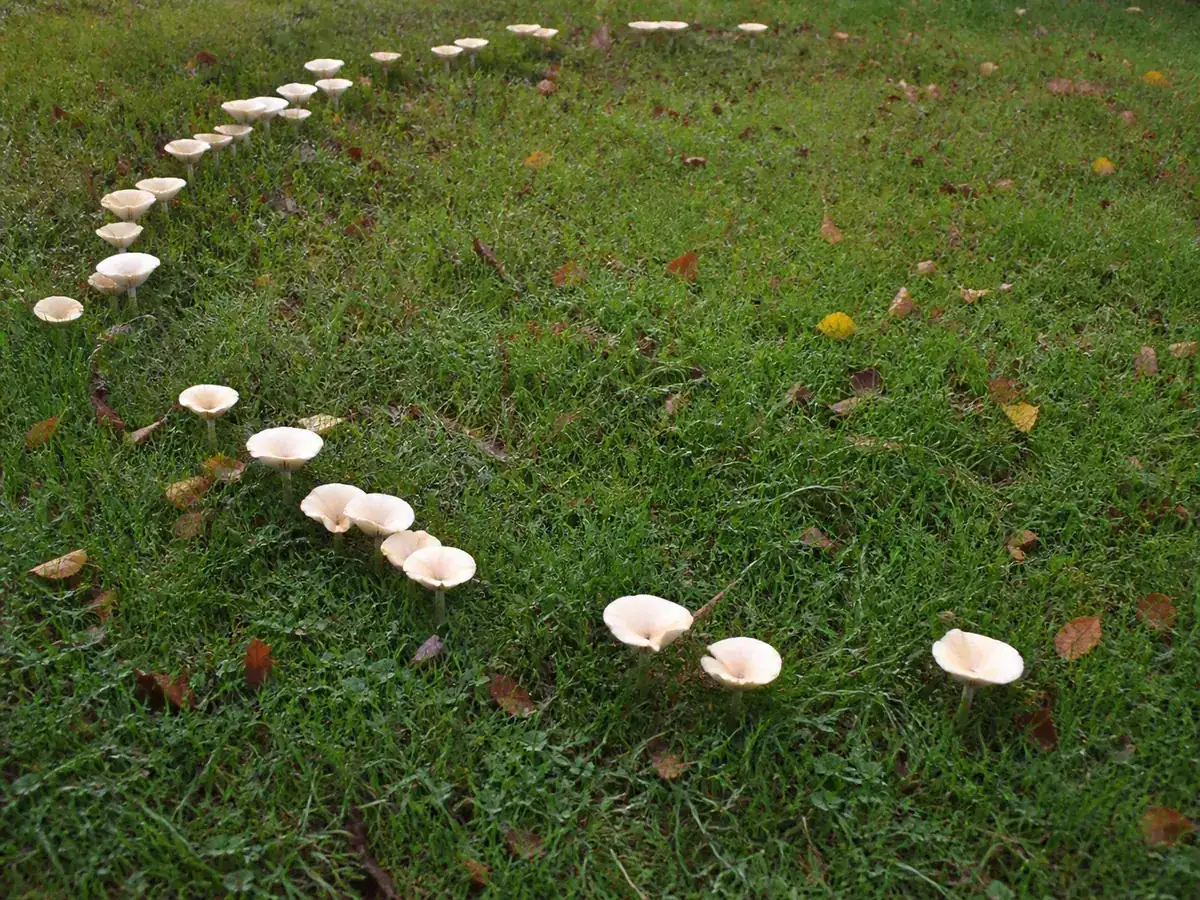
Removing visible mushrooms reduces immediate exposure for children and pets, but the mycelium remains below the turf. Check again after rain and place collected mushrooms where they cannot be eaten.
Avoid fungicide as a first response in a normal lawn. Moisture and buried organic matter support fruiting, while hand removal addresses the immediate access risk without promising eradication.
Is Clitocybe dealbata still the current name?
Index Fungorum and the Natural History Museum continue to list Clitocybe dealbata, while a 2023 phylogenomic treatment transferred it to Collybia dealbata. The same name may also be treated as close to or synonymous with Clitocybe rivulosa.
The nomenclature is less settled than the safety conclusion. Both traditional species concepts belong to the small pale grassland funnels associated with muscarine.
Clitocybe dealbata remains current in major fungal name resources. Its molecular placement helps explain the different names encountered in modern references.
Can a mixed fairy ring be sorted safely?
Ivory funnel has no culinary use. Cooking does not provide a reliable way to remove muscarine, and confusing it with a fairy-ring mushroom can turn a mixed lawn harvest into a poisoning event.
Do not salvage selected caps from an uncertain ring. When stem-to-cap identity has been lost, discard the whole collection rather than sorting by size or color in the kitchen.
Keep a suspected exposure sample uncooked when possible because gill attachment and cap surface help identification. Store it separately in paper and follow poison-center directions.
Ivory funnel questions
Is ivory funnel poisonous?
How quickly do symptoms start?
How is it different from fairy-ring mushroom?
What should I do if a child ate one?
Does ivory funnel always have a funnel-shaped cap?
Is Clitocybe dealbata the same as Clitocybe rivulosa?
Sources & References
- Index Fungorum Current nomenclatural record for Clitocybe dealbata.
- Natural History Museum Species Dictionary Accepted name, common name, and synonym records.
- NCBI Taxonomy Browser 2023 Collybia transfer and phylogenomic reference.
- FDA Bad Bug Book Clitocybe muscarine syndrome, rapid onset, and clinical signs.
- Cholinergic mushroom poisoning case Measured muscarine exposure and medical management.
- Mushroom poisoning updated review Clitocybe dealbata muscarine syndrome and clinical context.