Why is autumn skullcap so dangerous?
Autumn skullcap is one of the strongest reasons to leave unidentified little brown mushrooms out of the basket. Galerina marginata grows on decaying wood and can appear in the same landscaped beds, forest debris, and log habitat as species that people deliberately collect.
The danger is chemical as well as visual.
Research using DNA-confirmed specimens detected substantial amatoxins in every tested collection from the G. marginata complex. These toxins block RNA polymerase II and can cause life-threatening liver failure after a misleading symptom-free delay.
This profile uses Galerina marginata in the modern broad sense.
Names including G. autumnalis, G. venenata, G. oregonensis, and G. unicolor have historically been applied to mushrooms now treated within the same difficult complex. The familiar name autumn skullcap therefore points to a variable group rather than one fixed cap color.
Warning
If someone may have swallowed a small brown mushroom from wood, do not wait for a spore print or for symptoms. Contact Poison Control or emergency services and keep the remaining specimens for expert identification.
The safe decision is to recognize a danger pattern. Small brown caps, rusty spores, a slender ringed stem, and growth from wood should stop consumption, but absence of one visible feature does not prove safety.
Alpha-amanitin blocks RNA polymerase II, interrupting essential cell activity and placing the liver at particular risk. That mechanism explains why an apparently quiet interval after eating the mushroom cannot be treated as recovery.
Galerina marginata is also a species complex in the research literature. Field morphology usually supports a safety decision, but separation of smaller lineages can require microscopy, DNA, and a preserved voucher.
The danger is easy to underestimate because the mushroom is small and the first illness can look like ordinary food poisoning.
Amatoxins enter cells and block RNA polymerase II, so tissues with high metabolic demand, especially the liver, lose the ability to maintain normal function after the meal has already left the stomach.
A symptom-free interval does not reduce that risk. Nausea, vomiting, abdominal pain, and watery diarrhea may begin many hours after ingestion, then improve briefly while liver injury continues, which is why waiting for a second decline wastes treatment time.
The name autumn skullcap also hides a taxonomic caution. DNA studies group several historically separate names inside the G. marginata complex, and even specialists have found poor agreement between old morphology-based labels and genetic lineages.
For a forager, the useful conclusion is broader and safer. Any small rusty-spored Galerina from wood stays out of food and recreational collections.
How can you recognize the Galerina danger pattern?
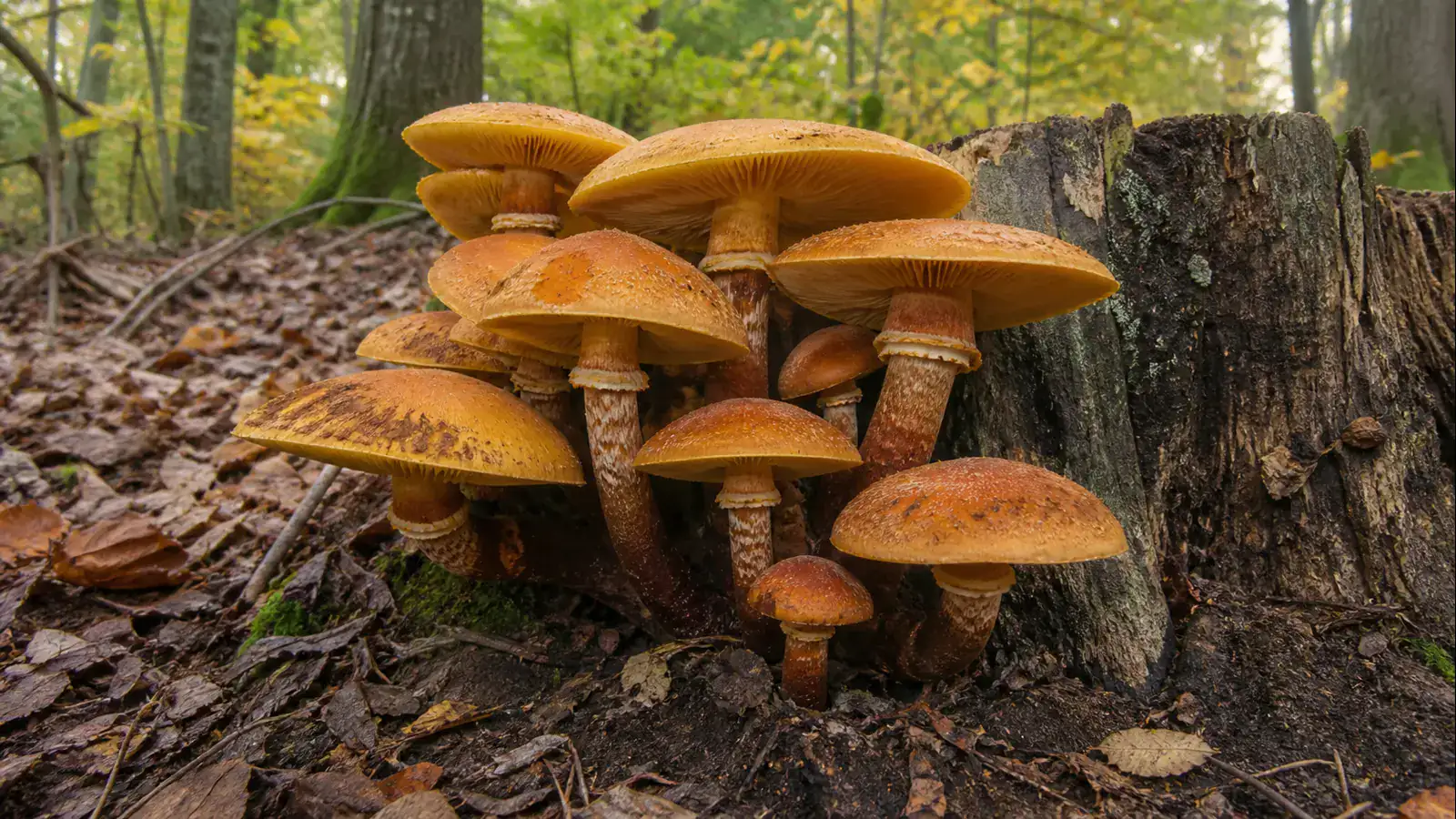
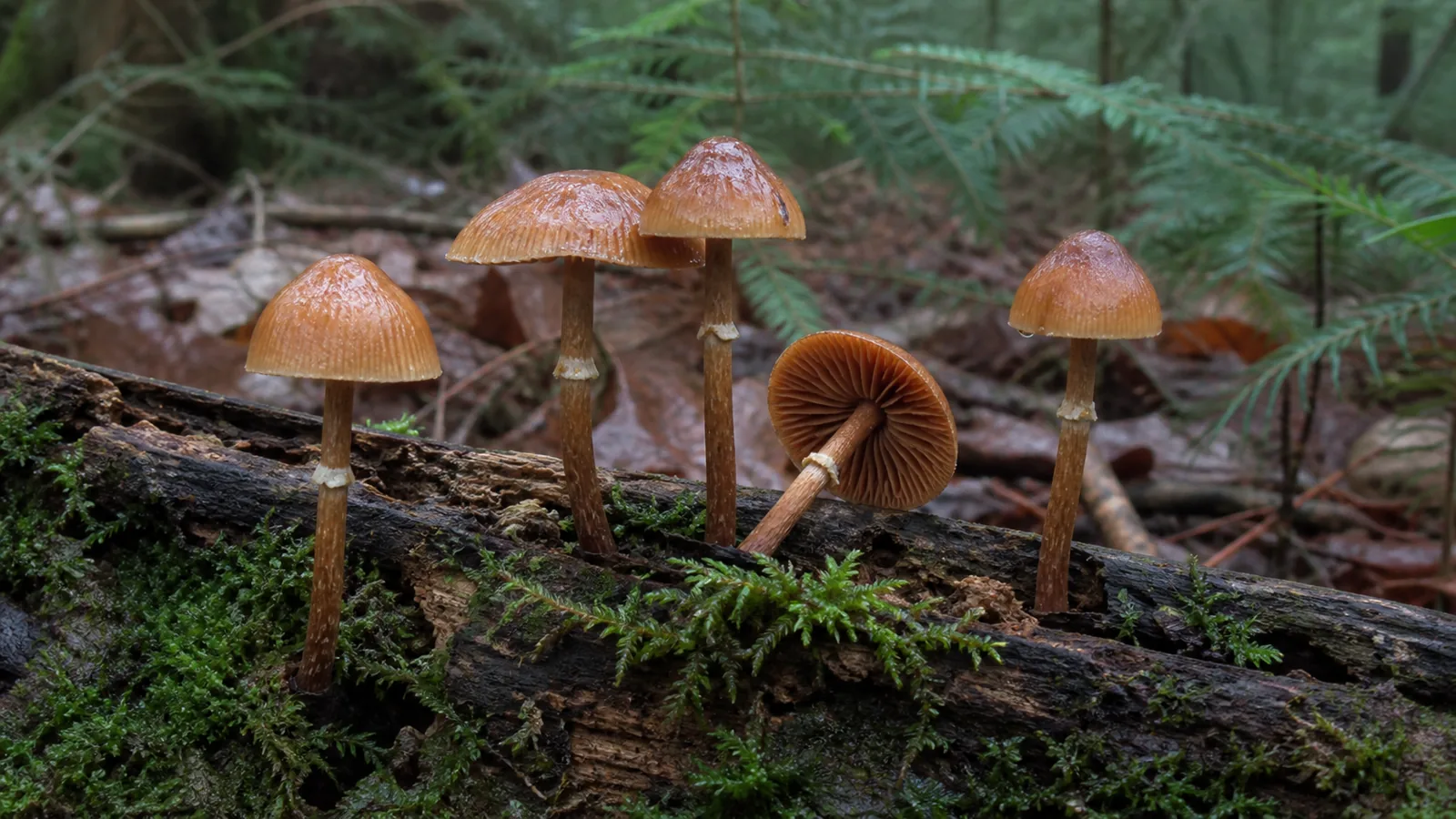
Moist ochre to honey brown, usually 1 to 4 cm wide, bell-shaped to convex before flattening, often paler as it dries.
Attached to slightly running down the stem, pale at first, then rusty brown as spores mature.
Slender, 2 to 8 cm long, often with a fragile ring or ring zone above darker fibrous tissue near the base.
Thin brownish flesh with a mild or mealy odor that is not a safe identification test.
Start with the substrate.
Autumn skullcap breaks down dead wood, so it fruits from logs, stumps, woody debris, buried roots, or wood chips. A mushroom that seems to rise from soil may still be attached to buried wood.
The cap is often honey brown, ochre, or tawny when wet.
It may show a translucent striate margin, then fade toward tan as moisture leaves. This change can make two mushrooms from one patch look less alike than they really are.
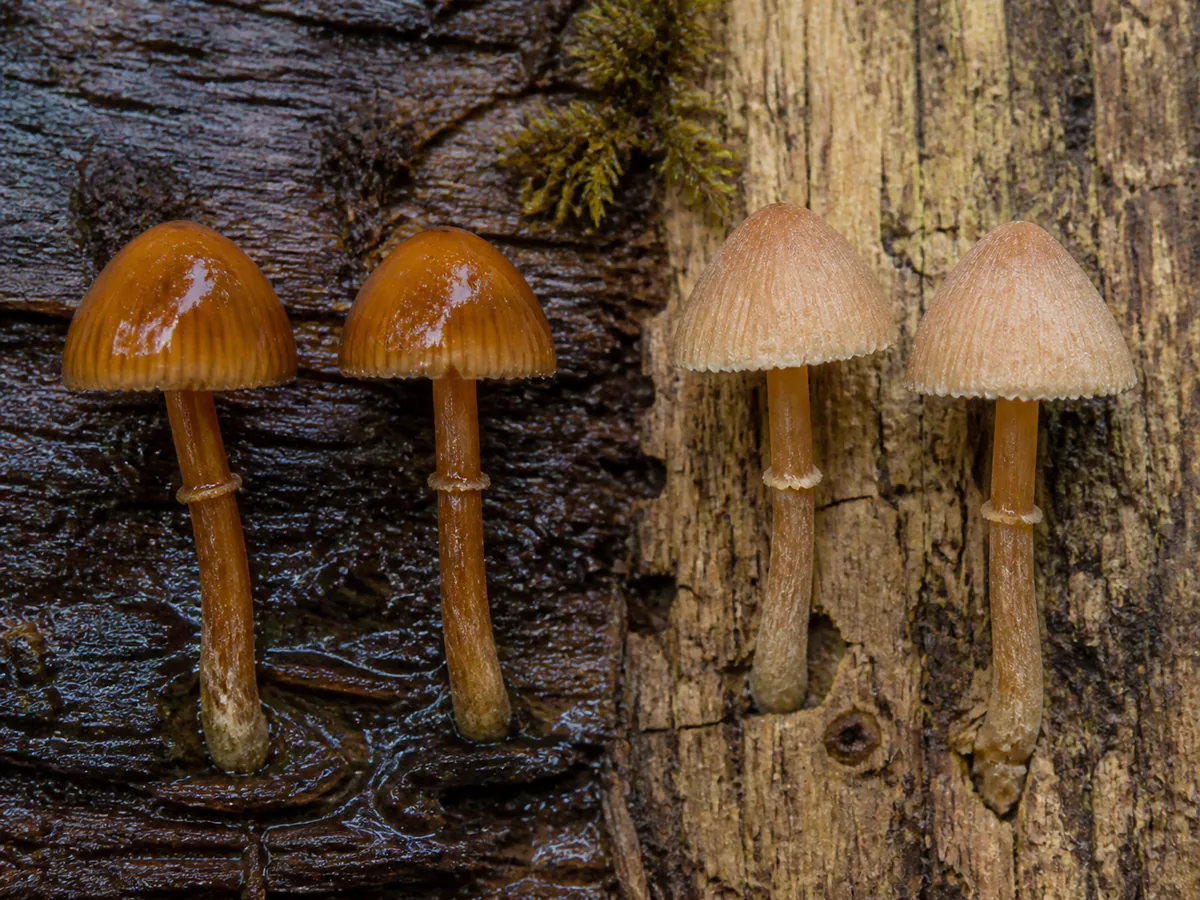
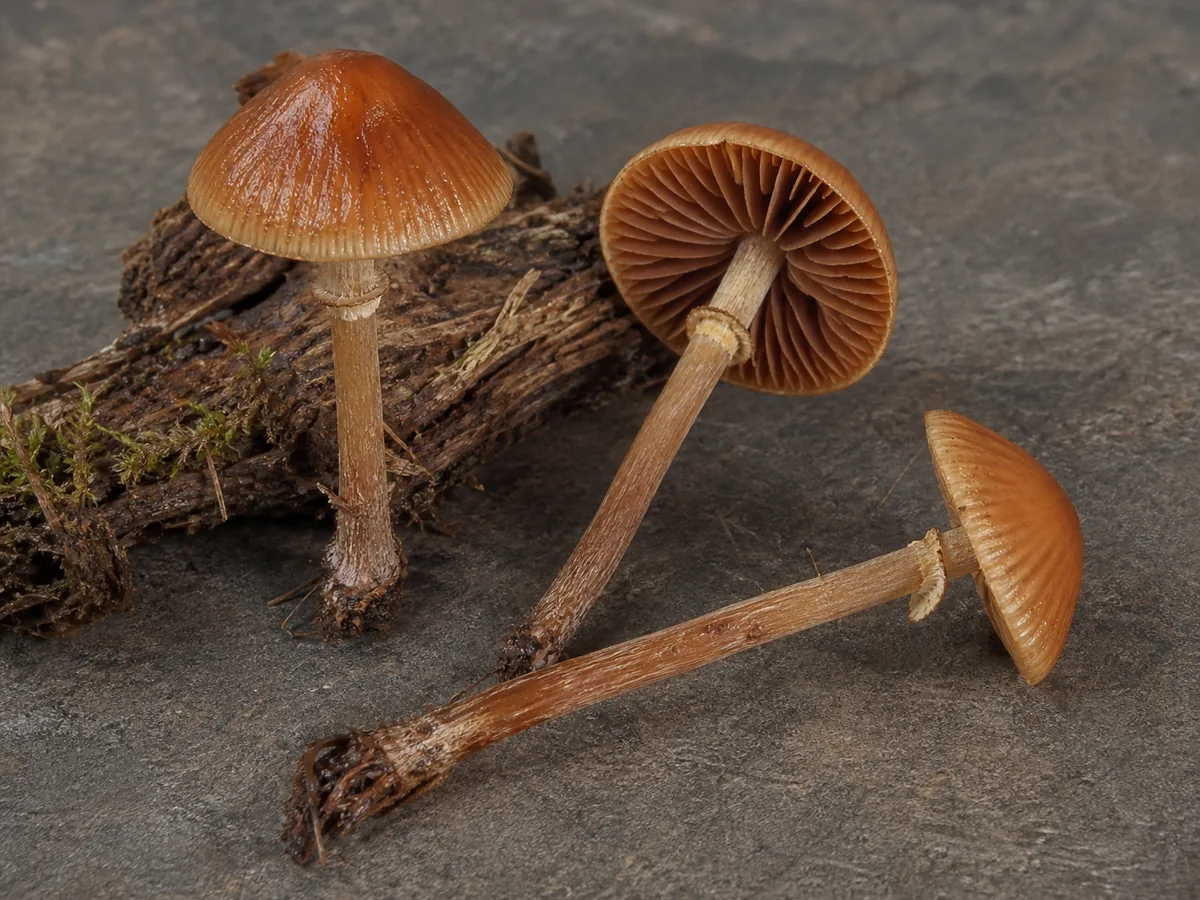
A ring can be conspicuous, reduced to a narrow zone, or lost with age and handling.
Treat the missing ring as missing evidence rather than proof that the mushroom is another species.
| Feature | Autumn skullcap pattern | Why the feature cannot stand alone |
|---|---|---|
| Cap | Ochre to honey brown and moisture-sensitive | Many harmless and sought-after species share the colors |
| Gills | Pale young, then rusty brown | Mature gill color can be hidden by lighting or age |
| Stem | Slender with a fragile ring or ring zone | Rain and handling can erase veil tissue |
| Spore print | Rusty to cinnamon brown | Other brown-spored wood mushrooms overlap |
| Habitat | On wood or woody debris | Several edible and psychoactive lookalikes use the same substrate |
A spore print helps separate rusty-spored Galerina from mushrooms with white or purple-brown spores. It does not resolve the many brown-spored species that require microscopy or DNA work.
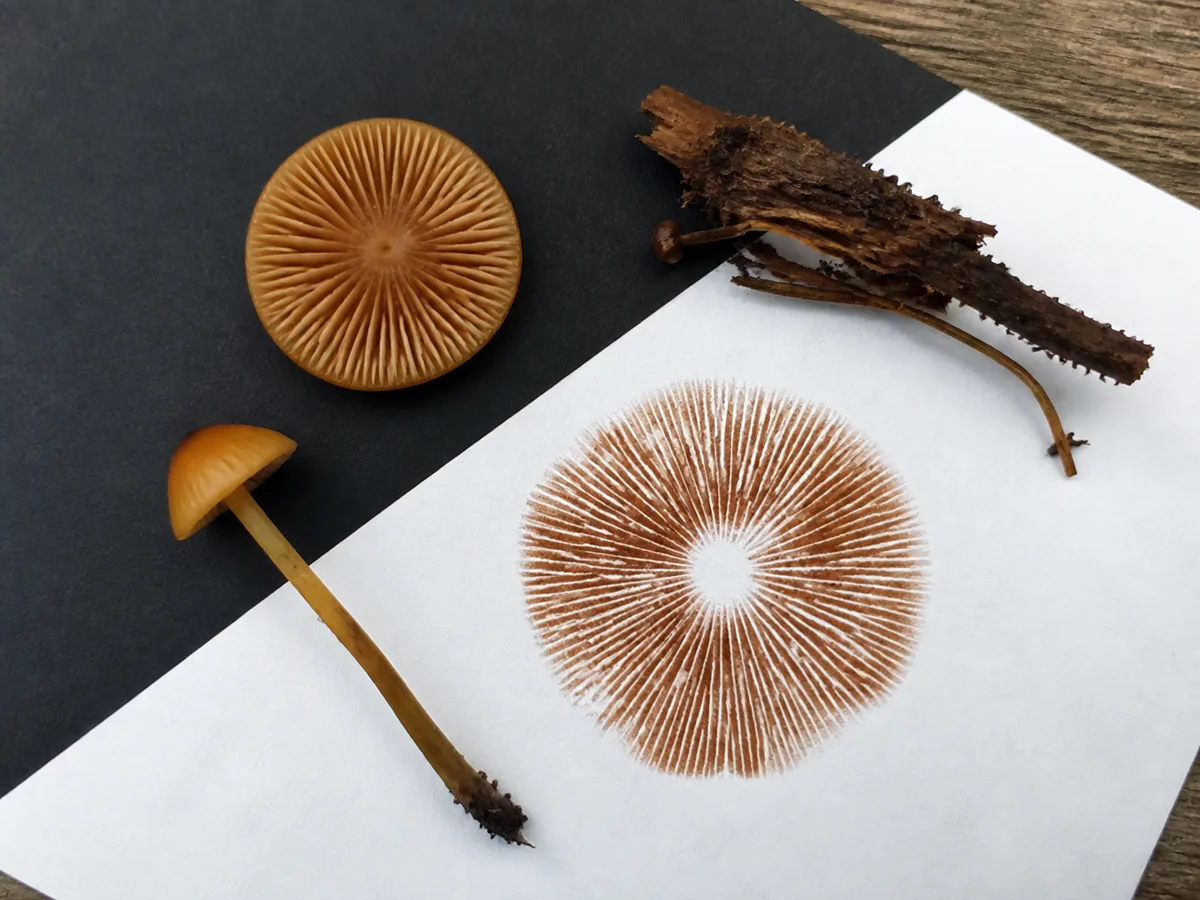
Microscopic characters include roughened brown spores with a smooth plage and bottle-shaped cystidia. Those details belong to trained identification because a household microscope and an unverified reference image can still produce a false match.
Taste a specimen to test bitterness or edibility
Assume blue bruising must appear on every psychoactive lookalike
clear an entire patch after checking one fruiting body
Photograph cap, gills, full stem, base, and substrate
Keep each collection separate if exposure may have occurred
Use a qualified local identifier for any ingestion decision
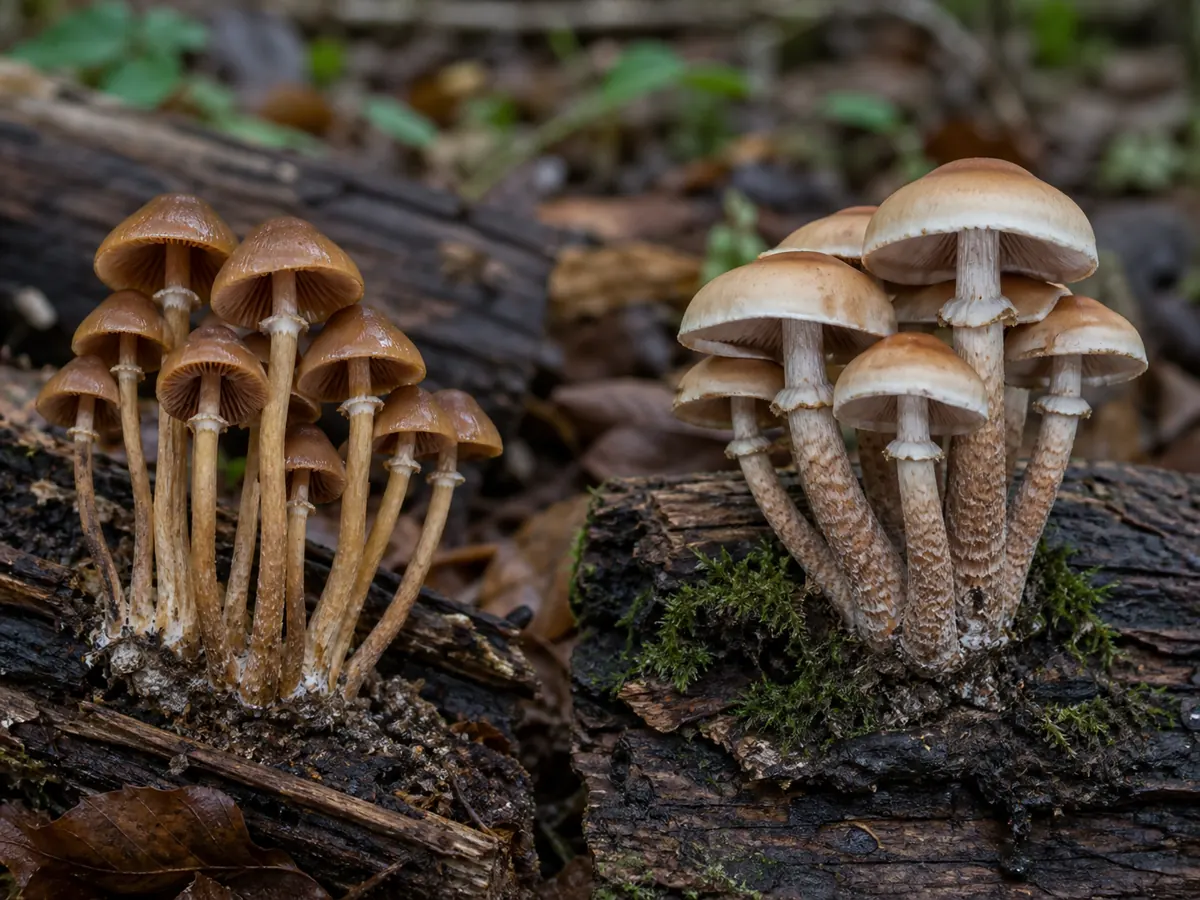
Read the mushroom as a developmental series when several ages are present. Young caps may be rounded with a pale veil, mid-stage caps show the clearest ring zone and gill attachment, and older caps flatten while the gills darken and the stem loses fragile tissue.
That sequence explains why a single checklist photo can mislead. Rain can wash the ring away, dry weather can pale the cap, and a mature rusty deposit can cover the original gill color, yet the wood attachment and fibrous two-toned stem may remain available.
The base deserves its own photograph.
Pulling only the cap leaves behind the point where the stem meets wood, moss, or a buried chip, and it also removes the evidence needed to separate a scattered fruiting from several species sharing one bed.
A microscope can support a trained determination by showing minutely rough brown spores with a plage and bottle-shaped cystidia. Those characters are not unique enough to turn an online image comparison into a safe identification, and DNA may still be required for a defensible species-level record.
If someone may have eaten this mushroom, act now. Call Poison Control at 1-800-222-1222 (US) or emergency services before symptoms appear, and save a piece of the mushroom for identification.
What should you do after possible autumn skullcap exposure?
A few small fruiting bodies may contain enough amatoxin to cause severe poisoning, while age and apparent condition do not reveal dose. Slug bites, insect tunnels, or other wildlife feeding are not evidence of human safety.
Do not wait for liver pain, yellow skin, or abnormal laboratory results before calling. Early gastrointestinal symptoms can be severe, but the clinically important feature is that serious liver injury may emerge after the person appears to improve.
Save uncooked mushrooms, cooked leftovers, packaging, and clear photographs in separate containers when this can be done without delaying the call. Note whether several collections or species entered the meal because a mixed basket can change both identification and risk assessment.
Do not induce vomiting or try milk, charcoal, alcohol, or a home remedy unless a poison specialist directs it for that case. The correct response depends on time, symptoms, amount, and local medical resources, none of which a species profile can prescribe safely.
Which mushrooms can be mistaken for autumn skullcap?
Autumn skullcap is dangerous because it occupies the same wood-chip and log habitat as several small brown mushrooms people collect. Color and cap shape overlap too much to separate them safely in a quick photograph.
The decision should start with the full specimen, substrate, spore color, and a specialist-level examination. A casual match to one feature is not enough for food or recreational use.
Do not collect a small brown wood-growing mushroom for consumption unless Galerina has been excluded by an expert. Autumn skullcap may grow beside visually similar mushrooms, so checking only one cap from a patch does not clear the rest.
Wood-loving Psilocybe species usually have a dark purple-brown spore print and may bruise blue. Autumn skullcap has a rusty brown print and does not reliably bruise blue, but weak bruising or a poor print can be misread.
Sheathed woodtuft, Kuehneromyces mutabilis, can also have a ring and a two-tone cap. Its clustered habit and scaly lower stem can help, but those characters vary enough that beginners should not use the comparison to approve a meal.
The most dangerous comparisons are not random brown mushrooms. They are other small species that also grow from wood and can appear in the same wet season, including velvet shank, sheathed woodtuft, and wood-chip Psilocybe.
Velvet shank normally lacks a ring and develops a dark velvety lower stem with a white spore print. Sheathed woodtuft can have a ring and rusty-brown spores, while Psilocybe may have a purple-brown print and blue bruising. Each contrast supplies useful evidence, but none clears an unidentified collection when key tissue is missing.
Mixed beds create a second trap. Two caps a few centimeters apart can belong to different mycelia, so checking the print or stem of one specimen cannot certify the rest of the patch. Keep suspected exposures separated by collection point and photograph each full stem with its substrate.
Deleting a blue-bruising sentence from a checklist does not solve the problem either. Bruising may be faint, absent, delayed, or present in unrelated fungi, so recreational-mushroom identification still requires a complete local key and expert confirmation.
Where does autumn skullcap grow?
Galerina marginata is a wood decomposer. It converts dead plant material in logs, stumps, roots, and chips, which places it among the site's wood-decomposer mushrooms.
Conifer wood is a frequent substrate, although hardwood records also occur. The fruiting bodies may appear singly, in loose groups, or in small clusters, so growth habit does not give a dependable yes-or-no answer.
Cool moisture drives visible fruiting.
Late summer and fall are common seasons in temperate forests, but irrigated mulch and mild wet weather can produce mushrooms outside that window. The common name is therefore a seasonal clue, not a calendar rule.
The species complex is widely distributed.
Molecular and herbarium studies include collections from North America, Europe, and other temperate regions, while recent work has documented it even in Antarctica. Local abundance varies with available wood and weather.
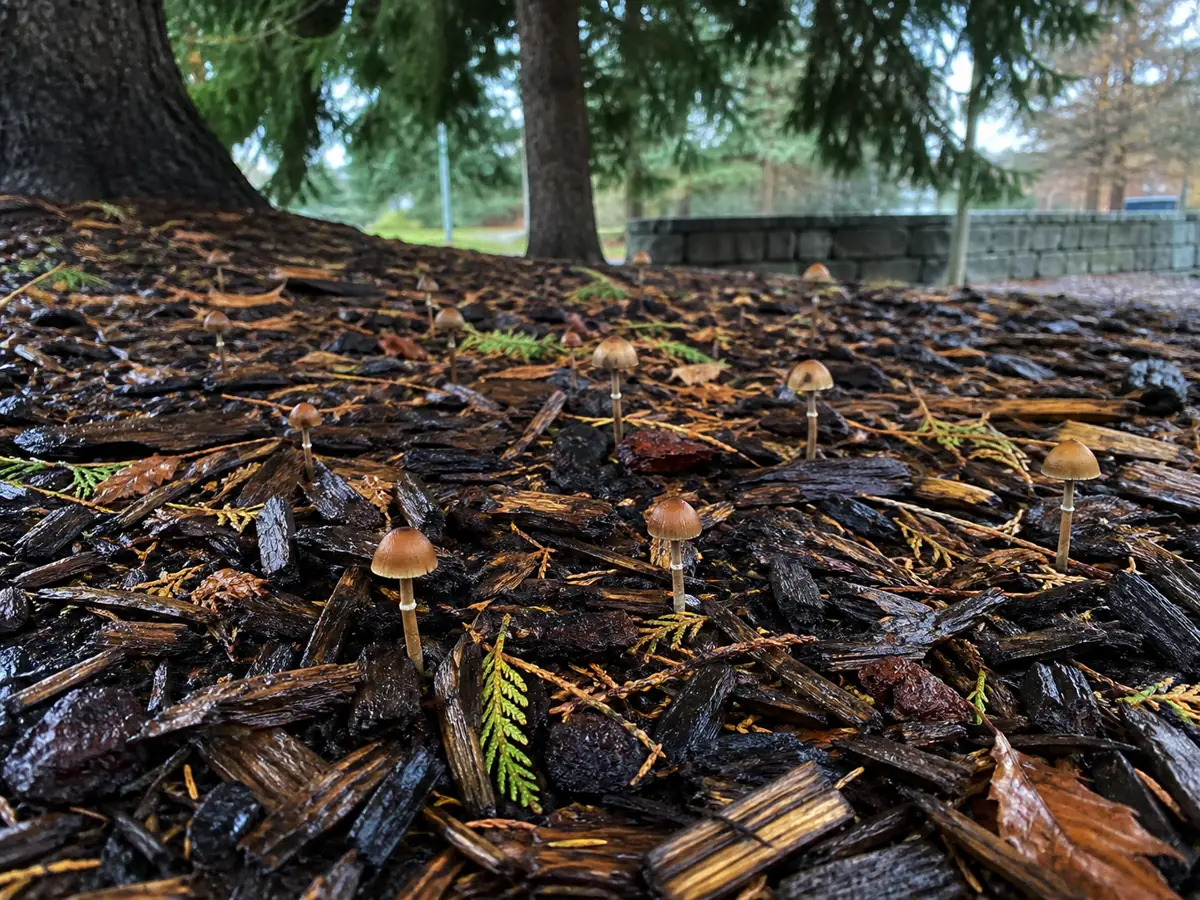
Wood-chip beds deserve special care because several small brown species can fruit together.
A patch is not one organism simply because the caps look similar from standing height. Photograph and examine each collection separately, and keep all of them out of food.
Wood chips around paths, playgrounds, and garden beds can hold buried fragments that make the mushrooms look terrestrial.
Move the litter gently enough to photograph the attachment, but do not scatter a suspect patch where children or pets can reach loose pieces.
Fruiting time follows moisture and temperature more closely than the calendar. A cool wet spell after irrigation can bring a flush in spring or winter, while a dry autumn may show none, so the common name only describes a frequent pattern.
The fruiting bodies are temporary structures of a mycelium already working through the wood. Removing caps reduces immediate contact risk but does not remove the fungus, and replacing or drying the woody mulch may matter more when repeated fruiting occurs in a high-use area.
What should you do when it appears in a yard?
There is no practical reason to cultivate autumn skullcap at home. The useful management question is how to reduce accidental exposure where it fruits naturally.
Removing visible mushrooms can reduce immediate access for children and pets, but it does not remove the mycelium inside wood. Fruiting may return after rain while the buried stump, log, or mulch remains.
Wear gloves or use a tool, collect all visible pieces, and place them in a sealed waste bag.
Wash hands and tools afterward, then recheck the site during wet weather. Touching an intact mushroom is not the same exposure as eating it, but clean handling prevents fragments from reaching mouths or food surfaces.
Replacing decaying landscape wood can reduce substrate over time. That work is site management rather than a guarantee, because roots and woody debris can remain below the surface.
Warning
If a child or pet may have swallowed any part, do not rely on yard cleanup as the response. Contact the appropriate poison service or veterinarian immediately and save a specimen.
In a private yard, first decide whether anyone can eat the mushrooms accidentally. Photograph them in place, remove complete fruiting bodies with gloves from child or pet areas, bag them, and wash hands and tools before the pieces are forgotten or mixed with edible garden harvests.
Repeated fruiting points to buried woody food. Raking away loose caps without changing wet chips, old roots, or decaying landscape timber can leave the same conditions in place, although disturbing an entire bed is unnecessary when access can be controlled.
If ingestion is possible, yard management stops being the first task. Call the appropriate poison service, retain specimens and photographs, and record the time, estimated amount, preparation, and every person who may have shared the exposure.
Can autumn skullcap ever be made safe to eat?
Autumn skullcap has no culinary use. Amatoxins remain dangerous after ordinary cooking, drying, freezing, soaking, or pickling, so preparation cannot turn this mushroom into food.
Do not conduct a taste test. A tiny chew-and-spit trial has no useful place when the possible species contains a liver toxin and the identification problem cannot be solved by flavor.
If a suspected specimen reached a kitchen, stop preparing the meal and isolate the whole batch. Keep uncooked pieces, trimmings, cooked leftovers, photographs, collection location, and meal timing for poison specialists.
Symptoms often begin with abdominal pain, vomiting, and diarrhea after a delay.
A temporary improvement can occur before liver injury becomes obvious, so feeling better does not safely close the case. The site's guide to mushroom poisoning symptoms explains why timing changes the medical response.
Home detox methods can delay hospital assessment, and neither alcohol nor an improvised remedy neutralizes amatoxin. Severe cases may require repeated laboratory monitoring, toxin-focused treatment, and transplant evaluation.
After a possible meal exposure, record how many fruiting bodies may be missing, when the food was eaten, when symptoms began, and who shared the batch. Those details help a poison specialist act while identification is still being resolved.
Which names belong to the Galerina marginata complex?
Galerina marginata is the accepted working name for a genetically close complex of rusty-spored wood decomposers in Hymenogastraceae. DNA studies brought several former names, including Galerina autumnalis, G. oregonensis, G. unicolor, and G. venenata, into the G. marginata concept.
Species-level boundaries inside Galerina remain difficult. A 2021 phylogenetic and toxin study found that expert morphology could usually recognize the toxic G. marginata complex, while names applied to smaller genetic lineages were inconsistent.
Every plausible G. marginata sensu lato collection should be treated as a deadly hazard. Fine delimitation belongs to specialists using microscopy, DNA data, and vouchered material.
Autumn skullcap questions
Is autumn skullcap deadly?
How soon do symptoms start?
Does cooking destroy the toxin?
What color is its spore print?
Does it always have a ring?
Can it grow in wood-chip landscaping?
Sources & References
- PLOS One, phylogeny and amatoxin distribution in Galerina DNA-confirmed toxin testing, morphology, and taxonomic limits of the Galerina marginata complex.
- Fungal Genetics and Biology, alpha-amanitin biosynthesis Genomic evidence that Galerina marginata produces alpha-amanitin.
- Clinical Toxicology, 20-year amatoxin treatment analysis Clinical course and urgency of amatoxin poisoning involving Amanita, Galerina, and Lepiota.
- Journal of Saudi Chemical Society, Antarctic Galerina morphology Modern macroscopic and microscopic description of Galerina marginata.