
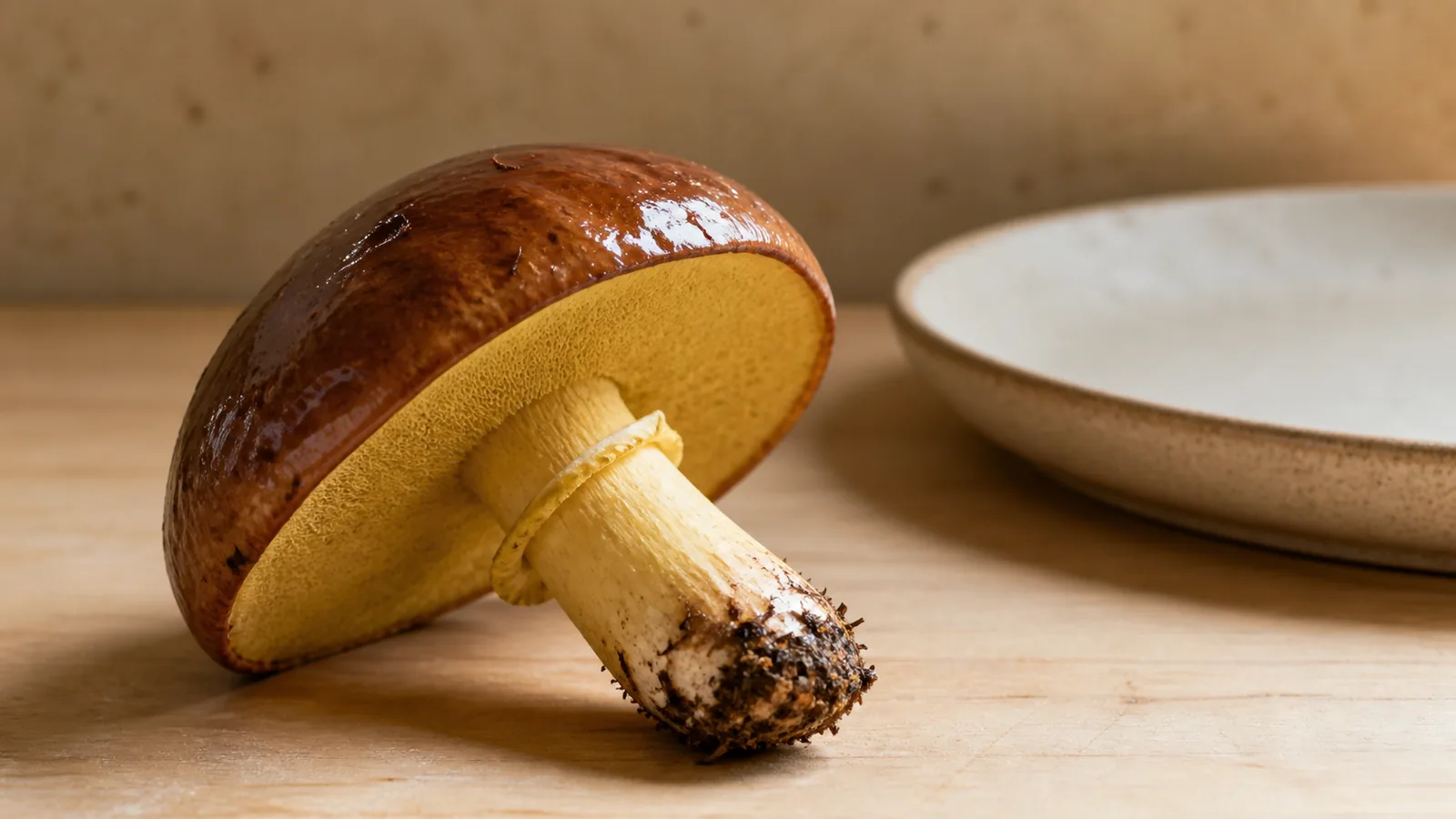
Skip slippery jacks during pregnancy unless the meal can be replaced with a traceable cultivated mushroom. The concern is avoidable uncertainty about the species, the wild collection site, and the lack of pregnancy-specific evidence.
This advice covers Suillus luteus, the bolete most often meant by slippery jack.
A seller or collector who uses only the common name has not established that every mushroom in the batch is that species.
Should you eat slippery jack during pregnancy?
The cautious answer is no. Ordinary edibility does not establish pregnancy safety, and no human pregnancy study specific to Suillus luteus was identified for this review.
Field references describe correctly identified slippery jacks as edible after thorough cooking, but that statement starts after identity has already been settled. It does not tell you whether a loose market bag, gift, or restaurant mixture contains only Suillus luteus.
Pregnancy raises the consequence of preventable foodborne illness.
CDC recommends washed produce and the clean, separate, cook, and chill sequence, yet those kitchen controls cannot identify an unknown fungus.
A packaged cultivated mushroom removes the field-identification question and gives you a supplier, date, and lot. It still needs proper storage and cooking, but the uncertainties become ordinary kitchen problems that you can actually control.
- Choose intact mushrooms in a labeled package.
- Reject slime, mold, sour odor, or pooled liquid.
- Keep raw produce away from ready-to-eat foods.
- Cook the mushrooms through and refrigerate leftovers promptly.
This substitution does not claim that every slippery jack is poisonous. It avoids spending uncertainty on a wild food that offers no pregnancy-specific advantage.
SafetyAre Golden Oyster Mushrooms Safe During Pregnancy?What does the name slippery jack actually identify?
Slippery jack most often refers to Suillus luteus, but it is also used within a wider group of sticky-capped Suillus. Names such as granulated slippery jack and pungent slippery jack show why the adjective does not belong to one species alone.
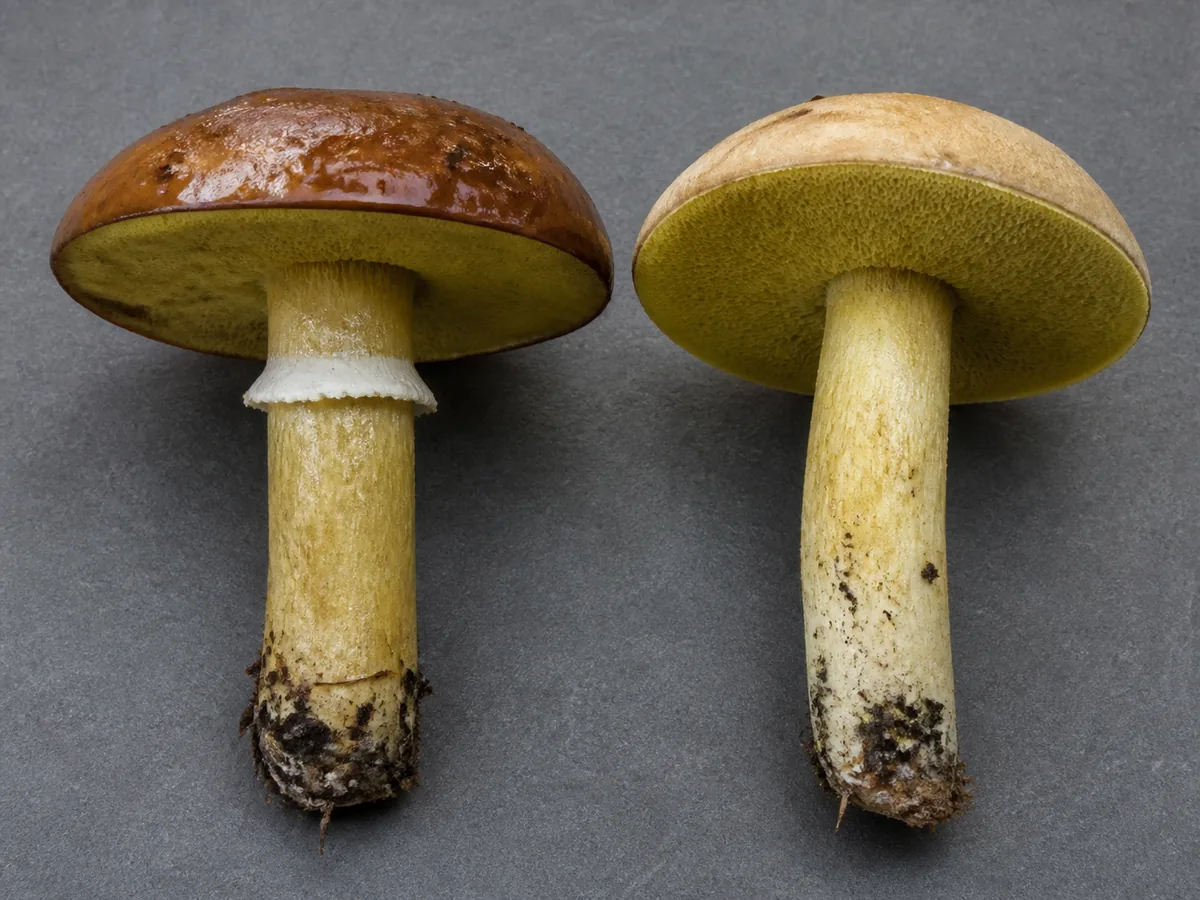
This brown slimy cap is therefore a starting observation, not a meal clearance.
Rain, age, and dry weather can also change how sticky the cap looks, so the feature becomes less dependable when it is taken out of context.
- Scientific boundary
- This page covers Suillus luteus
- Shared wording
- Other Suillus species carry slippery-jack common names
- Evidence lost first
- Slicing removes the intact stem, ring position, and cap attachment
- Batch rule
- One confirmed specimen cannot identify every mushroom beside it
The problem becomes sharper in dried pieces or a cooked mixture. Caps flatten and darken, stems separate, and the evidence needed to match one part to another can disappear before you see the dish.
A trustworthy source should be able to give the scientific name, collector or producer, collection date, location, and confirmation method. If those details end at the words slippery jack, the batch ends at the same point.
SafetyAre Hedgehog Mushrooms Safe During Pregnancy?Which features support Suillus luteus?
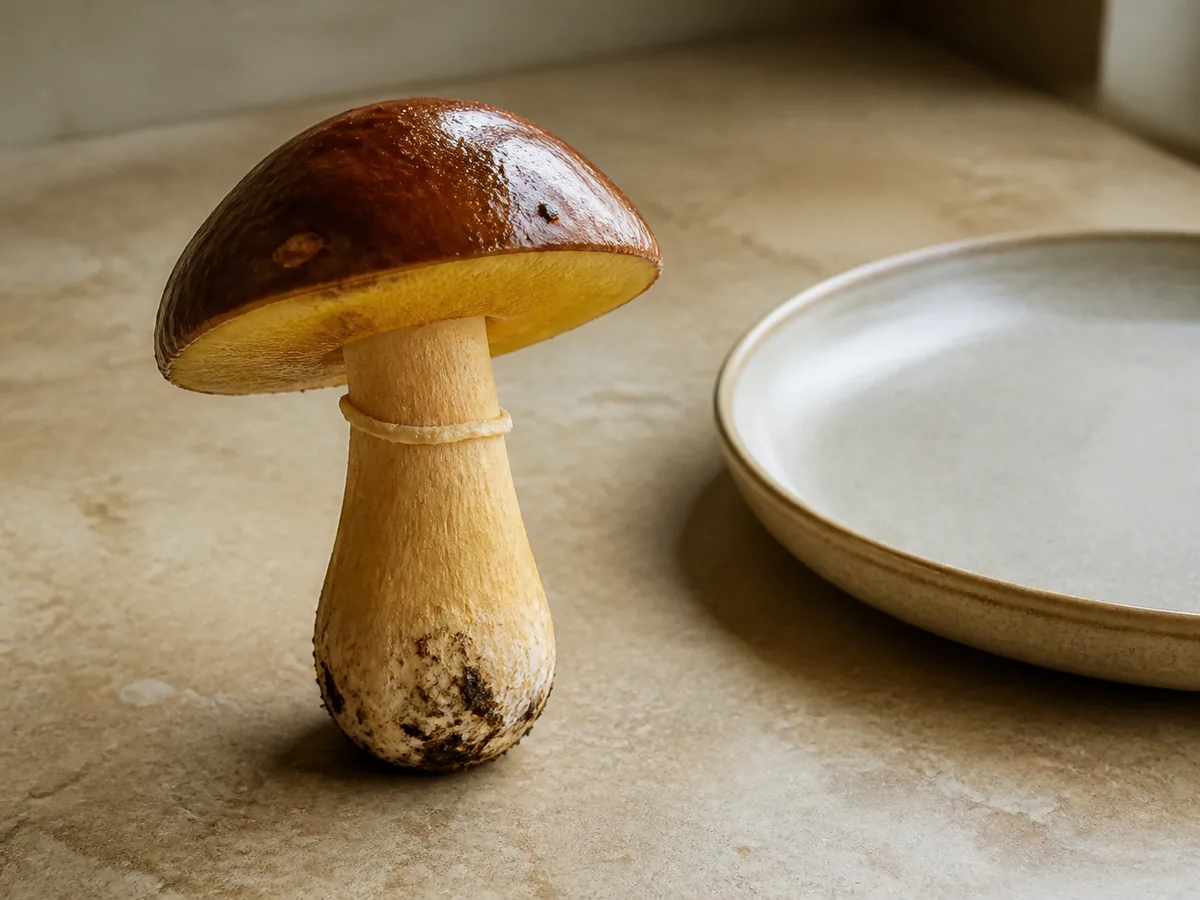
An intact Suillus luteus usually combines a brown cap that becomes sticky when wet, a yellow pore surface instead of gills, a pale stem with a ring, and an association with pine. The value lies in the complete pattern because each feature can occur elsewhere.
Together, anatomy and habitat can support an identification, but neither can clear a specimen alone.

The ring is useful because several other slippery-capped boletes lack it, though damage and age can make a partial veil difficult to read. A missing ring on a mature specimen creates a conflict that a phone app cannot explain away.
Pine is also evidence rather than proof. Roots travel beyond the nearest trunk, several tree species can share a patch, and a photograph may omit the actual host.
To preserve that evidence, photograph the mushroom from above, the side, underneath, and at the stem base, then record the trees and ground around it.
This evidence bundle lets a qualified regional identifier reject a mismatch, while one cropped cap image invites a confident error.
Even a sound identification does not answer the pregnancy question on its own. It resolves one uncertainty and leaves the absence of direct evidence, collection history, condition, and preparation still to be judged.
Why do cooks peel and thoroughly cook slippery jacks?
Many cooks remove the slippery cap skin because it can give the dish an unpleasant texture and is associated in field-guide practice with digestive intolerance. Peeling is a preparation choice, not a test that turns an uncertain mushroom into a safe one.
Field references still call for thorough cooking after the cap is cleaned.
That means heat must reach the center of every piece rather than brown only one wet surface.

Trim soil and damaged tissue only after the whole specimen has been identified. Cut accepted mushrooms to an even thickness, give released water room to evaporate, and keep cooking until every piece is hot and tender.
- Do not taste a raw fragment as an identification test.
- Do not count peeling as a substitute for cooking.
- Do not add raw slices as garnish after the pan is turned off.
- Keep the first serving small because individual digestive tolerance varies.
No official source reviewed here supplies a pregnancy-specific serving size, cooking duration, or internal temperature for Suillus luteus. Inventing one would turn a culinary estimate into medical reassurance.
WHO also warns that cooking does not neutralize every natural mushroom toxin.
Heat can reduce ordinary microbial risk and cook an accepted edible, but it cannot correct a species mistake or remove every contaminant absorbed at the collection site.
SafetyAre Oyster Mushrooms Safe to Eat During Pregnancy?Can a gift, dried bag, or restaurant dish be verified?
The evidence becomes weaker each time the mushroom is chopped, dried, mixed, or cooked out of your sight. Pregnancy is a reasonable point to stop when the scientific name and batch history no longer follow the food.
Warning
Decline a loose, mixed, or common-name-only batch during pregnancy. A confident collector and one intact example cannot establish the identity, condition, and cooking history of every fragment.
A sealed commercial package is more useful when it names Suillus luteus, the producer, lot, origin, storage directions, and preparation instructions. It improves traceability but still does not create direct pregnancy evidence.
At a restaurant, ask which scientific species was used, whether it was wild, who supplied it, and whether the kitchen can describe complete cooking of the batch.
A menu phrase such as wild mushrooms or forest boletes is too broad for this decision.
| Form | Evidence worth retaining | Decision when it is missing |
|---|---|---|
| Fresh gift | Whole specimens, collector, site, date, and qualified confirmation | Decline the batch |
| Dried bag | Scientific name, producer, lot, origin, and intact package | Choose another ingredient |
| Restaurant dish | Species, supplier, wild status, and preparation history | Order a cultivated mushroom dish |
| Mixed wild mushrooms | Separate identity and source record for every specimen | Do not serve it |
Washing can remove surface soil, and cooking can control part of the preparation risk. Neither action reconstructs a missing stem ring, separates mixed species, or proves where the mushrooms grew.
What should you do after eating a slippery jack?
Call Poison Control in the United States at 1-800-222-1222, use webPOISONCONTROL, or contact your local poison service when the species or batch is uncertain. Do not wait for symptoms to prove that a wild mushroom exposure matters.
State the pregnancy during the first contact. Give the meal time, estimated amount, preparation, source, scientific name claimed, and symptoms for every person who ate the dish.

Keep uncooked mushrooms, trimmings, cooked leftovers, packaging, receipts, and photographs.
Store them away from food that anyone might eat, and do not induce vomiting or try a home remedy unless a clinician directs you.
New nausea, vomiting, diarrhea, abdominal pain, fever, rash, dizziness, or unusual weakness deserves case-specific advice. Pregnancy can make dehydration and fever more consequential even when the original trigger proves unrelated to the mushroom.
| Situation | First action |
|---|---|
| Identity becomes uncertain | Call Poison Control or the local poison service |
| Vomiting, diarrhea, fever, or rash develops | Contact the poison service and obstetric clinician |
| Breathing trouble, collapse, seizure, severe confusion, or inability to wake | Call emergency services |
| No symptoms yet but the batch was wild and unverified | Seek poison advice rather than waiting |
Feeling well for a few hours does not reconstruct the identity of a mixed wild meal. Let the poison specialist or clinician close the case using the actual timeline and evidence.