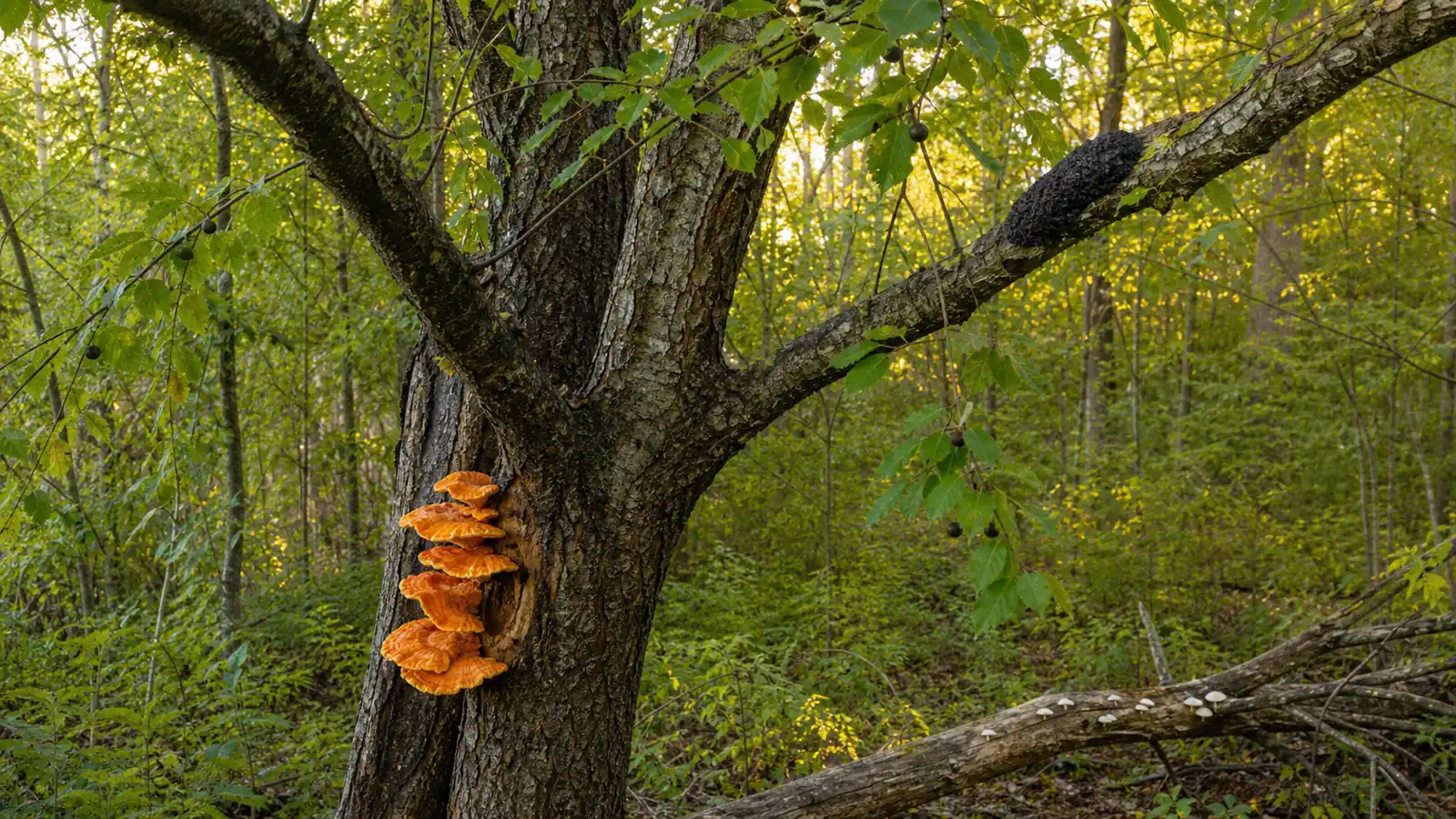
Cherry supports wood-decay mushrooms including chicken-of-the-woods relatives, while black knot is a disease gall rather than a shelf mushroom. Host identity, growth form, underside anatomy, and tree condition must be recorded separately.
A mushroom on cherry is not automatically edible, and fruiting on a living trunk can justify a separate tree-risk assessment.
Cherry trees can carry true mushroom fruit bodies, fungal diseases that do not form mushrooms, and harmless lichens at the same time. The first field task is to separate those categories before naming anything.
On living cherry, a bright shelf can indicate internal wood decay, while a black swollen branch is more likely black knot. A dark growth is not automatically a mushroom, and a mushroom on cherry is not automatically edible.
Cherry is also a broad host label. Wild black cherry, chokecherry, ornamental cherry, and orchard cultivars differ in bark, site, disease pressure, and the fungi likely to be recorded around them.
Confirm a Cherry, Then Record Its Condition
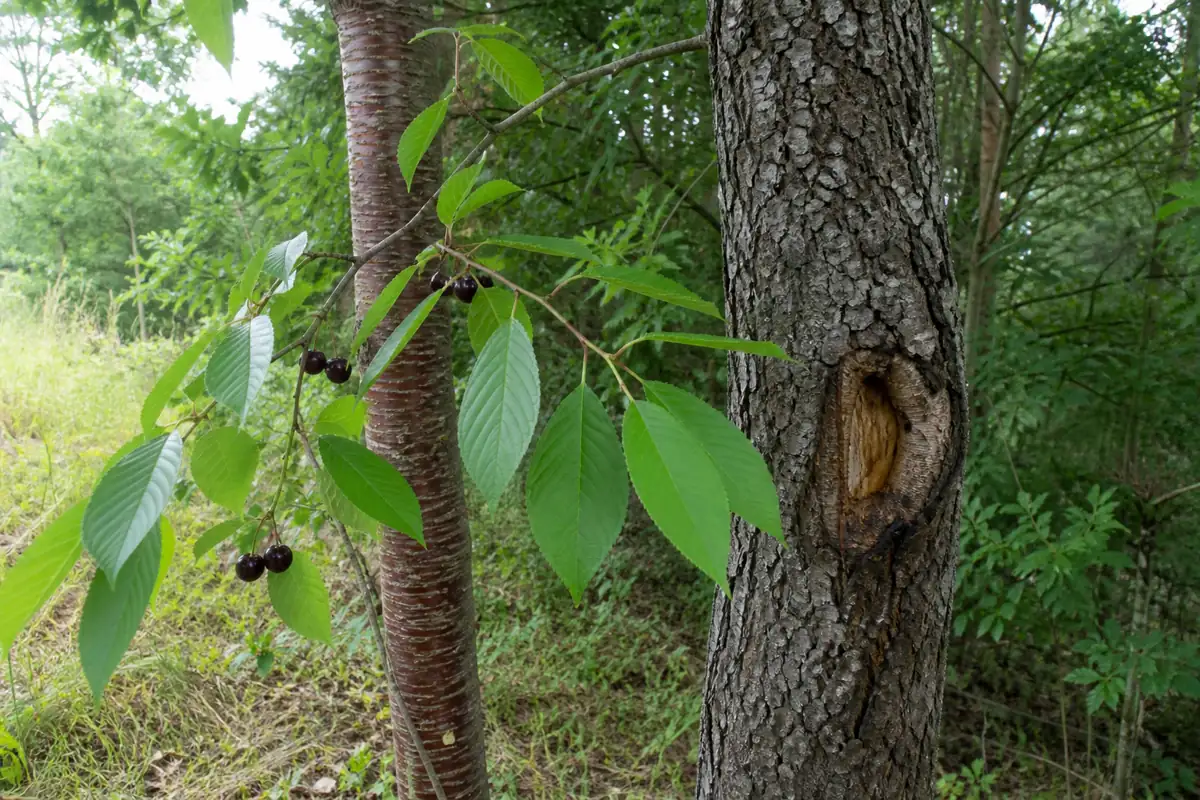
Black cherry often develops dark bark broken into small upturned plates that resemble burnt cornflakes. Younger bark is smoother with horizontal lenticels, and attached leaves are alternate, finely toothed, and usually carry small glands near the blade or petiole.
Orchard and ornamental cherries may retain smoother reddish bark with prominent horizontal marks. Photograph fruit, leaf, bud, twig, bark, and crown when available because one bark pattern cannot cover every Prunus.
| Tree evidence | Useful interpretation | Common mistake |
|---|---|---|
| Bark plates on an older trunk | Supports mature black cherry | Calling every scaly dark-barked tree cherry |
| Horizontal lenticels on young bark | Supports Prunus when paired with leaves and buds | Treating lenticels alone as species proof |
| Alternate toothed leaves and cherry fruit | Strong seasonal host evidence | Using fallen leaves from a mixed stand |
| Dead limb, wound, cavity, or seam | Identifies a likely decay entry or fruiting zone | Assuming the visible mushroom caused every defect |
The combined record makes host identity and tree condition available to the same review.
Record whether the tree is alive, declining, dead standing, or fallen. That state changes the meaning of an attached fungus and the risk of standing beneath it.
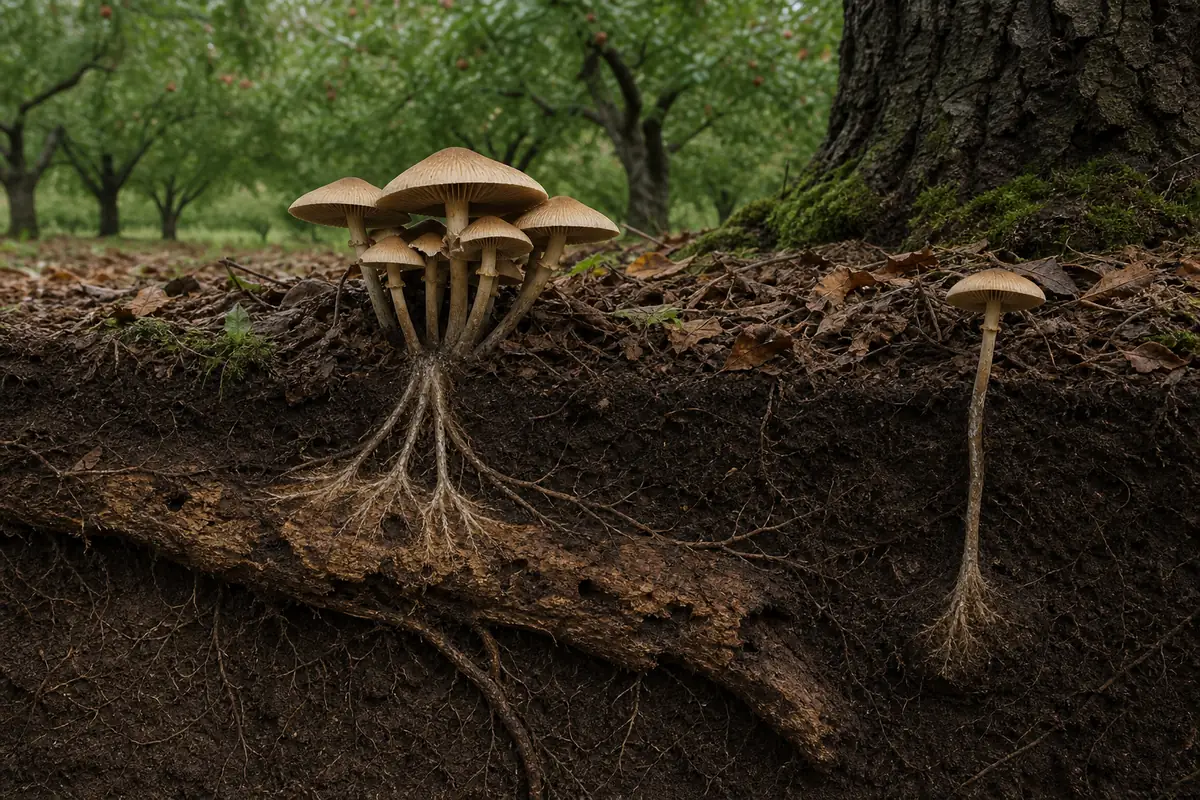
Cherry roots can extend well beyond the drip line, and mixed woodland roots overlap. A cap in soil under the crown therefore needs a complete base and a photograph of every plausible neighboring host.
In an orchard, note graft unions, old scaffold cuts, mower injuries, sunscald, and irrigation lines. These details explain likely entry points for decay fungi better than the age of the tree alone.
Black Knot Is a Disease Gall, Not a Shelf Mushroom
Black knot, caused by Apiosporina morbosa, forms elongated swollen galls on cherry and plum branches. Young infections can look olive and velvety, then harden into rough black masses that wrap along the twig.
The gall is altered plant tissue colonized by a fungus. It does not have the cap, gills, pores, teeth, or separable fruiting body expected from a typical mushroom.
This paired view makes continuity with the branch the decisive visible distinction.

Do not call black knot chaga. Chaga is a sterile black conk associated primarily with birch, while black knot follows cherry and plum stems as a disease gall.
A branch may carry black knot and a separate wood-decay fruit body at the same time. Photograph the gap between them and the attachment of each growth instead of treating one label as an explanation for the whole branch.
Note
Disease management is a separate decision | If a valued cherry has black knot, use regional extension guidance for pruning timing and sanitation. A mushroom identification page cannot assess the whole tree or replace an arborist.
Chicken of the Woods Can Signal Cherry Heart Rot
Chicken of the woods belongs to a North American Laetiporus complex. Members form yellow to orange fan-shaped shelves and cause brown rot in host heartwood, with cherry and other Prunus among documented hardwood hosts.
Warning
Look up before approaching | Large fruiting bodies on a living cherry near a path, car, play area, or building justify a qualified arborist assessment. Do not strike, climb, or pull on a weakened trunk to inspect a mushroom.
Young fruit bodies begin as rounded nodules and expand into overlapping fans. Fresh tissue is soft and suede-like, the underside has pores rather than gills, and older shelves fade, harden, and crumble.
The life-stage view keeps pore anatomy visible as color and texture change.

The mushroom is visible for a short period, while decay can remain inside the trunk for years. Brown rot removes cellulose and hemicellulose, leaving brittle wood that can lose structural strength.

Even after a confident identification, wild-food safety remains separate. Raw or undercooked Laetiporus can cause gastrointestinal illness, some people react to it, and polluted roadside or treated landscape sites add another reason to leave a specimen in place.
The youngest tender margin and the oldest woody attachment can look like different mushrooms. Record both in one frame, because life stage explains more of that contrast than host name does.
Other Cherry-Wood Fungi Need Underside Evidence
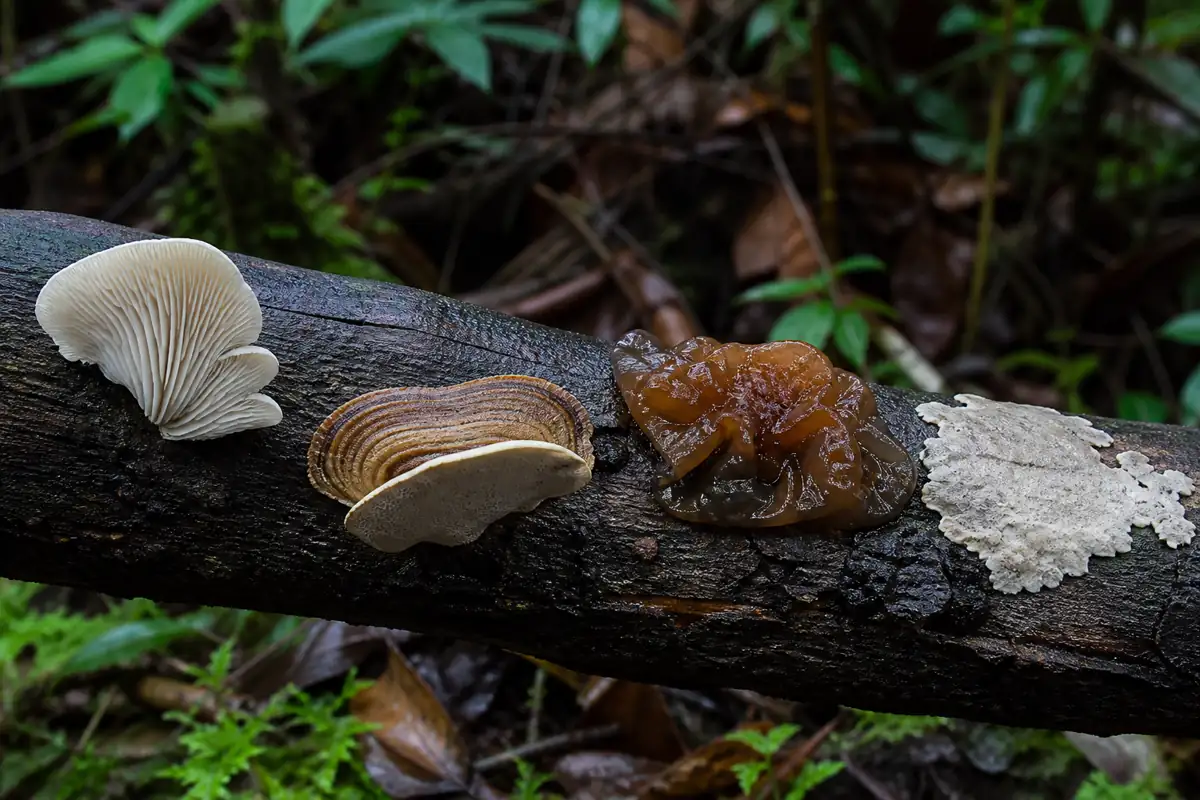
Dead cherry branches and logs can host pale oysters, thin zoned brackets, split-gill fungi, crusts, jellies, and small clustered mushrooms. Bark color cannot identify any of them.
When a fallen branch is safe and legal to move, photograph the fertile surface beneath the cap. Pores, gills, folds, teeth, and a smooth crust send the specimen into different identification paths.
| Growth form | Evidence to capture | Why the distinction matters |
|---|---|---|
| Fan with true gills | Gill attachment, stem position, spore deposit, and wood species | Narrows oyster-like fungi but does not prove edibility |
| Thin concentric shelves | Pore surface, hairiness, thickness, and flexibility | Separates turkey-tail-like brackets from lookalikes |
| Gelatinous lobes | Wet and dry form, color, attachment, and recent weather | Jelly fungi shrink dramatically as they dry |
| Flat crust | Margin, cracking, pore or tooth detail, and wood hardness | The visible surface may be only a thin reproductive layer |
The deadwood view holds the substrate steady while the fertile surfaces change.
If a cluster appears to rise from soil beside cherry, trace it carefully. Buried roots and old stumps can make a wood decomposer appear terrestrial.
A Cherry Candidate Grid Starts With Growth Form
Cherry supports a community, not one signature mushroom. The following profiles organize what to inspect next, and none supplies an edibility answer by itself.
That grid stays anatomical because orange color, striped caps, and clustered growth each occur in more than one group.
Use the tree-trunk mushroom guide when attachment is visible, and the dead-log guide when the wood is fully dead. Those routes answer substrate questions that a cherry-only list cannot.
What Fruiting Says About the Cherry Tree
A conk or mushroom is the visible reproductive part of a fungus that may already occupy internal wood. Pacific Northwest extension guidance notes that decay fungi commonly enter cherry through wounds that expose sapwood or heartwood, including pruning cuts, lightning injury, sunburn, and equipment damage.
Removing the fruit body changes the photograph, not the colonized wood. Fungicide cannot rebuild cell walls that the fungus has digested.
| Fruiting position | Tree question | Immediate action |
|---|---|---|
| Small dead twig on the ground | Is this ordinary deadwood decomposition? | Identify from a safe position and leave habitat intact |
| Dead limb still in crown | Could the limb fall into a used area? | Keep people away and have the limb assessed |
| Trunk wound or cavity | How far does internal decay extend? | Record wound and crown symptoms; seek a qualified inspection |
| Base or soil over major roots | Is the lower trunk or root plate affected? | Avoid loading, digging, or compacting the root zone before assessment |
| Stump after removal | Is this residual decay in dead roots? | Treat as deadwood ecology unless neighboring living trees share roots or damage |
No photograph can measure the thickness of remaining sound wood. An arborist may use sounding, probing, resistance drilling, tomography, crown inspection, and site targets to answer a different question from fungal identification.
Cherry Season Produces Different Evidence
Leafless months make bark, black knot, cavities, and old brackets easy to see. Spring moisture activates black-knot infection cycles and may reveal fresh wood fungi, while warm wet periods later in the year can produce new annual shelves and clusters.
Perennial conks persist after fertile surfaces weather. Annual fruit bodies can appear, sporulate, decay, and vanish between visits, so a clean trunk in July does not prove that no internal fungus exists.
Repeat photographs from a marked viewpoint can show whether a shelf returns at the same wound or a cluster tracks a buried root. That history helps an arborist and a mycologist even when it does not yield an immediate species name.
ForagingMushroom foraging laws in the UK: what is actually legalEdibility Requires More Than a Familiar Profile
A likely match to an edible profile still leaves condition, contamination, individual sensitivity, cooking, and local collection rules unresolved. Cherry bark or fruit in the frame does not remove those questions.
For an oyster-like mushroom, confirm true gills that run down the attachment, a white to pale spore deposit, fresh non-slimy tissue, and the complete cluster. For chicken of the woods, confirm pores rather than gills, the regional species complex, and fresh tender tissue before following any cooking guidance.
Never taste an unknown specimen as an identification method. If the underside, base, or interior was lost, wait for a better specimen instead of filling the gap with the host tree.
Warning
Illness after a wild mushroom meal is urgent | Contact emergency services or a poison center promptly. Save uncooked material, leftovers, photographs, and the meal timeline for medical identification.
Cherry Wood Chemistry Does Not Identify Mushroom Safety
Cherry leaves, wilted foliage, and seeds contain cyanogenic compounds that matter to livestock and plant handling. That plant fact does not create a dependable rule that every mushroom on cherry is toxic or safe.
Mushroom edibility depends on fungal species, condition, site contamination, preparation, and individual response. Host is one ecological character, not a chemical shortcut.
Animal feedingSlugs, insects, squirrels, and deer tolerate foods differently from humans
Cooking testHeat does not make an unidentified mushroom safe and does not remove every toxin
Host-only ruleCherry wood can support several unrelated fungal species
Complete identificationUse mature and young specimens, underside, attachment, spores, region, and current expert sources
Do not convert a true statement about the tree into a false edibility test for the fungus. Host chemistry is not a mushroom safety test, especially with old, waterlogged, insect-damaged, or roadside collections.
Close the Cherry-Tree Field Record
Take a wide photograph before touching the specimen. Include the crown, trunk base, neighboring trees, slope, and any target that could be hit by a failing limb.
- Confirm the cherry from attached features and record whether it is wild, orchard, or ornamental when known.
- Mark the growth as soil, buried root, exposed root, trunk, wound, branch, snag, stump, or fallen log.
- Photograph cap or shelf top, complete underside, margin, attachment, and a measured scale.
- Record fresh texture, bruising, odor from a safe distance, spore deposit when relevant, and changes after drying.
- Keep disease photographs, tree-risk observations, and mushroom collections as separate records.
Use a spore print only after preserving field context. A print can support a comparison, but it cannot restore a missing underside or prove which tree supplied a buried root.
The cherry clue is valuable when it narrows ecology. It becomes dangerous when it replaces morphology, site history, or a species-level safety decision.
Sources & References
- University of Florida IFAS Extension Laetiporus morphology, cherry hosts, decay, and safety.
- University of Minnesota Extension Black knot recognition and effects.
- USDA Forest Service Black cherry identification and ecology.