Indoor Laetiporus sulphureus fruiting is possible but strain-dependent. In a large controlled trial, only two of twelve strains produced mature shelves, so buy proven material, keep the synthetic-log method intact, and require organized primordia after induction before treating a colonized block as productive.
Chicken of the woods can fruit indoors, but clean colonization does not make the crop reliable.
In the largest published production trial, only two of twelve Laetiporus sulphureus strains produced mature fruit bodies under the tested synthetic-log system.
Treat the project as a strain trial with a possible harvest, not a routine bag recipe. That framing keeps you from spending months changing humidity around a culture that has never demonstrated fruiting capacity.
Which chicken-of-the-woods culture does this method cover?
This guide follows controlled fruiting work on L. sulphureus. It does not assume that L. cincinnatus, another regional Laetiporus, or a wild orange shelf will respond to the same substrate and induction.
A missing item changes the project before substrate work begins. An untraceable culture tests identity, fruiting capacity, and production conditions at once, so even a clean failure cannot show which premise was wrong.
Key takeaway
The evidence belongs to verified Laetiporus sulphureus | The common name covers several species, and an indoor method cannot be transferred between them from cap color alone.
The scientific label narrows the evidence, while the lot and fruiting history show whether the purchased material has reached the reproductive stage before.
Preserve all three because an orange shelf photograph without a traceable culture does not identify what is inside your bag.

Do not inoculate a living tree. Laetiporus decays wood, and a cultivation experiment should use contained dead substrate or a managed cut-log system rather than create a wound in a valued tree.
A wild clone also adds field identification, tissue isolation, and contamination screening. Buy a fruiting-proven culture for the first trial so the experiment tests production rather than several unresolved identities at once.
Growing MushroomsWhat Does a Mushroom Farm Actually Cost to Start?How realistic is indoor fruiting?
Indoor fruiting is biologically possible and operationally uncertain.
In the 3,000-unit published experiment, the blocks colonized, but only two of twelve strains produced mature fruit bodies after the tested induction treatments.
That result changes the budget. Build a small replicated trial, keep an untreated or differently handled comparison when practical, and decide in advance how many clean nonfruiting cycles justify retirement.
The numbers establish feasibility without promising the same outcome from a retail block. A different strain, fill mass, supplement, filter, or induction path changes the system that produced them.
The practical consequence is that clean white growth should be scored as one completed stage, not treated as proof that shelves will follow.
Set a retirement rule before the trial so an inactive culture does not consume repeated induction cycles simply because its substrate still looks clean.
Define success in stages. First require clean full colonization, then a specific response after induction, then organized shelves, and only then a sound harvest.
Should you buy a block or start from spawn?
Buy a mature block when the producer can name the species, strain or lot, substrate, and proven fruiting method.
This route lets you test induction and shelf development without recreating a demanding synthetic log.
Starting from spawn is a research-scale commitment. The successful study controlled multiple hardwood particle sizes, organic supplements, mineral additions, moisture, bag geometry, sterilization, inoculation, incubation, and induction.
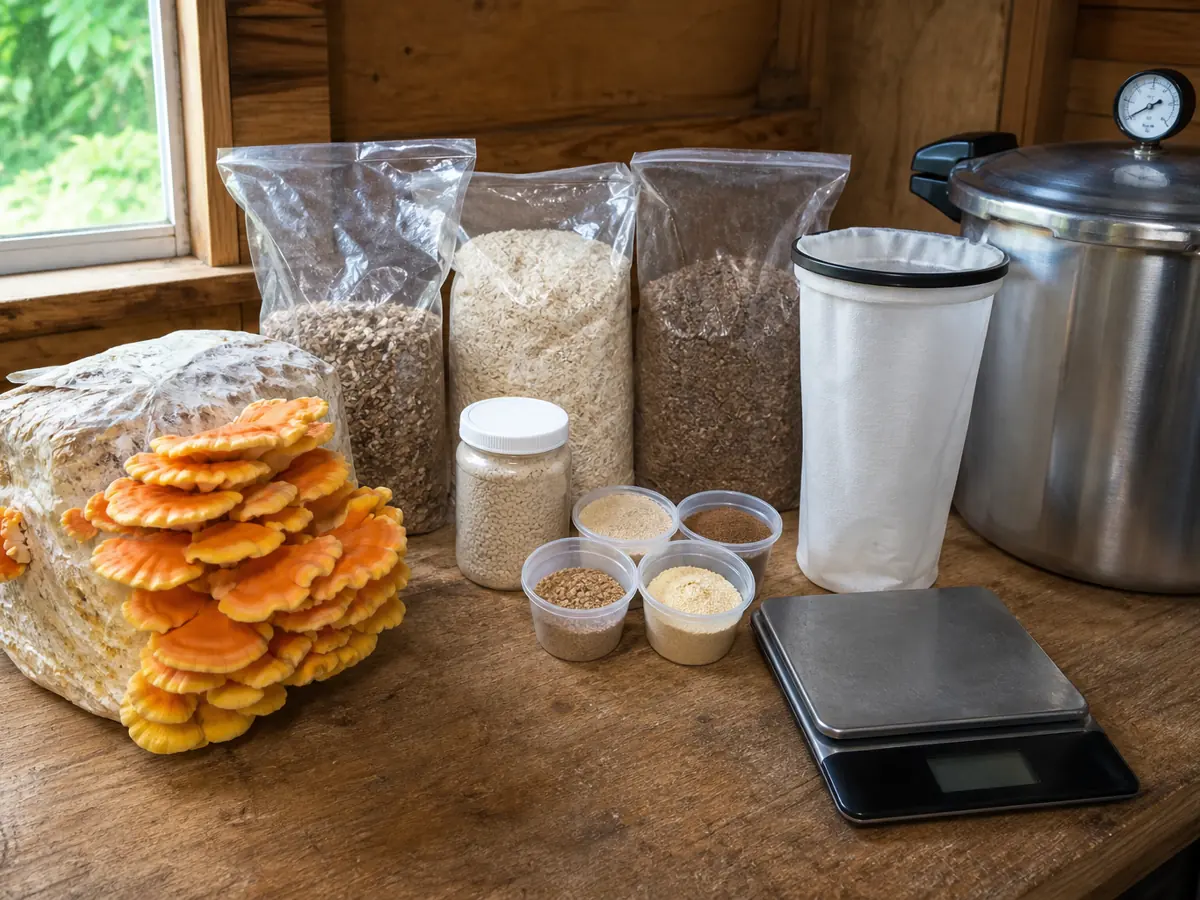
The equipment list is a process boundary. If the pressure vessel, clean transfer area, traceable culture, or repeatable weighing step is missing, a prepared block is the stronger starting route because it leaves fewer unresolved causes behind a failed fruiting attempt.
Ask the block seller what visible maturity, induction treatment, and response window apply to that exact product. Generic instructions copied from an oyster kit remove the strain-specific evidence that makes this difficult crop manageable.
Label each unit with culture lot, substrate batch, inoculation date, and treatment.
Without that record, a productive block cannot teach you which variable should be repeated.
Do not combine cultures or formulas in one bag. A small trial needs differences between units, not unresolved differences inside them.
What synthetic log supported fruiting?
The successful published substrate was a designed synthetic log, not plain loose sawdust.
It combined deciduous hardwood particles of different sizes with substantial organic nutrition, minerals, measured water, a defined container, and a complete sterilization process.
That complexity means the method should be copied as a chain.
Raising supplementation while shortening heat treatment creates a richer contamination medium without preserving the production evidence. A larger bag also changes the slowest-heating center, so cycle adequacy cannot be inferred from a smaller successful unit.
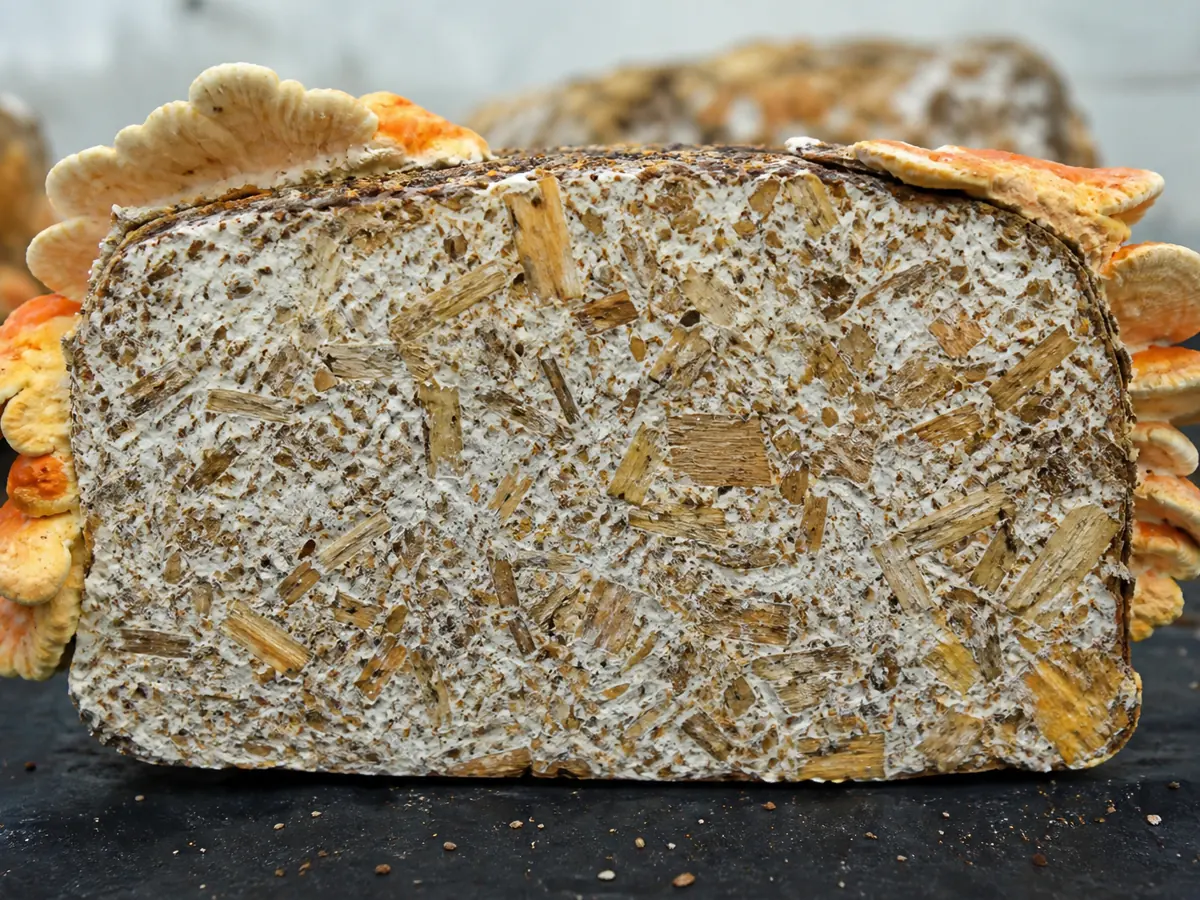
The coarse and fine fractions do different jobs. Larger pieces preserve structure and air paths, while finer material closes gaps and distributes moisture, so replacing the blend with one sawdust grade changes the physical block before nutrition is considered.
| Variable | What it controls | Common transfer error |
|---|---|---|
| Particle sizes | Air spaces, water distribution, and structure | Replacing the blend with compact fine sawdust |
| Organic supplement | Available nutrition | Adding more without increasing process control |
| Water | Mycelial access and internal gas space | Leaving a wet compressed base |
| Fill mass and bag | Heating, cooling, and exchange | Using a larger bag with the same cycle |
| Sterilization | Competitor reduction through the center | Counting only chamber temperature |
Use a formula only when you can reproduce its dry weights and water calculation.
Scoops hide density differences between fine sawdust, chips, and bran.
Cool the treated mass completely before inoculation and keep the filter dry. A warm center can injure culture, while early opening creates the largest contamination window.
Growing MushroomsHow Do Mushroom Sawdust Blocks Work from Mix to Fruit?How does a colonized Laetiporus block differ from other mushrooms?
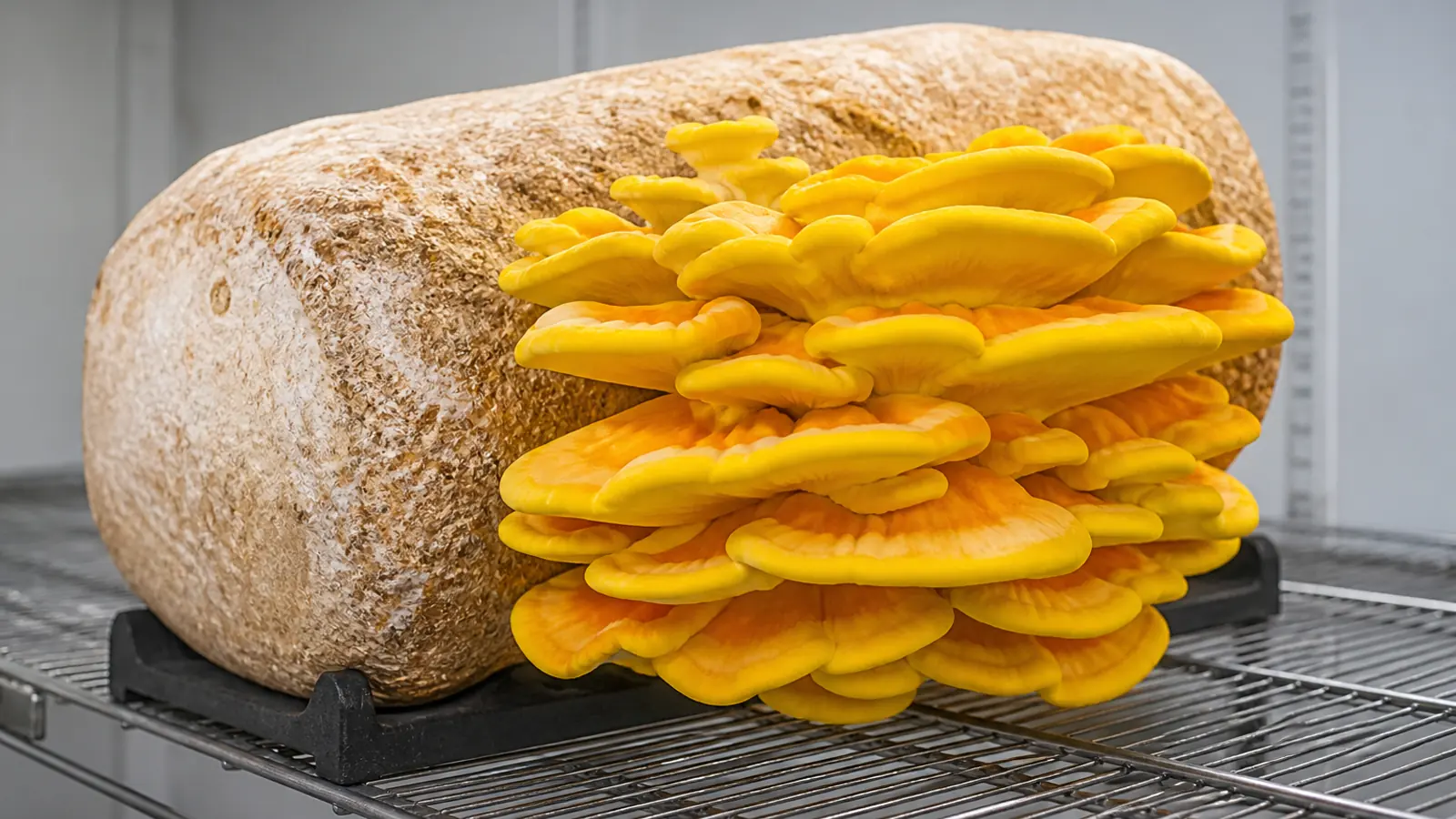
A mature L. sulphureus block can look unusual.
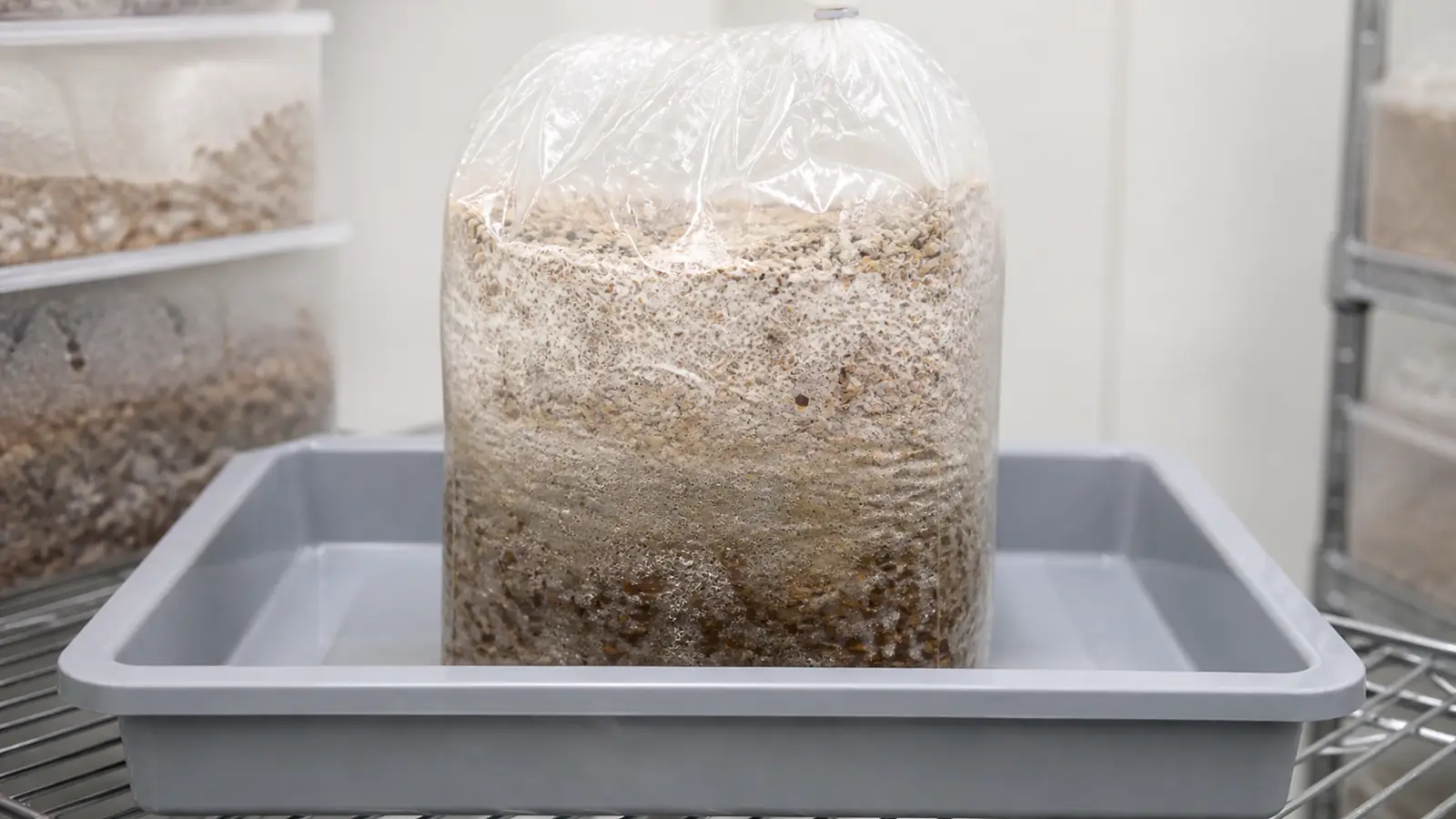
The successful research described orange to pink surface skin and a looser interior, so the block should not be forced into the dense white standard used for every other cultivated mushroom.
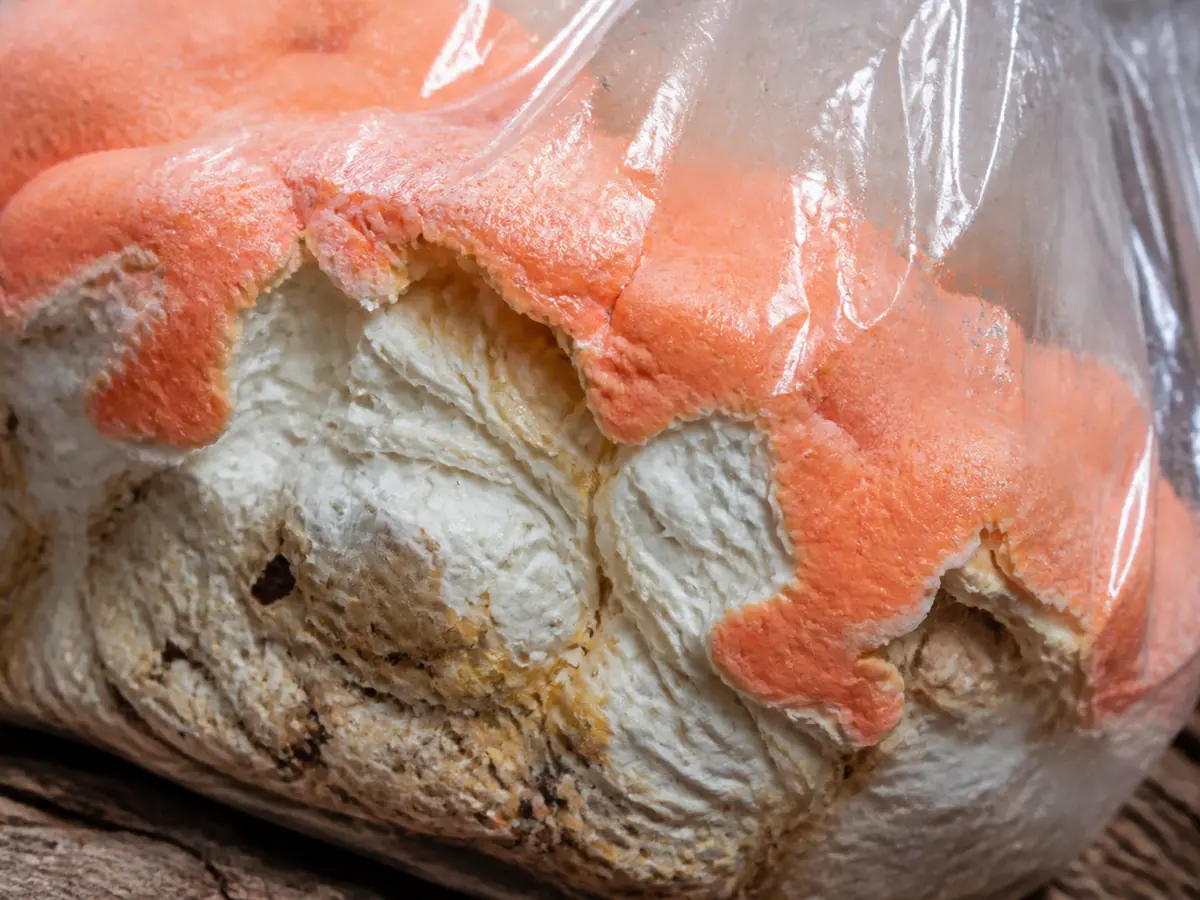
Expected color still needs structure and movement over time. A coherent orange-pink skin attached to known culture differs from a separate green powdery colony, black advancing line, or wet translucent collapse.
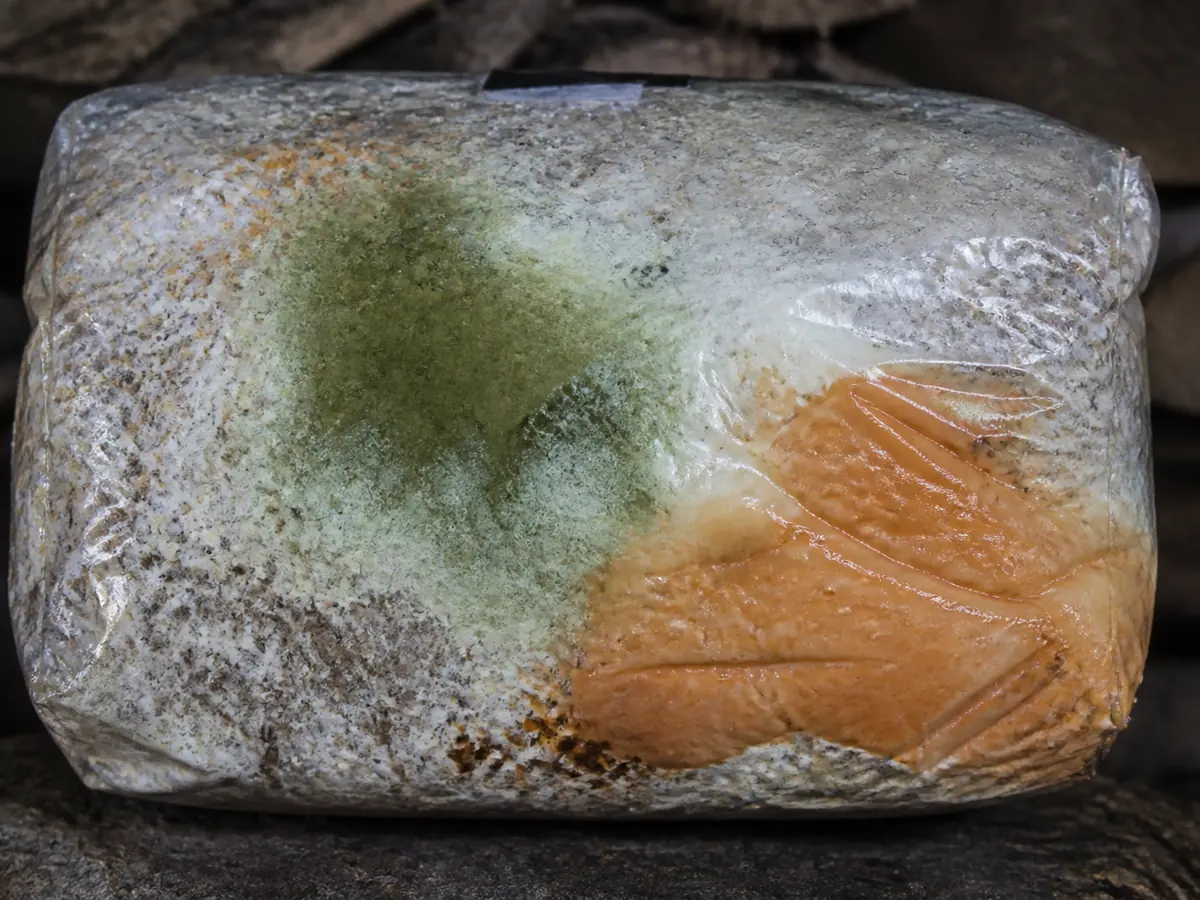
Assign the stage from structure, boundary movement, and batch history together. The four checks below separate expected occupation from a stalled block or a sealed-isolation event without treating orange-pink crop color as contamination by itself.
- Developing
- Known mycelium advances through the synthetic log
- Mature
- The substrate is occupied and the characteristic surface develops within the documented time
- Review
- Coverage stalls without a new foreign boundary
- Isolate
- Green, black, pink foreign growth or wet decay expands independently
Keep suspect bags closed and move them away from the trial. Opening a sporulating unit to inspect its interior spreads material across the room and destroys the clean comparison.
A clean block that never fruits is not automatically contaminated.
Compare it with sibling units from the same lot before deciding whether the problem is culture capacity, maturity, induction, or environment.
Keep one untreated or differently induced comparison when the available block count allows it. A shared clean nonresponse across treatments points toward culture capacity or maturity, while a response confined to the supported cold treatment strengthens the induction evidence for that lot.
How should the cold induction be applied?
Cold induction succeeded in one complete L. sulphureus system.
The study used either cold-water injection or 24 hours at 2 to 4°C, while cuts without the effective cold treatment did not produce the same result. That contrast supports a measured induction step for the tested strains, but it does not prove that colder treatment will rescue an unproven culture.
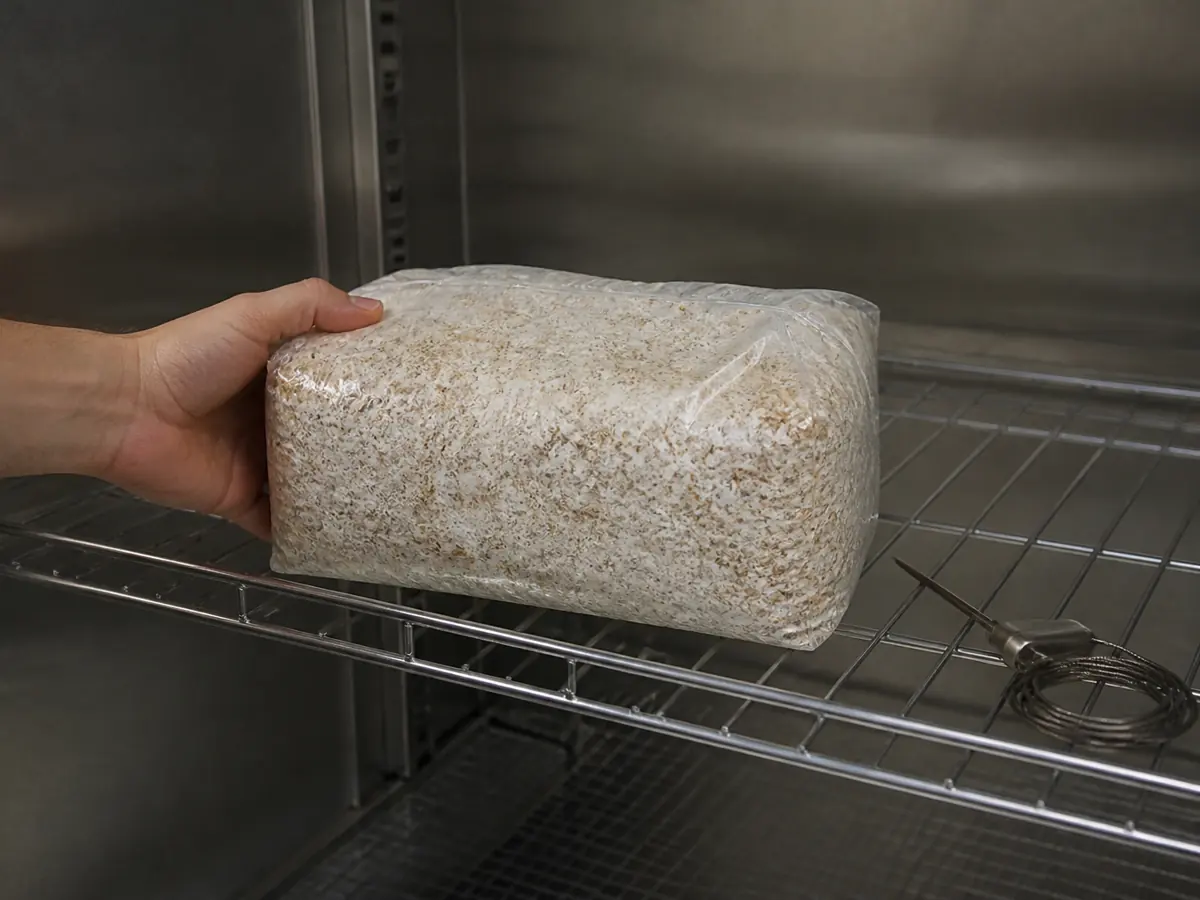
Do not translate that evidence into freezing an unknown kit. Confirm that the block producer supports cold induction, that the substrate is mature, and that the container can tolerate the method without drawing dirty water or room air inside.
Confirm maturity
Require complete documented colonization before induction
Choose the supported treatment
Use the strain supplier's method or preserve the published system
Measure the block environment
Record duration and temperature instead of relying on a refrigerator dial
Return to fruiting conditions
Provide clearance, humid replacement air, and diffuse light
Start the response clock
Photograph the same surfaces daily for organized primordia
Use the same camera angle before and after induction.
The comparison should reveal a localized organized change, while a general color shift or condensation film cannot establish primordia.
Cooling is a trigger, not a cure for a weak culture. Repeating colder or longer shocks after no response can damage the block without adding evidence.
Use several equivalent units when possible. A treated block and a comparison unit reveal more than repeated changes to the same aging substrate.
Growing MushroomsHow Do You Build an Outdoor Mushroom Bed That Lasts?What proves that induction produced primordia?
The meaningful response is organized yellow to orange primordia at a defined site. General whitening, droplets, or a colored surface skin can occur during colonization and does not prove that the crop entered reproductive development.
In responsive treatments, primordia appeared about five to six days after induction.
Keep that interval attached to the tested strains and use it as an observation window rather than a universal deadline.
A treatment comparison is most useful when equivalent blocks share culture, formula, age, and room position. If only one block is available, preserve the pre-induction record and avoid adding a second shock before the first observation window has closed.
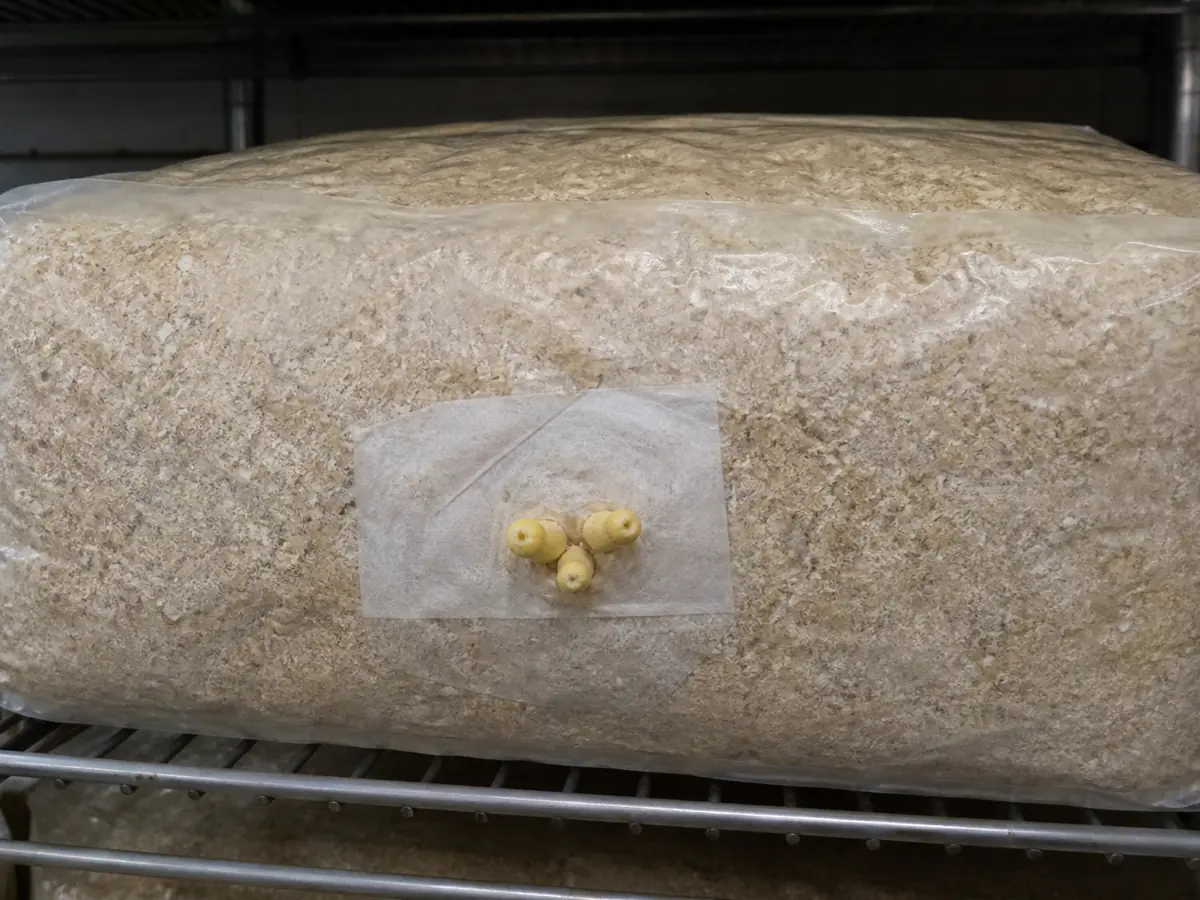
Use the table as a stage decision, not a color key.
Firm localized buds that enlarge belong to the reproductive sequence, while an unchanged skin or a soft wet patch requires a different diagnosis.
| Observation | Meaning | Decision |
|---|---|---|
| Localized firm yellow buds | Likely primordia | Preserve stable fruiting conditions |
| Expanding layered shelves | Productive response | Add clearance and support |
| Unchanged mature skin | No proven response yet | Review strain and induction record |
| Wet soft yellow patch | Possible decay | Isolate and compare over time |
Once primordia appear, avoid rotating or reopening the block. The attachment base is building structure, and a change in orientation can make the developing shelves deform or tear.
If equivalent blocks from the same lot repeatedly remain clean but inactive, revisit the evidence for fruiting capacity before adjusting every room control. This is the central diagnostic difference from an easy-fruiting oyster block.
How do you support expanding chicken-of-the-woods shelves?
Young shelves need clear space to project and enough support for a cluster that can reach several hundred grams.
Arrange the block so the attachment base stays stable and the growing edges do not press against plastic, a wall, or another crop. Plan that clearance before primordia enlarge because moving the block later can tear a heavy base.
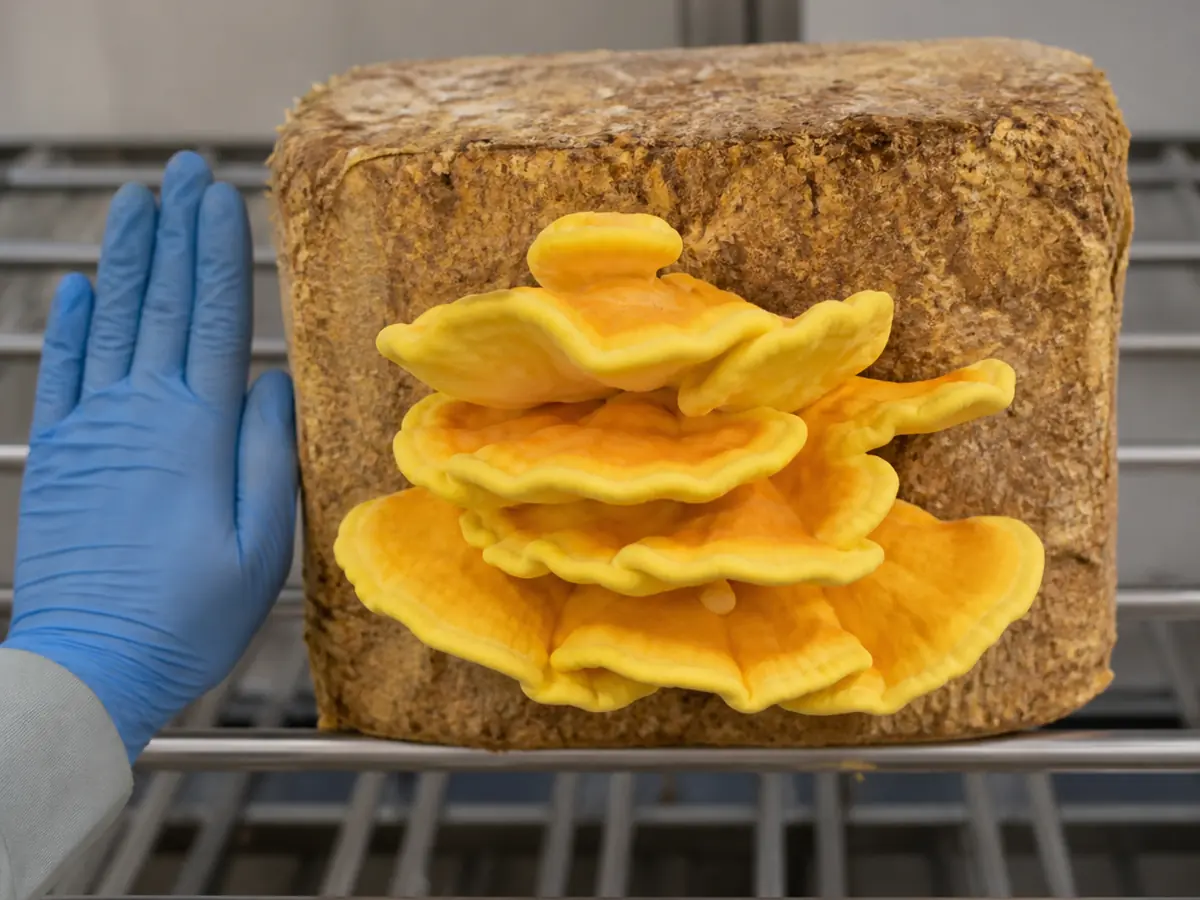
Provide humid replacement air without a fan stream hitting the margins. Thickening shelves need exchange, while thin dry edges show that the local air is removing water faster than the block can supply it.
Firm layered lobes with active yellow marginsHold the current balance
Increasing mass on a stable baseAdd external support without touching the edges
Long distorted tissue with poor shelf separationReview exchange and clearance
Cracked or crisp margins beside a ventReduce direct movement and restore humid air
Diffuse light helps orient the crop but should not heat the surface.
Measure temperature near the block and check for condensation rather than judging the room from a distant sensor.
Change one variable and document the response. The crop's form over the next observations is more useful than a dashboard number with no visible consequence.
When are cultivated shelves ready to harvest?
Harvest young cultivated shelves when the cluster is cohesive, firm, and vividly yellow-orange, with expanded lobes that have not become thin, dry, or tough.
The published responsive crops reached roughly 200 to 300 grams, but mass does not replace a condition check. Inspect the attachment, thick inner lobes, and exposed margins because those areas can mature at different speeds.

Support the cluster and cut cleanly at the base. Do not tear into the synthetic log, and keep each unit's harvest separate until identity, condition, and records have been checked.
- Photograph the attached crop before cutting.
- Record induction, first primordia, and harvest dates.
- Reject soft, moldy, foul, or waterlogged tissue.
- Cook a correctly identified sound harvest thoroughly before eating.
Personal tolerance and eating safety remain separate from cultivation success.
Try only a small well-cooked portion when the species and condition are secure, and do not use a cultivated result to justify eating an uncertain wild shelf.
The most valuable outcome can be a documented nonfruiting strain. Ending that line after a fair controlled trial protects the next batch from inheriting months of false hope.
Close the trial with a strain-level decision rather than a room-wide guess. Repeat only when identity, culture history, substrate record, induction response, and clean harvest form one traceable chain that another batch can reproduce.