Is deadly parasol poisonous?
The deadly parasol name can create the wrong expectation of a tall dinner-plate mushroom.
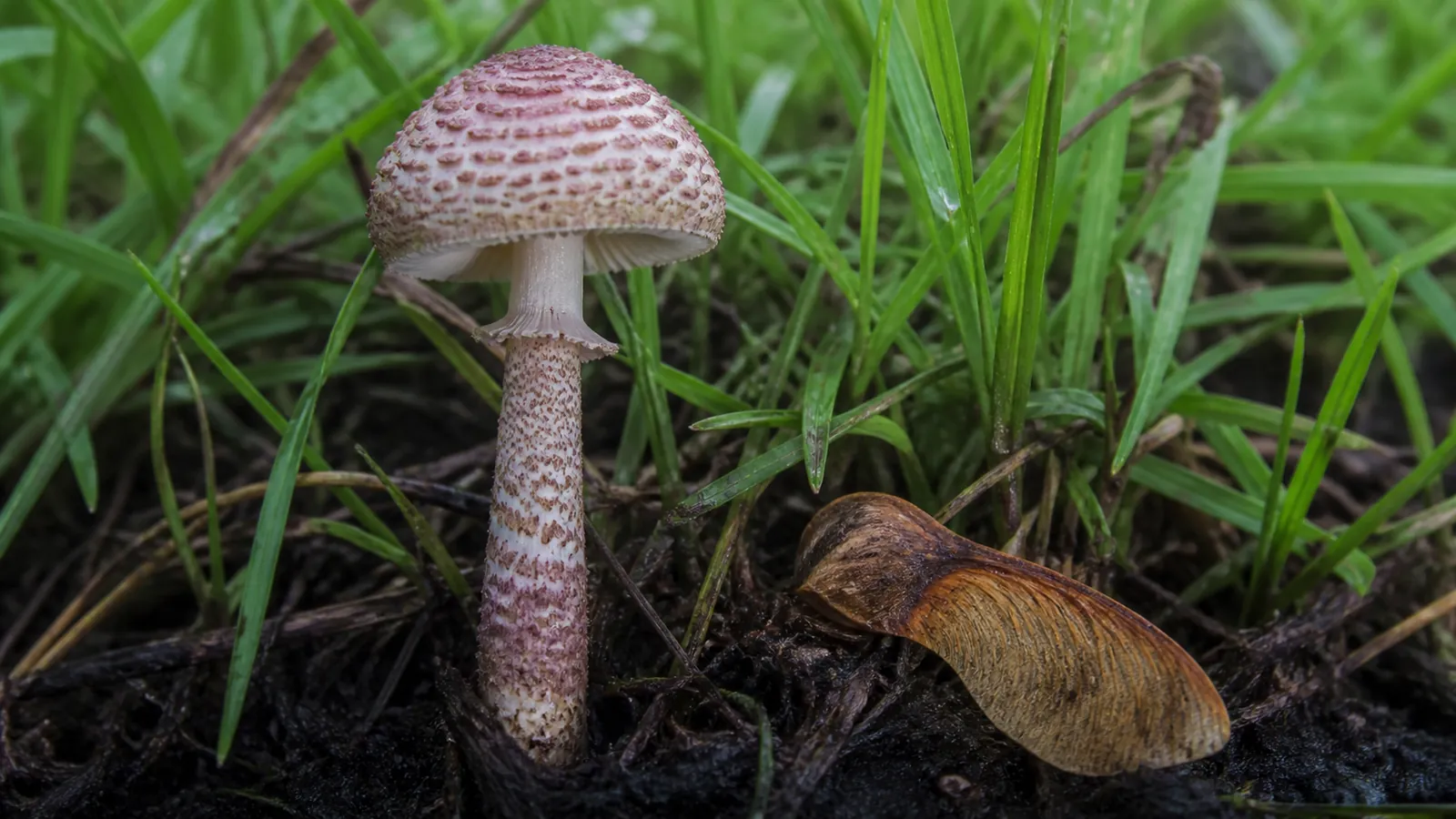
Lepiota subincarnata is a small, delicate species whose whole cap may be narrower than the ring of a mature true parasol.
A young cap carries a nearly continuous pink-brown or reddish-brown surface. Expansion tears that layer into scales and warts, often leaving a darker center and rough concentric bands over white flesh.
The gills remain pale and free from the stem. A mature white spore deposit confirms that the mushroom is not following the pink-to-chocolate gill sequence of Agaricus.
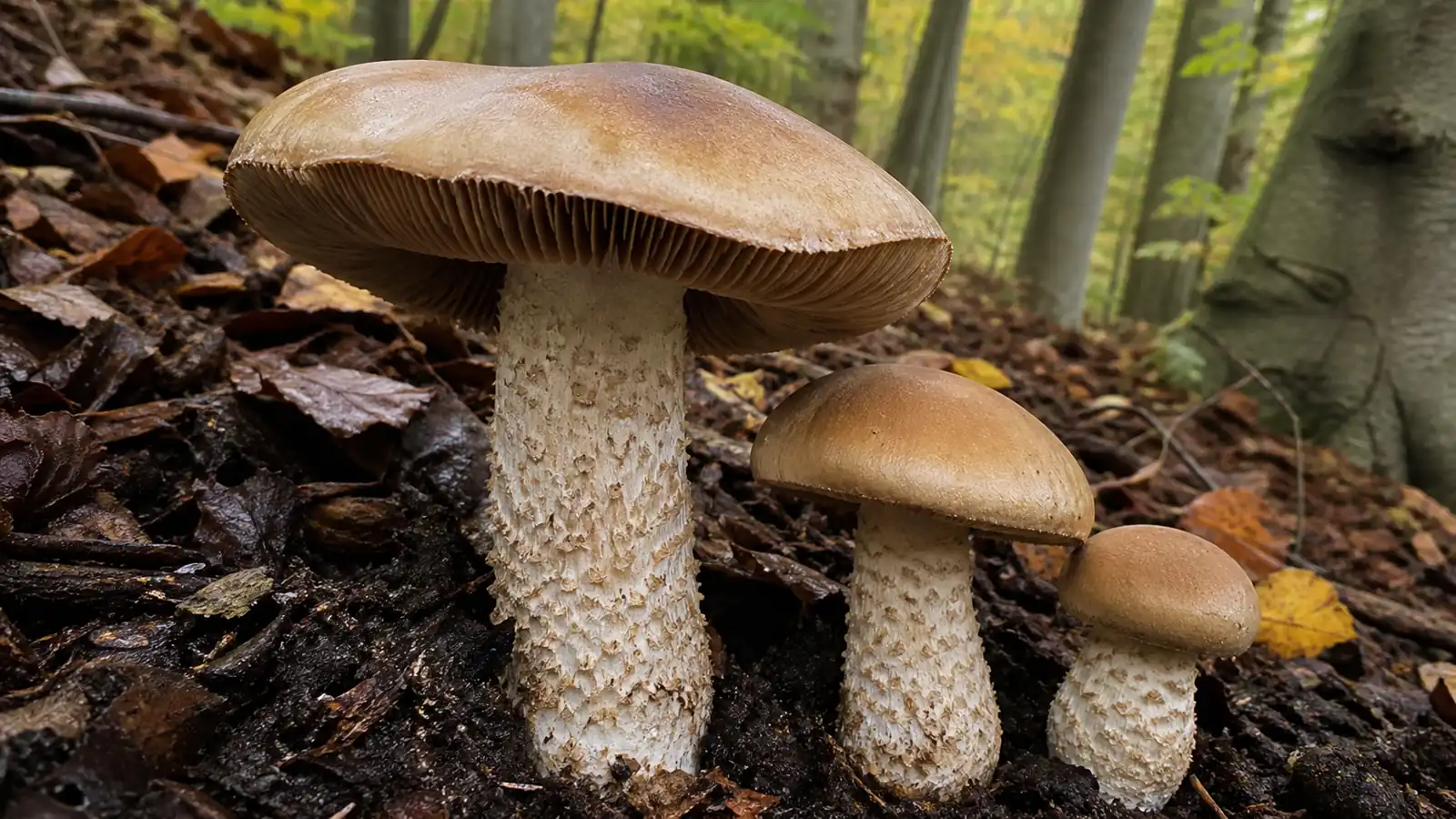
The stem bears some of the most useful context. Above the weak veil zone it is pale and smoother, while below it pink-brown felty fibers form incomplete bands that can be rubbed or weathered away.
No volva surrounds the base, but absence of a volva does not reduce amatoxin risk. Several deadly genera package the same toxin in very different fruiting-body structures.
Small stature lets one specimen vanish into a lawn harvest. Once stems are trimmed and caps are mixed, the cap scale pattern alone cannot reconstruct every mushroom's identity.
How do you identify deadly parasol?
Usually 1.5 to 6 cm across, convex then flatter with a low umbo, pink-brown to reddish-brown at first, breaking into concentric scales or warts over a pale background.
Free, crowded, white to cream, and remaining pale at maturity.
Slender, pale above a fragile ring zone, covered below by pink-brown felty bands or fibrils, and without a volva.
Thin white flesh with an indistinct, sweet, or fruity odor. Never taste it.
Preserve several maturity stages and keep each cap attached to its stem. A loose cap cannot show the veil zone, lower-stem bands, or base that separate the main lawn comparisons.
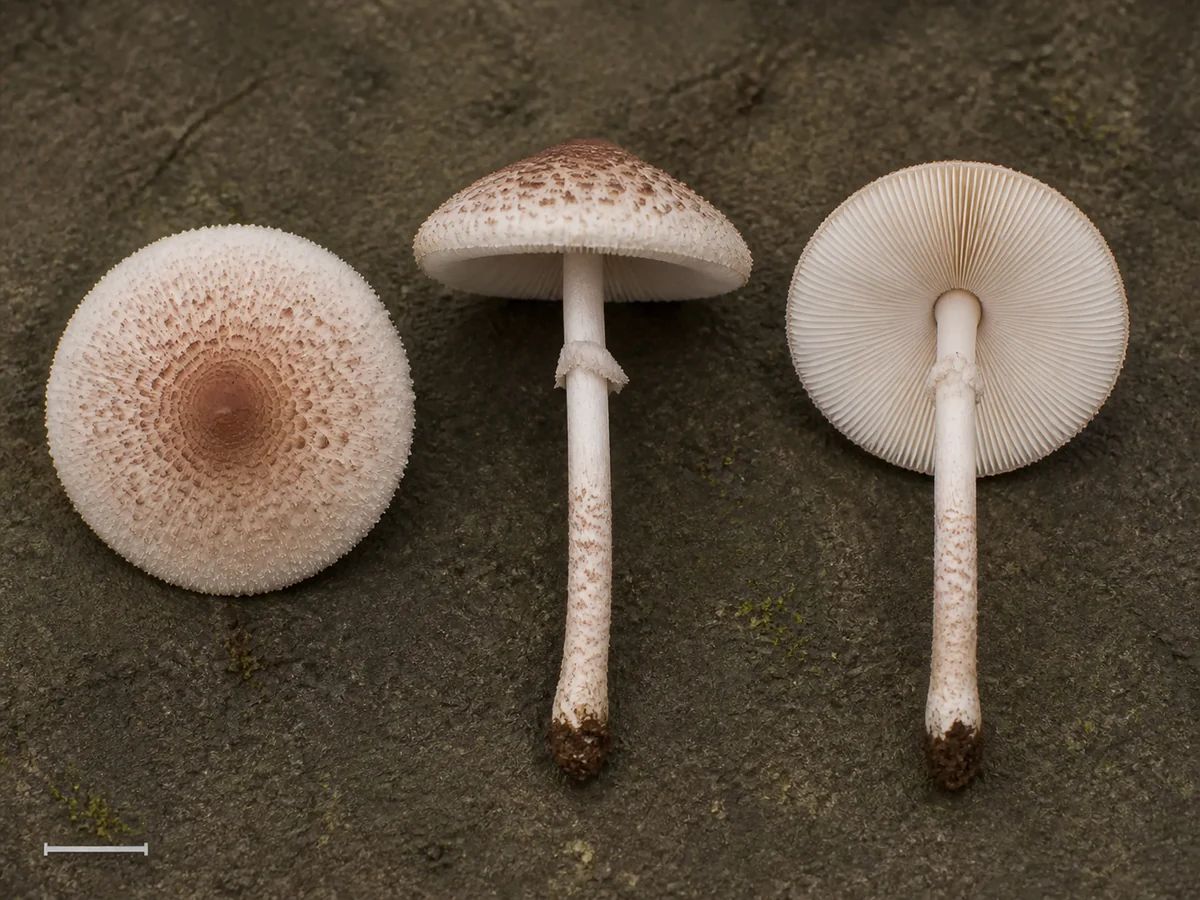
Compare both young and mature gills. A white spore print supports the small-Lepiota pattern but does not separate L. subincarnata from every toxic relative.
Microscopic spores, cap-scale tissues, cystidia, and DNA may be needed. Rain-washed caps, mown stems, and old dried material can lack the visual features emphasized in illustrated keys.
A complete safety decision can be reached before a complete species name.
A small free-gilled scaled mushroom with white spores stays out of the food basket.
If someone may have eaten this mushroom, act now. Call Poison Control at 1-800-222-1222 (US) or emergency services before symptoms appear, and save a piece of the mushroom for identification.
What happens if you eat deadly parasol?
If anyone may have eaten it, call Poison Control or emergency services immediately. Do not wait through the symptom-free interval and do not induce vomiting unless directed by a clinician.
Save mushrooms, trimmings, and food remains. Photograph the caps, free gills, full stems, collection site, and every species from the same basket because a mixed harvest complicates toxicology.
A small Lepiota can be distributed unevenly across a shared dish. List everyone served, the approximate portion from each part of the pan, and anyone who tasted raw pieces during preparation.
Keep collection-site specimens separate from kitchen evidence. A neighboring cap can support ecology and morphology, while scraps from the actual meal carry stronger exposure relevance.
Amatoxin illness can seem to improve after severe vomiting and diarrhea.
That quiet period may coincide with rising liver injury rather than recovery.
Early diarrhea can be blamed on food spoilage when several ingredients were served. Tell clinicians explicitly that wild mushrooms were involved so the delayed liver syndrome remains in consideration.
One normal laboratory result soon after the meal does not create a permanent all-clear. Poison-center and hospital teams decide the timing of repeat liver enzymes, clotting tests, glucose, kidney tests, and observation from the exposure history.
Do not send all evidence away with one person if several diners attend different hospitals. Photograph the complete set first, then follow poison-center directions for dividing or transporting material.
Warning
Delayed gastrointestinal symptoms after a wild mushroom meal require urgent medical assessment, serial liver tests, and poison-center consultation even when the person later feels better.
Which lawn mushrooms lose their identity in a mixed basket?
Fairy ring mushroom matters because both species can fruit in lawns and mulch with small tan or pink-brown caps. The fairy ring species has a smooth cap, widely spaced gills, no cap scales, and a remarkably tough stem.
Other small dapperlings create a second boundary.
Their differences may require microscopy, and several contain amatoxins, so a neighboring Lepiota name cannot be treated as an edible fallback.
Field mushroom develops free gills too, but they move from pink to chocolate brown and leave a brown print. It usually has a more substantial ring and lacks the pink-brown felty bands on the lower stem.
Large parasol mushrooms mature at a much greater scale and can have a movable ring or snakeskin stem pattern. Young stages and broken pieces erase those proportion clues.

| Candidate | Feature pointing away from deadly parasol | Failure case |
|---|---|---|
| Fairy ring mushroom | Smooth cap, distant gills, wiry stem | Pale lawn habitat overlaps |
| Field mushroom | Pink then chocolate free gills, brown print | Young gills begin pale |
| Mature large parasol | Much larger, robust ring and stem | Buttons are smaller |
| Other small Lepiota | Microscopy or DNA | Several are also deadly |
The field mushroom profile supplies the full mature-gill comparison. Never use a field mushroom name for a cap that has lost its stem.
Key takeaway
Reject the collection when scaled small caps and smooth lawn caps were mixed before every stem and mature gill set was matched.
Why do sources use josserandii and subincarnata?
Lepiota subincarnata has also been reported under Lepiota josserandii, and deadly parasol or fatal dapperling can refer to related small species in different sources. Synonym history complicates poison reports but does not weaken them.
The species belongs to an amatoxin-containing lineage within Lepiota.
Chemical studies have helped map that lineage, while microscopy and DNA refine the names applied to individual collections.
Public safety belongs at the group boundary when the species boundary is narrower than field evidence.
How can you tell a fully mature tiny Lepiota from a young large parasol?
Small size becomes useful only after maturity is established. A deadly parasol can open its cap, expose free pale gills, drop white spores, and lose part of its veil while remaining much smaller than a mature parasol mushroom.
A young large parasol creates the opposite problem because its cap is still compact and its veil is still changing. Judging the two from cap diameter alone confuses life stage with adult scale.
The ring is fragile and may disappear, while rain can soften scales or wash color from the cap. Mature size therefore remains one supporting line beside cap pattern, descending stem bands, white spores, lawn or mulch habitat, and expert examination.
A tiny mature parasol form is a stronger warning than a tiny unknown button. Neither state belongs in a food basket, but recognizing maturity prevents the reassuring claim that the specimen will simply grow into a familiar edible species.
How does landscape mulch bring it close to people?
Deadly parasol decomposes organic matter in soil, compost, leaf litter, wood chips, and landscape mulch. It does not require one living tree host, which lets it appear in open human-managed spaces.

Fruiting follows moisture and suitable temperature from summer into late autumn. Groups may be sparse, so finding one cap should trigger a search around the entire bed or lawn edge.
Mulch movement can relocate fungal material. Recently landscaped sites are therefore plausible habitat, and removal of one flush does not eliminate later fruiting.
Pick accessible mushrooms with gloves or a tool where children or pets play, seal them for disposal, and inspect again after rain. Touching intact mushrooms is not the same as eating them, but handwashing prevents fragments from reaching the mouth.
Garden habitat changes exposure, not chemistry.
Tended soil can support an amatoxin mushroom as readily as woodland litter.
How should a play area or garden be checked after one cap appears?
One deadly parasol in mulch or lawn should prompt a careful site check because the remaining fruiting bodies may be smaller, rain-washed, hidden by leaves, or cut below the cap by mowing. A sparse flush can spread across connected organic material rather than forming an obvious cluster.
Repeat the check after rain or irrigation because removing one flush does not remove mycelium from the substrate. Children and pets can return only after the visible mushrooms and loose fragments are gone, with supervision appropriate to the chance of another flush.
Touching an intact cap does not cause amatoxin poisoning through skin. Handwashing still matters after removal because small pieces can cling to fingers, tools, toys, or pet fur and later reach the mouth.
The practical goal is to prevent ingestion while preserving enough evidence to identify an exposure. Digging up an entire garden or applying an unnamed fungicide does not accomplish that immediate job.
What happens between the meal and liver injury?
Amatoxins block RNA polymerase II and interrupt protein production in vulnerable cells. After intestinal absorption, liver exposure can continue through recirculation of toxin in bile.
The usual progression begins with a silent interval, followed by intense vomiting and watery diarrhea, an apparent improvement, then biochemical and clinical liver injury. Kidney failure, coagulopathy, low blood sugar, encephalopathy, and death can follow in severe cases.
| Phase | Reader-facing consequence |
|---|---|
| No symptoms | Call now because absence of illness is expected early |
| Gastrointestinal illness | Replace fluid under medical guidance and begin laboratory monitoring |
| Apparent recovery | Continue observation because liver injury may be rising |
| Organ failure | Intensive care and transplant evaluation may be required |
Toxin studies have detected amanitins in L. subincarnata.
There is no established medicinal use and no safe self-experiment.
Can any kitchen process remove amatoxins?
Deadly parasol has no culinary use. The common word parasol should not connect it with recipes for large edible parasols.
Do not rely on parboiling, discarding water, alcohol avoidance, or prolonged cooking. Amatoxins remain dangerous after normal kitchen processing.
A small cap may be chopped before anyone notices its scales. If a possible Lepiota entered a mixed dish, preserve the meal, stop serving it, and contact Poison Control.
Removing visible pieces cannot establish that the remaining food is safe.
Fine fragments and cooking liquid can retain toxin, and more than one suspect mushroom may be present.
Deadly parasol questions
Is deadly parasol the same as a large parasol mushroom?
What toxin does it contain?
Does cooking destroy the toxin?
Where does it grow?
How is it different from fairy ring mushroom?
Why do some books call it Lepiota josserandii?
Sources & References
- Beaty Biodiversity Museum, Mushrooms Up! Morphology, lawn and mulch habitat, amatoxins, and fairy ring comparison.
- E-Flora BC Regional occurrence, deadly status, and fatality context.
- Occurrence and chemotaxonomical analysis of amatoxins Detection of amanitins in Lepiota subincarnata.
- CDC MMWR Amatoxin phases and urgency of early care.