
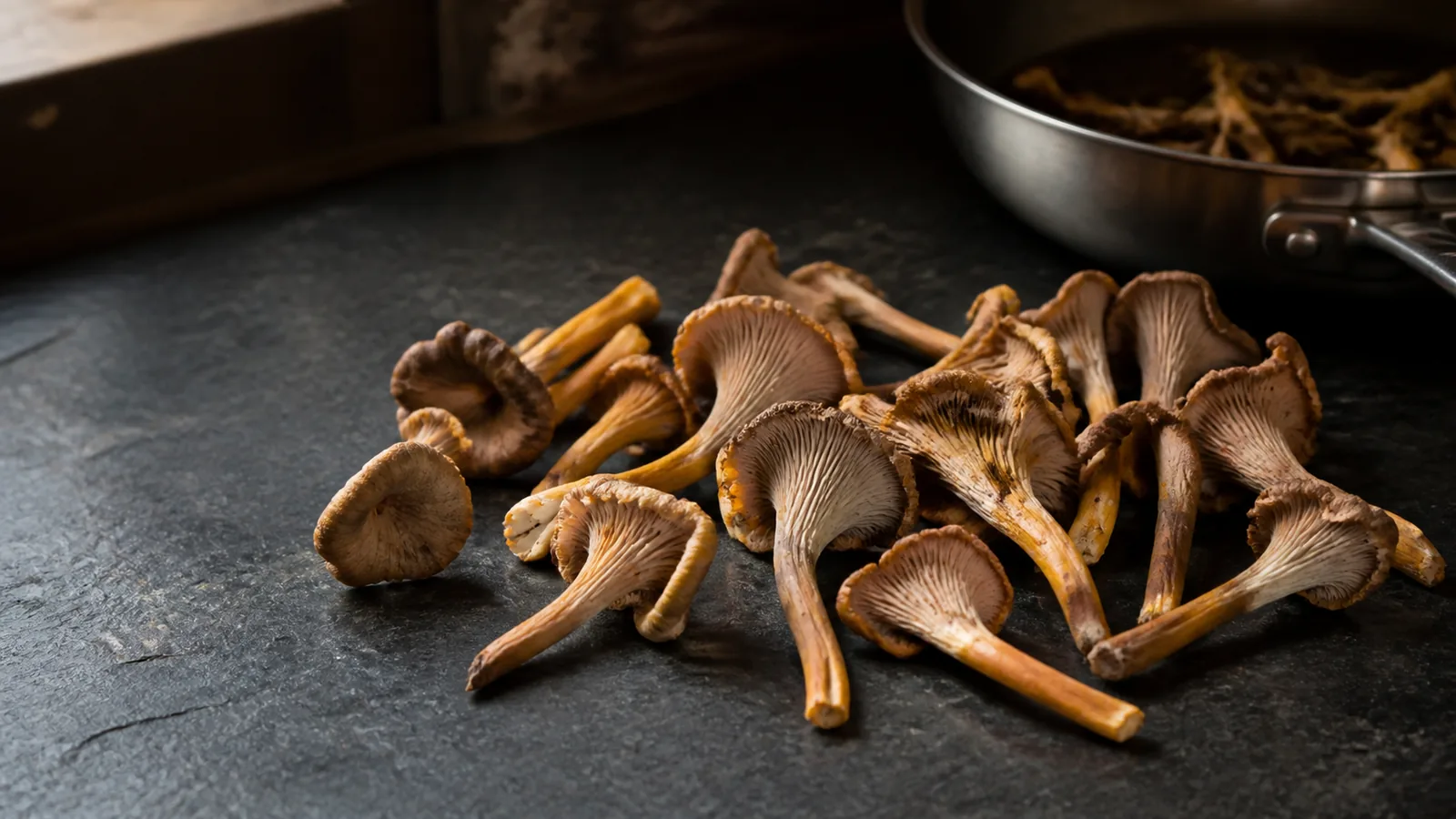
Verified winter chanterelles can be a reasonable pregnancy food when the exact species is known, the late-season batch is still firm, and every mushroom is cleaned and thoroughly cooked. A bag labeled only yellowfoot, a soft collection thawed after hard frost, or a wild gift nobody can verify should not go into the meal.
No human pregnancy study specific to Craterellus tubaeformis was identified.
The practical judgment therefore comes from pregnancy food-safety guidance, species records, mushroom handling advice, and poison-center precautions rather than evidence of a special prenatal benefit or hazard.
Two checks control the answer. First establish what the mushroom is, then decide whether that cold-weather fruit body is still sound food.
Start with the Latin name on the label
Note
Winter chanterelle and yellowfoot do not always identify one exact species. Ask whether the batch is Craterellus tubaeformis, and do not let a familiar common name replace qualified identification of every fresh specimen.
The USDA Forest Service lists Craterellus tubaeformis as winter chanterelle or yellow foot. A Codex standard also records Yellow Foot for Craterellus lutescens, so two edible relatives can arrive under overlapping market language.
That naming collision does not make either species poisonous because the scientific name carries the boundary that a restaurant menu, market card, or gift label may omit.
An intact winter chanterelle has a thin brown funnel, blunt forked ridges rather than separate blade gills, and a yellow-orange stem that is hollow through its length. Those details are useful for rejecting a conflicting batch, but they are not permission to approve a wild mushroom from this page.

A true-gilled mushroom, a solid stem, or a supplier who cannot explain the difference is enough reason to stop.
Processed pieces deserve more caution because chopping and powdering erase the very features that could reveal a mismatch.
If the label names Craterellus lutescens instead, assess that food as the species actually supplied rather than silently treating it as Craterellus tubaeformis. The two species need separate identities even when sellers use yellowfoot for both.
Regional knowledge still matters because common names and close Craterellus species vary across countries. A qualified local identifier or a commercial supplier with a verifiable species record is stronger evidence than a phone photograph, app result, or confident recollection.
A frost-resistant mushroom can still be too old to eat
Winter chanterelles often remain in the woods after other edible mushrooms have disappeared. Some firm specimens survive light frost well, but a mushroom that tolerates cold while attached to its mycelium is not automatically preserved after repeated freezing and thawing.
This decision belongs to the specimen in your hand.
A hard freeze can rupture wet tissue, and the damage becomes obvious after thawing as softness, excess water, darkening, or collapse.
That is why Health Canada advises choosing fresh, firm mushrooms and throwing out bruised or spoiled ones based on present condition rather than the prestige of a winter harvest.
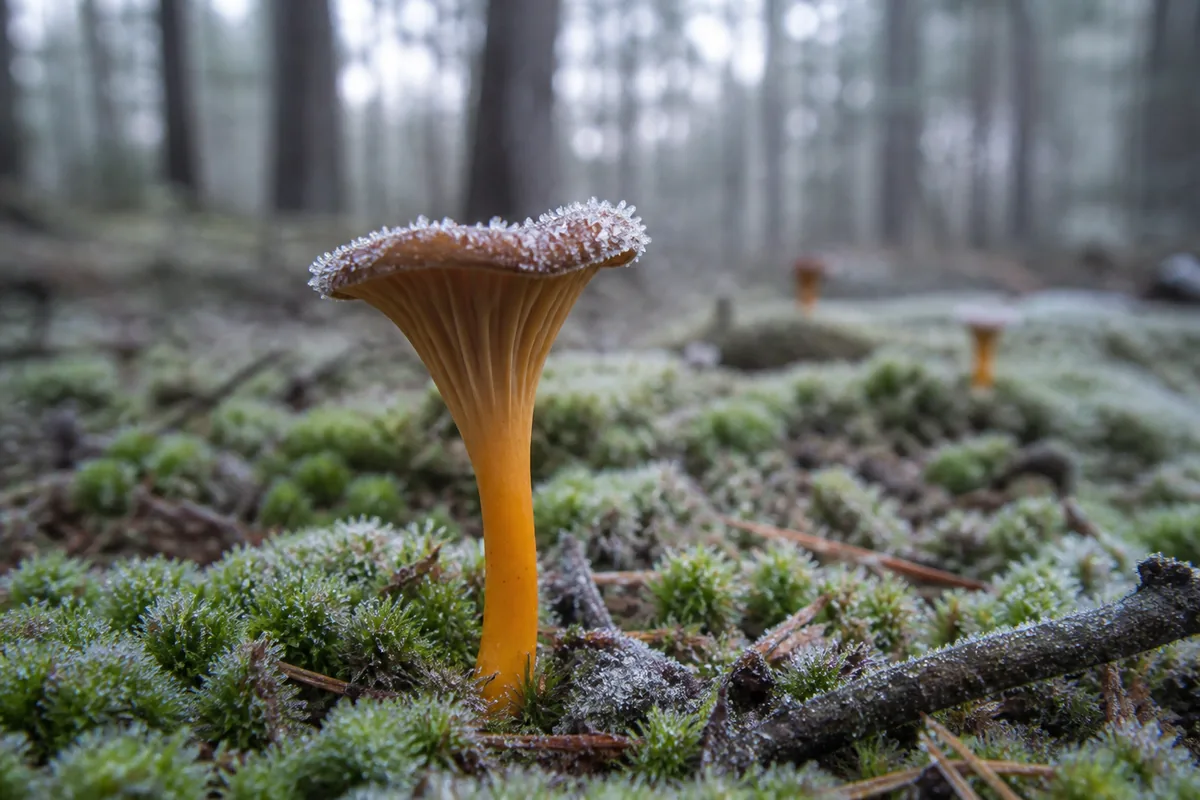
Press the cap edge and the lower stem after the mushroom has fully thawed. A clean springy response supports quality, while tissue that folds into wet paste has already answered the question.
Trimmed damage should be small and clearly limited. Discard the entire specimen when decay runs into the hollow stem because that tube can hide how far soft tissue has traveled.
Because tasting creates an exposure without proving freshness or identity, do not use a questionable piece as a test.
Once a sound batch passes inspection, move it into the refrigerator promptly because FDA guidance lists mushrooms among perishable produce that belongs at 40 F or below. Store loose fresh mushrooms in a paper bag or ventilated original package rather than sealing damp mushrooms into an airtight container.
Late season describes when you found the mushroom, while freshness describes whether you should eat it. Keeping those ideas separate prevents frost from becoming a false safety certificate.
SafetyAre Hedgehog Mushrooms Safe During Pregnancy?Which source leaves enough evidence?
A common name becomes less useful as the mushroom moves from an intact fruit body to a chopped, dried, powdered, or cooked product.
Each step can be legitimate, but each step transfers more responsibility to the identifier and processor whose records you cannot reconstruct at home.
| Source form | Evidence that should remain | Pregnancy decision |
|---|---|---|
| Fresh commercial batch | Scientific name, supplier, intact mushrooms, and sound condition | Continue to cleaning and cooking when the chain is credible |
| Sealed dried pieces | Named species, processor, lot or date, intact package, and recognizable pieces | Use only when the product history and condition are clear |
| Restaurant dish | Kitchen can name the species and wild-mushroom supplier | Ask before ordering and choose another dish when the answer is vague |
| Gift or mixed wild box | Identifier, collection separation, and intact specimens for every species | Skip when one person cannot verify every mushroom |
| Self-foraged or powder | Qualified fresh-state identification or a reputable sealed processor record | Do not rely on a home guess, photo, or unmarked powder |
This is why packaging matters even though it does not prove identity. It preserves a responsible business, lot, and species claim that a loose handful described as local or natural cannot supply.
Pregnancy raises the consequence of avoidable foodborne illness, so CDC recommends clean, separate, cook, and chill practices. Those controls reduce contamination after a food is chosen, but they cannot turn an unidentified wild fungus into a verified edible.
Because foraging safety starts before anything reaches the basket, every specimen needs an explanation based on several features and its habitat. A mixed box is harder to audit when broken caps and stems can no longer be paired.
This broader chanterelle pregnancy decision may look similar at the stove, but Craterellus tubaeformis adds the shared-name problem and late-season condition check, so a seller who can say only chanterelle has not answered the species question.
A familiar cultivated mushroom is the best substitute when the supplier record fails because it resolves the uncertainty without asking you to calculate how likely a naming error might be.
If this would be your first meal of winter chanterelles, keep the portion small and avoid combining several new wild species. An edible mushroom can still disagree with one person's digestion, and a simple plate makes any reaction easier to interpret.
SafetyAre Oyster Mushrooms Safe to Eat During Pregnancy?Let the pan finish releasing its water
The yellow stem is hollow and the cap forms a funnel, so inspect every mushroom where debris can hide.
Split larger specimens lengthwise, open folded caps, and look between the blunt false ridges for moss, needles, soil, insects, or soft tissue.
Health Canada says mushrooms can be brushed or rinsed under cool running water and do not need soap or produce cleanser. Wash them only when you are ready to cook, then pat them dry so added surface water does not prolong the wet stage in the pan.
Start with a clean uncrowded skillet because winter chanterelles hold substantial water. Heat first draws that water out, then evaporation allows the softened mushrooms to fry and develop flavor.

This liquid stage must finish before the dish is ready.
This sequence is more useful than inventing a species-specific internal temperature that no official source provides. A crowded pan can keep the batch steaming in its own water, so divide a large haul rather than accepting cool wet pockets.
The separate raw-edibility question ends at the same practical action. Do not use raw winter chanterelles as garnish, and do not stir uncooked powder into a finished dish after the heat is turned off.
Cooking verified mushrooms thoroughly reduces microbial risk and makes the tissue easier to digest, but heat does not repair a species mistake, which is why identity and condition were settled before the skillet appeared.
Rehydrated pieces need the same complete finish. Lift them out of their soaking bowl so grit stays behind, rinse if needed, then cook until the centers are hot and tender rather than merely warmed by sauce.
Keep the board and knife away from ready-to-eat foods, and wash hands and surfaces after handling a woodland batch.
Refrigerate cooked leftovers promptly in a shallow covered container and discard a dish whose time at room temperature is unknown.
Treat uncertainty as an exposure, not a naming debate
Call Poison Control in the United States at 1-800-222-1222, or your local poison service, if you ate the mushrooms and later learn that the species, supplier, or mixed batch cannot be verified. Do not wait for nausea because some dangerous mushroom symptoms can be delayed for many hours.
Say that you are pregnant during the first call. Give the meal time, estimated portion, product form, source, cooking method, and symptoms for every person who shared the dish.
Do not induce vomiting or try a home remedy unless a clinician directs it. Call emergency services for collapse, seizure, severe confusion, trouble breathing, or inability to wake the person.
Then keep the evidence separate and available.
- Save uncooked specimens, trimmings, cooked leftovers, dried pieces, or powder.
- Keep the package, receipt, lot mark, supplier name, restaurant details, and pre-cooking photographs.
- Record the first symptom and every meaningful change with a time.
- Note whether C. tubaeformis was named or whether the label said only winter chanterelle, yellowfoot, or wild mushroom.
Prior hives, swelling, wheezing, repeated vomiting, or severe diarrhea after this species is already a reason to avoid another meal and speak with a clinician. A previous mild reaction should not be used as a test of what a larger portion might do during pregnancy.
- First action
- Call Poison Control or the local poison service without waiting for symptoms
- Pregnancy
- State the pregnancy during the first call
- Evidence
- Keep mushrooms, leftovers, package, supplier details, receipt, and photographs
- Timing
- Record the meal and symptom course separately for every diner
- Future meals
- Use the exact scientific name and a verified supplier before considering the species again
Feeling well for a few hours does not settle an uncertain wild-mushroom exposure. The safest endpoint is the advice of the poison specialist or clinician who assessed the actual meal and the evidence attached to it.
Sources & References
- Safer Food Choices for Pregnant Women, CDC
- Fruits, Veggies and Juices, Food Safety for Moms-to-Be, FDA
- Selecting and Serving Produce Safely, FDA
- Food Safety Tips for Mushrooms, Health Canada
- Mushrooms of the National Forests in Alaska, USDA Forest Service
- Regional Standard for Chanterelles, FAO Codex
- Yellowfoot Chanterelle, Craterellus tubaeformis, Salish Mushrooms
- Winter Chanterelle, Galloway Wild Foods
- Wild Mushroom Warning, Poison Control