
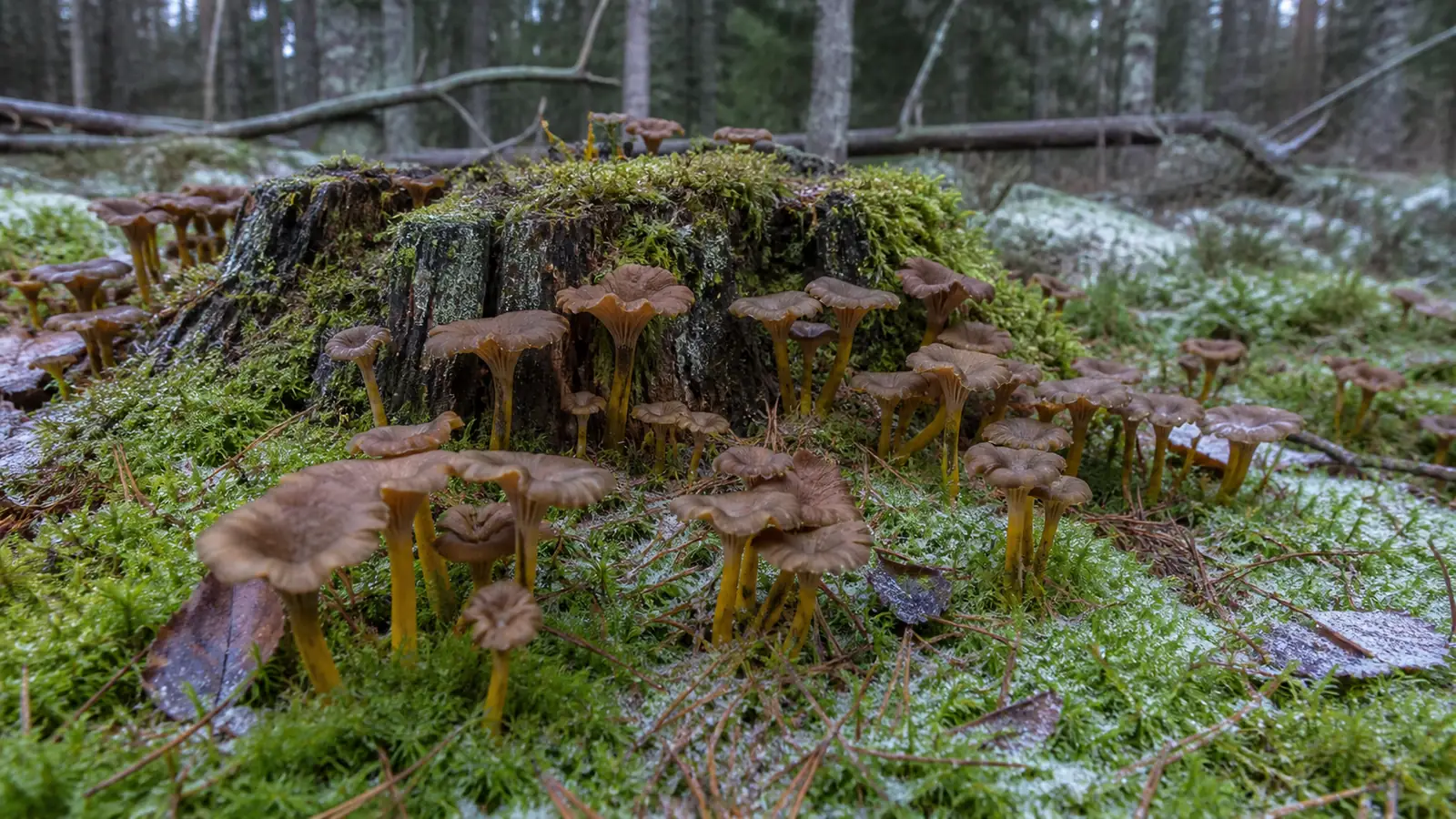
Pick a basket of yellowfoot in November and the standard wild mushroom warnings start to look like they were written about something else.
They come out of the moss almost clean. Nothing has been eating them, the lookalikes growing beside them are edible, and the whole pick can go in a bag without a single specimen being thrown out.
The cook-it rule still applies here, and it rests on one reason rather than the five you have probably read.
Can you eat winter chanterelle raw?
No, and the guidance is stated at the level of the genus rather than invented for this species.
Foraging references for the Pacific Northwest put it plainly, that like all chanterelles yellowfoot should be cooked before eating, and that raw consumption can cause stomach upset. That is a claim about digestion rather than about poison, and the difference matters for how seriously to take it.
- Verdict
- Cook them, on genus-level guidance rather than a species-specific hazard
- What raw causes
- Stomach upset, described for chanterelles generally
- What raw does not cause
- No named toxin and no documented poisoning for this species
- Field check
- The stem is entirely hollow, an empty tube when you snap it
- Season
- Late September into January, with the peak in November
Snap one across the stem before you go any further.
A bright yellow-orange tube with nothing inside it is the feature the common name is built on, and it takes a second to check. Everything below assumes you have done that.

Why the usual arguments do not apply here
Most advice about cooking wild mushrooms is really three arguments wearing one coat, and this species defeats all three.
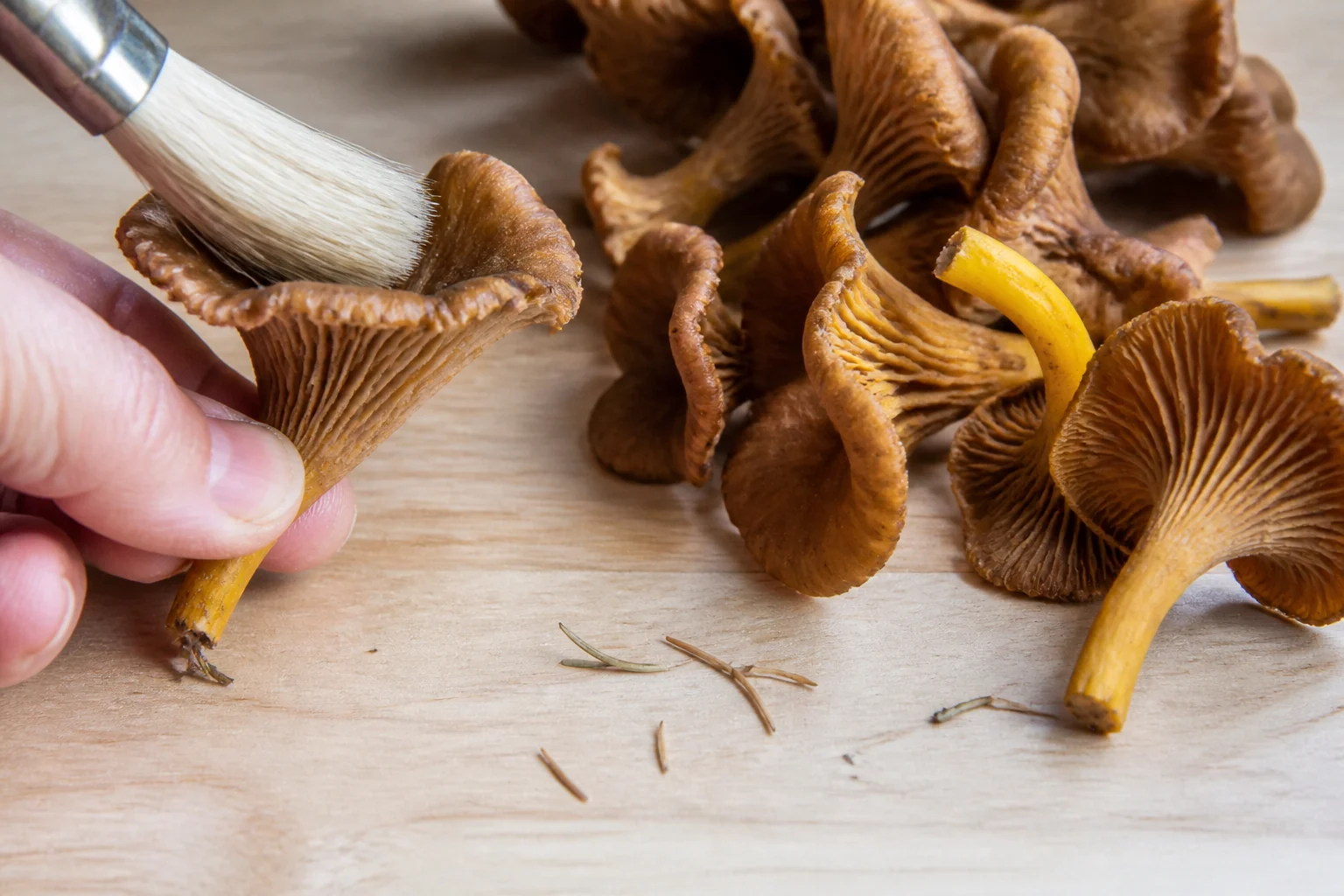
The first is dirt. Yellowfoot are described as remarkably clean compared with most wild mushrooms, and unlike golden chanterelles they do not soak up water, so a quick brush is usually the whole job.
The second is insects. This is an insect-resistant fungus, so the routine business of cutting out maggot damage barely arises, and fruit bodies stay sound in the woods long after other species have collapsed.
The third is the lookalike problem, and for this species it is the weakest of all.
The species that most resemble a winter chanterelle are golden chanterelle, ashen chanterelle and sinuous chanterelle, all of which are themselves edible. Getting the name slightly wrong in this group costs you accuracy rather than a hospital visit.
Note
Every one of those concessions is about the mushroom, not about your digestion. A clean, insect-free, correctly named specimen is still raw fungal tissue when it reaches your stomach.
There is one physical caveat to the cleanliness point that catches people out.
Not absorbing water is not the same as being dry, and a fresh yellowfoot carries a great deal of its own. Foragers who dry or cook large quantities sometimes wring the mushrooms out first, which concentrates them and adds a day or two of fridge life.
The one reason that still holds
What survives is the plainest reason of the set, and it is the one people find least convincing because it sounds mild.
Raw chanterelle is linked to stomach upset. Not to organ damage, not to a named compound, just to the fact that human digestion deals badly with raw fungal tissue, which is not a reason most people find dramatic.
Like all chanterelles, yellowfoot should be cooked before eating. Raw consumption can cause stomach upset.
Pacific Northwest foraging guidance for the species
Notice how small the claim is once it is written out.
The guidance names an outcome and stops there, without reaching for a toxin or a threshold, and the honest version of the rule is the same size.
The flavor argument does more work than the safety one for most people.
A raw yellowfoot is watery and faint. The deeper, earthier character that makes this species worth going out for in freezing weather is created in the pan, so eating one raw trades the entire point of the pick for a texture nobody enjoys.
Watch the pan rather than the clock, because the water they hold comes out first.
Yellowfoot release liquid within the first minute and then start to fry once it has gone, and that second stage is where the flavor arrives. A pan crowded with too many at once stays in the first stage and steams them instead.
Picking them after frost
This is the question that actually separates winter chanterelle from every other mushroom on the raw-or-cooked shelf, because the season runs long enough for it to come up.
The sources do not fully agree about frost-hit specimens, and it is worth knowing that before you drive somewhere.
One well-known forager photographs frozen specimens in mid-December and reports them still worth eating. A Pacific Northwest guide is more cautious and says quality declines after hard frosts.
Both accounts can be true, because a light freeze and a hard one are different events.
Take firm specimens that still smell faintly fruity
Pick after a light frost, which this species survives
Take anything soft, dark and waterlogged
Assume a hard freeze leaves them unchanged
Judge the specimens rather than the calendar.
Four things decide it at the patch.
- Firmness, because a specimen that folds in your fingers has begun breaking down
- Stem color, since the yellow fades before anything else does
- Smell, which stays faintly fruity right up until it does not
- Water, because one that feels heavy and sodden will never dry or fry properly
A frost-hit yellowfoot that is still firm, still yellow at the stem and still smells faintly fruity is worth taking. One that has gone soft, dark and watery has begun breaking down, and cooking will not undo that.
SafetyCan You Eat Beefsteak Polypore Raw? Yes, If You Slice It ThinFreezing and drying, and whether frozen counts as raw
A good November brings in more than anyone can cook that week, which is where the raw question comes back in disguise.
Freezing is not cooking, and neither is drying, so the raw question survives both.
Both are ways of stopping the clock, and a mushroom that comes out of the freezer uncooked is exactly as raw as the one that went in. If you freeze them raw for space reasons, the pan step just moves to the far side of winter.

Where the identification risk actually sits
Low, but not zero, and the one worth learning is the exception to the pattern rather than another chanterelle.
| Species | How it differs | What it costs you |
|---|---|---|
| Golden chanterelle | Larger, solid stem, fruitier smell, blunt false gills | Nothing, it is a choice edible |
| Ashen chanterelle | Grayer cap and paler stem, otherwise very close | Nothing, also edible |
| Sinuous chanterelle | More wrinkled and yellower spores | Nothing, also edible |
| Chrysomphalina chrysophylla | True gills rather than veins, and it grows on decaying wood | The only one worth ruling out by habit |
Two of them are worth putting a face to.
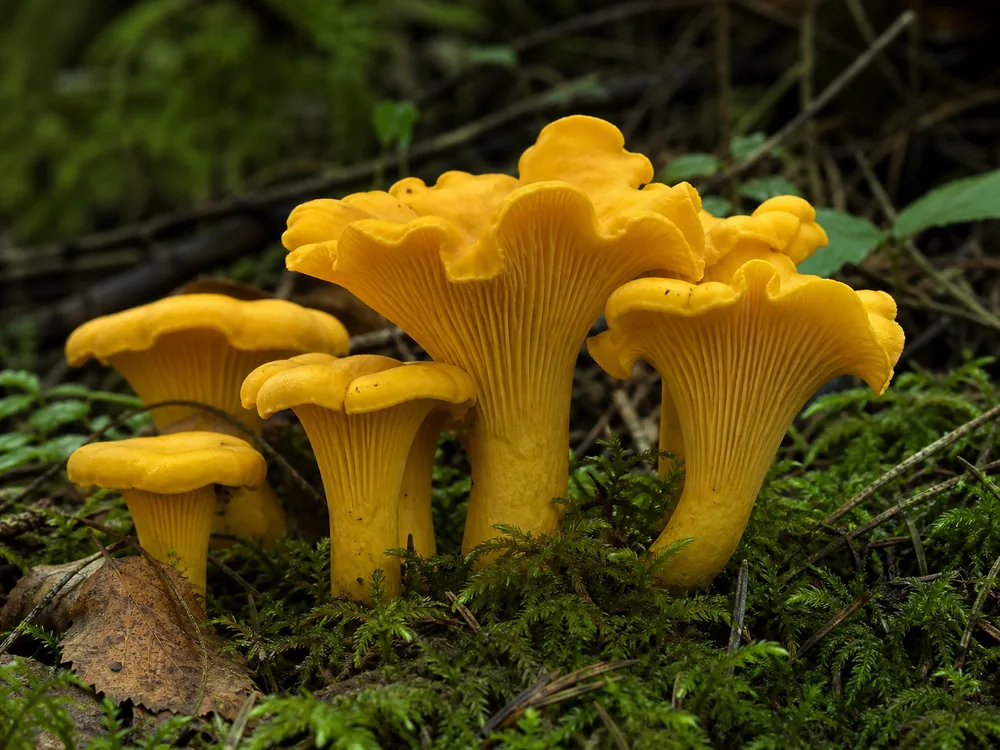 Summer to autumnGolden chanterelleLarger, solid stem, fruitier smell
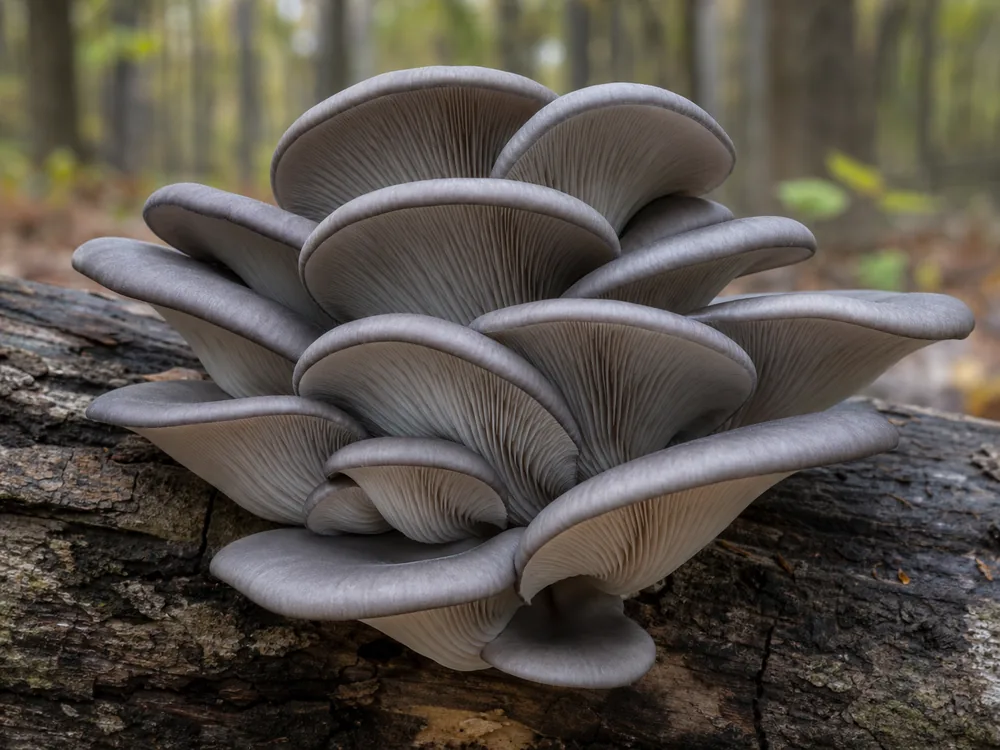 Autumn to winterOyster mushroomTrue gills, grows on wood, no funnel at all
The second card is a contrast rather than a lookalike. An oyster mushroom is the everyday example of true blade gills growing straight out of wood, which is the exact combination that rules a mushroom out of this group.
The separating features are the same two you would check anyway, the gills and the ground.
Look for vein-like false gills running down the stem instead of true blade gills, and look at what the mushroom is growing out of. Yellowfoot come up out of moss and soil, often in the moss banked around an old stump, while a mushroom growing directly from the face of rotting wood is something else.
The habitat itself narrows the ground further before you pick anything up.
These favor hemlock-dominant forest with real moisture, thick moss around old conifer stumps, and the wetter microsites on a slope rather than the dry ground between them. In the Pacific Northwest that mostly means below two thousand feet.
Tip
Learn the false gill and the hollow stem together and you have the species. Both are visible on a single specimen in a few seconds, and neither depends on getting the light right for a photograph.
Sources & References
- Yellowfoot Chanterelle, Craterellus tubaeformis, PNW identification and foraging States that like all chanterelles yellowfoot should be cooked before eating and that raw consumption can cause stomach upset, plus cleanliness, hollow stem, season, habitat and the Chrysomphalina lookalike.
- Winter Chanterelle, Galloway Wild Foods Records persistence after frost with mid-December specimens still good, insect resistance, high water content and the wringing-out habit, drying and the September to January season.