Why does a gray morel turn yellow?
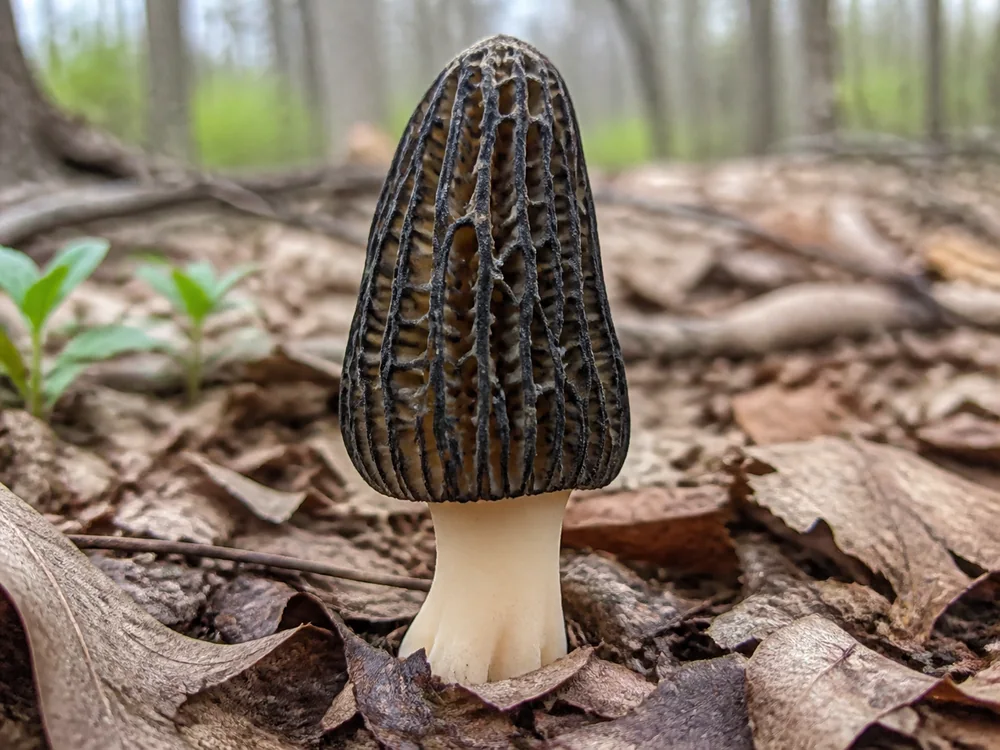
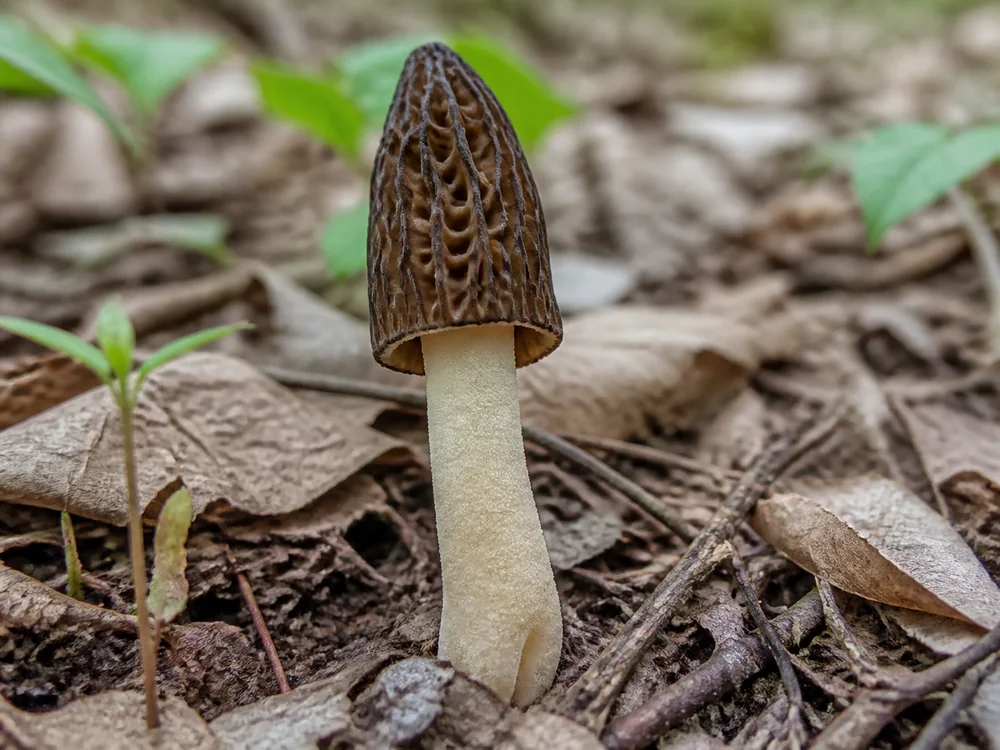
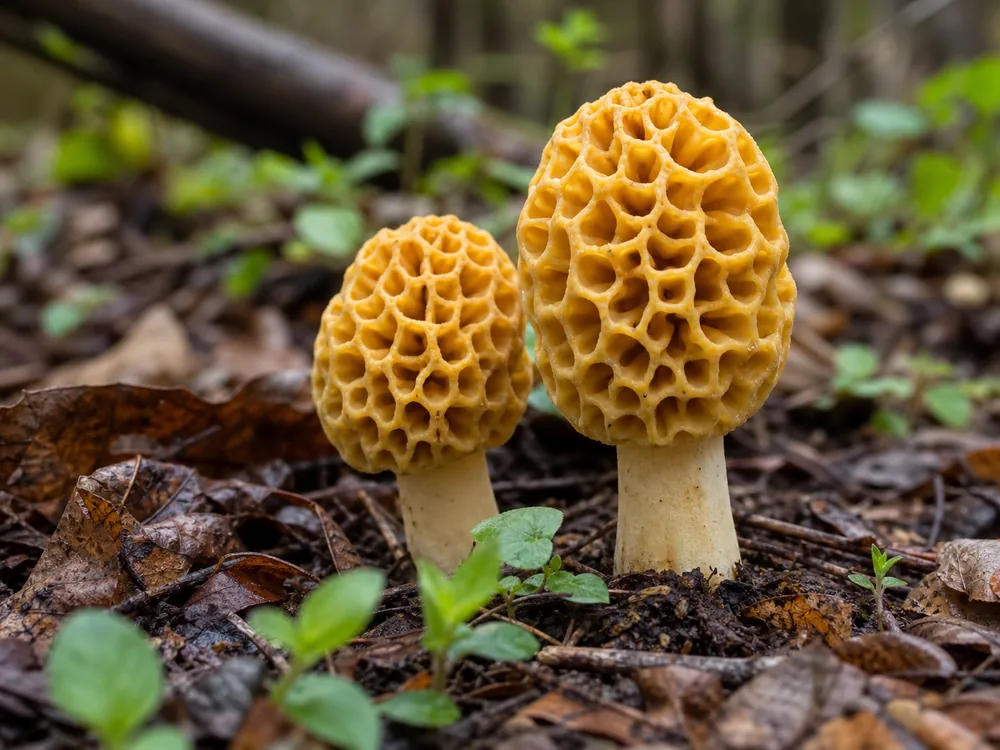
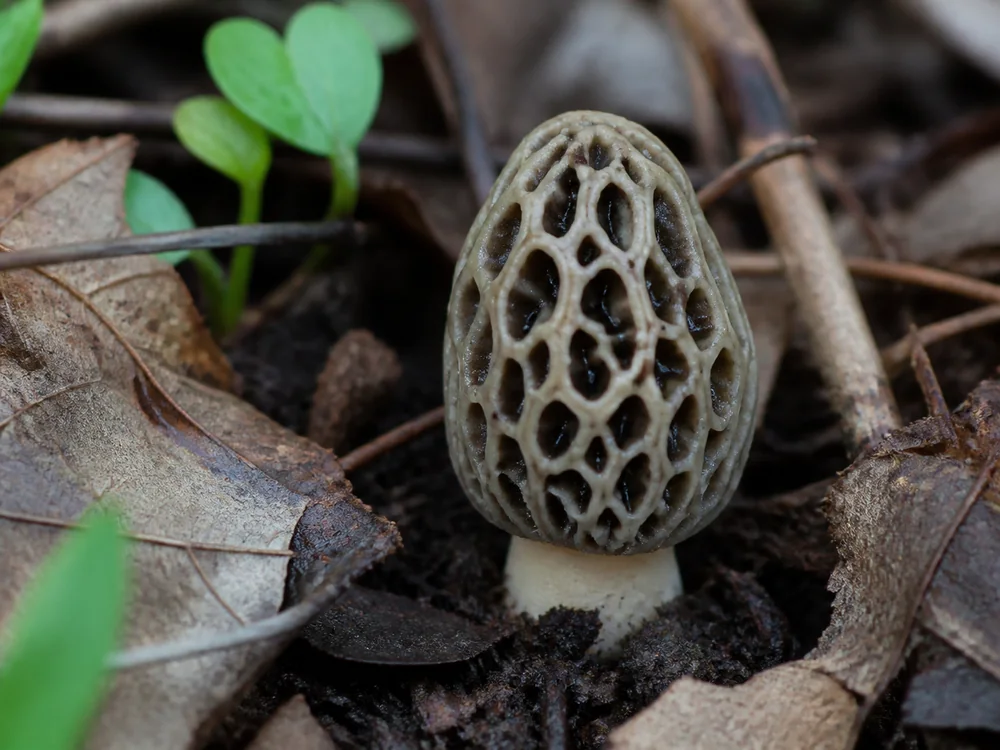
Gray morel is a field name for the young gray stage of the eastern yellow morel treated on this page, Morchella esculentoides. As the fruitbody expands, its gray ridges and dark pits can lighten toward tan or yellow.
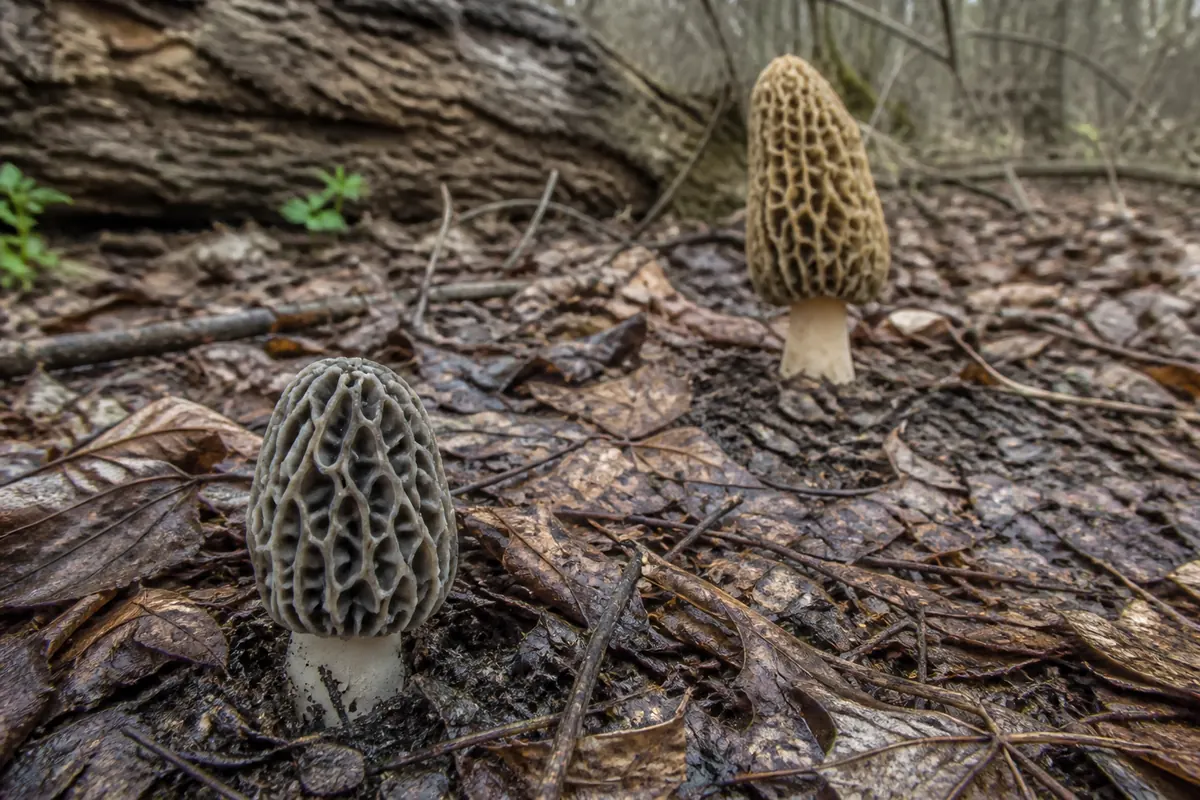
The same patch can therefore produce mushrooms that look like two common-name types. Gray describes a developmental appearance here, not a separate edible species.
Young fruitbodies tend to be squat or egg shaped, with pale gray ridges surrounding gray-brown to nearly charcoal pits. Later fruitbodies usually become taller and paler, while reddish-brown spotting can appear with age.
North American morel taxonomy was revised with multilocus DNA data because European names had been applied too broadly. That evidence supports a species boundary, while the visible gray-to-yellow shift explains why color alone cannot settle an identification.
Which marks stay reliable as the color changes?
Egg-shaped to conical and pitted, with pale gray to pale tan ridges and gray-brown to nearly charcoal pits when young. Both ridges and pits yellow and darken as the mushroom grows, sometimes spotting reddish brown.
No gills. The pitted surface of the cap carries the spores.
White to cream, short and stout while the mushroom is young, hollow and continuous with the cap.
Thin and brittle, hollow from cap tip to stem base, mild earthy smell.
Read a gray morel from structure outward. Its cap has genuine pits divided by firm ridges, and the irregular network is less vertically organized than the ridges on a black morel.
The lower cap edge is fused near the stem base. It does not hang as a loose skirt, which separates this form from a half-free morel before color enters the decision.
Cut the complete fruitbody lengthwise. A continuous hollow interior is required, while cottony tissue or several irregular chambers rules the specimen out.

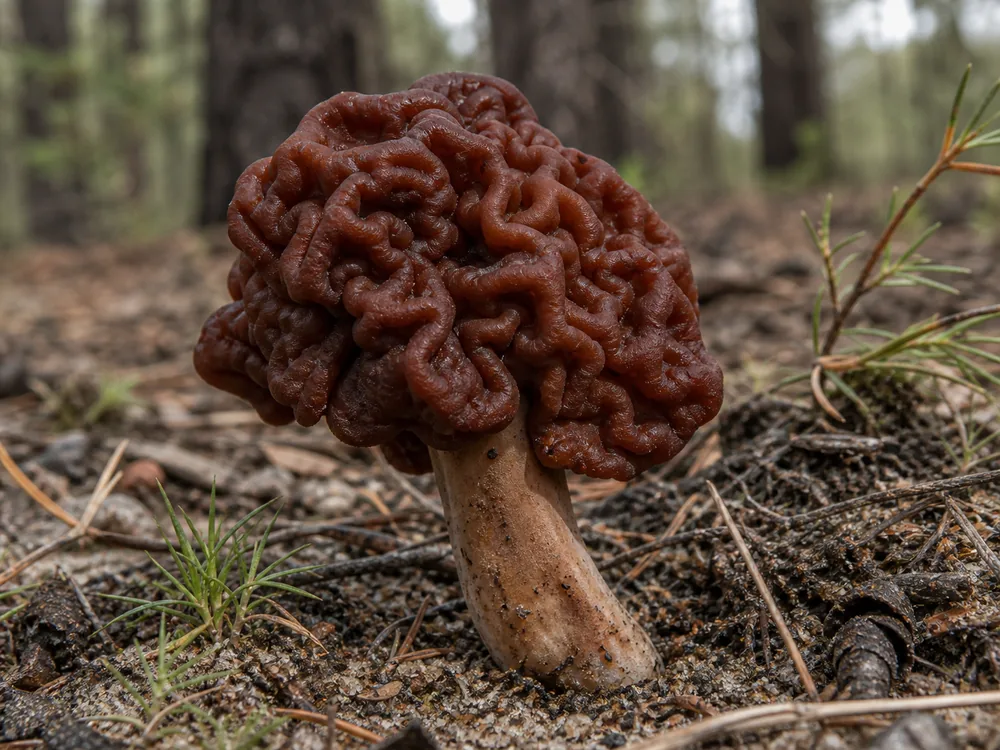
A false morel can also be gray or brown, so its color does not resolve the risk. The false morel comparison shows the surface and interior contrast, but a damaged or incomplete specimen still needs qualified local confirmation before it is considered food.
What can pass for a gray morel?
A gray morel is a true morel, so it takes the same cut as any other. The more useful question is usually whether to pick it at all.
A false morel is never hollow. Its cap is wrinkled or brain-like rather than pitted, and its interior is cottony or chambered.
Gray coloring is not evidence either way. Young true morels are often gray, and some false morels are pale, so the cut decides it and nothing else does.
Anything whose cap hangs free from the top of the stem is a Verpa rather than a morel.
How should a gray-stage morel be prepared?
Gray-stage fruitbodies follow the same kitchen safety rules as mature yellow morels because they are the same species. Halving each one also exposes grit, insects, decay, and any interior structure that contradicts the identification.
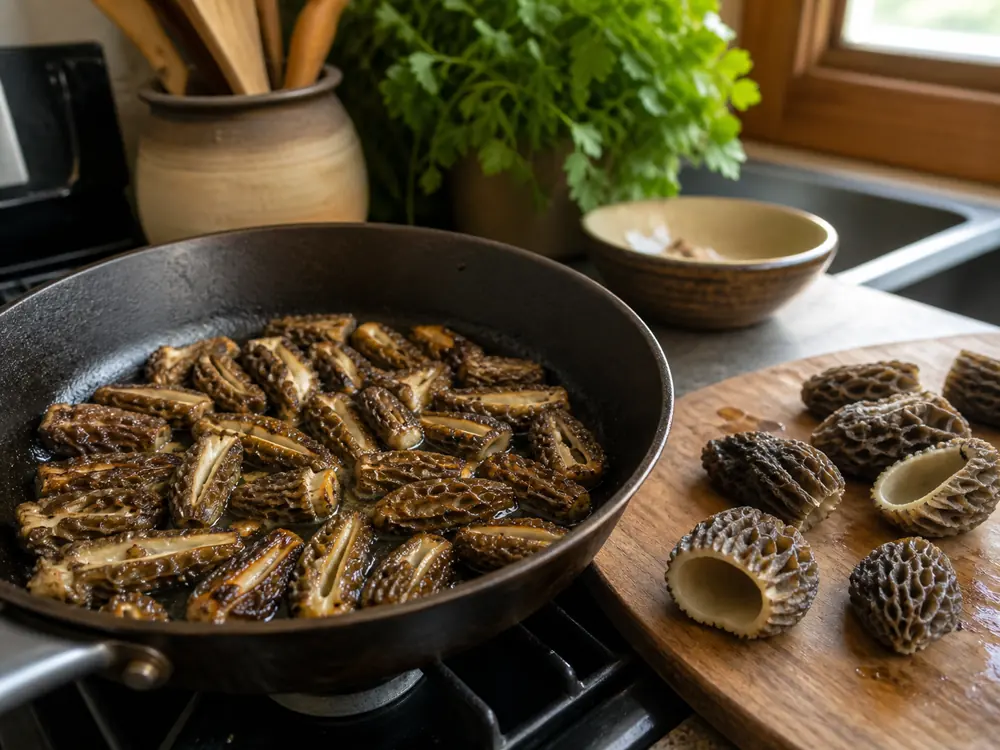
A 2023 Montana outbreak investigation linked morel exposure to 51 gastrointestinal illnesses, including three hospitalizations and two deaths. Raw morels had a stronger association with illness than mushrooms reported as at least partially cooked, so every piece requires thorough cooking.
A crowded wet pan can brown the outside unevenly while the mushrooms steam. Work in a single layer and allow released moisture to evaporate before finishing the cook.
The mushroom poisoning symptoms page explains why symptom timing and a retained specimen matter during a call. Do not wait for severe symptoms before seeking professional advice.
Where does the gray stage appear?
The gray stage appears in spring deciduous woodland across much of the eastern and midwestern range of Morchella esculentoides. Missouri records place this yellow-morel species on the ground in woods, river bottoms, and other moist sites.
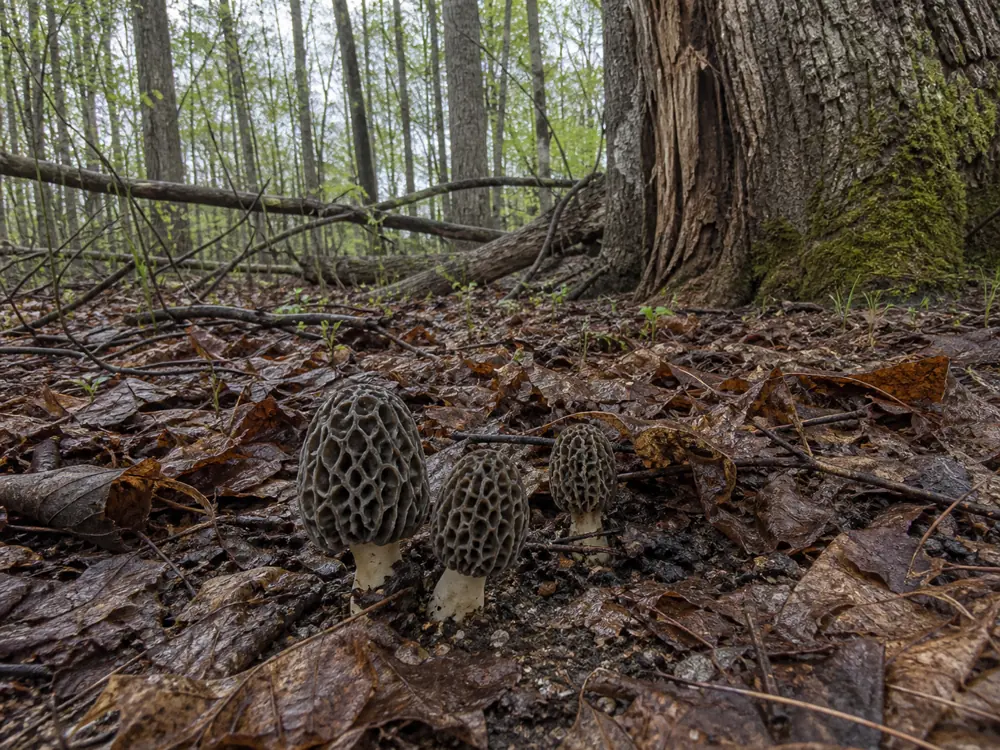
Dying elm is a familiar association, while living ash, cottonwood, tulip poplar, oak, and hickory are also documented. The list is a search aid rather than a host test because multiple trees can occupy the same patch.
Deep leaf litter on draining ground can hold spring moisture without remaining flooded. Creek benches, river terraces, and sheltered slopes often provide that combination, but fruiting still shifts with latitude, elevation, soil warmth, and recent weather.
- Scan several moisture and exposure zones around a likely tree instead of only its trunk.
- Record bark, buds, fallen leaves, slope position, and recent weather with the specimen.
- Photograph the cap surface, attachment, full stem base, and complete lengthwise cut.
- Keep uncertain or deteriorating mushrooms separate and follow the landowner's collection rules.
Habitat narrows the search but does not prove the species. Every collected fruitbody still needs the same surface, attachment, interior, and condition checks.
Note
A known patch can change as tree health, canopy cover, soil moisture, and spring temperature change. A missed fruiting does not identify one cause.
Can a gray-morel kit reproduce this species?
No verified home method can be promised specifically for the gray stage of Morchella esculentoides. A product labeled gray morel also does not prove that it contains this eastern species or that its instructions reproduce a documented fruiting method.
Commercial morel production shows that some Morchella lineages can be cultivated under tightly managed conditions. That result does not validate spore water, mesh-bag dispersal, cutting instead of pulling, or garden-bed claims for this species.
Treat a wild patch as habitat to document rather than a crop you can reliably propagate. Record the trees, soil setting, weather, and fruitbody stage, then judge any future return by what actually fruits there.
Do gray morels have medicinal use?
Morels appear in traditional food cultures across the northern hemisphere, and laboratory studies have examined their polysaccharides and antioxidant activity.
None of that work supports a clinical claim. There is no reliable evidence that eating morels treats or prevents disease in humans, and they belong on the plate rather than in a medicine cabinet.
The health information that does matter is the warning. Raw or undercooked morels cause gastrointestinal illness, and a small number of people react badly even to thoroughly cooked ones.
What do cooked morels provide?
Morels are low in calories and largely water, with a modest amount of protein and dietary fiber, and they are eaten for their flavor rather than as a significant source of nutrition.
Fungi exposed to sunlight convert ergosterol into vitamin D2, so morels can contribute meaningful vitamin D depending on how and where they grew.
They also supply iron, copper, manganese and phosphorus along with several B vitamins, though a normal portion keeps all of those contributions small.
Published nutritional values for wild mushrooms vary widely with growing conditions, maturity and handling, so they are best treated as approximations rather than fixed figures.
None of it changes the preparation rule, because the nutritional benefit is modest and the requirement to cook morels thoroughly is not negotiable.
Taxonomy & Naming
Gray morel is an unstable common name. This page uses it narrowly for young gray fruitbodies of Morchella esculentoides in eastern North American hardwoods, not for western fire-associated species or every morel that happens to look gray.
A 2012 multilocus revision described Morchella esculentoides among the North American lineages separated from names historically borrowed from Europe. Some later taxonomic treatments and databases place it under Morchella americana, so a scientific record should state which name system it follows.
That naming issue does not make color diagnostic. Location, ecology, mature form, microscopy, and DNA evidence can matter when a collection needs species-level certainty.
For a food decision, the name never replaces the physical checks. The pitted surface, low cap attachment, continuous hollow interior, sound condition, and thorough cooking requirement must all agree.
Gray morel questions
Is a gray morel a different species from a yellow morel?
Are gray morels safe to eat?
How do you tell a gray morel from a black morel?
Should I pick small gray morels or leave them?
Why did my gray morel spot stop producing?
What does finding only grays tell me?
Sources & References
- MushroomExpert Yellow morel cap sculpture, color change with age, cap attachment near the stem base, and the gray naming confusion.
- North American Mycological Association Morel adverse-reaction reports and the requirement to cook morels thoroughly.
- Missouri Department of Conservation Yellow morel field description, gray-to-yellow development, hollow interior, spring season, and hardwood habitat.
- CDC Morbidity and Mortality Weekly Report The 2023 Montana outbreak, dose-response evidence, stronger association with raw exposure, and the recommendation to cook morels thoroughly.
- Kuo et al., Mycologia 104(5) Multilocus revision of North American Morchella and formal treatment of Morchella esculentoides and Morchella punctipes.