Liquid culture distributes an inoculation quickly rather than producing better mycelium, and the price is that a liquid medium hides what a plate would show at a glance. Use agar to verify a culture is clean and liquid to multiply it. The medium is about four percent sugar by weight, sterilized at fifteen psi for thirty minutes or longer for larger volumes, with the cooker vented first so trapped air does not leave the contents below temperature. Judge a jar by whether the growth forms discrete clouds that settle, and use two to five millilitres per quart of grain injected down the inside of the glass.
Six grain jars went off in the same week, and they all traced back to one syringe.
Liquid culture can spread contamination as efficiently as healthy mycelium.
What does liquid culture actually do?
It distributes an inoculation quickly. That is the whole benefit, and it is a genuine one for anyone running more than a jar at a time.
One healthy jar can inoculate a dozen grain jars in a few minutes, with no scalpel, no flame between transfers and no waiting for a plate to grow out. For anyone running more than a jar or two of sawdust blocks at a time, that is a genuine change in what is possible.
Test the culture before distributing it to more grain.
Speed of distribution is the only thing on offer here. The same culture on agar grows at the same rate with the same vigour, because nothing about suspension in sugar water improves a fungus.
Liquid culture distributes growth quickly, but apparent clarity does not establish purity.
Why is agar still the gate?
Because a plate shows you things a jar hides.

That difference comes from the medium rather than from the organism. Agar spreads growth across a surface, so anything that is not your mycelium appears as a separate colony with its own color, texture and edge.
A liquid mixes everything together instead, so a bacterial population that would be an obvious cream-colored smear on a plate becomes the same faint uniform cloudiness a young healthy culture shows.
Three things a plate shows you that a jar cannot. All of them come from growth sitting on a surface rather than suspended in a liquid:
- Separate colonies, each with their own color, texture and edge.
- Where a contaminant sits, which lets you cut clean tissue away from it.
- Growth rate against a visible reference, since the whole plate is in one plane.
Key takeaway
The workflow experienced growers use is not liquid culture instead of agar. It is agar to verify a culture is clean, then liquid to multiply the verified culture, and the plate is the step that makes the jar trustworthy.
That order matters more than any other advice here, because a culture started from a verified plate is a reliable tool while one started from an unverified spore syringe is a fast way to lose a whole run.
Growing MushroomsWhat Does a Mushroom Farm Actually Cost to Start?What is the recipe and does the sugar matter?
Water and a sugar. There is less to argue about here than the internet suggests.
The working concentration is about four percent sugar by weight, which comes out at roughly four grams in a hundred millilitres of water. Below that the culture is slow, and above it growth actually falls off rather than improving.
| Medium | Typical use | Notes |
|---|---|---|
| Light malt extract | The default | Complete enough for most species, mixes cleanly |
| Honey | Common substitute | Works well, varies by source |
| Dextrose | Clean and predictable | No trace nutrition, which is fine here |
| Potato dextrose | Richer | Rarely necessary in a liquid, useful on agar |
Notice that the table has no column for yield, because the nutrition in the jar is not what limits the culture and adding more of it produces no more usable mycelium.
The practical recipe fits in three lines:
- Four grams of light malt extract in a hundred millilitres of water.
- Filtered or distilled water if your tap water is heavily chlorinated.
- Nothing else, because additives raise contamination risk far faster than they raise growth.
Too much sugar is a real failure and worth stating plainly. High concentrations draw water out of the hyphae by osmosis, which is why a very sweet jar grows more slowly than a correctly mixed one.
Tip
A few grains of a light malt extract is enough to color the water noticeably. If your medium comes out dark brown you have almost certainly overdosed it, and it is quicker to remix than to wait three weeks finding out.
What goes into the lid?
Two components, both of which fail in ways that are easy to miss until a jar is already open.
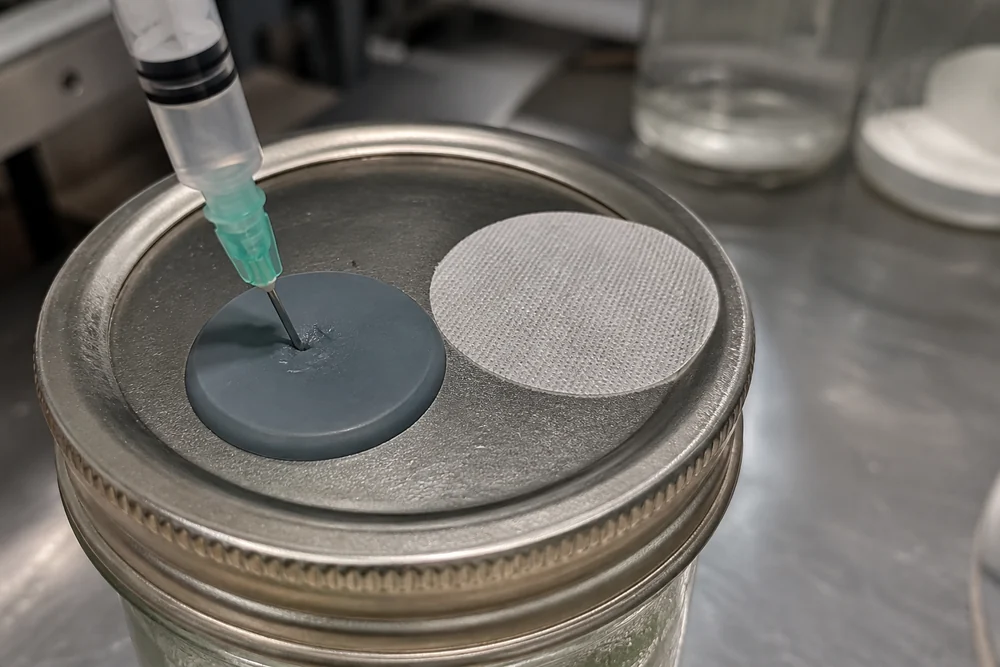
A self-healing injection port is a thick silicone plug that closes behind a needle. It lets you take liquid out repeatedly without ever removing the lid, which is the entire reason the method works.
A filter patch does the opposite job. It lets the jar exchange air during sterilization and cooling without letting anything in, and a jar sealed with no filter can pull unfiltered air in around the lid as it cools.
- The port
- Silicone, self-sealing, punctured with a needle rather than opened.
- The filter
- A patch or a stuffed cotton hole that breathes and excludes spores.
- Port failure
- Repeated punctures in one spot stop sealing after five or six uses.
- Filter failure
- A wet filter passes organisms, so keep liquid off it.
- The check
- Hold the lid to the light and look for a pale worn ring on the port.
Rotate where you puncture. Hitting the same millimetre every time wears a channel through the silicone, and the jar goes from sealed to open without any visible change.
Growing MushroomsHow Do Mushroom Sawdust Blocks Work from Mix to Fruit?How do you sterilize it properly?
Fifteen psi, held long enough for heat to reach the middle of the liquid.

Fifteen psi corresponds to about 121 degrees Celsius, which is the temperature that kills bacterial endospores rather than merely inconveniencing them. Anything below that is pasteurization with extra steps.
Time scales with volume rather than with risk, so a liter flask needs considerably longer than a half-pint jar and the answer is always more minutes rather than more pressure.
Warning
Venting is not optional. Trapped air inside a pressure cooker means the gauge reads fifteen psi while the contents sit well below 121 degrees, which is exactly the failure that produces jars that look fine and are not.
The rest step at the end is the cheapest insurance in the whole method. A jar left for two days will cloud visibly if the sterilization failed, and finding that out before you inject it costs nothing but patience.
Do you need a stir bar?
No, though it is genuinely useful.

Agitation breaks the mycelium into fragments, and every fragment becomes a new growth point. Every fragment is a new growth point, so a stirred culture reaches usable density considerably faster than a still one.
Shaking the jar by hand once a day does most of the same thing. It is less consistent and less thorough, and for one or two cultures at a time the difference is a few days rather than success against failure.
The stir plate earns its place when you are producing cultures on a schedule rather than one jar every few months, and until then the money is better spent on agar plates and a still air box.
How do you tell a good jar from a bad one?
By what the liquid does when it sits still. Movement is the test, not appearance.

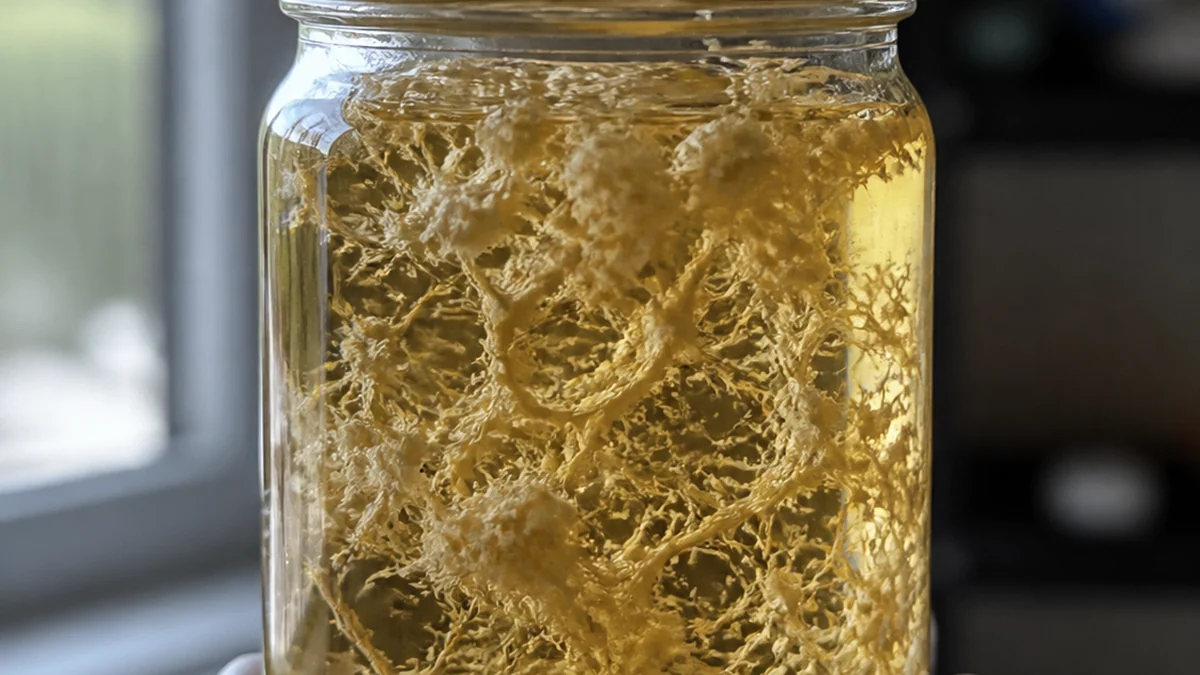
A healthy culture forms discrete white clouds in a medium that is otherwise clear. Tilt the jar and the clouds move as objects; leave it alone and they settle without the surrounding liquid changing.
A bacterial bloom is uniform, going faintly milky throughout without resolving into separate structures and without clearing when the jar is left to stand.
Once a jar has clearly failed, identifying the specific organism matters far less than the decision to throw it away.
Look at it in daylight against a white background
Tilt it and watch whether the growth moves as discrete pieces
Leave an ambiguous jar to stand for two days and look again
Judge a jar in the dark or through a grow tent window
Inject from a jar that smells sour or yeasty on opening
Assume a film on the surface will settle out
Some signs end the discussion before any of that subtlety matters:
- A film or skin across the surface of the liquid.
- Any color that is not white in the growth, particularly pink, green or gray.
- Bubbles or fizzing, which mean something is fermenting your sugar.
Smell is the fastest test and the most under-used. A clean culture smells faintly of the medium and of mushroom, and anything sour, yeasty or sharply sweet means the jar is finished regardless of how it looks.
The awkward case is a jar that is slightly hazy and young, and two days standing in a fridge separates them, because mycelium settles and a bacterial population does not.
Growing MushroomsHow Do You Build an Outdoor Mushroom Bed That Lasts?How do you draw and handle a syringe?
Carefully. This is where most home contamination actually enters, rather than anywhere upstream.
A few quick checks cost less than losing several grain jars.

Wipe the port with alcohol before the needle goes anywhere near it, then flame the needle until it glows, let it cool for fifteen seconds and puncture without touching anything else on the way.
Draw with the jar upright and the needle in the liquid rather than in the headspace. Pulling air in makes the syringe harder to dose accurately and puts a bubble where you wanted culture.
Note
A fresh needle for each session costs very little and removes a whole category of problem. Needles blunt quickly on silicone, and a blunt needle tears the port instead of parting it, which is how a port that should last twenty punctures fails at six.
Work in still air, and if you are building toward a fruiting chamber later, the same still-air discipline is what makes that stage manageable too. A still air box or even a cleared corner away from doors and fans makes more difference at this step than any equipment further upstream.
How do you inoculate grain with it?
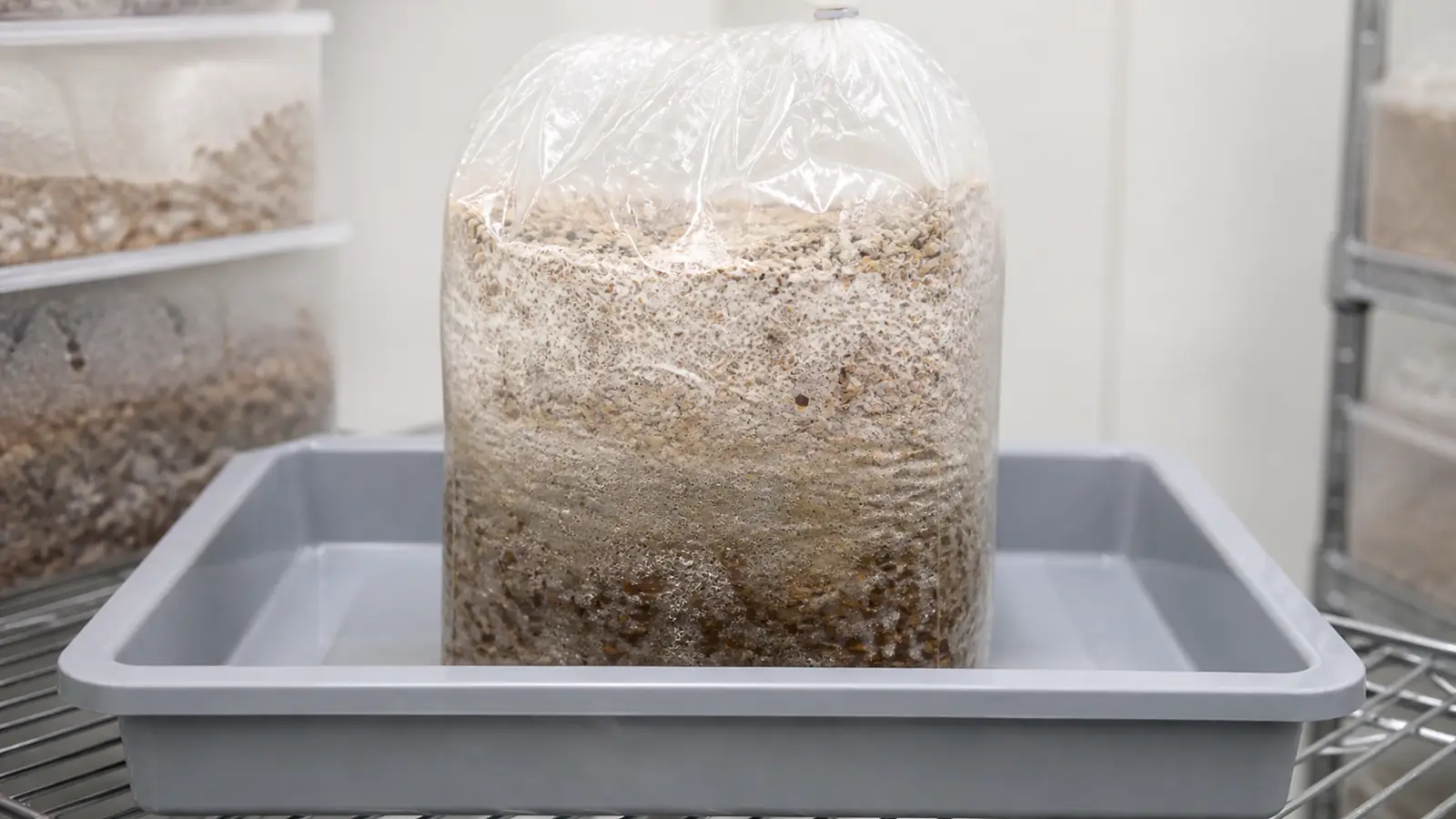
Two to five millilitres per quart jar, injected against the glass.

Volume matters less than distribution does. Five millilitres delivered into one spot colonizes more slowly than two millilitres spread down the side of the jar, because what matters is how many separate starting points you created.
Injecting against the inside of the glass lets the liquid run down and spread through the grain, and it lets you watch colonization begin at several points over the following days.
Shake the jar once colonization is clearly underway. Breaking up the colonized clumps redistributes them and can halve the time to full grain spawn, which is the same fragmentation principle as the stir plate.
Do not shake a jar that has barely started. Fragmenting a culture that has not yet taken hold spreads a small amount of mycelium very thin, and slow jars are exactly the ones that lose races.
How long does it keep?
Several months refrigerated, with a decline nobody warns you about.
Viability and vigour are different things. A jar that is four months old will usually still colonize, and it will do it noticeably more slowly than a jar that is four weeks old.
That slowness matters more than it sounds, because colonization speed is the whole defence against a competitor and an old culture is measurably more likely to lose a bulk substrate tub.
Repeated subculturing is the other limit. Each transfer from liquid to liquid accumulates the ageing that agar storage largely avoids, so a culture kept alive by refreshing jars for two years is not the culture you started with.
A culture that has slowed is also a culture that pins late and unevenly, which reads at the fruiting stage as an aborted pin problem rather than as a culture one.
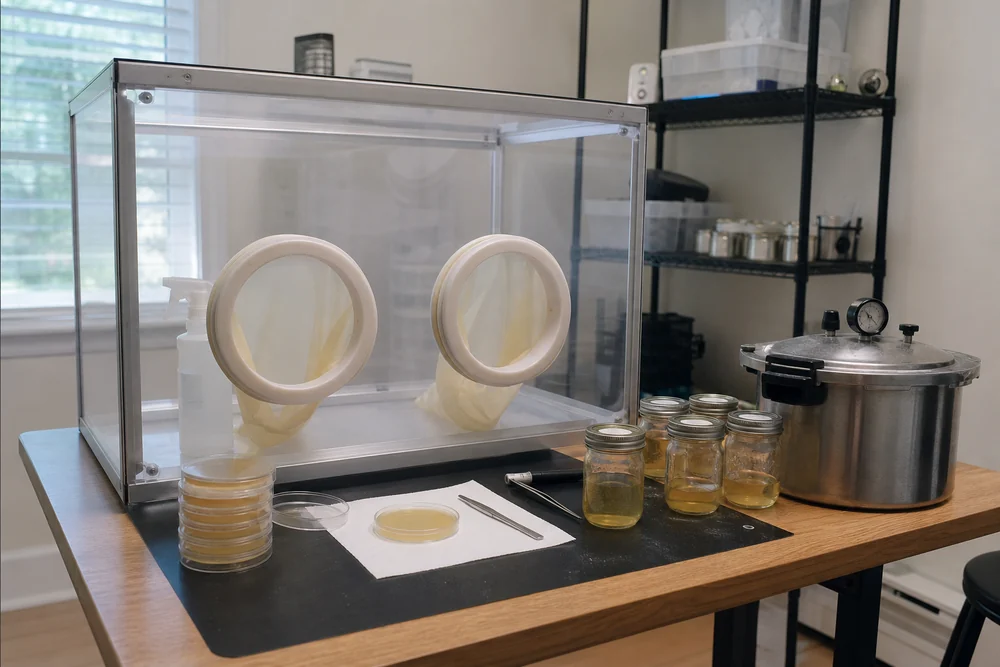
The practical answer is to keep a plate. A verified plate in a fridge is the reference copy, and every liquid jar is a working copy made from it rather than from the last working copy.
One thing worth settling before any of this is which species you are committing a season to, since a king oyster and a lion's mane want quite different things from you.
From here the chain is mechanical. Grain, then bulk, then fruiting, and a block that colonizes well and then marks after pinning is a watering problem rather than a culture one.
Sources & References
- Mushroom Spawn Production and Culture Maintenance (Penn State Extension) University extension material used for the role of verified culture stock, for the relationship between colonization speed and competitor pressure, and for the degradation of vigour through repeated subculturing rather than through loss of viability.
- Guide to Home Canning, principles of pressure processing (USDA / National Center for Home Food Preservation) Federal food preservation guidance used for the relationship between fifteen psi and approximately 121 degrees Celsius, for the requirement to vent trapped air before pressurising, and for the principle that processing time scales with the volume being heated rather than with the temperature applied.
- Cornell Small Farms specialty mushroom production resources Extension programme material used for standard spawn workflow practice, including the use of verified plate culture as the reference stock and liquid or grain culture as working copies.