
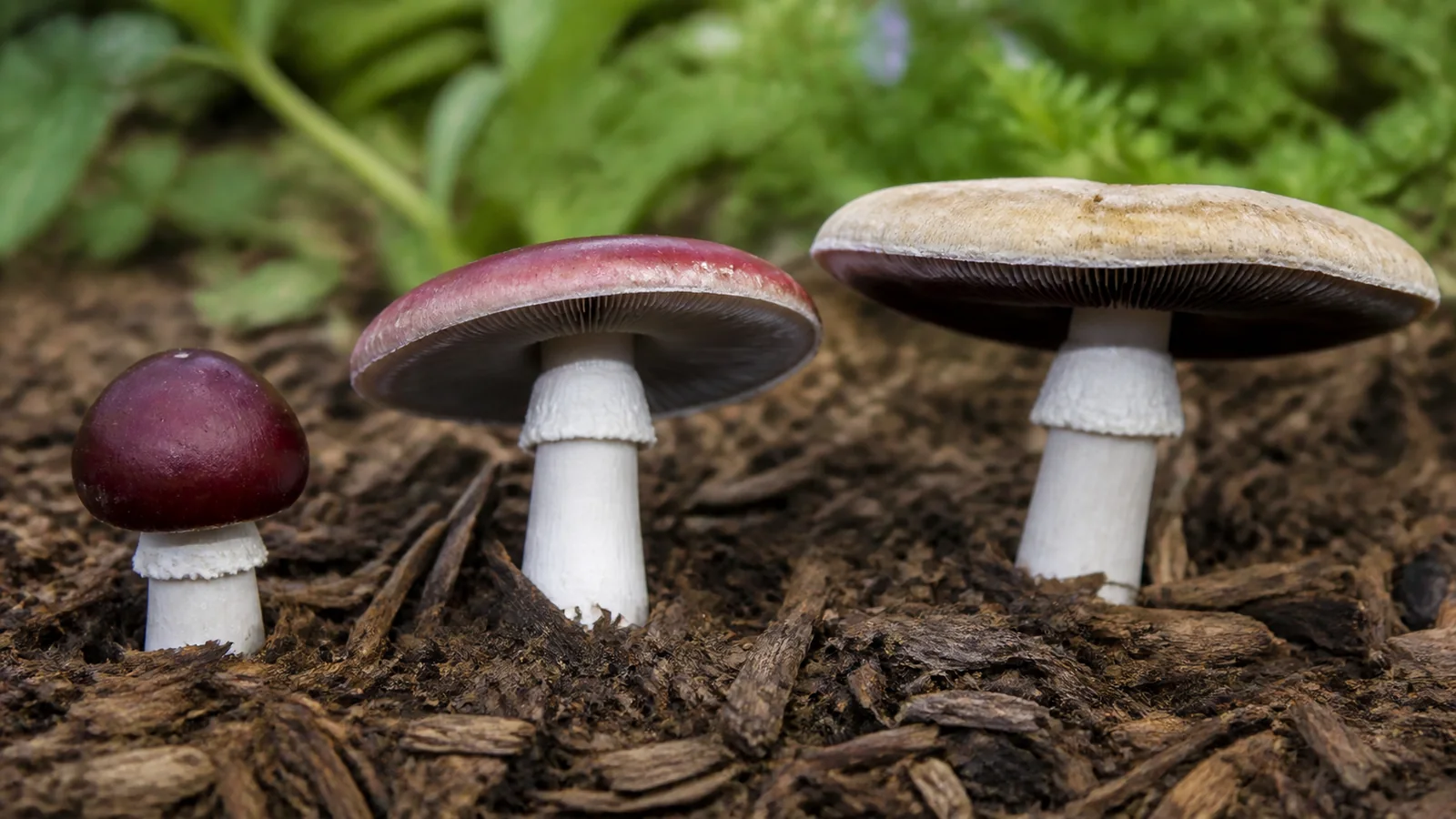
Most of the mushrooms in this series arrive by accident. This one you planted on purpose, in a bed you built, out of chips you spread yourself.
That is exactly why the answer has to work differently here.
Can you eat wine cap raw?
No, and the honest reason is that nobody has written down an answer either way.
- What the references say
- Every description of eating it is a cooked one
- What none of them say
- Anything at all about eating it raw
- Cooked texture
- Crisp rather than soft, which is unusual in a mushroom
- Cooked flavor
- Mild, earthy and nutty
- The real constraint
- Whether the identification is closed on this specimen
Three pages rank for this exact question and not one of them answers it either way. They describe the mushroom, they explain how to grow it, they recommend sauteing it in butter, and the word raw never appears.
Silence is not permission, and it is not a warning either.
What it usually means is that nobody has had a reason to test it, because this is a mushroom grown deliberately to be cooked and everybody who writes about it cooks it. That leaves no evidence in either direction, and it leaves one real risk that has nothing to do with the species at all.
It is worth saying what this mushroom is, because most people asking this question own one rather than found one.
Wine cap goes by king stropharia and garden giant as well, and it is the species sold as spawn to spread through a bed of hardwood chips. It fruits in the same ground people use for paths and borders, it produces heavily, and it is one of the very few gourmet mushrooms a person can grow without any equipment at all.
That accessibility is the whole reason this question gets asked.
Somebody who has waited a season for a bed to produce is standing over the result feeling a long way from a foraging risk, and the temptation to taste a piece on the spot is a gardener's temptation rather than a forager's.

The bed you sowed is still open ground
Growing it yourself feels like certainty and it is a different thing entirely. You know exactly what you put into the bed, and you do not know what came out of it.
Warning
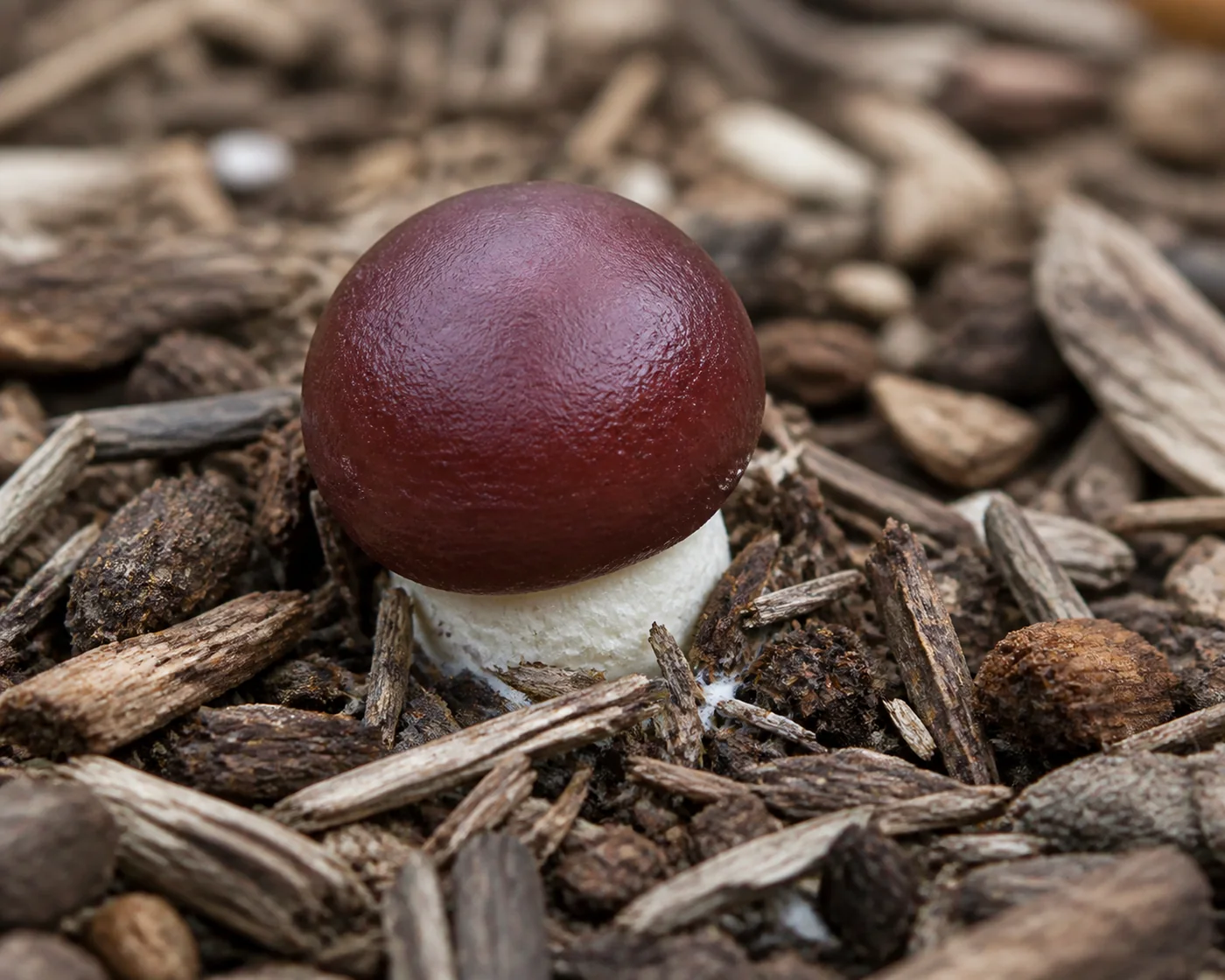
A wood chip bed is open ground. Spores land on it, other fungi colonize it, and a bed inoculated with wine cap spawn will still produce whatever else finds the conditions suitable. The stage at which any confusion is hardest to resolve is the unopened button, which is also the stage a grower is most pleased to find.
One foraging reference puts the risk in a single sentence.
Deadly mushrooms such as the death cap may superficially resemble wine caps at certain stages.
A foraging reference on this species
That deserves proportion rather than alarm. A death cap coming up in a hardwood chip bed is not a common event, and it is not impossible either, and the reason it matters here is not the odds.
It is that this particular mistake has no version where you get away with it.
Everything else in this series fails softly. A bitter mushroom is a wasted dinner, a badly cooked one is an unpleasant evening, and this one is the only page in the cluster where the downside is measured in organs.
Volunteers in a chip bed are normal rather than exceptional.
Any bed of decaying hardwood is habitat, and over a season or two it will host things nobody put there, most of them small brown mushrooms of no consequence whatsoever. The point is not that the bed is dangerous, it is that the bed is not a container and the spawn you spread does not have exclusive use of it.
Check the source, identity, and condition before preparation.
None of them need expertise and all of them work at the button stage, which is the stage that matters. Doing them properly once on a new bed and spot-checking after that is a proportionate amount of care for something shaped like this.
The three checks that settle it
Take these in order of how much each one actually settles.
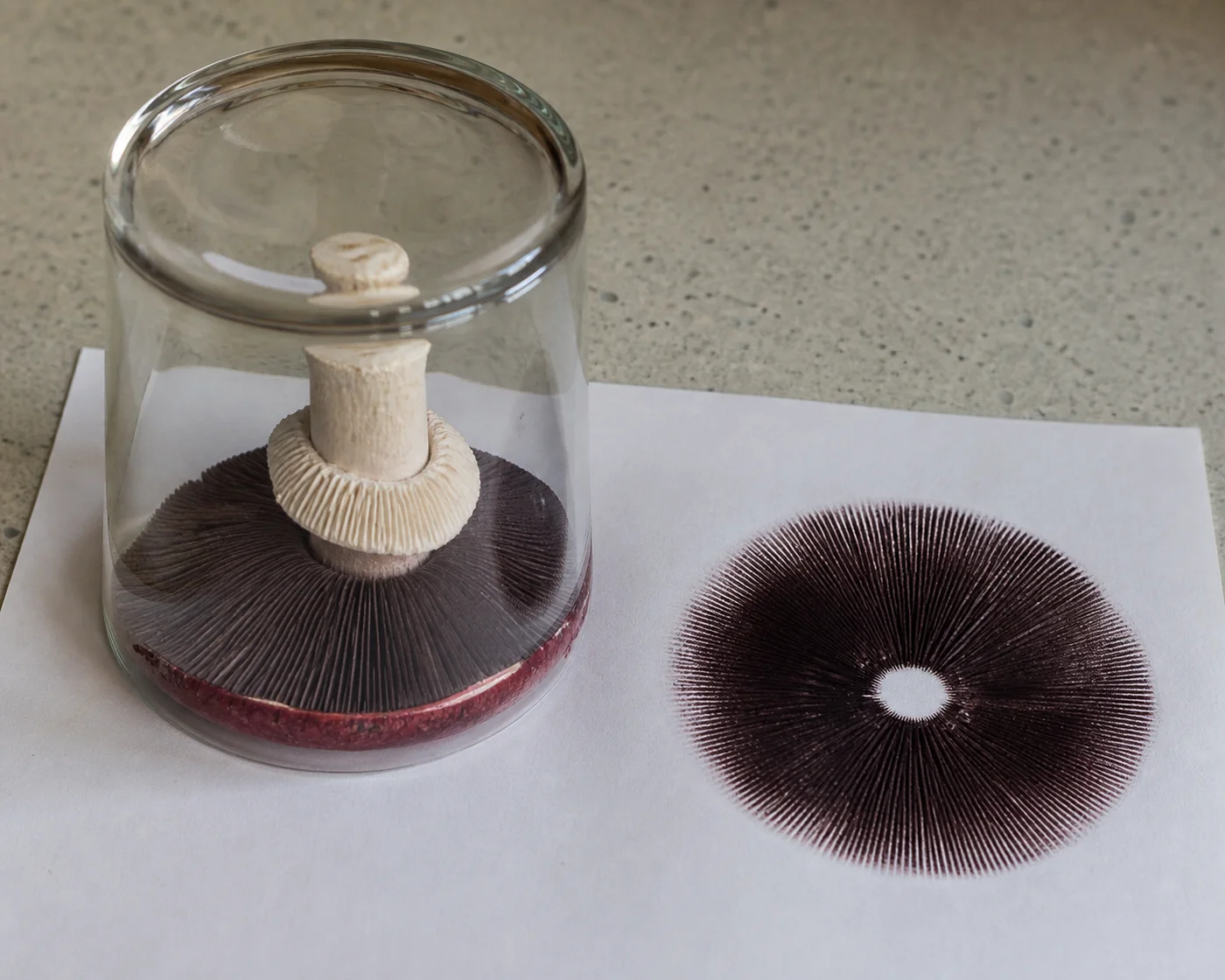
The spore print is the one that ends the argument. A wine cap drops a deposit so dark it reads as black against white paper, and the mushroom that warning is about drops a white one.
Nothing about that comparison is subtle on a sheet of white paper.
It takes a cap, a sheet of paper, a glass over the top and a few hours, and it gives you an answer you cannot talk yourself out of afterwards. On a new bed it is worth doing once even when you are already confident.
A print takes a few hours rather than a night, in most cases.
A fresh mature cap laid on paper under a glass will usually give a readable deposit in two to four hours, and leaving it overnight simply makes it denser. If a cap gives nothing at all it is either too young to have started dropping or too old to have anything left, and both are reasons to test a different specimen rather than to conclude anything.
The ring is the check you can make without leaving the garden.
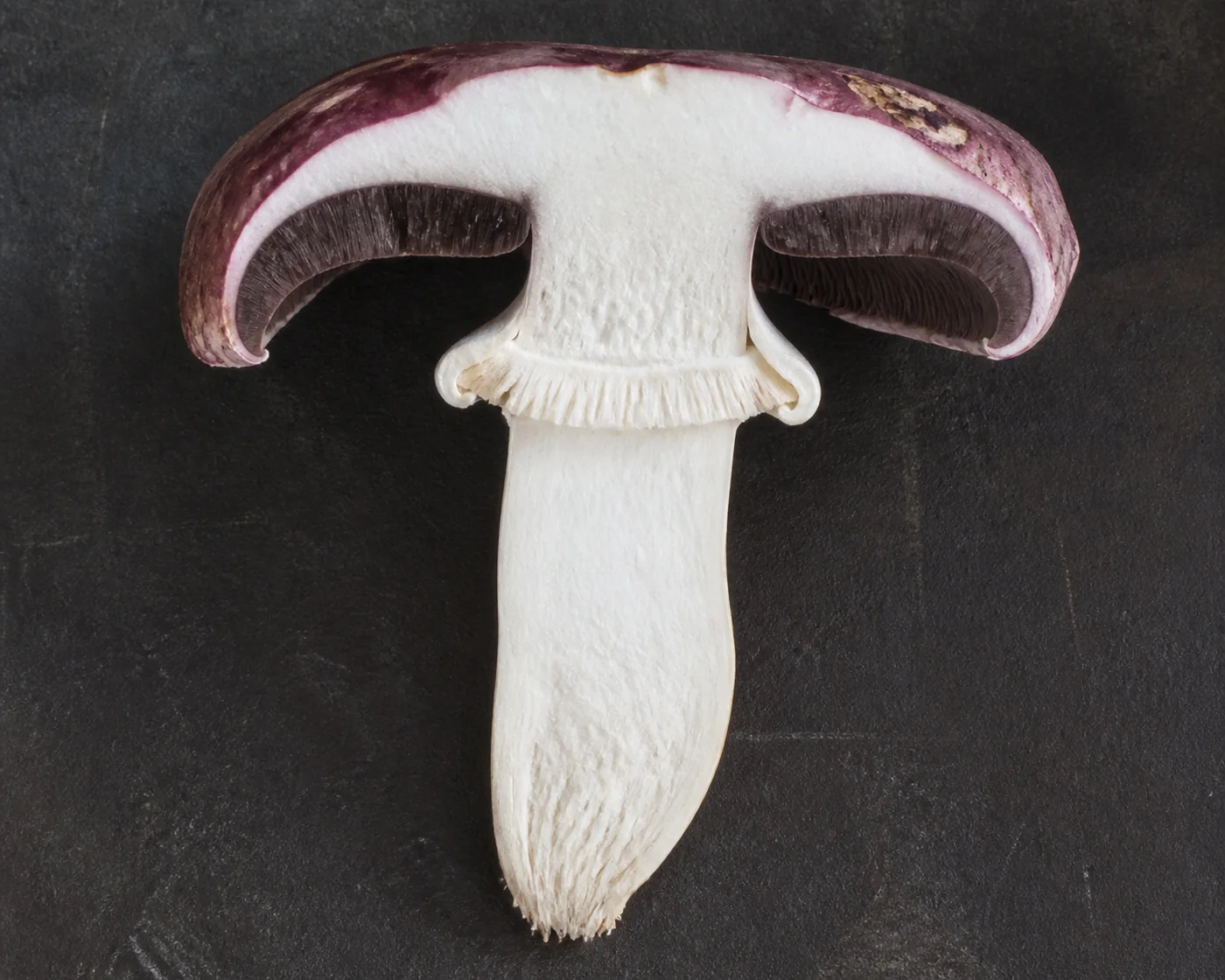
The species is named for it, because rugosoannulata means wrinkled ring, and the upper surface of that thick white collar is grooved like the milled edge of a coin. Nothing else coming out of a mulch bed carries one like it.

There is a catch with the gill check at the button stage.
On an unopened cap the gills are still sealed under the veil, so the one color check you can make in the garden is unavailable exactly when you most want it. That is why the print and the stem base carry the weight on a young specimen.
The stem base is the third check and it is the one people skip.
A wine cap tapers into white cords running off into the wood chips, with nothing wrapped around the bottom of the stem. A sac or a cup down there is the feature that stops everything, and it usually sits below the surface where a knife cut at ground level would leave it behind.
Why the color will not help you
The common name is doing you a disservice.
| Feature | What it does | Can you rely on it |
|---|---|---|
| Cap color, young | Deep wine red to burgundy | Only while it is young |
| Cap color, mature | Fades to a soft pale brown | No |
| Cap color in sun | Can fade to almost white | No |
| Gill color | Pale, then gray, then dark purple-brown | Yes, and it runs one way only |
| Spore print | Dark purple-brown to black | Yes, completely |
Wine cap describes a young mushroom sitting in shade. Leave the same specimen a few days in an exposed bed and most of the color that gave it the name has gone.
That is a problem because color is the feature people actually use.
Somebody who learned this mushroom as the big burgundy one in the wood chips will meet a faded flattened specimen and either throw away a perfectly good mushroom or, far worse, accept a pale one on the grounds that wine caps go pale.
The colors that do work run in one direction and never reverse.
Gills go pale, then gray, then dark purple-brown, and they never travel back. A pale-capped mushroom with dark purple-brown gills is an old wine cap, and a pale-capped mushroom with white gills is not a wine cap at any age at all.
There is a simple rule for a mushroom that will not resolve.
It goes in the bin rather than in the basket, and that costs nothing here in a way it would not elsewhere. A bed producing repeatedly through three seasons means a discarded mushroom is replaced within a fortnight, which makes this the cheapest place in the whole series to be cautious.
Picking from your own bed
Which ones to pick and when are the same question here, because the picking rule and the eating rule land on the same mushroom.
Harvesting while the cap is still domed gives you the firm texture the species is grown for, and it hands you the specimen with the most intact features at the same time. Both reasons point at the same moment.
Lift the first few rather than cutting them.
The base is one of the three checks and a knife at chip level leaves it behind in the bed, so early in a flush it is worth easing a whole mushroom out to look at the bottom of the stem. Once a bed has proved itself across a season, cutting is fine.
A bed does not produce one crop once and then finish.
It flushes repeatedly from spring into autumn and keeps going for as long as the chips last, which means the identification question comes back every few weeks rather than once at the start. That is the argument for making the checks a habit instead of an event.
The yield catches people out in the other direction rather than this one.
An established bed can produce more in a single flush than a household will eat, and the mushrooms are large enough that a dozen is a serious quantity of food. That is worth planning for before the flush arrives rather than during it.
How long a bed keeps going comes down to the chips.
Coarse hardwood chips break down over roughly two to three seasons, and the bed produces until the wood is spent, at which point it is topped up rather than started again. That means these checks are not a one-off task attached to a new bed but something that comes round with every top-up.
What cooking actually gives you
The last argument against eating this one raw is not a safety argument at all. It is that cooking is more or less the entire point of the mushroom.
Crisp is the word that keeps coming up, and for a mushroom it is genuinely unusual.
Most mushrooms go soft in a pan, and this one browns and holds an edge, which is why it takes to a grill in a way that a field mushroom never will. That texture is a cooked property, and there is no raw version of it to compare against.
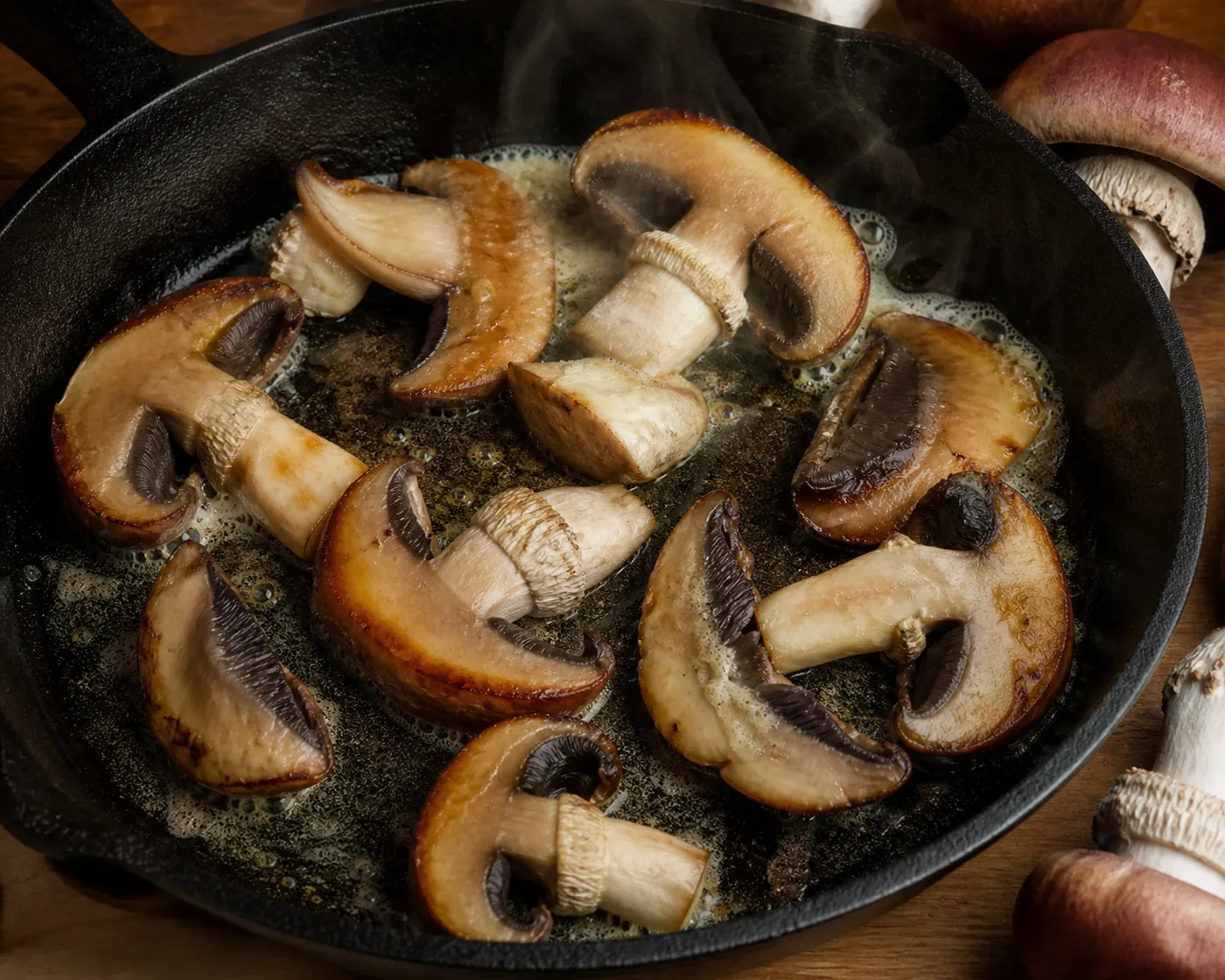
The stems of this mushroom are worth a sentence, because most pages discard them.
A wine cap stem is solid and firm rather than fibrous, so it slices and cooks alongside the cap instead of going into a stock pot. On a mushroom this size that roughly doubles what you carry in from a flush.
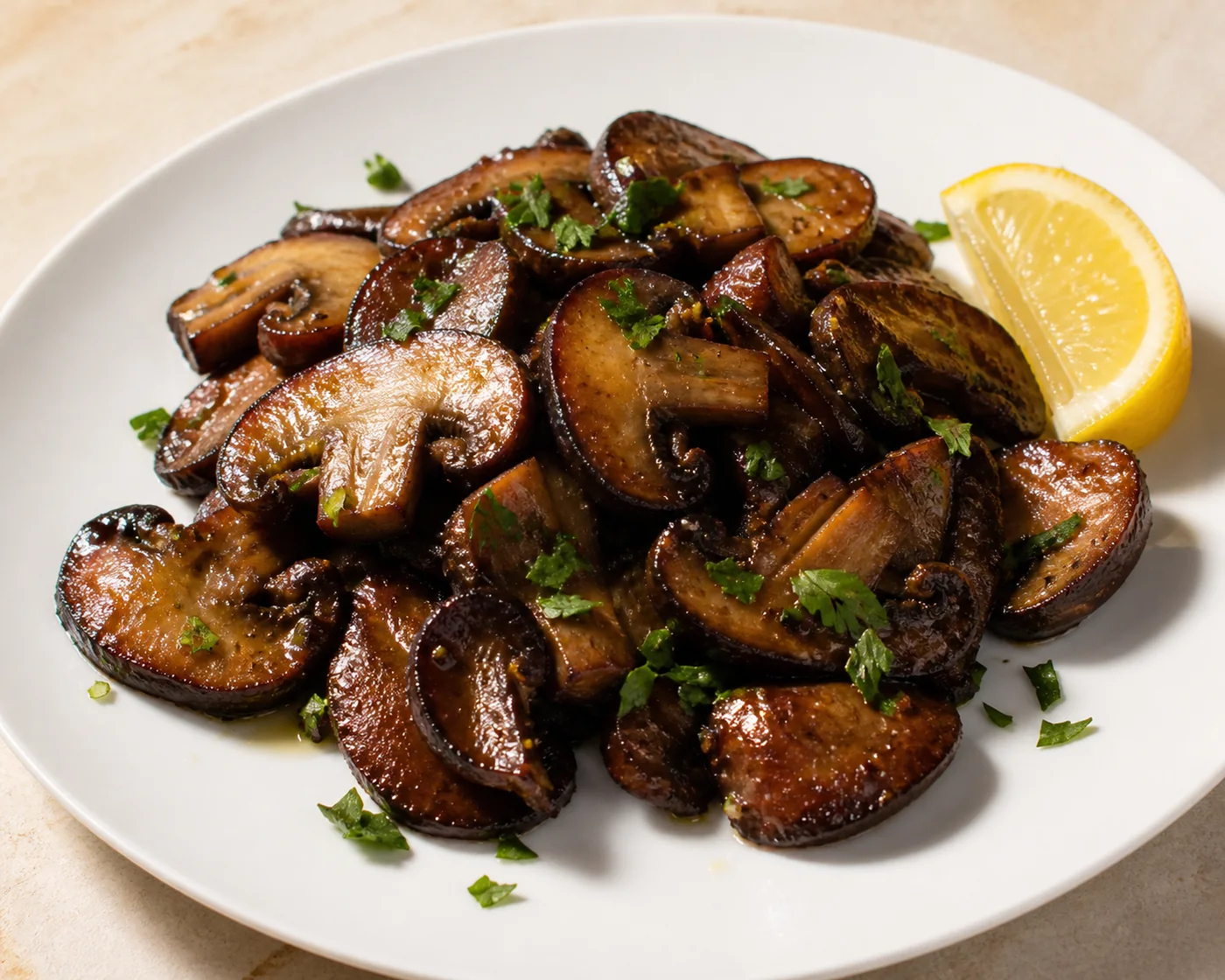
A flush keeps better cooked than raw.
Sliced and browned in a pan, then cooled and refrigerated, they hold for several days and go straight into anything, where the same mushrooms left whole in a fridge go soft and start to open. Cooking on the day of the flush is the honest answer to a bed that produces faster than you can eat.
So the answer is no, and not for the usual reason.
Nothing in a correctly identified wine cap is going to hurt you, there is no recorded benefit to eating one raw, and there is one good reason not to eat anything out of an open bed before checking it. Cook it in butter and the question stops mattering.
Sources & References
- Large and Edible Wine Cap Mushrooms, Stropharia rugosoannulata, Eat The Planet Gives the caps reaching up to 30 cm, the wine red color fading to a soft pale brown and to almost white in sun, the deep dusky purple to gray gills, the wrinkled collar around the stalk, the wood chip and garden mulch habitat, the spring through autumn season, and the warning that deadly mushrooms such as the death cap may superficially resemble wine caps at certain stages.
- Stropharia rugosoannulata, Wikipedia Gives the dark purple-brown to black spore print, the gills running pale then gray then dark purple-brown, the reddish-brown cap up to 30 cm, the wrinkled ring, the wood chip habitat in summer and autumn, the ease of cultivation on a similar medium, and the cooking recommendation to saute in butter or grill.
- Wine Cap Mushroom, King Stropharia, Garden Giant, MycoHaus Gives the burgundy-brown caps fading to brown-tan, the affinity for wood chips in gardens and mulch beds, the instruction to harvest while caps are still convex and not yet fully opened, and the uses from sautes and stews to risottos. Does not address raw consumption.