
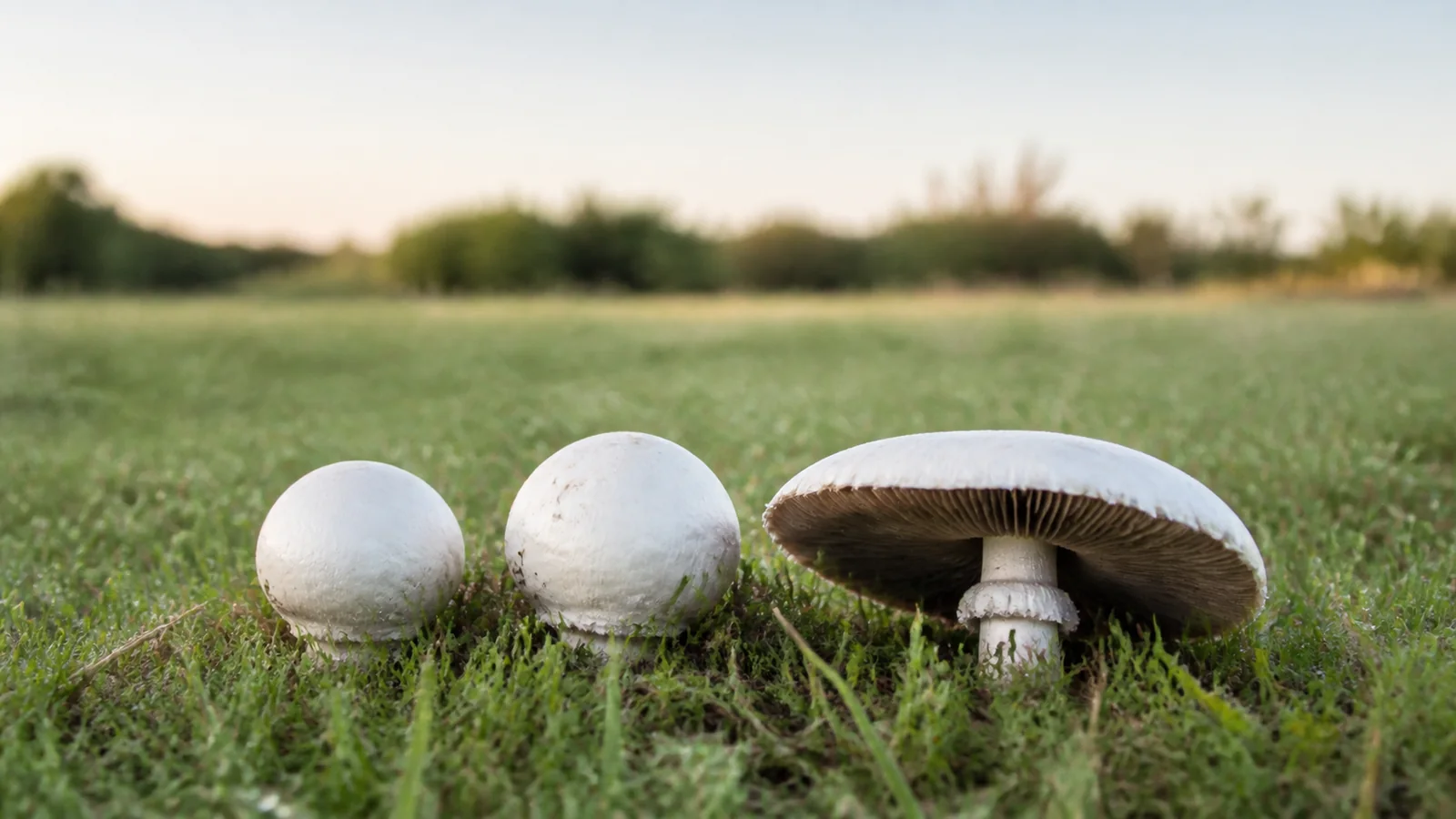
A field mushroom looks so much like the ones in the shop that most people stop looking at it. Same white cap, same short stem, same size, pulled out of grass instead of a punnet.
Resemblance to a shop-bought mushroom is no reason to skip the identification checks.
Can you eat field mushroom raw?
No, and not because of anything the mushroom contains.
The reason to cook a wild Agaricus is not that heat neutralizes something. It is that cooking is the point in the process where most people look again, and raw removes that pause entirely.
There is also the ordinary reason that applies to everything picked out of a field. It has been in contact with soil, animals and whatever was on the grass, none of which happened to the punnet in the shop.
That second reason is minor and worth stating anyway.
The first one is the whole page. A field mushroom is genuinely good food, and the only thing standing between a basket of them and a serious problem is a check that takes about three seconds and gets skipped precisely because the mushroom looks so familiar.
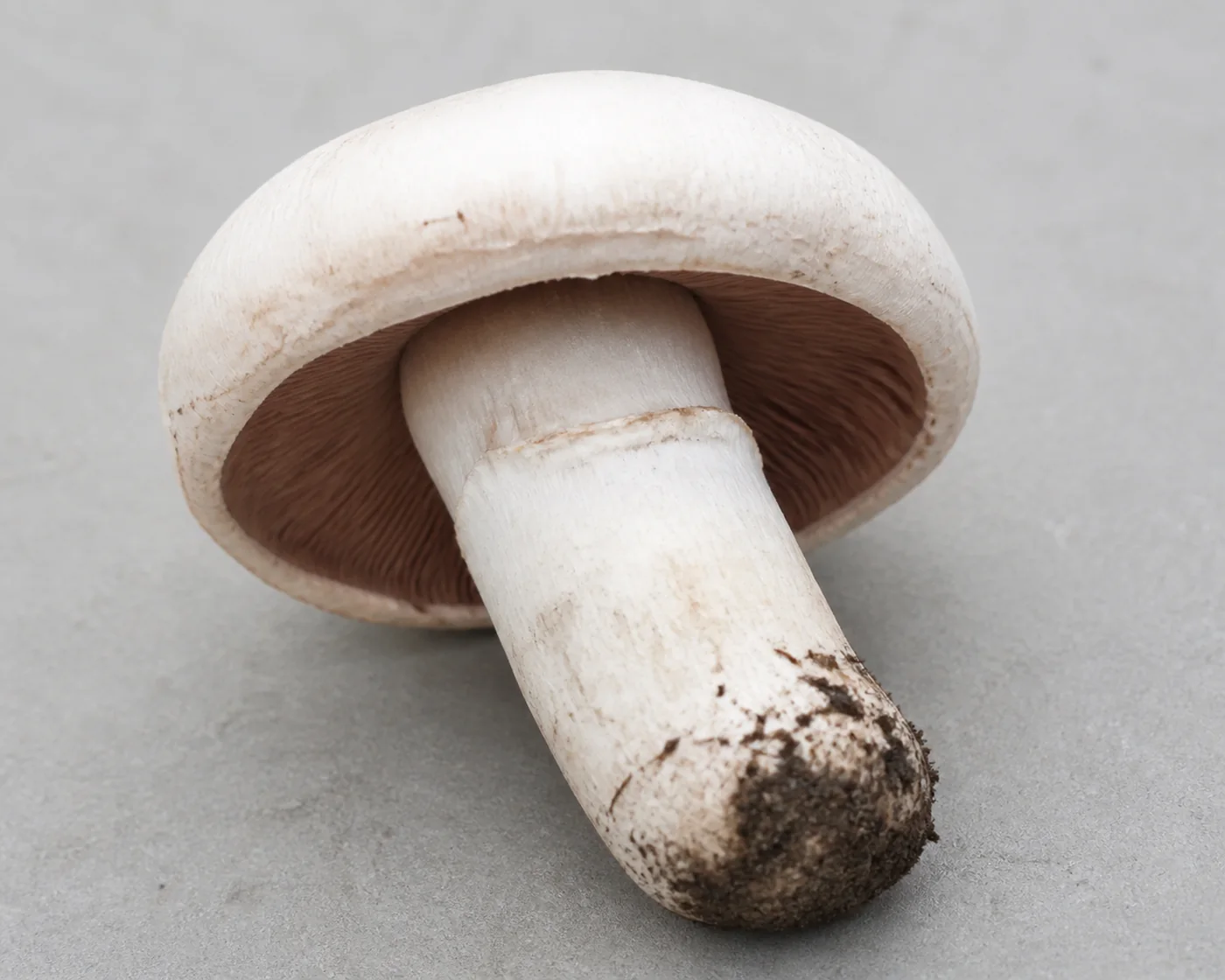
One small thing does separate it from a shop mushroom on sight. The cap skin hangs slightly over the edge of the cap rather than stopping flush with it, which is easy to see once somebody points it out and easy to miss for years otherwise.
The check that has to come first
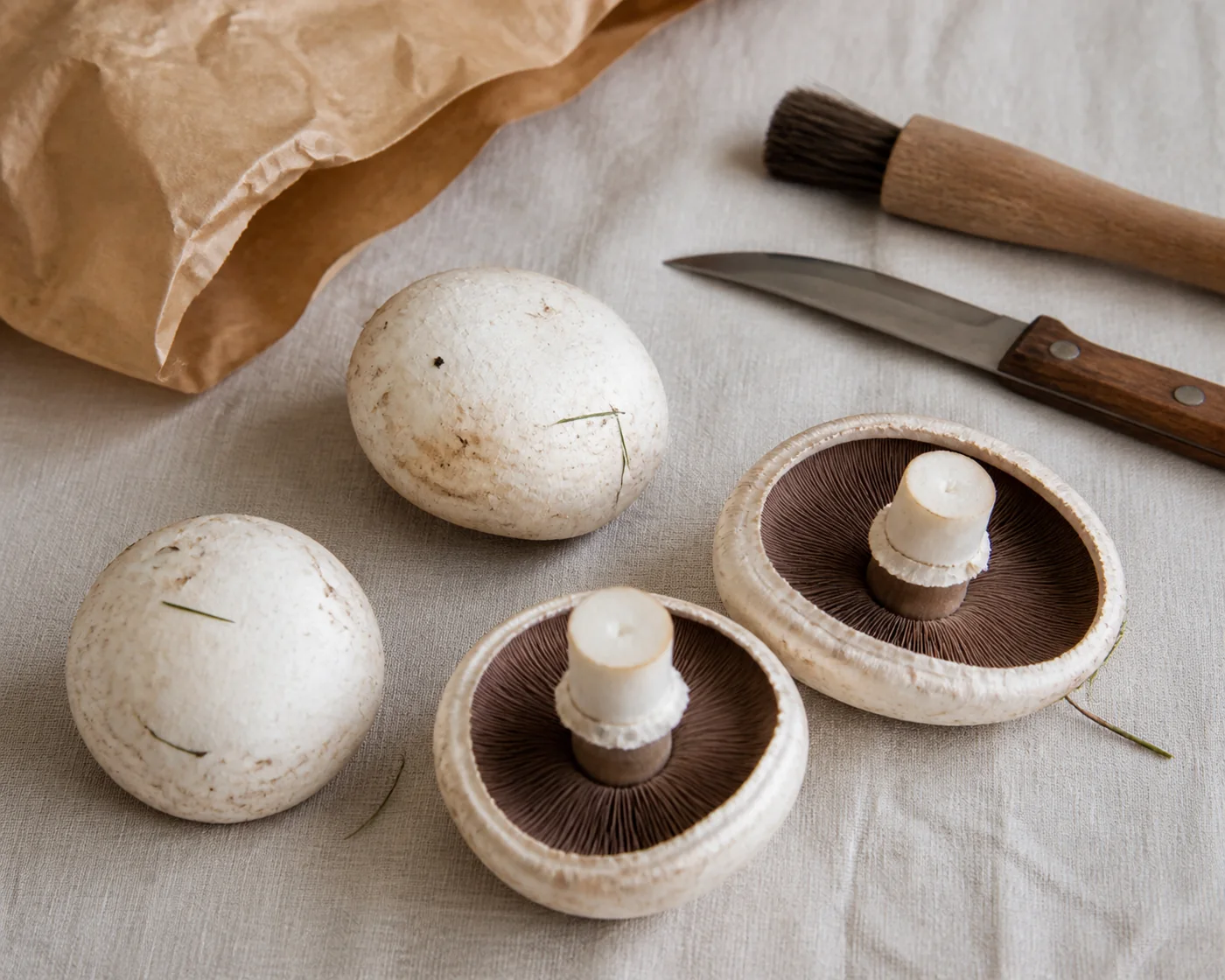
Turn it over and look at the gills, and that is most of it.
- Young field mushroom
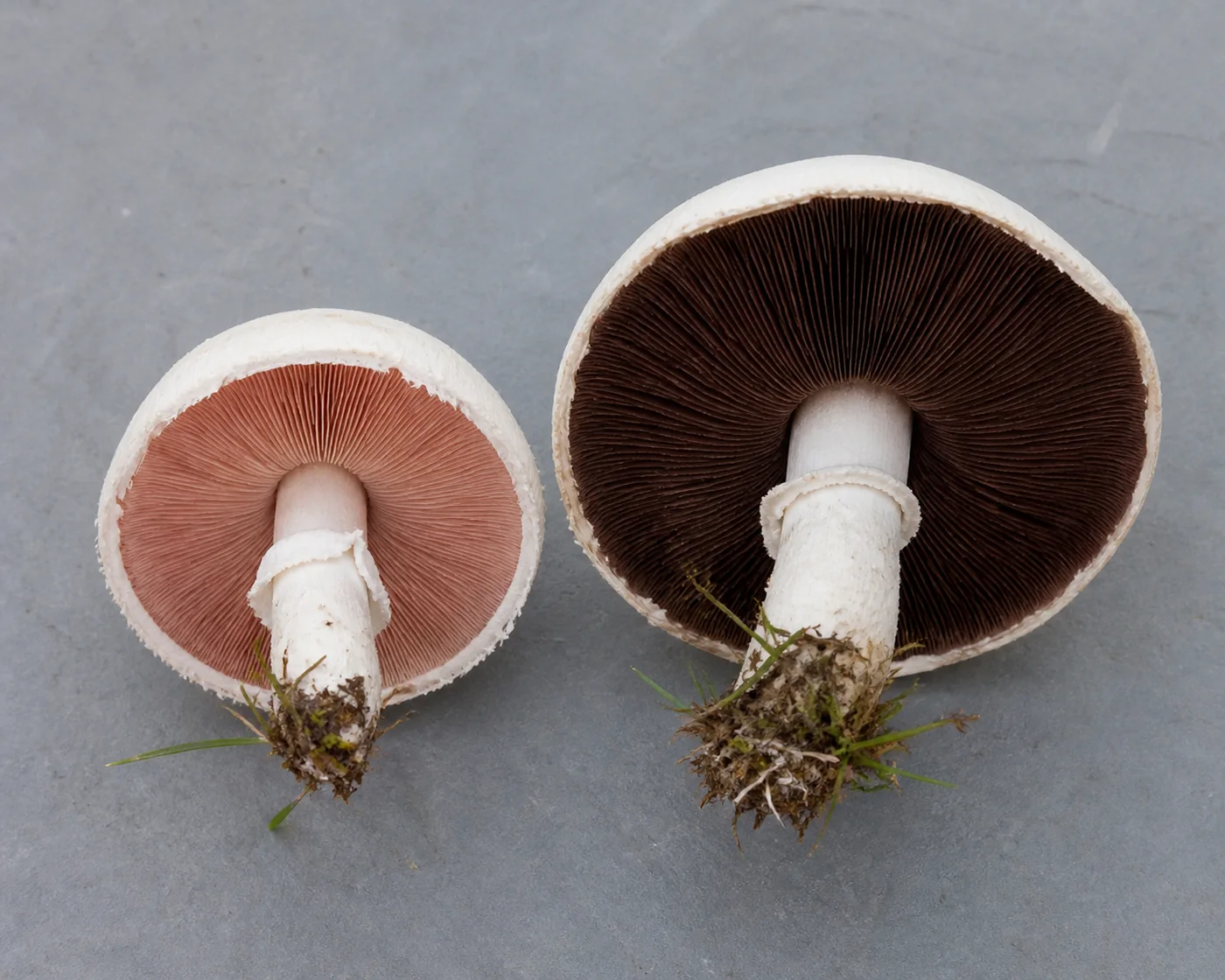
- Gills a strong deep pink
- Getting older
- Pink darkening through brown
- Mature
- Dark brown to almost black
- Attachment
- Crowded and free from the stem, not running down it
- What is never right
- Gills that stay white
The pink is unmistakable when you have seen it once. It is not a pale blush, it is a definite pink, and a young field mushroom underneath looks like nothing else growing in short grass.
What matters more than the pink is what it rules out. A mushroom whose gills stay white through its whole life is not a field mushroom at any stage, and the reason that matters is the next section.
Age is the only complication, and it does not push the gills anywhere near white.
A very old field mushroom has gills so dark they read as black rather than brown, which is fine and still not white. The direction of travel is always pink towards black, never towards white and never back again.
The one that kills people is in the same grass
What a field mushroom could be instead is a short list, and one item on it is fatal.
There is a white mushroom that grows in the same fields and it is not an Agaricus at all. It is the reason the gill check is not optional.
Warning
The destroying angel is white, grows in grass and woodland edges, and contains amatoxins. Its gills are white when young and stay white at every stage, where a field mushroom is already pink. It also grows out of a bag-like sac at the base of the stem, which a field mushroom never has, and which is often below the surface where a knife cut through the stem will miss it entirely.
Amatoxin poisoning from a white mushroom is not something you notice in time. Nothing happens for hours, then the symptoms that arrive look like ordinary food poisoning, and the damage to the liver is already under way while the person is telling themselves they ate something dodgy.
If somebody has already eaten a white grassland mushroom and there is any doubt at all, the advice is not to wait and see whether anything happens.
Keep an uncooked specimen from the same pick as well, because identifying what was actually eaten is the first thing anyone treating it will ask for.
That is why one white gill ends the conversation.
There is no version of this where you weigh it up, taste a corner, or decide the rest of the basket looked fine. Field mushrooms are common and a doubtful one costs nothing to leave behind.
Pink is the right answer here
Field mushrooms bruise, and the color they bruise is the second useful thing about them.
The smell is the part people skip, and on a field mushroom it is the more reliable half of the check.
This mushroom stains chrome yellow when bruised or cut and smells of Indian ink, hospitals or iodine.
A field reference on the yellow stainer
Indian ink and hospitals are not subtle comparisons. Nobody who has smelled a cut yellow stainer describes it as mushroomy, which is exactly what a field mushroom smells of and nothing more.
This is one of the few places in this series where the rule beginners get taught actually works. Yellow bruising on a small white grassland Agaricus is a genuine reason to put it down, and pink is a genuine reason to keep it.
That is not true one species along.
The horse mushroom is a larger relative that bruises yellow perfectly legitimately, so the same rule fails completely on that one. Two mushrooms out of the same meadow, one where yellow means stop and one where it means nothing at all.

The missing ring is the real trap
Most identification guides give the ring as a feature of this species, and most field mushrooms in a basket do not have one.
The ring on this species is thin and tears easily, so weather and handling remove it long before the mushroom is past eating. A specimen with no ring is completely normal and is not evidence of anything.
The problem is that a missing ring takes away the feature people lean on.
Somebody who has learned ring, white cap, grass as their identification has nothing left when the ring is gone, and the two remaining features describe several mushrooms including one that will kill them.
A spore print closes it when the field checks leave any doubt at all. It is also the least demanding test in foraging.
Lay a cap gills down on paper overnight under a glass. A field mushroom drops a dark brown print and the species you are ruling out drops a white one, and there is nothing subtle about the difference.
The order the checks have to happen in
None of this works as a list to remember.
It works as a sequence, and the first step happens before the mushroom leaves the ground.
| Step | What you are looking for | What fails it |
|---|---|---|
| Dig, do not cut | The whole stem base, out of the soil | Any bag or sac around the base |
| Turn it over | Pink or brown gills, free from the stem | Gills that are white |
| Cut the stem base | A faint pink flush | Bright chrome yellow, or an inky smell |
| Before the basket | Every specimen checked on its own | One doubtful mushroom going in with the rest |
| At home, if unsure | A dark brown spore print | A white print, or no print at all |
The first row is the one people get wrong most often. Cutting the stem at ground level leaves the most important feature in the soil, and a knife is the tool that makes it easy to skip the step that matters.
A knife is the right tool for trimming and the wrong tool for lifting. Twist the stem out whole, look at the base, and cut off the dirty part afterwards where you can still see what you removed.
The fourth row is the one nobody thinks about until it happens.
A single unchecked mushroom dropped into a basket with forty good ones does not stay separate, and the honest response at that point is to cook none of them, which is a much bigger loss than the ten seconds it would have taken.
Check them one at a time, in the field, before they touch each other.
Sources & References
- Field Mushroom, Agaricus campestris, Wild Food UK Gives the instruction to cook it before consumption, the five to eight centimeter cap with the cuticle hanging over the margin, the gills crowded and free from the stem starting deep pink and turning dark brown, the white flesh bruising slightly pink, the delicate ring of which only traces can usually be found, the May to November season in pasture, meadows, lawns and parks, and the yellow stainer staining chrome yellow with a smell of Indian ink, hospitals or iodine.
- Agaricus arvensis, Horse Mushroom, First Nature Used for the contrast with the larger relative, which yellows where bruised as a normal feature and so does not answer to the same bruise rule.