
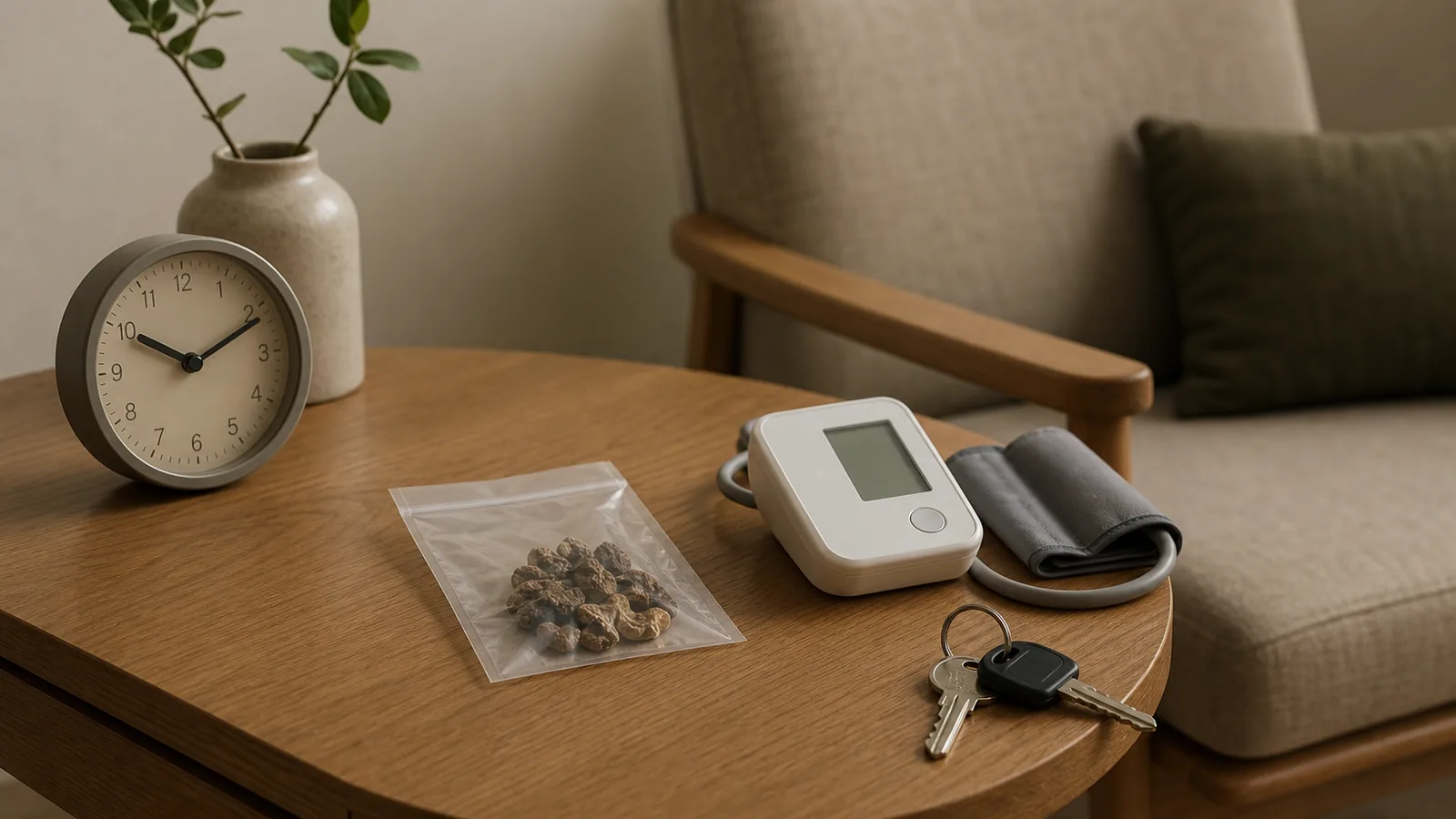
Psilocybin mushroom effects can include visual distortion, altered time, intensified emotion, nausea, headache, anxiety, and impaired judgment. Most uncomplicated acute effects resolve over several hours, but uncertain mushroom identity, injury, overheating, seizure, chest symptoms, or persistent loss of contact with reality requires a broader emergency response.
- Active pathway
- Psilocybin is converted to psilocin, which acts mainly at serotonin 2A receptors
- Typical onset
- Effects often begin about 20 to 60 minutes after swallowing mushrooms
- Common duration
- Prominent acute effects often last about 4 to 6 hours, with a variable tail
- Main safety question
- Can the person remain physically safe, responsive, and willing to accept help?
Which effects are expected, and which are not?
An uncomplicated acute psilocybin state can change color, shape, sound, body awareness, and the apparent speed of time. Thoughts may feel unusually connected or fragmented, while mood can move between wonder, laughter, fear, sadness, and suspicion.
Perceptual change is only one part of the state.
Attention, working memory, reaction time, and judgment can deteriorate even when the person speaks clearly. Driving, swimming, cooking, climbing, crossing traffic, and handling weapons remain unsafe because a familiar task can be misread or forgotten.
Physical effects commonly include dilated pupils, nausea, headache, dizziness, tremor, sweating, increased pulse, and a temporary rise in blood pressure. Controlled clinical studies also report anxiety, and the likelihood of an unpleasant experience rises when the dose is stronger or the person becomes frightened.
- Visual patterns, intensified colors, and altered depth can fit the acute syndrome.
- Time distortion can make minutes feel much longer.
- Nausea, headache, and transient anxiety occur in controlled studies.
- Poor coordination and slowed decisions increase injury risk.
- Complete unresponsiveness, seizure, or severe chest pain does not belong to a routine effect.
A person's ability to engage with a safety request matters more than whether the physical or visual effect sounds dramatic.
Someone who can state their name, accept reassurance, remain seated, and follow a simple safety request differs from someone who runs into danger, cannot be redirected, or becomes progressively less responsive. That functional distinction guides the next action while medical advice is obtained.
No symptom should be interpreted without the exposure.
A known amount of laboratory psilocybin given after screening in a monitored trial creates a different risk setting from unidentified mushrooms, concentrated products, alcohol, stimulants, prescription medicines, sleep deprivation, or an unknown powder.
SafetyAmatoxin Poisoning: Why Symptoms Can Fade Before Liver FailureHow psilocybin changes perception and the body
Psilocybin is a prodrug that the body converts to psilocin. Psilocin then acts primarily as a partial agonist at serotonin 2A receptors, with effects across brain systems that integrate sensory input, attention, emotion, and the sense of self.
| Stage | Biological event | Visible consequence |
|---|---|---|
| Absorption | Psilocybin enters after oral exposure | Onset varies with food, formulation, and amount |
| Conversion | Enzymes remove a phosphate group to form psilocin | Active drug becomes available to the brain |
| Receptor action | Psilocin stimulates serotonin receptors, especially 5-HT2A | Perception, salience, and thought patterns change |
| Clearance | Psilocin is metabolized and eliminated | Acute effects gradually decline |
This serotonin receptor effect does not create one predictable sensory or emotional outcome.
The same sensory change can feel interesting in a calm setting and threatening in a crowded or confusing one. Expectations, psychiatric history, recent stress, sleep, dose, and the behavior of nearby people all shape the experience around the pharmacology.
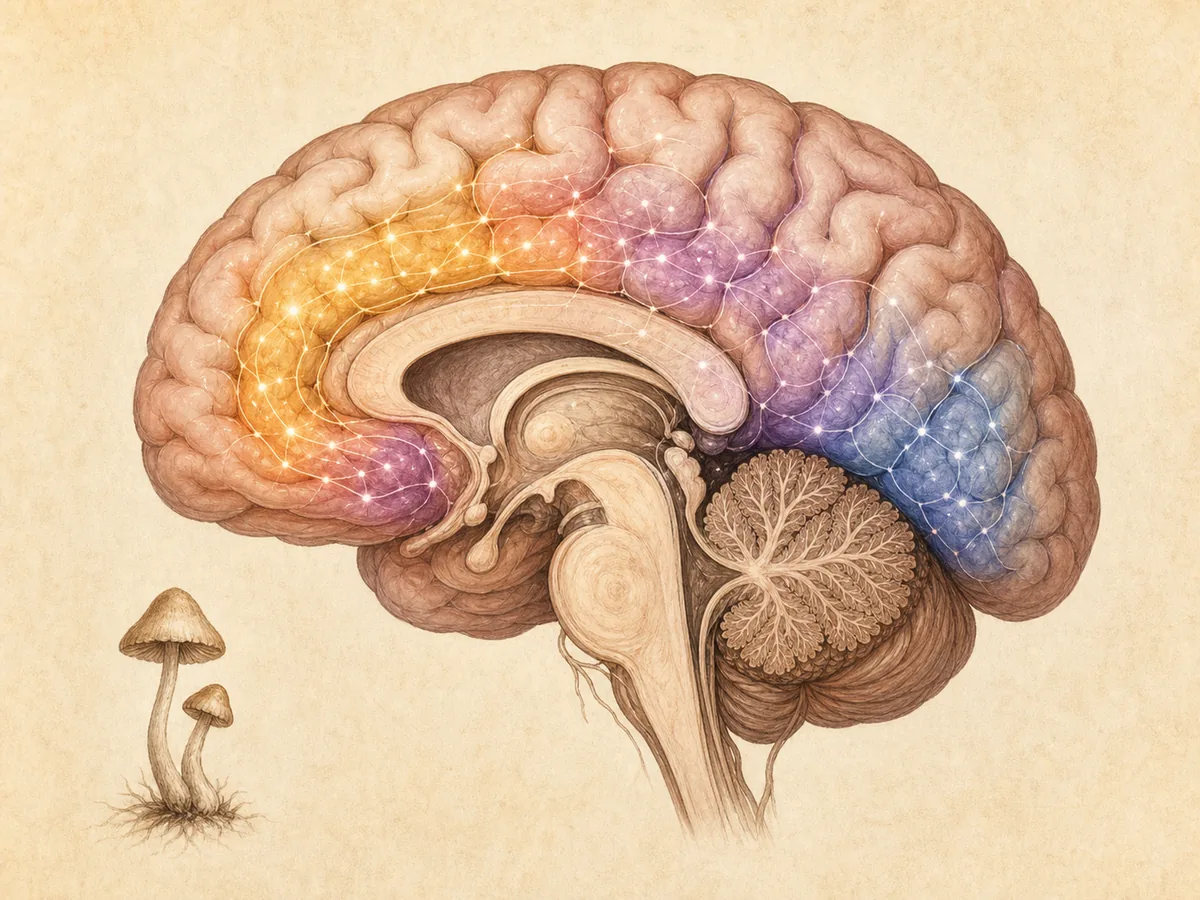
The body responds at the same time.
Pulse and blood pressure can rise, pupils widen, temperature may increase modestly, and nausea or dizziness can develop. A 2024 pooled analysis of controlled administrations found tachycardia in a minority of sessions and dose-related increases in body temperature, which supports monitoring without making those trial results a safety guarantee for uncontrolled use.
Psilocybin does not remain confined to a visual experience.
Slower responses and impaired executive function can affect choices, while fear can further increase pulse and breathing. This overlap explains why a calm environment can reduce secondary danger even though it does not speed drug metabolism.
The onset and recovery curve
Effects often begin within 20 to 60 minutes after mushrooms are swallowed, although a fuller stomach, dried material, a beverage, an extract, or repeated consumption can shift the observed start. The clock begins with the earliest exposure rather than the last dose remembered.
The acute rise can feel abrupt once visual and emotional effects become noticeable.
Visual and emotional effects often intensify over the next hour or two, then ease gradually across a total acute period commonly described as four to six hours. Stronger exposure, redosing, co-ingestants, and individual metabolism can extend or complicate that curve.

Time alone cannot clear the person.
A stopwatch does not account for an uncertain product, another drug, a head injury, dehydration, or a poisonous lookalike. Worsening confusion, new fever, repeated vomiting, severe agitation, or declining responsiveness after the expected peak should prompt reassessment rather than patience.
Redosing an uncertain product makes the exposure timeline harder to interpret.
Each later exposure can overlap the first one, and an edible product may distribute its contents unevenly. Record what was taken, the form, each time, the source, and every co-ingestant without trying to calculate a safe remaining duration.
Recovery becomes credible when function returns in the expected direction.
The person becomes calmer, more oriented, steadier on their feet, able to communicate, and free of new physical warning signs. Supervision still continues until judgment and coordination are reliable enough for ordinary surroundings.
Emergency signs that change the response
Call emergency services for seizure, collapse, loss of consciousness, breathing trouble, severe chest pain, dangerous overheating, major injury, repeated uncontrollable vomiting, or behavior that creates an immediate threat. A person who cannot be awakened or protected from traffic, heights, water, fire, or weapons needs urgent help.
Warning
Do not assume every severe symptom is a stronger psilocybin effect. Unknown mushrooms, co-ingestants, head injury, low blood sugar, serotonin toxicity, heat illness, and an acute psychiatric condition can require different treatment.
Severe agitation deserves a physical check as well as a behavioral description.
Report temperature, pulse if it can be measured safely, breathing, sweating, muscle rigidity, tremor, vomiting, and any medicines or drugs involved. Marked fever, sustained muscle rigidity, clonus, seizure, or rapidly worsening vital signs does not fit simple reassurance at home.

Do not physically corner or restrain a frightened person unless emergency personnel direct an immediate life-saving action.
Several people grabbing someone can intensify panic and cause falls, positional injury, or fighting. Create distance from hazards, keep exits visible, use one calm speaker, and tell dispatch what the person is doing now.
Suicidal statements, violent intent, and immediate hazards require direct emergency escalation.
Take the words seriously even if they occur during intoxication, remove access to weapons when this can be done safely, and do not leave the person alone. Emergency and crisis professionals can address the immediate risk and determine what follow-up is needed after the acute state clears.
SafetyCan Inkcap Mushrooms Make Alcohol Dangerous?A safer environment reduces secondary harm
A sober helper can reduce injury by making the room quieter, simpler, and easier to navigate. Lower harsh light, turn off loud media, move bystanders away, secure doors leading to traffic or balconies, and remove keys, knives, firearms, flames, and breakable objects.
Key takeaway
Use one calm voice, short literal sentences, and simple choices. Tell the person where they are, that help is present, and that the effects are being monitored without arguing about what they perceive.
The helper should remain observable and nonthreatening.
Sit at a comfortable distance, avoid sudden touch, and ask before changing the room. Repeated questions, jokes, filming, or a crowd of concerned friends can increase confusion and humiliation.
- Keep the person away from stairs, baths, pools, roads, roofs, and cooking equipment.
- Set aside the package, remaining mushrooms, and other substances for responders.
- Note the exposure times and behavior changes.
- Offer only the fluid or food advised by Poison Control when nausea or consciousness is a concern.
- Call for help if the person becomes less responsive, hotter, more agitated, or physically unstable.

Reassurance should stay honest.
Promise that you will remain present and seek help, but do not promise an exact finish time or insist that nothing bad can happen. A calm statement loses value if new medical signs are ignored.
The helper also needs a safety limit.
If the person becomes violent, leaves the safe area, or cannot be redirected, create distance and call emergency services rather than trying to manage the situation alone. Personal safety and rapid professional support take priority over keeping the event private.
The mushroom identity remains a separate risk
An alleged magic mushroom can still be the wrong species, a mixed collection, or a processed product with no reliable identity. The clinical history must keep that uncertainty open even when hallucinations fit psilocybin.
Liberty cap, Psilocybe semilanceata, is one recognized psilocybin-containing species, but a common name does not establish the contents of dried fragments or powder. Small brown mushrooms include many unrelated genera, and some dangerous species share size, color, habitat, or spore tones.
Blue bruising is an observation rather than a safety test.
Several psilocybin-containing species can bruise blue as compounds oxidize, yet the reaction can be weak, absent, imitated by other pigments, or impossible to assess after drying. A blue mark cannot measure potency or rule out another mushroom.
Purple-brown spores support some Psilocybe identifications without proving them.
A purple-brown spore print from an intact product must be combined with cap texture, gill attachment, veil remnants, stem characters, habitat, geography, and microscopic evidence when required. Dried material loses many of those features, while powder removes nearly all of them.
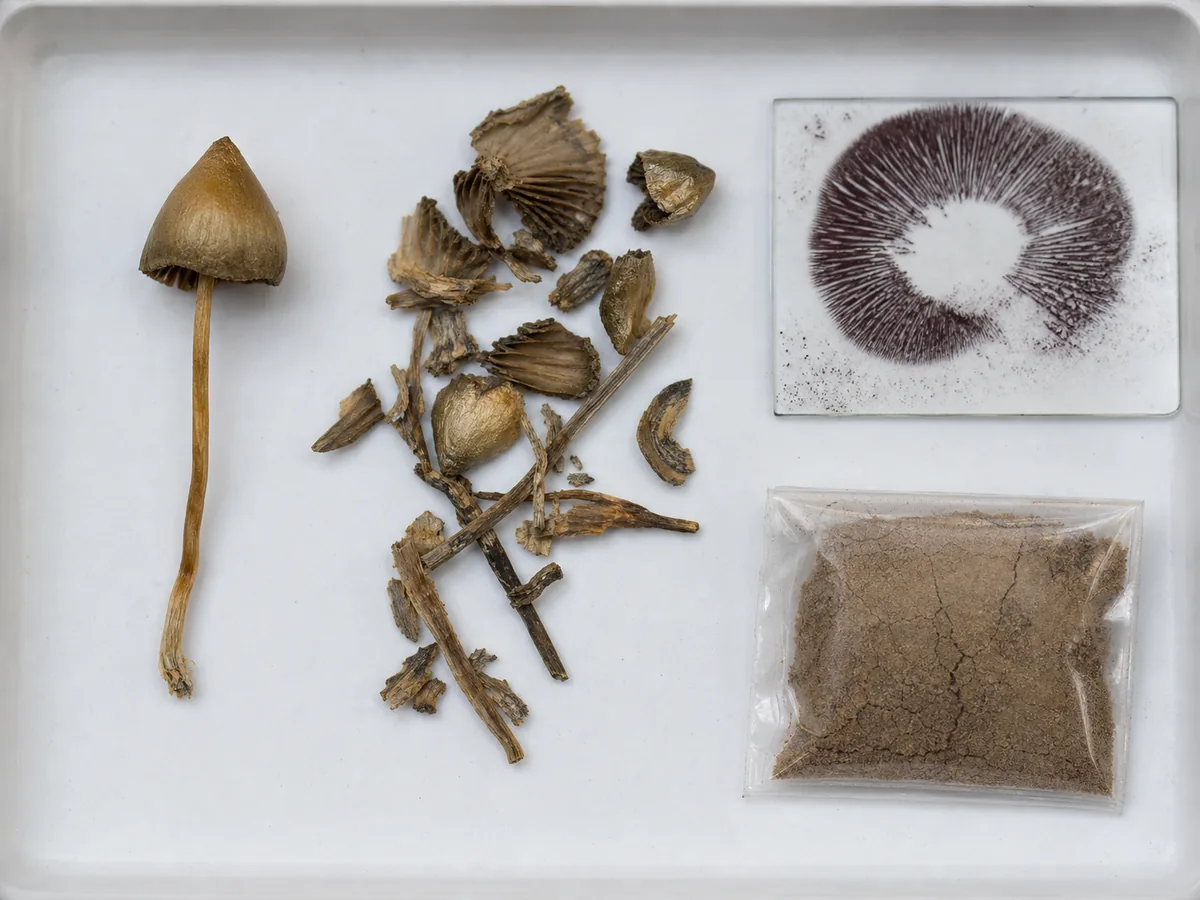
Preserve the remaining mushroom product and specimen material without handling it more than necessary.
Save the container, receipt or source description, intact specimens, photographs, and vomited material when responders request it. Tell clinicians whether the exposure involved a tea, food, capsule, chocolate, gummy, extract, or unidentified powder because the label may not match the contents.
The identity problem changes the timeline.
Delayed vomiting, liver-area pain, jaundice, reduced urine, severe drowsiness, seizure, or a course that does not ease as expected can point away from uncomplicated psilocybin effects. Poison Control can coordinate identification and medical advice while treatment proceeds.
SafetyGyromitrin Poisoning: Why False Morels Can Trigger SeizuresAmanita effects follow a different pathway
Fly agaric and panther cap are psychoactive mushrooms, but their main compounds are ibotenic acid and muscimol rather than psilocybin. Their effects can alternate between agitation, confusion, abnormal movements, profound sleepiness, and central nervous system depression.
This distinction matters because a red or brown Amanita is not a psilocybin mushroom.
Fly agaric may be recognized by a red to orange cap with pale veil patches, while panther cap often has a brown cap with white patches and can produce severe poisoning. Weather can wash away those patches, and color alone cannot establish either species.
The symptom pattern of these Amanita species also differs.
Muscimol acts at GABA receptors and can produce delirium, marked sedation, jerking movements, and seizures alongside visual changes. A person who cycles between extreme agitation and deep unresponsiveness needs clinical assessment rather than management as a difficult psychedelic experience.
| Claimed exposure | Main active pathway | Important distinguishing risk |
|---|---|---|
| Psilocybin mushroom | Psilocin at serotonin receptors | Perceptual change, anxiety, impaired judgment, autonomic effects |
| Fly agaric | Ibotenic acid and muscimol | Delirium, abnormal movements, sedation, possible seizure |
| Panther cap | Ibotenic acid and muscimol | Potentially stronger neurological depression or agitation |
| Unknown processed product | Unverified | Adulterants, dose uncertainty, and no specimen evidence |
Do not use preparation traditions or appearance claims to test the distinction.
Preserve the material, report the actual symptoms, and let a poison specialist treat the uncertainty as part of the exposure.
What clinical care addresses
Clinical care first protects airway, breathing, circulation, temperature, glucose, and the person from injury. Staff assess orientation, agitation, trauma, hydration, pulse, blood pressure, oxygenation, and the possibility of another substance or mushroom.
Supportive care is the foundation.
A quiet monitored setting may be enough for an uncomplicated course, while intravenous fluids, nausea treatment, wound care, cooling, or respiratory support follow measured needs. Clinicians may use a benzodiazepine for severe agitation or panic when its benefits and respiratory risks have been assessed.
Testing is driven by abnormal findings and uncertainty.
Glucose, electrolytes, kidney and liver function, an electrocardiogram, toxicology information, pregnancy status, or injury imaging may be relevant in a particular case. No routine blood result confirms a field-collected mushroom as psilocybin.
The observation period follows the trend.
Improving orientation and behavior, stable vital signs, controlled nausea, safe walking, and no emerging sign of a different toxin support recovery. Persistent psychosis, mania, severe depression, suicidal thinking, or perceptual disturbance after the acute drug effect needs psychiatric and medical follow-up.
Controlled clinical evidence must stay in its lane.
Recent trials generally report transient nausea, headache, anxiety, dizziness, and blood-pressure increases under screening and supervision, with serious acute events uncommon. Those findings do not transfer directly to unsupervised exposure because trial participants, products, doses, support, and rescue care are deliberately controlled.
The 2024 acute-adverse-effect meta-analysis included six randomized trials and 528 participants. Headache, nausea, anxiety, dizziness, and elevated blood pressure occurred more often with therapeutic psilocybin than with the comparison conditions, while the reported acute effects resolved within 48 hours.
Those trial participants were screened and observed by trained teams using measured psilocybin.
An emergency department cannot assume the same boundaries for field mushrooms, an edible product, or a mixed-drug exposure. Product identity, trauma, temperature, behavior, circulation, and psychiatric history therefore remain part of the assessment even when the initial story names psilocybin.
Recovery is a functional decision
Fading visuals do not by themselves restore judgment, balance, or the ability to respond to a sudden hazard. Recovery requires a steady direction across perception, behavior, physical signs, and the person's capacity to make ordinary decisions.
Keep the recovering person with a sober adult while judgment remains uncertain.
Do not allow driving, cycling in traffic, swimming, heights, machinery, childcare, or important financial and legal decisions until sleep, coordination, attention, and judgment have clearly returned. A fixed number of hours cannot account for redosing, an unknown product, or a night without sleep.
The next day can still carry functional and sleep consequences.
Headache, fatigue, poor sleep, anxiety, low mood, or embarrassment can affect function after the main perceptual changes stop. Hydration, food, rest, and prescribed medicines should follow ordinary medical guidance rather than an improvised recovery regimen.
Persistent mood or perceptual symptoms deserve medical assessment.
Ongoing visual disturbance, panic, depression, suicidal thoughts, mania, paranoia, or difficulty functioning should not be dismissed as something the person must simply wait out. Report the timing, prior mental-health history, medicines, substances, sleep, and current safety concerns to a clinician.
A completed recovery has both a calm person and a safe plan for the hours that follow.
Sources & References
- https://pubmed.ncbi.nlm.nih.gov/38598236/
- https://www.ncbi.nlm.nih.gov/books/NBK537111/
- https://pmc.ncbi.nlm.nih.gov/articles/PMC11774429/